---
title: "Junko Shimizu × Masahide Yoshida: Part 2\n\n\"Let's Change Japan's Meetings with Partition 2.0\""
description: ""
url: "https://dentsu-ho.com/en/articles/1037.md"
html_url: "https://dentsu-ho.com/en/articles/1037"
canonical: "https://dentsu-ho.com/en/articles/1037"
language: "en"
alternate_language_url: "https://dentsu-ho.com/articles/1037"
translation: "machine"
type: "article"
site: "Dentsu-ho (電通報)"
llms_txt: "https://dentsu-ho.com/llms.txt"
published: "2014-05-07T07:00:00+09:00"
---
# Junko Shimizu × Masahide Yoshida: Part 2 "Let's Change Japan's Meetings with Partition 2.0"
> Navigation: [Site index (llms.txt)](https://dentsu-ho.com/llms.txt) · [Home](https://dentsu-ho.com/en) · Parent: [New Articles (新着記事)](https://dentsu-ho.com/en/latest_articles) · [Everything About Wakamon](https://dentsu-ho.com/en/booklets/36)
Note: This website was automatically translated, so some terms or nuances may not be completely accurate.
Published: 2014-05-07T07:00:00+09:00 · Series: [Everything About Wakamon](https://dentsu-ho.com/en/booklets/36) (Part 14 of 56)
## Themes and tags
- Themes: [Marketing (マーケティング)](https://dentsu-ho.com/en/theme/marketing), [Advertising (AX) (広告)](https://dentsu-ho.com/en/theme/ax), [Management / Corporate Affairs (BX) (経営 / 企業)](https://dentsu-ho.com/en/theme/bx), [Customer Experience (CX) (顧客体験)](https://dentsu-ho.com/en/theme/cx), [Digital / Technology (DX) (デジタル / テクノロジー)](https://dentsu-ho.com/en/theme/dx), [Creative (クリエイティブ)](https://dentsu-ho.com/en/theme/creative), [Social Issues (社会課題)](https://dentsu-ho.com/en/theme/social_issue), [Idea Generation & Methodologies (アイデア / 発想法)](https://dentsu-ho.com/en/theme/idea), [Insights / Research (インサイト / 調査)](https://dentsu-ho.com/en/theme/insight)
- Tags: [Design](https://dentsu-ho.com/en/tag/デザイン), [Innovation](https://dentsu-ho.com/en/tag/イノベーション), [Future](https://dentsu-ho.com/en/tag/未来), [Planning](https://dentsu-ho.com/en/tag/プランニング), [Solution](https://dentsu-ho.com/en/tag/ソリューション)
## Authors
- Junko Shimizu(Tokyo Graphic Recorder / Tokyo Graphic Recorder)
- [Masahide Yoshida](https://dentsu-ho.com/en/person/93)(Dentsu Inc. / Dentsu Inc. Business Design Square / Concept Designer)
## Adjacent articles
- Previous: [https://dentsu-ho.com/en/articles/1036](https://dentsu-ho.com/en/articles/1036) · Next: [https://dentsu-ho.com/en/articles/1175](https://dentsu-ho.com/en/articles/1175)
## Body

[Following the previous session](http://dentsu-ho.com/articles//1036), Tokyo Graphic Recorder's Shimizu Junko and Wakamon representative Yoshida, a researcher, will discuss new forms of creativity.
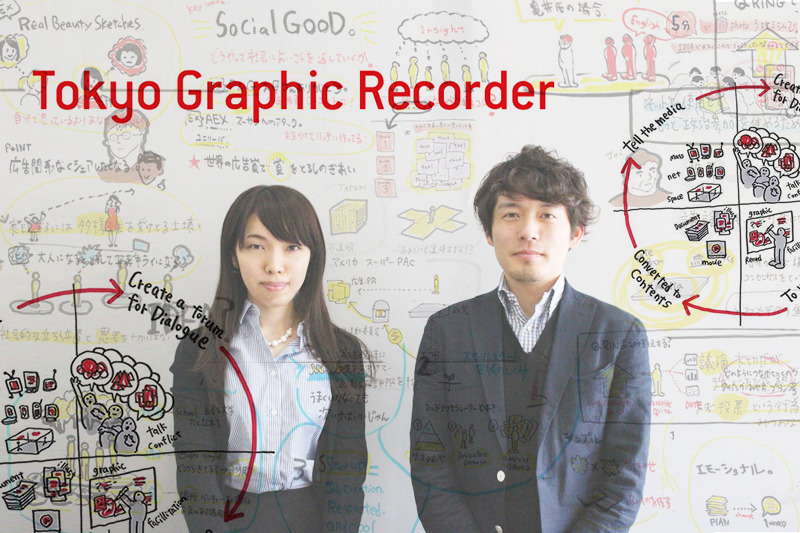
## The Point Where Creativity Flows
**Yoshida:** In your work, Shimizu-san, I hardly sense any distinction between creators and recipients, or between those giving instructions and those receiving them. It's more about creating a space where everyone thinks together, or builds consensus collectively. Not karate, but more like aikido-style creativity?
**Shimizu:** It's strange, but I wasn't that type at all. I admired super creators and wanted to make exactly what I envisioned. But necessity forced me to realize I couldn't do what I wanted without creating that kind of space...
**Yoshida:** So you're fundamentally an individualist. I'm curious how you think about the power of the individual versus the power of the organization or team.
**Shimizu:** I've heard the saying, "If you want to go fast, go alone. If you want to go far, go together." That's exactly right. Tokyo Graphic Recorder got this far with just me, but I definitely felt limitations. Now, I'm working to make this function within Yahoo, a company of 6,000 people, thinking we can aim for much greater distances.
**Yoshida:** Through your Graphic Recording work, you've joined various teams. Objectively speaking, what makes a good team for you, Shimizu?
**Shimizu:** Last December, I participated in the "Japan Data Journalism Awards 2013." The team I formed there was like a band with completely different specialties: a reporter from The Huffington Post, an engineer from Jiji Press, an analyst from Kyoto University, and me, the designer. What made this team so great was that everyone respected areas outside their own expertise and always kept an open mind toward the unknown. The moment we'd ask, "What about design?" or "What's the journalistic interpretation?", everyone immediately contributed their input, and the discussion built up rapidly.

**Yoshida:** That's open innovation in action. The fundamental premise is that going forward, you can't create truly valuable new things without engaging with people outside your own field. It's no longer a world where something can be created solely from the mind or sensibility of a single super-creator.
**Shimizu:** I think it's about engaging while not fearing that boundaries will be broken. It's not about losing your livelihood or anything like that (laughs). There's a graph [that my respected business designer, Shuji Hamaguchi, often draws](http://en.wikipedia.org/wiki/Hideshi_Hamaguchi). It represents where creativity is unleashed. Where is that? It's the peak of the mountain at the intersection of the right and left brain. Because it's a single point, the only way to avoid tumbling down is to keep moving back and forth.

**Yoshida:** I see. That's why it's incredibly nerve-wracking.
**Shimizu:** Conversely, leaning heavily into either specialized field is incredibly easy, but that's actually a low point. Even if you reach the peak on that axis, you'll never match the height of the summit.
**Yoshida:** So while there are people who've reached great heights at either end, staying there means you'll never discover what lies beyond.
**Shimizu:** The team for the Data Journalism Awards included people from both ends, but what worked was that everyone had respect for this peak and genuinely wanted to reach it.
## The Case for "Division 2.0" That Doesn't Create Friction
**Yoshida:** Thinking along those lines, the role of D-titled professions might change going forward. Creative Director, Art Director... What do you think about the future of the "D"?
**Shimizu:** We're actually running a project at Yahoo right now where, because having a D-person involved can create friction, we recently did an overnight retreat without any Ds. I facilitated the concept-making process. Ultimately, that D person takes responsibility, gives advice, and properly escalates issues when needed. In that environment, I could work freely, and we ended up with a solid concept. That felt really good.

**Yoshida:** Like a playing manager. That's a team-building approach you rarely see in traditional companies. By the way, Shimizu, when you're holding a pen and sketching during those discussions, what are you consciously focusing on?
**Shimizu:** I try to visualize things that everyone might otherwise pretend not to see and just move past. It's not about being mean; it's about the designer being the one who ultimately gets the "Well done!" moment for pointing out those missing pieces. Even if it's something a senior executive said, sketching out the missing content in a matrix or something can quickly clarify the direction of the discussion.
**Yoshida:** Where putting it into words would definitely create friction, Shimizu-san's drawings—or rather, his style—is perfect. It's gentle, without any bitterness.
**Shimizu:** If this were a PowerPoint slide, it would look like a pretty aggressive tactic. But the key is drawing it on the spot and saying, "Is this the kind of thing you mean?"
**Yoshida:** I think the conductor in an orchestra is incredibly important. But you, Shimizu-san, conduct while playing yourself, or sometimes don't even conduct—the sound itself becomes the direction... If "Please handle this because of this reason" is "Facilitation 1.0," then I think there must be something like "Facilitation 2.0."
**Shimizu:** "Creating the space" sounds like a cliché these days, but it's genuinely crucial. Moreover, I feel that for future D-level people, it's essential to create that space without it being obvious, to lead without the members noticing.
## Toward "Design to Keep Thinking Going"
**Yoshida:** Thinking about it, Graphic Recording is fundamentally about the other person, or about people other than yourself – it's an activity deeply rooted in the space. That's precisely why it's expanding, connecting with people in various positions and roles, and opening up new possibilities.
**Shimizu:** However, Tokyo Graphic Recorder isn't open to absolutely everything. Even for work, I've decided not to draw things I don't find interesting as a designer. I turn down projects I'm not enthusiastic about. The criteria I look for are:\
1.It must be an idea I genuinely find interesting.\
2.It must be a discussion worth preserving for the future.\
Those are the two criteria.
**Yoshida:** There's a distinct individuality there. I think young people today exist in a world where it's hard to hold onto their own subjectivity. They might think something tastes bad, but because a food site says it's ★3.65, their own opinion gets swept away. Or they ask Google before voicing their thoughts. We've talked about the positive aspects of this trend toward collective consensus-building, but the downside is this tendency to look for a compromise and just go with the flow. What are your thoughts on this kind of compromise-seeking mentality?
**Shimizu:** I think education plays a big role in this. We've always been taught to seek the "right answer." Even I feel uneasy deep down if there's no clear compromise. [But](http://www.axisinc.co.jp/media/magazinedetail/168/) during [our AXIS Design Thinking feature interview](http://www.axisinc.co.jp/media/magazinedetail/168/), Kotaro Watanabe [from takram](http://www.takram.com/) mentioned that design thinking has an aspect of being a "method to keep thinking going." That really clicked for me! Even if things get chaotic, the most creative and exciting thing is to not fear it, keep layering ideas together, and make a leap.
**Yoshida:** Graphic Recording feels like it's confronting that very challenge. Finally, how do you think the projects and creations that young people will take on in the future could make the world more enjoyable?
**Shimizu:** It's about redefining the concept of "story."\
Because the "stories" that older guys think up these days are rapidly becoming stale. Take Ayumu Hirano, the snowboarder who won silver at the Sochi Olympics.\
He honestly said in an interview, "I just did what I wanted to do and ended up riding well." While mass media doesn't particularly like that kind of candor, I think he's right. As more young people like him emerge, the contrived, hype-driven stories imposed by outsiders feel phony. I think this kind of thing deepens the generational gap. So, I want to value the sensitivity to perceive seemingly ordinary, "stories that don't look like stories," and think about how to convey them.
**Yoshida:** In your approach, Shimizu-san—not directing but gently lifting things up—I sense new possibilities for creativity.
---

**【Wakamon Profile】**\
Dentsu Inc. Youth Research Department (nicknamed Wakamon) is a planning team that engages with the real lives and mindsets of young people, primarily high school and college students. We seek hints to brighten and invigorate the near future, just half a step ahead of their "now." By anticipating the future through their insights, we realize new businesses that foster better relationships between young people and society. Currently, 14 project members are based across our Tokyo headquarters, Kansai branch, and Chubu branch. We also share updates on the Wakamon Facebook page ( [https://www.facebook.com/wakamon.dentsu](https://www.facebook.com/wakamon.dentsu) ).
## Back Numbers (バックナンバー)
- [Junko Shimizu × Masahide Yoshida: Part 1 "What is Graphic Recording: Creating a 'Space' for Creation?"](https://dentsu-ho.com/en/articles/1036) — 2014-04-30T07:00:00+09:00 · [Marketing (マーケティング)](https://dentsu-ho.com/en/theme/marketing)
- [SEKAI NO OWARI × Momoko Okura: Part 2 "Where is SEKAI NO OWARI's goal? The climb is more fun than the view from the top."](https://dentsu-ho.com/en/articles/990) — 2014-04-23T07:00:00+09:00 · [Marketing (マーケティング)](https://dentsu-ho.com/en/theme/marketing)
## Author (著者)
### Junko Shimizu
Tokyo Graphic Recorder / Tokyo Graphic Recorder
Born in 1986, after graduating from Tama Art University's Department of Information Design, worked as a web designer for three years. During this time, trained for one year at no problem's free advertising school in strategy development and creative work to connect brands with consumers. Subsequently, while involved in projects at WATER DESIGN that created business and product distribution beyond existing frameworks, also began activities with Tokyo Graphic Recorder. Providing content for TV, newspapers, and web media while researching the integration of design and business strategy with companies and educational institutions. Featured as a New Creator in the February issue of Monthly Brain. Currently, as a UX Designer at Yahoo! JAPAN, challenging next-generation creativity born from Business × Technology × Design while researching Graphic Recording. Recently started guest lecturing at the Media Design Seminar in the Department of Information Design at Tama Art University.
### Masahide Yoshida
Dentsu Inc. / Dentsu Inc. Business Design Square / Concept Designer
After graduating from university and working at a previous company, I joined Dentsu Inc. After roles as a strategic planner and in sales, I now belong to Dentsu Business Design Square, which revitalizes overall management with ideas, implementing joint projects with various companies. I also concurrently serve on the "Dentsu Youth Research Department" (Dentsu Wakamon) project targeting teens and young adults, engaging in consumer psychology and trend analysis, and developing consulting/communication plans based on these insights. Winner of the 2009 JAAA Advertising Essay Contest, Newcomer Division. Solo-authored works include 'Antenna Power' (Mikasa Shobo, 2019). Co-authored works include 'The Youth Exodus' (MDN Corporation, 2016) and 'Why Do You All Start Talking About the Same Things When It Comes to Job Hunting?' (Sendenkaigi, 2014). PARC CERTIFIED FIELDWORKER (Certified Ethnographer).
- [Person page](https://dentsu-ho.com/en/person/93)
- Series: [Everything About Wakamon](https://dentsu-ho.com/en/booklets/36), [A Classroom Connecting You and Society](https://dentsu-ho.com/en/booklets/88), [If you understand young people, you can see the future \~ Commemorative Series for the Release of "The Youth Divide" \~](https://dentsu-ho.com/en/booklets/214), [What do you think of this future for Dentsu Inc. Business Design Square?](https://dentsu-ho.com/en/booklets/361), [ONE JAPAN in DENTSU "Quit, conform, or change."](https://dentsu-ho.com/en/booklets/403)
- Latest articles: [The Art of "Stepping Outside the Lines": Expanding Exciting Possibilities Both Inside and Outside Large Corporations](https://dentsu-ho.com/en/articles/8359), [Solving Young Employees' Problems! Hacking Large Corporations: "Techniques" Public Consultation Session -ONE JAPAN CONFERENCE 2021-](https://dentsu-ho.com/en/articles/8022)
Sharing: the HTML page offers share buttons for X, Facebook, LINE and Hatena Bookmark (not reproduced here).
## Related links
- [Home](https://dentsu-ho.com/en)
- [Site index (llms.txt)](https://dentsu-ho.com/llms.txt)