---
title: "Where's that news coming from?\nWhy young people choose online media."
description: "■Online News in Full Bloom In recent years, the proliferation of smartphones has created an information environment where people can connect to the internet anytime, anywhere. Fueled by this situation, new information (news) continuously emerges in real time from various sources, including social media..."
url: "https://dentsu-ho.com/en/articles/2707.md"
html_url: "https://dentsu-ho.com/en/articles/2707"
canonical: "https://dentsu-ho.com/en/articles/2707"
language: "en"
alternate_language_url: "https://dentsu-ho.com/articles/2707"
translation: "machine"
type: "article"
site: "Dentsu-ho (電通報)"
llms_txt: "https://dentsu-ho.com/llms.txt"
published: "2015-07-06T06:00:00+09:00"
---
# Where's that news coming from? Why young people choose online media.
> Navigation: [Site index (llms.txt)](https://dentsu-ho.com/llms.txt) · [Home](https://dentsu-ho.com/en) · Parent: [New Articles (新着記事)](https://dentsu-ho.com/en/latest_articles) · [Insight Memo](https://dentsu-ho.com/en/booklets/1)
Note: This website was automatically translated, so some terms or nuances may not be completely accurate.
Published: 2015-07-06T06:00:00+09:00 · Series: [Insight Memo](https://dentsu-ho.com/en/booklets/1) (Part 45 of 65)
## Themes and tags
- Themes: [Marketing (マーケティング)](https://dentsu-ho.com/en/theme/marketing), [Advertising (AX) (広告)](https://dentsu-ho.com/en/theme/ax), [Management / Corporate Affairs (BX) (経営 / 企業)](https://dentsu-ho.com/en/theme/bx), [Creative (クリエイティブ)](https://dentsu-ho.com/en/theme/creative), [Social Issues (社会課題)](https://dentsu-ho.com/en/theme/social_issue), [Media / Content (メディア / コンテンツ)](https://dentsu-ho.com/en/theme/media), [Idea Generation & Methodologies (アイデア / 発想法)](https://dentsu-ho.com/en/theme/idea)
- Tags: [Innovation](https://dentsu-ho.com/en/tag/イノベーション), [Media](https://dentsu-ho.com/en/tag/メディア)
## Authors
- [Akira Miwa](https://dentsu-ho.com/en/person/104)(Dentsu Inc. / Dentsu Inc. Media Innovation Lab / Director of Media Innovation Research)
- [dentsu Media Innovation Lab](https://dentsu-ho.com/en/person/75)(Dentsu Inc.)
## Adjacent articles
- Previous: [https://dentsu-ho.com/en/articles/2514](https://dentsu-ho.com/en/articles/2514) · Next: [https://dentsu-ho.com/en/articles/2955](https://dentsu-ho.com/en/articles/2955)
## Body
## **■Online News in Full Bloom**
In recent years, the proliferation of smartphones has created an information environment where people can connect to the internet anytime, anywhere. Fueled by this trend, we now live in an era where new information (news) can be obtained in real time from various sources, including social media.
Online media provide a wide range of information daily, spanning genres from politics and economics to dating advice.Portal site news has enjoyed unwavering popularity since the early days of internet adoption. Furthermore, in recent years, "curation media" has emerged. This type of media, often driven by smartphone users, organizes diverse topics—both hard-hitting and light-hearted—based on reader engagement predictions generated by high-performance computers, unconstrained by the traditional reporting priorities of established news outlets. Additionally, "summary sites" and other uniquely online media platforms have proliferated. These often involve ordinary internet users collecting, organizing, and presenting information about the evolving context surrounding specific news stories, frequently incorporating online reaction comments.What direction are the media serving as people's information sources heading?
Where are the media sources people rely on headed?
## **■ Various online media now rank high among "trusted sources"**
In today's world, where news information is accessible anytime to suit a wide range of interests, what sources and media do people rely on in their daily lives?
We categorized various information sources and media—from television and newspapers to online news sites and personal blogs—into 71 types and examined how much people "rely on" them in their daily lives (Figure 1).
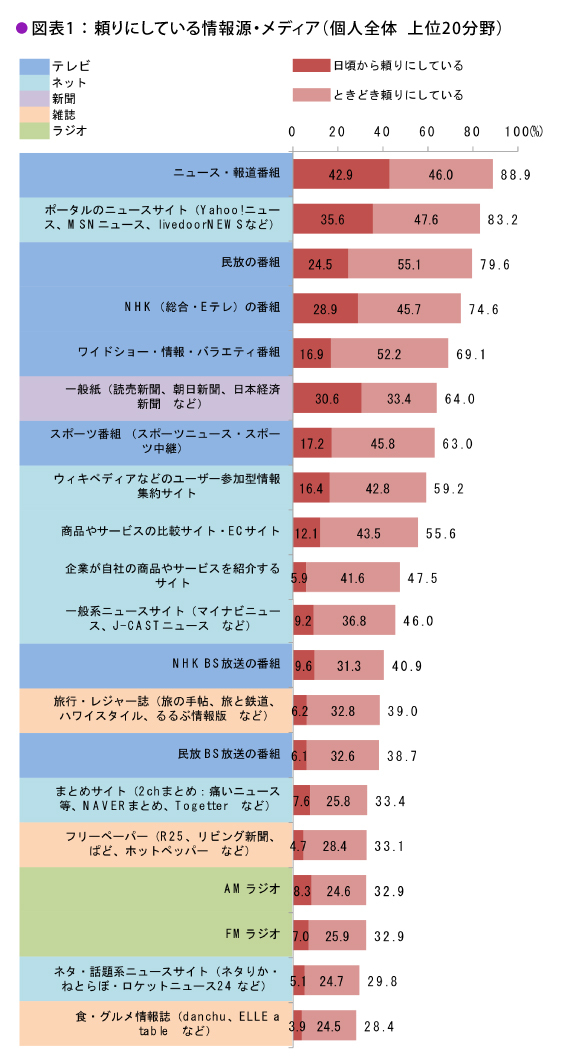
The graph shows the top 20 media sources with the highest percentage of respondents who particularly "rely on them" among 4,367 men and women aged 15 to 69 nationwide. While traditional media like TV and newspapers rank highly, it's interesting to note that relatively new, popular online media (such as "summary sites" at 15th place and "trending/gossip news sites" at 19th place) are also consistently within the top 20.
## **■Younger Generations Rely Heavily on Online Sources \~ Differences by Age**
When broken down by age group, online media's standing rises further among those in their 20s. Following "summary sites" at 7th place and "trending news sites" at 13th, "curation sites" also appear at 18th. It seems there are indeed age-related differences in the news media people rely on.
Therefore, we analyzed the media by dividing them into 13 factors (Figure 2).
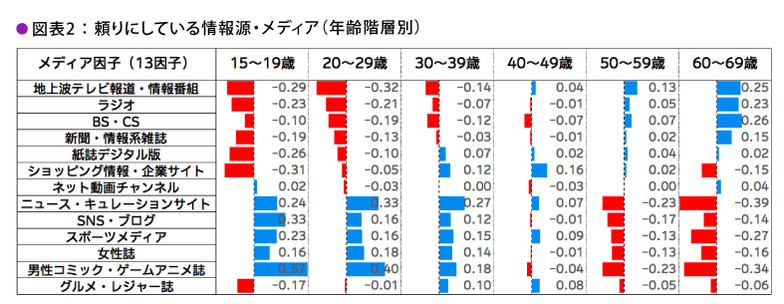
Respondents were asked how much they "rely on" each of 71 media types in their daily lives, and the responses were aggregated into the above 13 factors.\
Each item is normalized so that the average for all respondents (ages 15-69) is 0.\
Blue indicates a positive value. This means the percentage of people in that age group who regularly rely on that media is higher than the overall average.\
Red indicates negative values. This means the proportion of people in that age group who regularly rely on that media is lower than the overall average.
---
Blue bars indicate a higher proportion of respondents who answered they "regularly rely on" that media. "Terrestrial TV news/information programs," "Radio," "BS/CS," and "Newspapers/Information Magazines" show particularly strong support from middle-aged and older adults, centered around those in their 50s and 60s.In contrast, the two online media groups—"News Curation Sites" and "SNS/Blogs"—along with the three segmented media types—"Sports Media," "Women's Magazines," and "Men's Comics/Game/Anime Magazines"—are primarily supported by younger demographics from teens to those in their 30s.
Let's focus specifically on the "News Curation Sites" group. This category includes "Trending/Topic-Based News Sites," "Aggregator Sites," "General News Sites," and "Curation Sites." It's evident that support for this group is expanding across a broad age range, not just among those in their 20s, but also among those from their teens to their 40s.
## ■What are the characteristics of people who rely on news curation sites?
What are the characteristics of people who score high on "news curation sites," primarily among younger generations? Figure 3 (called multiple regression analysis) shows the results, but it can be difficult to understand at a glance, so let's interpret it with some explanation.
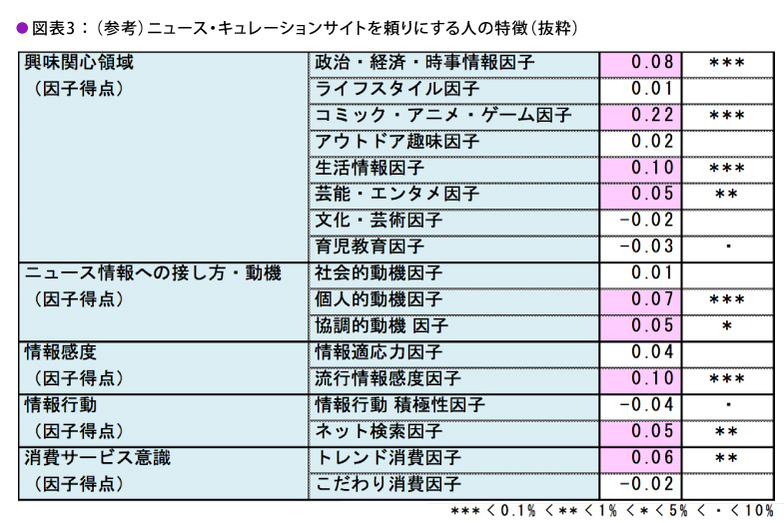
**Interest Areas Are Quite "Casual"**\
While interested in "Politics, Economy, Current Affairs," the strongest characteristic is their interest in "Comics, Anime, Games." Other notable interests include "Lifestyle Information" (which includes typical news like weather, traffic, incidents, and accidents) and "Entertainment."
**Approach to news and motivation: "Satisfying personal interests" and "Sharing topics with peers"**\
People who rely on news curation sites engage with daily news primarily for "personal motivations" like enriching their own lives and hobbies, rather than "social motivations" such as wanting to participate in publicly accessible topics. Furthermore, "cooperative motivation" – seeking conversation topics to align with friends or colleagues – also plays a significant role.
**Information behavior and consumption awareness strongly prioritize "trends" over "specific preferences"**\
Examining the characteristics of information sensitivity, behavior, and consumption awareness reveals a strong expression of the sensibility often described as "reading the air" – a trait gaining attention in recent years. While there is a strong awareness of "trend information" and "trends," the aspect of demonstrating "particularism" in consumption appears weak.
Thus, it seems reasonable to conclude that people who rely on online news media in general approach information with motivations more akin to flipping through magazines focused on light topics related to daily life and hobbies—motivations similar to those when browsing such magazines to have conversations with friends—rather than motivations driven by a desire for journalism-heavy newspapers.
From a business perspective, the new online news media rapidly gaining popularity in recent years can be seen as successfully capturing these user characteristics through their content lineup and information presentation systems. Consequently, they serve as a receptacle for a large youth demographic holding a casual attitude toward information (in this sense, they also appear promising as advertising platforms).
## **■What will online news media look like in 10 years?**
How will curation media and summary sites, which are currently expanding their role as media relied upon by younger generations, look in 10 years? Will they continue to accompany them as news sources when these younger generations mature and become central figures in society and their families?
While the exact form remains unclear, as more smartphone-native generations develop an interest in news media, it is certain that an increasing number of people will rely on news information from the internet.
Legislation lowering the voting age from 20 to 18 has been enacted. New media centered around the internet may also ignite the still-weak motivation among younger generations to seek out social and public news information. Perhaps in ten years, they will have grown into new comprehensive media platforms.
---
\[Survey Overview\]\
● Survey Period: March 6 (Fri) to March 9 (Mon), 2015\
● Survey Method: Online questionnaire survey\
● Survey Participants: Men and women aged 15 to 69 nationwide (excluding high school students), allocated according to gender, age group, and residential area population ratios\
●Valid Sample Size: 4,367 individuals\
●Survey Implementation: Video Research Ltd.
## Back Numbers (バックナンバー)
- [Log Analysis to Deepen Understanding of Smartphone Users (1) \~Why Do Older Women Use Game Apps More Frequently?\~](https://dentsu-ho.com/en/articles/2514) — 2015-05-12T14:20:16+09:00 · [Advertising (AX) (広告)](https://dentsu-ho.com/en/theme/ax)
- [Which products saw advertising spending increase? 2014 Full-Year & Second-Half Data](https://dentsu-ho.com/en/articles/2227) — 2015-02-27T07:00:00+09:00 · [Advertising (AX) (広告)](https://dentsu-ho.com/en/theme/ax)
## Author (著者)
### Akira Miwa
Dentsu Inc. / Dentsu Inc. Media Innovation Lab / Director of Media Innovation Research
Since joining the company, I have primarily conducted research and studies in the fields of information and communications, digital devices, and content at DENTSU SOKEN INC. I have also worked on building business visions and providing consulting services for both public and private sector clients. My responsibilities have spanned a wide range of areas, from cameras and robots to e-books. From July 2012, I worked on projects related to information media in general within the Media Innovation Research Department. I have held my current position since November 2015.
- [Person page](https://dentsu-ho.com/en/person/104)
- Series: [Insight Memo](https://dentsu-ho.com/en/booklets/1), [Smartphones and the Japanese](https://dentsu-ho.com/en/booklets/118), [Shiodome Media Researcher Commentary](https://dentsu-ho.com/en/booklets/137), [The Future of Visual Communication with Dominique Chen](https://dentsu-ho.com/en/booklets/163), [The Future of Video Services](https://dentsu-ho.com/en/booklets/252), [Smartphones: A Decade of Creative Destruction](https://dentsu-ho.com/en/booklets/306), [Media Behavior Data × Social Sequence Analysis](https://dentsu-ho.com/en/booklets/325), [The 30 Years of the Heisei Era: The Transformation and Innovation of Information Media](https://dentsu-ho.com/en/booklets/349), [The Reiwa "New" Era! Where is the Media Society Headed?](https://dentsu-ho.com/en/booklets/402)
- Latest articles: [What is the significance of advertising for the younger generation?](https://dentsu-ho.com/en/articles/7247), [How have changes in the media environment altered the younger generation's "social outlook"?](https://dentsu-ho.com/en/articles/7233)
### dentsu Media Innovation Lab
Dentsu Inc.
Launched in October 2017, leveraging Dentsu Inc.'s longstanding media and audience research expertise. Conducts research and disseminates insights to capture shifts in people's diverse information behaviors and understand the broader media landscape. Provides proposals and consulting on the communication approaches companies need within this context.
- [Person page](https://dentsu-ho.com/en/person/75)
- Series: [Insight Memo](https://dentsu-ho.com/en/booklets/1), [Special Discussion: "Japan's Advertising Expenditures"](https://dentsu-ho.com/en/booklets/183), [Explore the Amazing World of YouTube Creators with UUUM](https://dentsu-ho.com/en/booklets/449), [Information Media White Paper 2024: The Rapidly Changing Media Environment and Consumers](https://dentsu-ho.com/en/booklets/631), [100 years since its birth. Radio, today...](https://dentsu-ho.com/en/booklets/681), [College Students and the Future of Media, Communication, and Advertising in Ten Years](https://dentsu-ho.com/en/booklets/683), [Information Media White Paper 2025: New Horizons in Communication Shaping the Future](https://dentsu-ho.com/en/booklets/707), [Information Media White Paper Special Report 2026: “The Current State of Evolving Information Trends”](https://dentsu-ho.com/en/booklets/746)
- Latest articles: [From Media to IP: The Evolving Japanese Entertainment Business](https://dentsu-ho.com/en/articles/9901), [So Different Even Though It’s the Same Country!? A Comparison of Media Behavior Between Local and Urban Areas](https://dentsu-ho.com/en/articles/9816)
Sharing: the HTML page offers share buttons for X, Facebook, LINE and Hatena Bookmark (not reproduced here).
## Related links
- [Home](https://dentsu-ho.com/en)
- [Site index (llms.txt)](https://dentsu-ho.com/llms.txt)