---
title: "Tokyo Marine Nichido Fire Insurance \"National Inbound Tourism Survey\"\nConducted using social big data"
description: ""
url: "https://dentsu-ho.com/en/articles/5069.md"
html_url: "https://dentsu-ho.com/en/articles/5069"
canonical: "https://dentsu-ho.com/en/articles/5069"
language: "en"
alternate_language_url: "https://dentsu-ho.com/articles/5069"
translation: "machine"
type: "news"
site: "Dentsu-ho (電通報)"
llms_txt: "https://dentsu-ho.com/llms.txt"
published: "2017-04-11T15:00:00+09:00"
---
# Tokyo Marine Nichido Fire Insurance "National Inbound Tourism Survey" Conducted using social big data
> Navigation: [Site index (llms.txt)](https://dentsu-ho.com/llms.txt) · [Home](https://dentsu-ho.com/en) · Parent: [News (ニュース)](https://dentsu-ho.com/en/news)
Note: This website was automatically translated, so some terms or nuances may not be completely accurate.
Published: 2017-04-11T15:00:00+09:00 · Category: News (ニュース)
## Themes and tags
- Themes: [Marketing (マーケティング)](https://dentsu-ho.com/en/theme/marketing), [Digital / Technology (DX) (デジタル / テクノロジー)](https://dentsu-ho.com/en/theme/dx), [Insights / Research (インサイト / 調査)](https://dentsu-ho.com/en/theme/insight)
- Tags: [Big Data](https://dentsu-ho.com/en/tag/ビッグデータ), [Inbound](https://dentsu-ho.com/en/tag/インバウンド), [Survey](https://dentsu-ho.com/en/tag/調査)
## Adjacent articles
- Previous: [https://dentsu-ho.com/en/articles/5068](https://dentsu-ho.com/en/articles/5068) · Next: [https://dentsu-ho.com/en/articles/5070](https://dentsu-ho.com/en/articles/5070)
## Body
Tokio Marine & Nichido Fire Insurance recently conducted a "Nationwide Inbound Tourism Survey" based on social big data analysis.
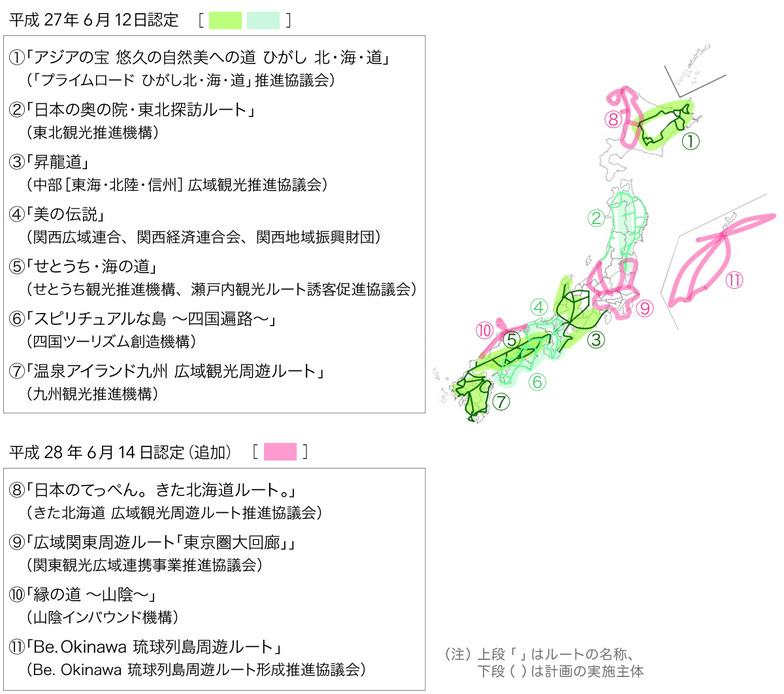
This survey, conducted with the cooperation of the "Social Insight Lab" (a collaborative organization between Dentsu Inc. and NTT DATA), utilized all Twitter (English) data and SNS data such as Weibo (Chinese) from the 11 areas designated as "Wide-Area Tourism Routes" by the Japan Tourism Agency. It investigated and analyzed the tourism dynamics and preferences of foreign tourists.
Going forward, Tokio Marine & Nichido will provide the survey overview to local governments and inbound tourism operators to aid in formulating tourism policies and inbound initiatives.
## \[Key Findings\]
By analyzing the raw voices of foreign tourists, the survey revealed more authentic needs, such as the hidden gems they find appealing and the types of tourism resources that attract them.
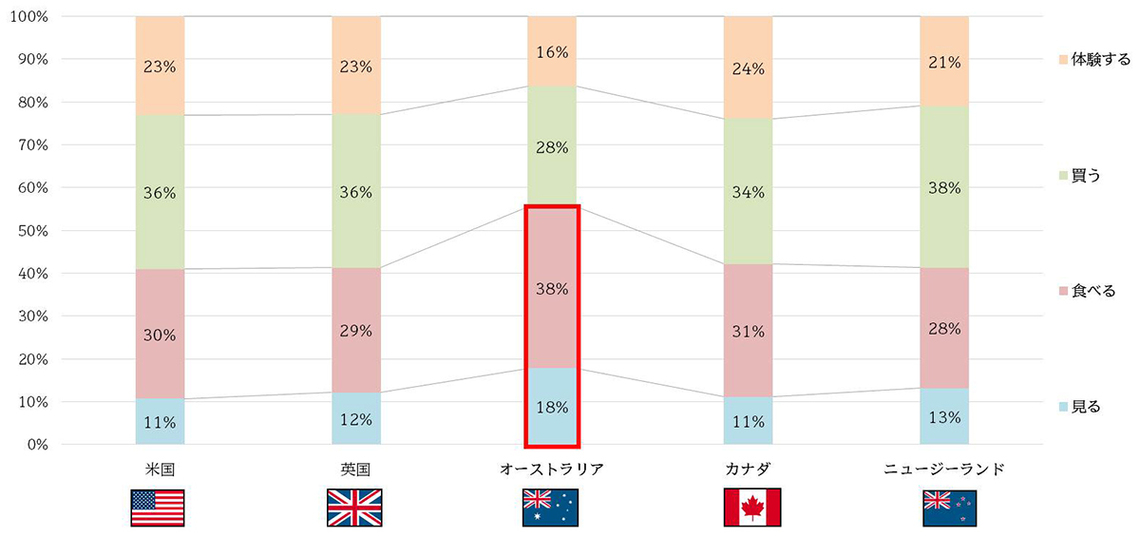
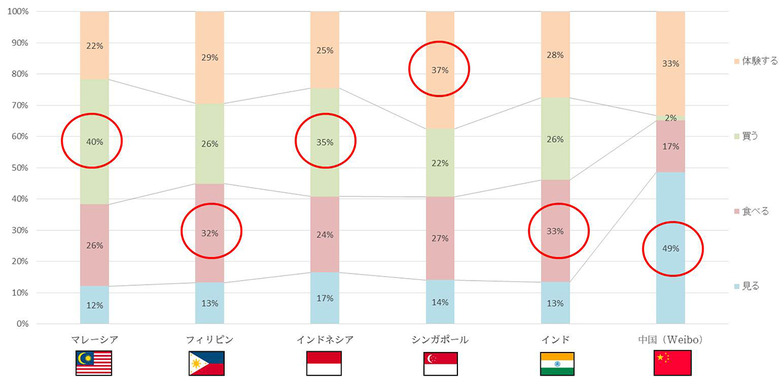
### 1.Top 5 English-speaking and Asian countries' topic composition ratios for "See," "Eat," "Buy," and "Experience"
Tourists from the four English-speaking countries other than Australia showed a high volume of topics related to "shopping," while Australian tourists had a significantly higher volume of topics related to "eating."
Compared to English-speaking tourists, Asian tourists post more frequently about "experiences."
Analysis of Weibo posts shows Chinese tourists post more about "enjoying scenery" and "experiencing activities" than "shopping" or "eating," indicating a clear shift from "object-based tourism" to "experience-based tourism."
### Figure 1: Topic Composition Ratio of "Seeing," "Eating," "Buying," and "Experiencing" Across Five Countries
### Chart 2: Topic Composition Ratios for "Seeing," "Eating," "Buying," and "Experiencing" in the Top 5 Asian Countries
### 2. Hidden Gem Tourist Spots Identified from Foreigners' Positive and Negative Tweets
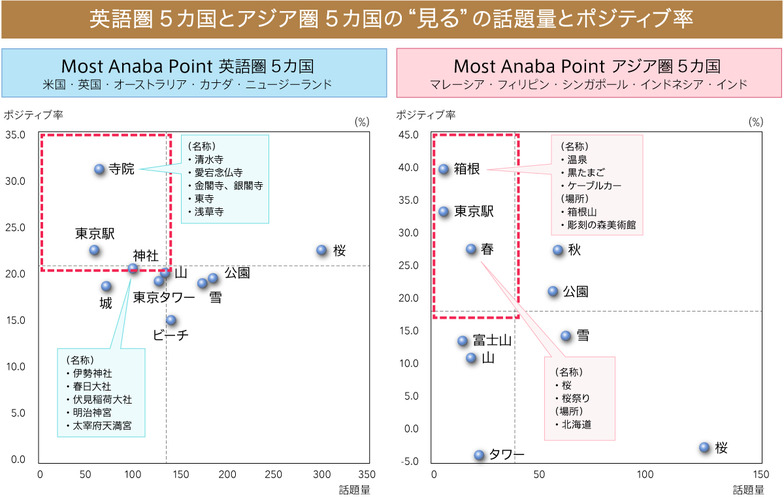
This analysis uniquely examined both topic volume and content through linguistic analysis to distinguish positive and negative sentiment. It identified tourist spots with low topic volume but high evaluation.
In the five English-speaking countries, while topics about Japan's ancient architecture like temples, shrines, and castles were low in volume, they received high ratings upon viewing. This suggests they hold significant potential as tourist resources to attract foreign visitors.\
In the five Asian countries, it became clear that experiential destinations like Hakone, along with seasonal natural scenery, received high praise.
### Figure 3: Composition of "Sightseeing" in Japan Tourism for Top 5 English-speaking and Asian Countries
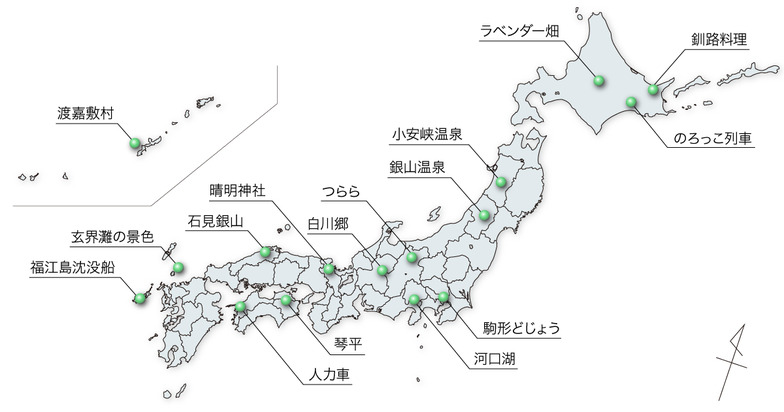
### Figure 4: 11 Areas Designated as Wide-Area Tourism Routes by the Japan Tourism Agency
### Figure 5: Tourist Spots with Low Discussion Volume but High Visitor Ratings by Prefecture
**\[Survey Overview\]**\
**○Analysis Period**\
One year from November 2015 to October 2016\
**○Primary Analysis Data Sources**\
Full Twitter data, Weibo data\
**○Number of Posts Analyzed, Countries/Regions**\
736,213 English-language Twitter posts and 100,128 Chinese-language Weibo posts. Analysis of foreign tourists' discussions about Japan across over 50 countries/regions based on a total of 836,341 data points\
**○Research and Analysis Organization**\
Social Insight Lab (a collaborative organization between Dentsu Inc. and NTT DATA)
Sharing: the HTML page offers share buttons for X, Facebook, LINE and Hatena Bookmark (not reproduced here).
## Related links
- [Home](https://dentsu-ho.com/en)
- [Site index (llms.txt)](https://dentsu-ho.com/llms.txt)