---
title: "Dear Sir/Madam, Are you creating content!? (Part 1)"
description: ""
url: "https://dentsu-ho.com/en/articles/5383.md"
html_url: "https://dentsu-ho.com/en/articles/5383"
canonical: "https://dentsu-ho.com/en/articles/5383"
language: "en"
alternate_language_url: "https://dentsu-ho.com/articles/5383"
translation: "machine"
type: "article"
site: "Dentsu-ho (電通報)"
llms_txt: "https://dentsu-ho.com/llms.txt"
published: "2017-08-18T06:00:00+09:00"
---
# Dear Sir/Madam, Are you creating content!? (Part 1)
> Navigation: [Site index (llms.txt)](https://dentsu-ho.com/llms.txt) · [Home](https://dentsu-ho.com/en) · Parent: [New Articles (新着記事)](https://dentsu-ho.com/en/latest_articles) · [Dentsu Design Talk](https://dentsu-ho.com/en/booklets/23)
Note: This website was automatically translated, so some terms or nuances may not be completely accurate.
Published: 2017-08-18T06:00:00+09:00 · Series: [Dentsu Design Talk](https://dentsu-ho.com/en/booklets/23) (Part 97 of 109)
## Themes and tags
- Themes: [Creative (クリエイティブ)](https://dentsu-ho.com/en/theme/creative), [Media / Content (メディア / コンテンツ)](https://dentsu-ho.com/en/theme/media)
- Tags: [movie](https://dentsu-ho.com/en/tag/映画), [Design Talk](https://dentsu-ho.com/en/tag/Design Talk), [Copywriter](https://dentsu-ho.com/en/tag/コピーライター), [TCC](https://dentsu-ho.com/en/tag/TCC), [Creative](https://dentsu-ho.com/en/tag/クリエイティブ)
## Authors
- [Naga Hisashi](https://dentsu-ho.com/en/person/1389)(Dentsu Inc. / Content Business Design Center / film director)
- Takasaki Takuma
- [Nagaaki Onoe](https://dentsu-ho.com/en/person/865)(Dentsu Inc. / FC Room / Planner/Creative Director)
## Adjacent articles
- Previous: [https://dentsu-ho.com/en/articles/5209](https://dentsu-ho.com/en/articles/5209) · Next: [https://dentsu-ho.com/en/articles/5384](https://dentsu-ho.com/en/articles/5384)
## Body
This edition of Dentsu Design Talk welcomes Mr. Tadashi Nagahisa from Dentsu Inc., who won the Grand Prize in the Short Film category at the 33rd Sundance Film Festival for the film "And So We Put Goldfish in the Pool." Joining him are Takuma Takasaki, who has created buzz by navigating the boundary between advertising and content, and Nagaaki Onoe, who creates compelling content by freely exploring both web and real-world spaces. In an era where anyone worldwide can create content thanks to digital technology, we explore the pride of being advertising professionals and how to create content that truly resonates.
※The film "And So We Put Goldfish in the Pool" can be viewed [here](https://vimeo.com/170127382).
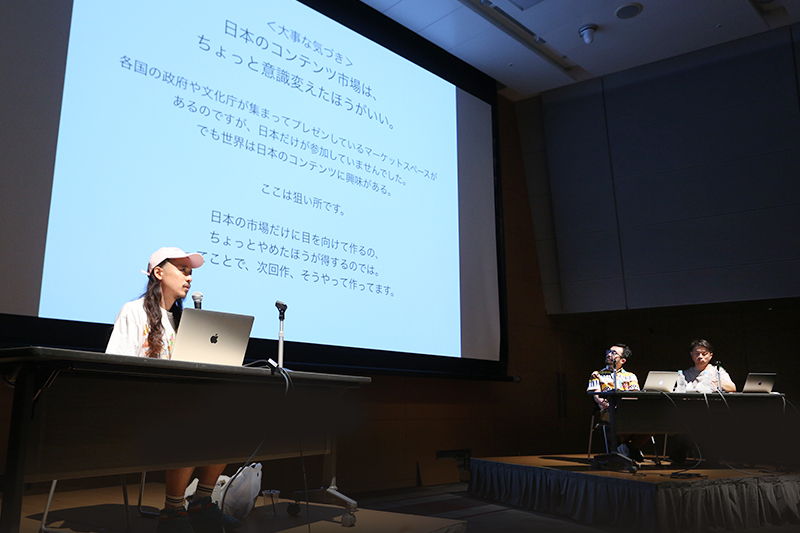
(From left) Masayoshi Nagahisa (Dentsu Inc.), Nagaaki Onoe, Takuma Takasaki
## \
## Reasons for its acclaim at the Sundance Film Festival
**Takasaki**: When Nagahisa told me we'd won the Grand Prize in the Short Film category at the Sundance Film Festival, I was completely stunned. Anyone who's ever dreamed of filmmaking trembles at the mention of Sundance. I never in my wildest dreams imagined my junior would win the Grand Prize.
**Nagaku**: Honestly, it's huge (laughs). The Sundance Film Festival is the largest and most prestigious international film festival dedicated to indie films. It's famous for discovering young directors. Director Damien Chazelle, for example, won an award for his short film "Whiplash," which he then rebuilt into the feature film "Whiplash" that became a hit. It's no exaggeration to say his breakthrough with "La La Land" started at Sundance.
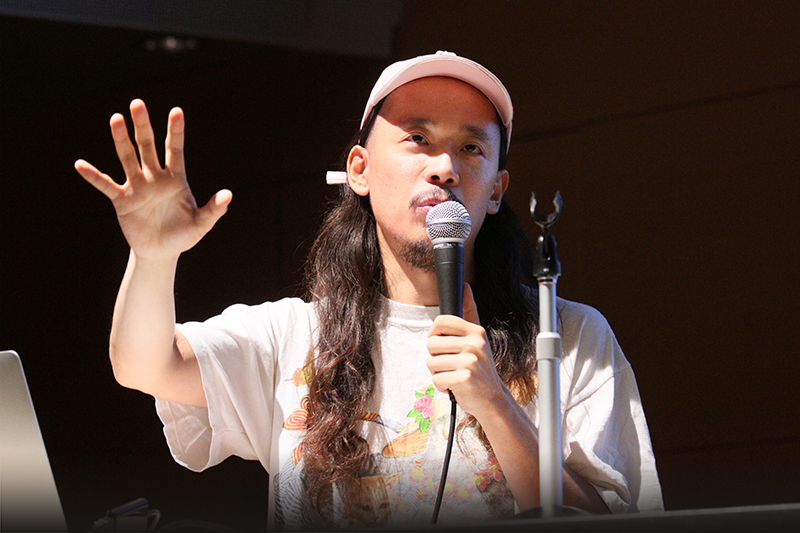
**Takasaki**: How did the project for this film, "And So We Put Goldfish in the Pool," come about?
**Nagaku**: I originally graduated from a film school. Now I work as a commercial planner creating ads, so I rarely had opportunities to make films. However, I found a competition called the "MOON CINEMA PROJECT," which funds the project that wins first place in a web vote. I decided to challenge it, and thankfully, I won first place and was able to make the film.
**Takasaki**: I voted for it too. "And So We Released Goldfish into the Pool" is based on an actual incident that happened in Sayama City, Saitama Prefecture, right?
**Nagaku**: Yes, it's based on an incident in the summer of 2012, when four junior high school girls stole 400 goldfish from a "goldfish scooping" booth during a summer festival and released them into the pool at their school.
**Takasaki**: What do you think made such a local motif resonate on a global stage?
**Nagaku**: Personally, I hoped the Japanese schoolgirls' mindset and the exotic festival atmosphere would be appreciated. But actually, it was praised because the film's theme resonated with global issues, portrayed through innovative visual expression. I intended it as a story about the very specific locale of Sayama City, so I was surprised it was called a global theme.
**Takasaki**: That's probably because the world those girls inhabit isn't unique; it depicts emotions anyone can relate to.
**Nagaku**: Sayama City is a place where you can reach Tokyo in just an hour. Most people who live there spend their entire lives without ever living in the city itself. The main characters, the girls, say things like "I hate it" and "I want to escape" about spending their whole lives in Sayama City, but they've resigned themselves to the fact that they probably can't. Why is this global? Because apparently, many people around the world live in the same way, in the suburbs of large cities, spending their lives with pent-up feelings in a closed environment.
**Takasaki**: So you discovered the theme after learning about the incident?
**Nagaku**: No, learning about the incident wasn't the trigger. I was already living with a sense of resignation. For example, even when feeling immense stress, I'd recognize that it was interesting in its own way. I had this sort of "positive resignation" personality.
**Takasaki**: So the theme was already within you, and a single incident helped give it shape.
## How does film differ from TV commercial production?
**Nagaku**: Americans told me "And So We Put Goldfish in the Pool" felt "really real." I think that's less about the dialogue's realism and more about scenes like the protagonist's brother talking about adult videos – scenes unnecessary to the plot. Because I believe the "real" in life is that kind of noise.
**Onoe**: Sorry, I was just listening intently. If I don't ask now, we'll end up in silence (laughs). Watching the film, scenes like eating gratin with a "squelch" sound really stood out as noise. You just can't depict scenes like that in TV commercials.
**Nagaku**: TV commercials are structured logically. But sometimes, things just hit you hard, even if you can't articulate why. I consciously embed those kinds of scenes.
**Takasaki**: I often sense a rebellious streak against mainstream trends in your commercials, Nagahisa-kun, but I actually don't feel that much of it in this film. It seems like you're striving for extreme purity in the theme. Where does that difference come from?
**Nagaku**: I wonder. TV commercials exist to sell products, so no matter how emotional the visuals, the endpoint is always the product. Films, on the other hand, are a space to present ideas; they don't need to clearly state the goal. That might be the difference.
**Takasaki**: Advertising, if you just put the product out there, no matter how surreal or poorly written the script, it lands. If you don't have that resolve from the start—that you can't get complacent about that—it tends to become childish in its expression. Maybe the difference comes from the space where you can create, not just how to break conventions.
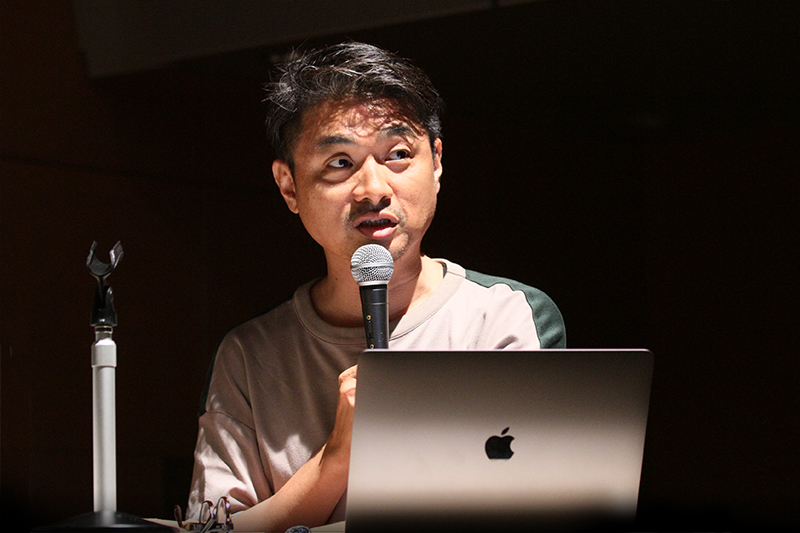
**Nagaku**: In that regard, I think Onoe-kun is truly skilled at creating content with his own perspective and emotional depth.
**Takasaki**: The work of Onoe-kun's generation is incredibly interesting. Even after delivery, they keep revising and evolving it. It feels like the conversation with the client continues long after the project is handed off.
**Onoe**: Yes, a lot of it is built on call and response. It's about stepping into the circle, so to speak.
## Making advertising work through personal passion
**Nagaku**: Onoe-kun, you used to draw manga. Don't you still feel like drawing now?
**Onoe**: The time I drew manga was a dark period when jobs would disappear midway and nothing ever got published. I vented my pent-up frustrations through manga. But now that I can get my work published, that urge has faded. Though occasionally a theme I want to draw comes up. Speaking of manga-related content, I absolutely love "Kochira Katsushika-ku Kameari Kōen-mae Hashutsujo" (Kochikame), and I got to work on their 40th anniversary & end campaign. One part of that was the low-budget theme park "Kameyashiki." We hijacked Hanayashiki amusement park, selling bland yakisoba for 3000 yen, creating a merry-go-round broadcasting horse racing, and finally posting a sign saying "Ryōsan ran away, so we're closing."
In this project, I think I managed to express things I'd long felt—like the theme park's overpriced yakisoba or the tackiness of the merry-go-round—as content. I just kept thinking about what Ryōsan would actually do if he were real.
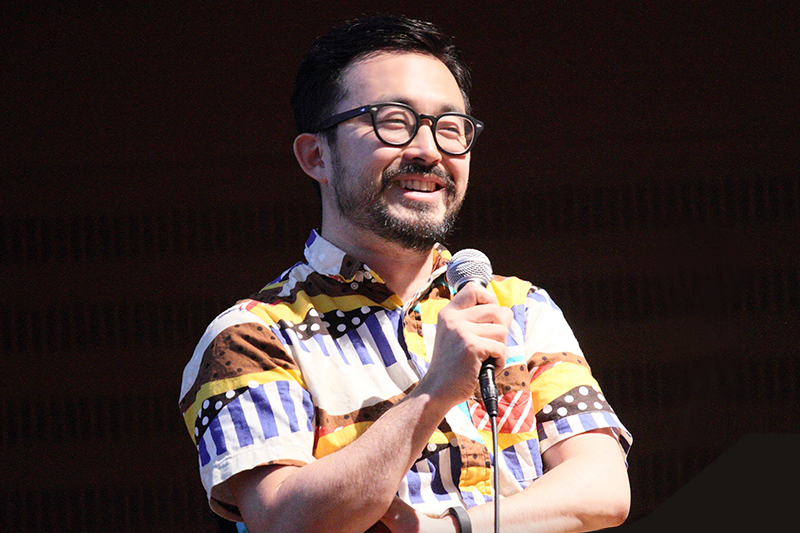
**Nagaku**: It contains a lot of personal passion, yet it still functions perfectly as an advertisement.
**Onoe**: There's an infinite amount of content on the web. To win in that space, I believe it's crucial to express passion at a level that other content simply can't achieve.
When Nissin Foods' cup noodle campaign "Donbare Series" for "Nissin Donbei" was canceled, we commissioned manga artist Akira Miyashita, known for "Kaizoku!! Otoko Juku," to draw the cancellation manga "Donbare \~ The Tale of Donbei \~". I drew the storyboards myself and redrew them countless times. Manga artists are truly amazing. Finally, following the standard ending for a canceled manga, we had all the characters appear together for "Stay tuned for what's next with Donbei. Part 1 Complete."
**Nagaku**: That's the part, right? (laughs)
**Onoe**: Yeah, exactly (laughs). It was crucial to end it while hinting at a planned Part 2. I thought, "What could happen if I combined the 'serialization cancellation imagery' I'd accumulated from reading manga in the past with advertising?" That's how I came up with the concept.
That's how I create ads—by pulling out things I love. For me, it's mostly manga. Takasaki, what do you think shapes who you are today?
**Takasaki**: For me, it's entirely the music, novels, movies, and manga I encountered in my teens. As I gain more experience, I feel drawn back to those origins. Like something I can't resist.
I'm not necessarily creating things I like, but I absolutely cannot create things I dislike.
**Nagaku**: It's true—compared to the past, I really feel a growing momentum valuing the individual's sense of "liking" something.
**Takasaki**: Thanks to the media revolution and the flood of content, it's become easier to find "people who like the same things" all over the world. I feel like personal taste is becoming an even more important sense.
※Continued in Part 2\
You can also read the interview [here on AdTae](https://www.advertimes.com/20170818/article255938/)!\
Planning & Production: Dentsu Live Inc. Creative Unit Creative Room 2, Aki Kanahara
\
## Back Numbers (バックナンバー)
- ["Anti-Design Thinking"—A Methodology to Avoid Being Led Astray by Imported Concepts—(Part 2)](https://dentsu-ho.com/en/articles/5209) — 2017-06-10T06:00:00+09:00 · [Marketing (マーケティング)](https://dentsu-ho.com/en/theme/marketing)
- ["Anti-Design Thinking"—A Methodology to Avoid Being Led Astray by Imported Concepts—(Part 1)](https://dentsu-ho.com/en/articles/5208) — 2017-06-09T06:00:00+09:00 · [Marketing (マーケティング)](https://dentsu-ho.com/en/theme/marketing)
## Author (著者)
### Naga Hisashi
Dentsu Inc. / Content Business Design Center / film director
Born in 1984 in Tokyo. In 2017, his directorial debut, “And So We Put Goldfish in the Pool,” became the first Japanese film to win the Grand Prize in the Short Film category at the Sundance Film Festival. His awards include the TCC Newcomer Award, the OCC Best Newcomer Award, and a medal in the Cannes Lions Young Lions FILM category, among others.His representative works include the feature films \*WE ARE LITTLE ZOMBIES\* and \*Death Days\*, the WOWOW original dramas \*FM999\* and \*I’m Dead!\*, the short film \*Kaguya By Gucci\* for Gucci, and the music video for \*FOOL\* by Hitsuji Bungaku. He is also active as a screenwriter and theater director. His latest work, \*Enjo\*, is currently streaming on U-NEXT.
- [Person page](https://dentsu-ho.com/en/person/1389)
- Series: [Dentsu Design Talk](https://dentsu-ho.com/en/booklets/23), [Not Just Advertising! Dentsu Inc. Creators FILE](https://dentsu-ho.com/en/booklets/323), [Web Dentsu Inc. Original Video "A Certain Brainstorming Session"](https://dentsu-ho.com/en/booklets/395), [Let's talk about Cannes. CANNES LIONS 2023](https://dentsu-ho.com/en/booklets/612), [Ten people, ten ways of thinking](https://dentsu-ho.com/en/booklets/616)
- Latest articles: [Stories that reach the world are born from “ultra-personal” places](https://dentsu-ho.com/en/articles/9812), [──Is Nagahisa-san actually a bit clumsy?](https://dentsu-ho.com/en/articles/8714)
### Takasaki Takuma
Joined Dentsu Inc. in 1993. Received numerous domestic and international awards, including his third Creator of the Year award in 2010, following previous wins in 2013. His publications include "The Art of Expression" (Chuo Koron Bunko), the novel "Auto Reverse" (Chuo Koron Shinsha), and the picture book "Black" (Kodansha). Hosts J-WAVE's "BITS&BOBS TOKYO." Co-wrote and co-produced the film "PERFECT DAYS," which won the Best Actor Award for Koji Yakusho at the 2023 Cannes Film Festival. Left Dentsu Inc. in March 2025.
### Nagaaki Onoe
Dentsu Inc. / FC Room / Planner/Creative Director
I specialize in flexible communication design that embraces anything and everything. Recent major projects include: "What if there was a mountain in the middle of Tokyo?", "Everyone's Pinot Game", "Cup Noodle", "Fujiwara Tatsuya CookDo", "#667 Love Letters", and "Sanctuary: Giant Monkey Cherry Blossom Statue". He also serves as the ACC BC Division Jury President and Editor-in-Chief of "Copy Yearbook 2022." Perhaps due to the stress, he suffers frequent gout attacks. He is challenging himself to improve his constitution while getting 8 hours of sleep.
- [Person page](https://dentsu-ho.com/en/person/865)
- Series: [Rapper vs. Copywriter](https://dentsu-ho.com/en/booklets/270), [Dentsu Design Talk](https://dentsu-ho.com/en/booklets/23), [Let's talk about Cannes. CANNES LIONS 2022](https://dentsu-ho.com/en/booklets/565), [Beyond the Pandemic: The Current State of OOH—A DX-Based Perspective](https://dentsu-ho.com/en/booklets/605), [I tried using AICO2 with that person everyone's been talking about!](https://dentsu-ho.com/en/booklets/673)
- Latest articles: [What you want at a bakery isn't just bread. What kind of future dreams do AI copywriters envision?](https://dentsu-ho.com/en/articles/9197), [OOH is the city's "recommendation engine."](https://dentsu-ho.com/en/articles/8747)
Sharing: the HTML page offers share buttons for X, Facebook, LINE and Hatena Bookmark (not reproduced here).
## Related links
- [Home](https://dentsu-ho.com/en)
- [Site index (llms.txt)](https://dentsu-ho.com/llms.txt)