---
title: "\"Data\" × \"Human Touch\"\nOutput That Resonates"
description: ""
url: "https://dentsu-ho.com/en/articles/5546.md"
html_url: "https://dentsu-ho.com/en/articles/5546"
canonical: "https://dentsu-ho.com/en/articles/5546"
language: "en"
alternate_language_url: "https://dentsu-ho.com/articles/5546"
translation: "machine"
type: "article"
site: "Dentsu-ho (電通報)"
llms_txt: "https://dentsu-ho.com/llms.txt"
published: "2017-10-20T05:00:00+09:00"
---
# "Data" × "Human Touch" Output That Resonates
> Navigation: [Site index (llms.txt)](https://dentsu-ho.com/llms.txt) · [Home](https://dentsu-ho.com/en) · Parent: [New Articles (新着記事)](https://dentsu-ho.com/en/latest_articles)
Note: This website was automatically translated, so some terms or nuances may not be completely accurate.
Published: 2017-10-20T05:00:00+09:00
## Themes and tags
- Tags: [Monthly Dentsu Inc. News](https://dentsu-ho.com/en/tag/月刊電通報)
## Authors
- [Takashi Uozumi](https://dentsu-ho.com/en/person/96)(Dentsu Consulting Inc. / Executive Officer, Partner)
- Satoshi Umeda
## Adjacent articles
- Previous: [https://dentsu-ho.com/en/articles/5508](https://dentsu-ho.com/en/articles/5508) · Next: [https://dentsu-ho.com/en/articles/5785](https://dentsu-ho.com/en/articles/5785)
## Body
## The Happy Bridge Between Digital Marketing and Creativity
Data-driven digital marketing has become mainstream.\
However, even with sophisticated data analysis, output that fails to resonate emotionally requires skillful human touch. So, how should this human touch be applied?
This time, Takashi Uozumi of Dentsu Digital Inc., involved in digital marketing, held a discussion on this theme. His counterpart was Satoshi Umeda, a Creative Director at Dentsu Inc. and author of the bestseller "The Power of Putting It Into Words." As a specialist in articulating people's inner voices, and someone who actually comes from a marketing background, how does Umeda view this issue?\
Together, they explore the future of digital marketing.
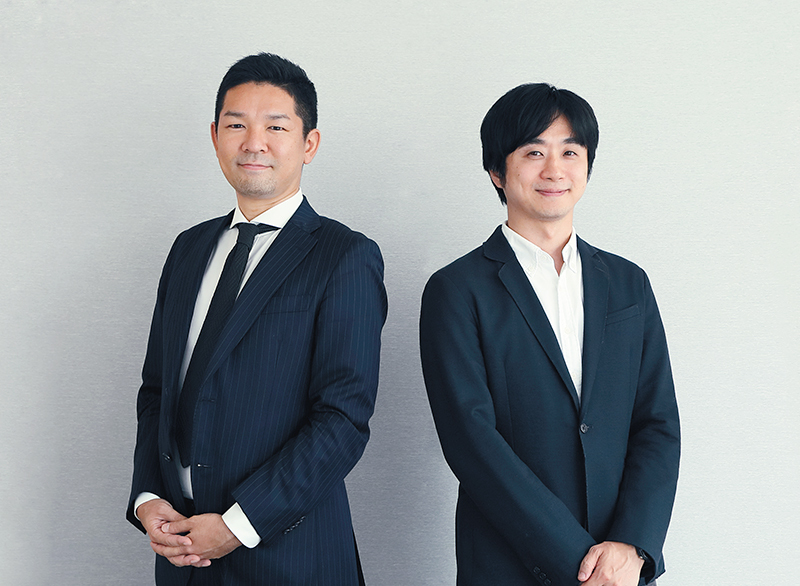
(From left) Takashi Uozumi, Satoshi Umeda
## What "Common Ground" Is Needed in Data Analysis
**Uozumi:** Just as "big data" has become established, the technology and talent for analyzing data are now in place. However, when connecting that to the final output, I feel the bridge between data analysis and the creative side isn't functioning well. How should we interpret vast amounts of data and what should the output be? That's what I want to consider.
**Umeda:** I also started in marketing before moving into creative. I believe anyone involved in advertising production, including creatives, cannot escape digital marketing. However, there might be a difference in perspective between those whose livelihood is data analysis and creators whose livelihood is output, regarding how to use that data.
**Uozumi:** Technological advances now allow us to analyze individual data in detail and provide personalized outputs back to each person. But creating unique messages for every single person has its limits; we must group people to some extent. This raises the issue of how to analyze and output data for groups. When analyzing groups with data, we often end up seeking the "average" and basing our messages on that.
**Umeda:** The question is whether averaged data holds any real meaning. For example, even if you create an "average face" based on various Japanese people as the "typical Japanese face," no actual Japanese person looks like that. In other words, even when considering group data, you can't derive real individuals, nor can you create messages that truly resonate with them. We shouldn't look at the "trees" (individuals) from the "forest" (group). Instead, we should look at the "forest" from the "trees." And then, we should verify with data whether what we see from the individual can also be said to be general.
**Uozumi:** Since we joined the company at the same time, we often discuss this. We used to describe our current approach as "finding common denominators," right?
**Umeda:** For example, suppose we have four numbers: 2, 4, 6, and 12. Instead of calculating the average, we focus on the shared element they possess – the fact they are all even numbers. Similarly, when it comes to human hearts, finding these shared elements will be crucial going forward. Isn't that the role of digital marketing? Rather than seeking averages, analyzing by identifying shared elements should yield fascinating insights.
**Uozumi:** Furthermore, while digital systems can identify these common denominators, crafting the right message for them still requires human creativity. That's the ideal form of human involvement in digital marketing, isn't it?
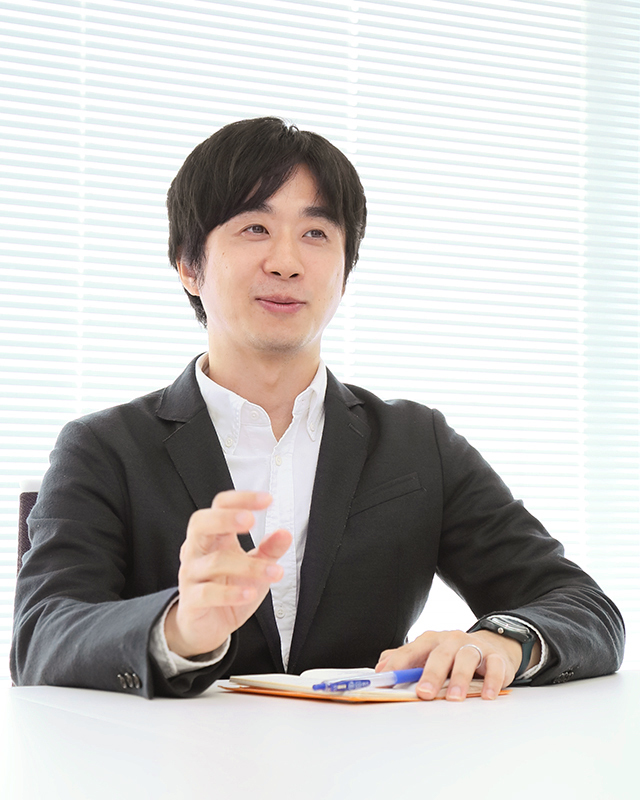
Umeda
## Creating "Hypotheses" to Find Common Ground
**Uozumi:** Identifying shared elements within a group and outputting something that resonates with them. In this sense, I believe the copy Umeda created serves as a valuable reference. I'm referring to Georgia's slogan: "The world is built by someone's work." While work and its values differ for each person, hearing this phrase allows everyone to uniformly adopt a positive attitude. Isn't that because it pinpointed the shared elements among working people and distilled them into the copy?
**Umeda:** For that copy, we did the work of identifying that common ground intuitively, together with the client and team members. But now, we can prove such intuitions by looking at digital marketing analytics and saying, "This is real." In fact, we're in an era where intuition alone isn't trusted; we need backing and explanations. So, digital marketing should exist to provide that backing for whether human intuition is correct.
**Uozumi:** Relying solely on human intuition is challenging, but on the other hand, if you try to solve everything with data alone and become a "data supremacist," you end up averaging things out. I think the key is finding the right balance between the two.
**Umeda:** Also, crucial for identifying common factors is how you design the data's entry and exit points. You must properly formulate hypotheses at the "entry point" before collecting data, then verify if those hypotheses are correct at the "exit point" when analyzing the data. From my marketing experience, I've learned the hard way that common factors are never discovered by accident. They won't surface unless you build hypotheses.
**Uozumi:** There's a hypothesis created by people, and then big data exists to verify and support that hypothesis. I also think this is how it should fundamentally be.
**Umeda:** Without a hypothesis, you can drown in data or lose sight of it altogether. What's clear with a sample size of 100 becomes obscured with 10,000. Above all, without a solid initial benchmark, you can't properly evaluate the data. Drowning in data often stems from weak hypotheses. This approach could contribute to new ways of selling products.

Mr. Uozumi
## The collaboration between data and people creates new ways to sell products
**Uozumi:** The evolution of digital marketing has changed how companies and customers interact. Previously, we analyzed the "short-term process leading up to purchase" as the customer journey, but now the mainstream approach is to observe customers over the medium to long term.
**Umeda:** Within this shift, I believe companies need to accompany customers throughout their lives. It's about tracking them over time, not just in the short term—essentially a "customer life journey." We were discussing this very topic in my department. However, even here, relying solely on data isn't ideal. Why? Because it lacks warmth. That's the biggest problem with data.
**Uozumi:** Digital marketing already captures customers' life changes and milestones through data, enabling us to detect life events. But determining what we can do for that customer and what message to convey requires a different skill set. Without human involvement here, I feel the warmth disappears.
**Umeda:** For example, if a man buys competitive swimwear, we can infer he's developing an interest in improving his health. So what kind of output should we provide? Current digital marketing often defaults to recommending related products. But with human involvement, we could step back and offer healthcare information instead. Rather than linking it to products, we could approach it from the perspective of "How can we help improve your health?"
**Uozumi:** Precisely because digital marketing allows us to track customers' detailed lifestyles, how we output that information becomes crucial. And that, ultimately, is something people must do.
**Umeda:** The challenge is how to communicate to customers that we're observing them without making them feel uncomfortable. If customers perceive the output as intrusive, it backfires and risks diminishing their affection for the company or brand. To achieve non-intrusive output, human creativity is essential.
**Uozumi:** As corporate value shifts from products to experiences, digital marketing must function not as a sales tactic, but as experience design that delivers exceptional experiences. If we keep this in mind and collaborate closely with creators, we can contribute to transforming corporate business models.
**Umeda:** As creators, we'll be happier if we can see big data not as an adversary, but as an ally that validates our own gut feelings. That's what I believe will drive the future development of digital marketing.
## Author (著者)
### Takashi Uozumi
Dentsu Consulting Inc. / Executive Officer, Partner
Consistently engaged in supporting clients' digital transformation of marketing operations. Early focus on the potential of big data and cloud computing, leading to numerous solution developments, consulting engagements, articles, and presentations leveraging these technologies. Currently active under the theme of "Building New Relationships Between Companies, Customers, and Employees." Certified Management Consultant.
- [Person page](https://dentsu-ho.com/en/person/96)
- Series: [Is big data an enemy or an ally for advertising agencies?](https://dentsu-ho.com/en/booklets/39), [So, is big data ultimately an enemy or an ally for advertising agencies?](https://dentsu-ho.com/en/booklets/89), [Digital marketing beyond advertising](https://dentsu-ho.com/en/booklets/247), [Business Producer Committed to the Business](https://dentsu-ho.com/en/booklets/416), [The DX Engine Driven by Treasure Data and Dentsu Inc.](https://dentsu-ho.com/en/booklets/446), [Thinking with the Right Brain and Left Brain: The Future of Advertising Agencies and Consulting Firms](https://dentsu-ho.com/en/booklets/553)
- Latest articles: [To the Shin Publicity Department. The Trend Toward Transformation into a "Marketing Organization"](https://dentsu-ho.com/en/articles/8988), [The key lies in employee happiness. What is the "Happiness Management" envisioned by TOYOTA CONIQ, Inc.?](https://dentsu-ho.com/en/articles/8312)
### Satoshi Umeda
Graduated from the Graduate School of Science and Engineering, Sophia University. Engages in diverse activities including product development, magazine serialization, and providing music to artists alongside advertising production. Received over 30 domestic and international awards including Cannes Lions, Good Design Award, and the Japan Tourism Agency Director-General's Commendation. Author of books such as "Planners Scheme Three Times" (Nikkei Publishing). Media appearances include NHK's Ohayo Nippon, TBS's Hiruobi!, and Yahoo! Top. Ranked in the top 10 copywriters by the CM Research Institute in both 2014 and 2015. Visiting Researcher at Yokohama City University's Department of International Urban Studies. Left Dentsu Inc. in 2018.
Sharing: the HTML page offers share buttons for X, Facebook, LINE and Hatena Bookmark (not reproduced here).
## Related links
- [Home](https://dentsu-ho.com/en)
- [Site index (llms.txt)](https://dentsu-ho.com/llms.txt)