---
title: "E-book: How to Spread Social Design (Part 2)"
description: "The third installment of the \"DENTSU DESIGN TALK\" series has been released from Kadokawa Minutes Book, a compact e-book label operated by BookWalker Co., Ltd.\nThe third installment is \"How to Spread Social Design,\" featuring Kazufumi Nagai, founder of HAKUHODO DESIGN; Osamu Fukushima, founder of Fukushima Design after working at ADK; and Susumu Namikawa of Dentsu Inc. Social Design Engine. We will gradually introduce the talks of these three individuals, who explored their relationship with society and connected through UNICEF's \"Prayer Tree Project.\""
url: "https://dentsu-ho.com/en/articles/885.md"
html_url: "https://dentsu-ho.com/en/articles/885"
canonical: "https://dentsu-ho.com/en/articles/885"
language: "en"
alternate_language_url: "https://dentsu-ho.com/articles/885"
translation: "machine"
type: "article"
site: "Dentsu-ho (電通報)"
llms_txt: "https://dentsu-ho.com/llms.txt"
published: "2014-03-07T17:50:59+09:00"
---
# E-book: How to Spread Social Design (Part 2)
> Navigation: [Site index (llms.txt)](https://dentsu-ho.com/llms.txt) · [Home](https://dentsu-ho.com/en) · Parent: [New Articles (新着記事)](https://dentsu-ho.com/en/latest_articles) · [Dentsu Design Talk](https://dentsu-ho.com/en/booklets/23)
Note: This website was automatically translated, so some terms or nuances may not be completely accurate.
Published: 2014-03-07T17:50:59+09:00 · Series: [Dentsu Design Talk](https://dentsu-ho.com/en/booklets/23) (Part 21 of 109)
## Themes and tags
- Themes: [Advertising (AX) (広告)](https://dentsu-ho.com/en/theme/ax), [Social Issues (社会課題)](https://dentsu-ho.com/en/theme/social_issue), [Media / Content (メディア / コンテンツ)](https://dentsu-ho.com/en/theme/media)
- Tags: [Books](https://dentsu-ho.com/en/tag/書籍), [Social](https://dentsu-ho.com/en/tag/ソーシャル), [Advertisement](https://dentsu-ho.com/en/tag/広告), [Design Talk](https://dentsu-ho.com/en/tag/Design Talk)
## Authors
- Kazufumi Nagai(HAKUHODO DESIGN / HAKUHODO DESIGN President and CEO / Art Director)
- Fukushima Osamu(Fukushima Design / Graphic Designer)
- [Susumu Namikawa](https://dentsu-ho.com/en/person/30)(Dentsu Japan / Chief AI Officer / Executive Creative Director / Chief AI Master)
## Adjacent articles
- Previous: [https://dentsu-ho.com/en/articles/884](https://dentsu-ho.com/en/articles/884) · Next: [https://dentsu-ho.com/en/articles/886](https://dentsu-ho.com/en/articles/886)
## Body
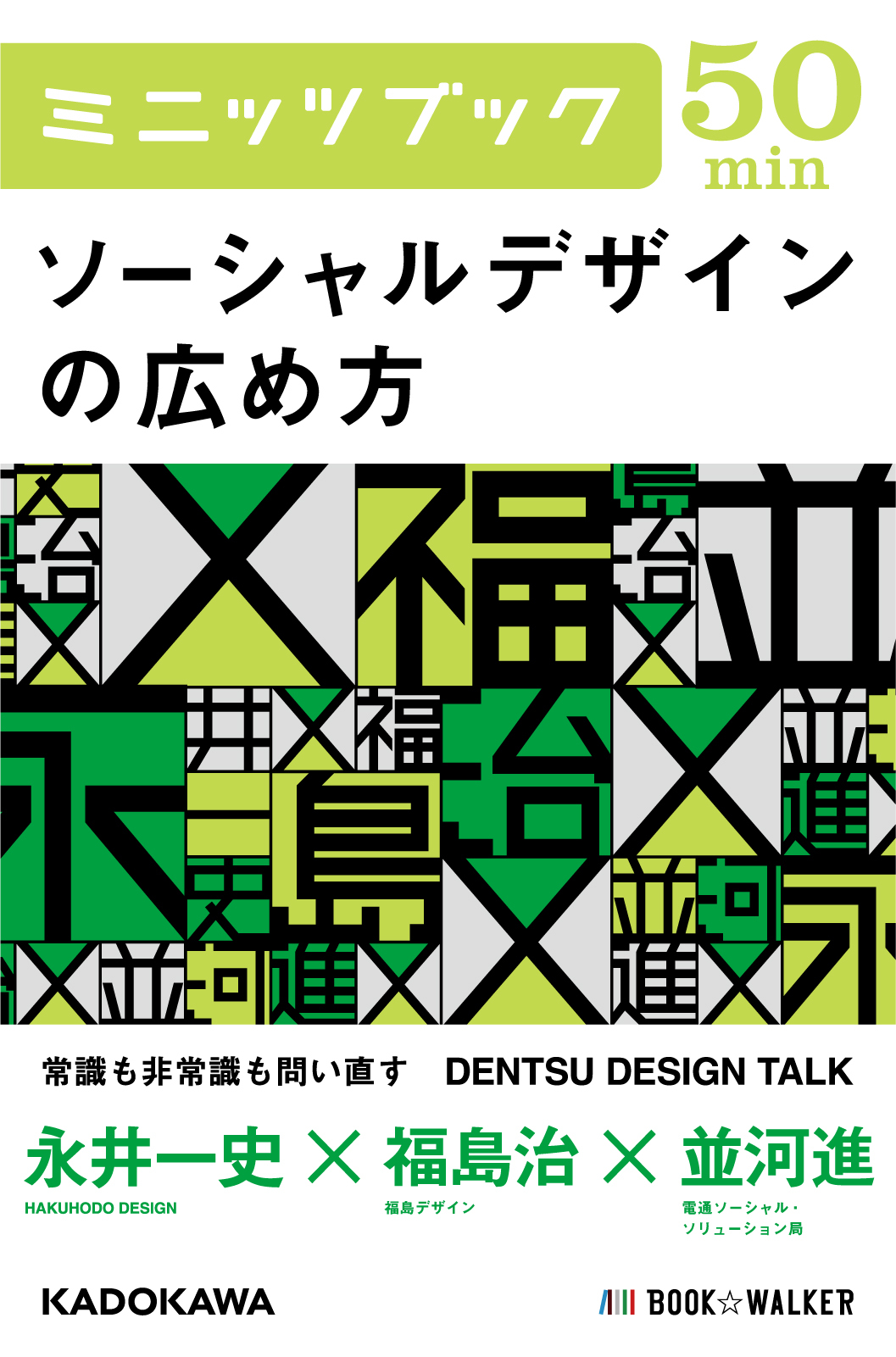
[**The third installment of the "DENTSU DESIGN TALK" series**](https://bookwalker.jp/series/13130/list/) has been released from Kadokawa Minutes Book, a compact e-book label operated by BookWalker Co., Ltd.\
The third installment is "How to Spread Social Design" by Kazufumi Nagai, founder of HAKUHODO DESIGN; Osamu Fukushima, founder of Fukushima Design after working at ADK; and Susumu Namikawa of Dentsu Inc. Social Design Engine. We will gradually introduce the talks of these three individuals, who explored their relationship with society and connected through UNICEF's "Prayer Tree Project."
## \
**Namikawa:** Next, I'd like to discuss "the relationship between improving society and advertising agencies." Previously, when I interviewed Mr. Nagai for a serialized feature on the 'Senden Kaigi' website, I was very impressed by how clearly he organized and explained how advertising agencies can relate to improving society—whether it's through reconstruction support or solving problems in developing countries.
The first is providing services that improve society alongside companies.
The second is finding something new and valuable that will be important for future society, and using our creative skills to help spread it, even if just a little. This would also include supporting the communication aspects of social activities.
The third is to take on a more business-like role in solving social problems through creative power.
He explained that these are the three main paths, and it really helped me organize my thoughts.
I thought, "I'd like to do #3," or "Mr. Nagai is probably #1," or "Mr. Fukushima is likely doing both #2 and #3." When people talk about "social contribution" or "doing it for society," it often feels vague, leading to rough discussions like "it's about the heart, not the money." This helped me organize those thoughts in my mind. Could you elaborate a bit more on these three classifications, Mr. Nagai?
**Nagai:** Regarding the first category, fundamentally, companies receive monetary compensation from customers. This means the customer perceives value worth paying for. If we consider society as a collection of individuals, then the existence of companies inherently serves society. I believe that's the basic principle. When we discuss social contribution, it often gets framed as companies being purely profit-driven and chasing money. But talking with people in business, I sense that individuals genuinely care. I think it's fundamentally unhelpful to separate those two aspects too sharply. Recently, whether it's CSV or the earlier CSR, the social perspective is absolutely embedded in how companies continue their operations within society. Europe and America have already shifted decisively in that direction. Moving forward, as businesses evolve to make social issues a source of profit, the traditional view of "social" equating to supporting NPOs will shift. Instead, we creative professionals will support and expand the businesses themselves. Broadly speaking, this expansion of a major pathway is the first key point.
The second point involves something I've personally assisted with several times: helping to spread ideas that previously existed but failed to gain traction due to poor communication. We do this by repurposing skills we've developed through our interactions with companies.
There's been talk of a "new public," and I believe it's crucial to embed important initiatives that government alone cannot fully support into society.
The third point isn't very concrete, but it involves activities like the "TAP PROJECT" or the "Prayer Tree" – initiatives that weren't requested by anyone, but started by volunteers coming together. They aren't business-scale projects, but rather expressions of our own creative approach: activities we undertake not because we were asked, but because we want to be the ones driving them. Until now, there was always a clear divide between company work and other activities, making things difficult. But that barrier is breaking down across society as a whole, and I feel our own proactive, unique activities will surely increase.
**Namikawa:** Especially the first point—it's less about traditional advertising and more about the idea that when a company and society come together, they create shared value. That process itself becomes communication. It's a stage that precedes simply promoting products or services, so if requests come in during the advertising phase, it becomes harder to propose such ideas. Mr. Nagai, do you think advertising agencies themselves will continue to take on advertising projects, but also shift toward co-creating services, businesses, and product development with companies—where that co-creation itself becomes the advertising?
**Nagai:** I think both scenarios exist. It's true that over the past decade, our involvement with clients has increasingly shifted upstream. Ad agencies are involved in product development everywhere, and they also bring expertise to business strategy. With companies constantly being told they need to transform themselves and pursue innovation, there's a growing demand for support in precisely those areas. I feel that when it comes to creating new value going forward, the primary focus will be on this perspective. In fact, we're already seeing this shift happening.
**Namikawa:** That's true. But I personally anticipated an even more profound shift. I sensed Japan might undergo a major transformation following the earthquake. While I've seen a gradual increase in cases where I enter corporate projects through consulting—whether for business development or CSR initiatives—and help drive corporate shifts, how do you perceive the pace and nature of this change, Nagai-san?
**Nagai:** I was just talking with some people from social venture capital firms recently, and we touched on the generational gap. The mindset of those in their 30s and younger today aligns with the values and perspectives we're discussing here. However, the generations above them—those in their 50s and 60s—still hold positions of power within organizations, so we haven't seen drastic changes yet. That's why I think things will likely shift dramatically once those generations step back.
**Namikawa:** So we're waiting for a generational shift?
**Nagai:** I think it will gradually shift, and then suddenly transform.
(To be continued)
E-books are available for purchase below
[](http://bookwalker.jp/de212cfd08-d463-47e0-867a-6a5aeed38f67/?adpcnt=7qM_9kfr)
## Back Numbers (バックナンバー)
- [E-book: How to Spread Social Design (1)](https://dentsu-ho.com/en/articles/884) — 2014-03-07T07:00:00+09:00 · [Creative (クリエイティブ)](https://dentsu-ho.com/en/theme/creative)
- [Naohiro Ukawa × Naoki Sato "Media Production Going Independent!!!"](https://dentsu-ho.com/en/articles/844) — 2014-02-28T09:35:25+09:00 · [Digital / Technology (DX) (デジタル / テクノロジー)](https://dentsu-ho.com/en/theme/dx)
## Author (著者)
### Kazufumi Nagai
HAKUHODO DESIGN / HAKUHODO DESIGN President and CEO / Art Director
Born in 1961. After graduating from Tama Art University in 1985, joined Hakuhodo Inc. In 2003, he established HAKUHODO DESIGN Inc. In 2007, he spearheaded the Hakuhodo+design project, which undertakes activities to support solving social issues through design. From 2008, he served as editor-in-chief of the magazine "Kōkoku" for three years. Recipient of numerous awards including the Mainichi Design Award, Creator of the Year, and the ADC Grand Prix.
### Fukushima Osamu
Fukushima Design / Graphic Designer
Born in 1958. Professor, Department of Design, Tokyo Polytechnic University. Graduated from the Graphic Design Course at Japan Design Institute. Worked at Katsumi Asaba Design Studio and ADK before establishing Fukushima Design in 1999. His activities span social design, design education, graphic design, advertising, and more. He supports the activities of the Artability Library for Artists with Disabilities, and engages in design and lecture activities centered on social communication. This includes planning and implementing projects like the UNICEF Prayer Tree Project and the JAGDA Gentle Handkerchief Project, as well as organizing exhibitions themed around social contribution. Recipient of numerous awards, including the Tokyo ADC Award, Cannes Lions International Festival of Creativity Gold and Bronze Lions, and the World Poster Triennale Toyama Grand Prix.
### Susumu Namikawa
Dentsu Japan / Chief AI Officer / Executive Creative Director / Chief AI Master
Specializes in AI-driven projects and social initiatives connecting businesses and society. Launched Dentsu Creative Intelligence in September 2022. Initiated joint research with the University of Tokyo AI Center. Serves as Unit Leader of the Augmented Creativity Unit. Author of numerous publications including "Social Design" (Kiraku-sha) and "Communication Shift" (Hatori Shoten). Recipient of multiple awards including the Yomiuri Advertising Grand Prize and the Dentsu Advertising Award.
- [Person page](https://dentsu-ho.com/en/person/30)
- Series: [Advertising Doujinshi Commu-Shifu: My Intellectual Adventures with the Stray Bag](https://dentsu-ho.com/en/booklets/6), [Mom's Potential Value](https://dentsu-ho.com/en/booklets/15), [Dentsu Design Talk](https://dentsu-ho.com/en/booklets/23), [Correspondence Regarding Communication Shift](https://dentsu-ho.com/en/booklets/58), [The Near Future of Advertising from the Device's Perspective](https://dentsu-ho.com/en/booklets/285), [The Case for People-Driven Marketing That Connects with Individuals](https://dentsu-ho.com/en/booklets/302), [The DX Engine Driven by Treasure Data and Dentsu Inc.](https://dentsu-ho.com/en/booklets/446), [Organization vs. Creativity](https://dentsu-ho.com/en/booklets/546), [To be supported, loved, and sell for the long haul. Fanbase CX Program](https://dentsu-ho.com/en/booklets/587), [Monthly CX](https://dentsu-ho.com/en/booklets/515), [Spotify Opens the Future of Audio Advertising](https://dentsu-ho.com/en/booklets/669), [Hitachi, Ltd. × Dentsu Inc. × Dentsu Digital Inc.: Tackling Social Issues with Generative AI!](https://dentsu-ho.com/en/booklets/696), [How We All Want to Approach Mental Health Together](https://dentsu-ho.com/en/booklets/667), [GO Future: Growth Officer, Speaking of the Future](https://dentsu-ho.com/en/booklets/699)
- Latest articles: [Dentsu Inc. Mental Health Lab's Challenge: Reaching Out to Non-Parties](https://dentsu-ho.com/en/articles/9617), [—GO Namikawa, how will AI change the future?](https://dentsu-ho.com/en/articles/9405)
Sharing: the HTML page offers share buttons for X, Facebook, LINE and Hatena Bookmark (not reproduced here).
## Related links
- [Home](https://dentsu-ho.com/en)
- [Site index (llms.txt)](https://dentsu-ho.com/llms.txt)