---
title: "In the AI era, the individual’s point of reference shifts from “society” to “the self.” Context-based touchpoint design that “penetrates” consumers"
description: "As the media landscape and advertising market undergo significant changes with the advent of generative AI, planners active on the front lines will explain the current situation and strategies for responding. In this installment, Takuma Hiromoto of Marketing Division 1 discusses “Changes in Individual Values and Points of Reference” in the AI era."
url: "https://dentsu-ho.com/en/articles/9922.md"
html_url: "https://dentsu-ho.com/en/articles/9922"
canonical: "https://dentsu-ho.com/en/articles/9922"
language: "en"
alternate_language_url: "https://dentsu-ho.com/articles/9922"
translation: "machine"
type: "article"
site: "Dentsu-ho (電通報)"
llms_txt: "https://dentsu-ho.com/llms.txt"
published: "2026-11-19T06:00:00+09:00"
---
# In the AI era, the individual’s point of reference shifts from “society” to “the self.” Context-based touchpoint design that “penetrates” consumers
> Navigation: [Site index (llms.txt)](https://dentsu-ho.com/llms.txt) · [Home](https://dentsu-ho.com/en) · Parent: [New Articles (新着記事)](https://dentsu-ho.com/en/latest_articles) · [Information Media White Paper \~ The Forefront of Planning 2026: “Connection Planning in the AI Era” \~](https://dentsu-ho.com/en/booklets/756)
Note: This website was automatically translated, so some terms or nuances may not be completely accurate.
Published: 2026-11-19T06:00:00+09:00 · Series: [Information Media White Paper \~ The Forefront of Planning 2026: “Connection Planning in the AI Era” \~](https://dentsu-ho.com/en/booklets/756) (Part 2 of 2)
## Themes and tags
- Themes: [Marketing (マーケティング)](https://dentsu-ho.com/en/theme/marketing), [Customer Experience (CX) (顧客体験)](https://dentsu-ho.com/en/theme/cx), [Digital / Technology (DX) (デジタル / テクノロジー)](https://dentsu-ho.com/en/theme/dx), [Media / Content (メディア / コンテンツ)](https://dentsu-ho.com/en/theme/media)
## Authors
- [Takuma Hiromoto](https://dentsu-ho.com/en/person/3784)(Dentsu Inc. / Marketing Division 1 / Planner)
## Adjacent articles
- Previous: [https://dentsu-ho.com/en/articles/9835](https://dentsu-ho.com/en/articles/9835)
## Body
In this series, as part of the “Frontiers of Planning” section of the “Information Media White Paper 2026,” we will explore the theme of “Connection Planning in the AI Era.”
As the media landscape and advertising market undergo significant changes with the advent of generative AI, leading planners on the front lines explain the current situation and strategies for responding.
In this installment, Takuma Hiromoto of Marketing Division 1 discusses “Changes in Individual Values and Reference Points” in the AI era.
[Information Media White Paper 2026](https://www.dentsu.co.jp/knowledge/infomedia/2026/index.html)
Connection Planning: The integrated design of various touchpoints between companies, brands, and consumers—encompassing not only traditional media and customer touchpoints but also the flow of information mediated by generative AI.
*Unless otherwise noted, the figures and data appearing in this series are based on the survey results from the “Information Media White Paper 2026.”
**\**\
[▼Among AI users, it was the “awareness of society as a reference point” that had faded](https://dentsu-ho.com/en/articles/9922#INDEX01)\
[▼An information explosion, yet people use only three media outlets per day. “Closed worlds” have become the norm](https://dentsu-ho.com/en/articles/9922#INDEX02)\
[▼Shifting evaluation criteria from “retinal impression” to “acceptance.”](https://dentsu-ho.com/en/articles/9922#INDEX03)[Context](https://dentsu-ho.com/en/articles/9922#INDEX04)[Determines a Commercial’s Penetration Power](https://dentsu-ho.com/en/articles/9922#INDEX03)\
[▼Context Is Not Something to “Decide,” but Something to “Interpret.” Design It Through Internal Observation and AI](https://dentsu-ho.com/en/articles/9922#INDEX04)\
[▼Summary: “Context” as a Means to Enter the Reality of Each Individual Consumer](https://dentsu-ho.com/en/articles/9922#INDEX05)
### What has faded among AI users is the “awareness of societal norms.”
Among those reading this, there may be some who feel that, compared to 20 or 30 years ago, the societal expectation of “how things should be” has been fading year by year, and that individual lifestyles have become increasingly diverse.
While this shift in the notion of “how things should be” has been driven in part by the internet and technology over the past 20 to 30 years, it may be accelerating even further due to the widespread adoption of generative AI.
As [Asada](https://dentsu-ho.com/articles/9835) described [in the first installment of this series](https://dentsu-ho.com/articles/9835), AI is acting as a “gatekeeper” for human perception and is transforming the entry points to all forms of information—including advertising. Digging deeper into this shift reveals the possibility that people’s values—which underlie these points of contact with information—are changing.
The following analysis, based on Dentsu Inc.’s ongoing consumer surveys, examines changes in over several hundred attitudinal items among groups that use AI and those that do not.
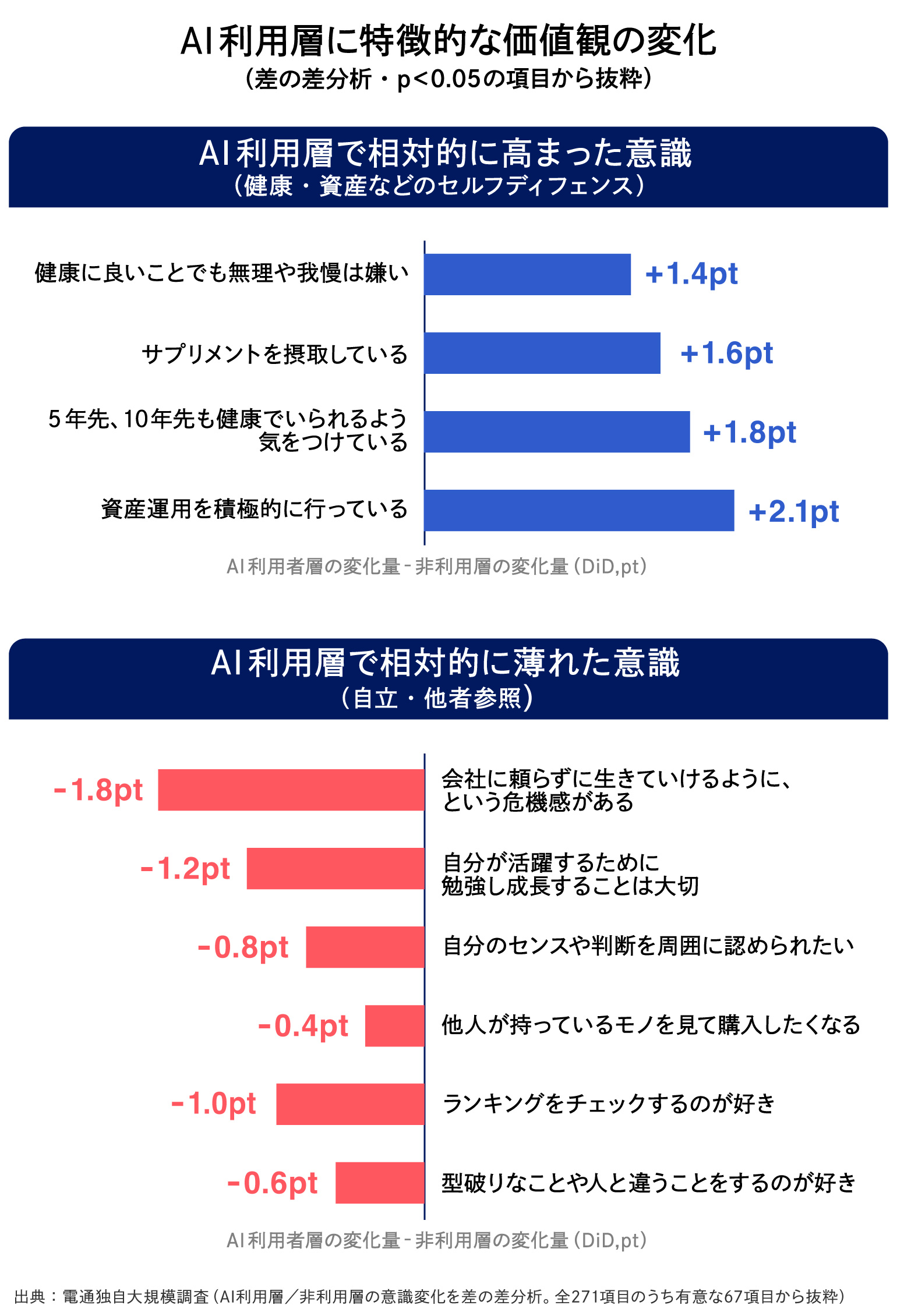
Figure 1: Changes in Values Characteristic of AI Users (excerpted from items with p < 0.05 in the Difference-in-Differences\* analysis)\
\*Difference-in-Differences (DiD) analysis: An analytical method that examines the “difference in the magnitude of change before and after” between a group where a change occurred and a group where it did not, thereby accounting for overall trends over time and isolating the specific impact of that change.
First, items that have seen a relative increase among AI users in recent years include “actively managing my assets” (+2.1 points) and “taking care to stay healthy five or ten years from now” (+1.8 points). These reflect a “self-defense” mindset focused on protecting one’s health and assets—in other words, safeguarding oneself.
In contrast, attitudes that have declined among AI users in recent years include those related to independence and personal growth, such as “I feel a sense of urgency to be able to live without relying on my company” (−1.8pt) and “It is important to study and grow in order to succeed” (−1.2pt).
Furthermore, items such as “I like doing unconventional things or things that are different from others” (−0.6 points) were also less pronounced compared to non-AI users. Additionally, “I want those around me to recognize my taste and judgment,” “I feel compelled to buy things when I see what others have,” and “I like checking rankings” all showed consistent declines.
When viewed together, a clear pattern emerges. What is fading are the norms of “how a fully-fledged adult should be” and the mindset of comparing oneself to others—in other words, values and behaviors that use “society” as a reference point.
What remains, instead, are one’s own health, assets, and personal values. Consumers are letting go of “society” as a reference point and, unconsciously, are building their own “castles”—spaces protected by their own perceptions of reality and values. That is how I interpret it.
Conversations with AI are, so to speak, conversations with one’s own reflection in a mirror. You ask questions based on your own interests, and you receive answers aligned with your own assumptions. In such interactions, moments of friction with society or situations that force major shifts in values are unlikely to arise.
However, this phenomenon is not caused by AI alone. Rather, my assessment is that it began about 30 years ago with the development of an environment—driven by internet-based technologies such as social media and recommendation systems—that allows people to “select and engage with only the information that suits them,” and generative AI has merely accelerated this trend.
### An Information Explosion, Yet We Use Only Three Media Outlets a Day: “Closed Worlds” Have Become the Norm
Why do people build their own little castles?
First and foremost, the information explosion is the underlying factor. Since it’s impossible to keep up with all information, social media and AI have become filters that help people sift through the information they want to see.
In addition, people have developed a tolerance for noise, allowing them to brush off unnecessary information as easily as breathing. Even my 6-year-old niece has mastered the art of swiping past ads unrelated to her interests amid the ceaseless stream of short videos.
Furthermore, as you are likely aware, social media and other digital media in particular have been proliferating rapidly. However, a surprising fact is that the number of media platforms used per person per day has not increased significantly.
According to a large-scale survey conducted by Dentsu Inc., when looking at the “number of media platforms used at least once a day”—including television, smartphone apps, and various VOD services—the composition has remained virtually unchanged from 2021 to 2025, with roughly half of the population continuing to spend their days using three or fewer media platforms at most.
Although the range of options has expanded, the number of choices people make has not changed. While it’s rare for someone to engage with 10 or more types of social media or media platforms in a single day, this does not mean that individual media consumption has become “broad but shallow”; rather, each person is narrowing down and optimizing their media choices.
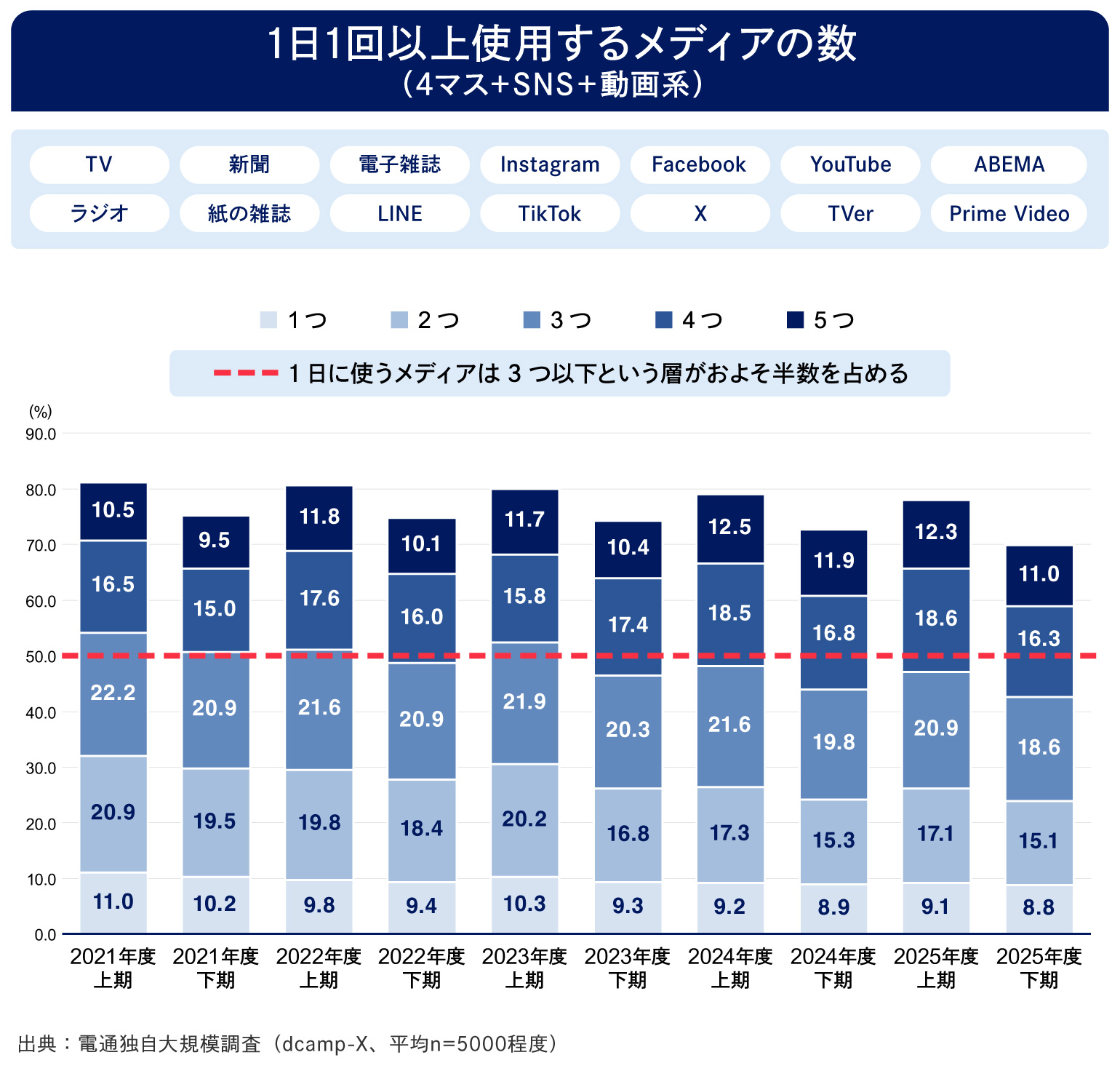
Figure 2: Number of media platforms used at least once a day (traditional media + social media + video platforms). Source: Dentsu Inc.’s large-scale proprietary survey (dcamp-X, average N ≈ 5,000)
Have you ever had the experience where a major news story or celebrity that was huge to you meant absolutely nothing to your family or friends? This, too, may stem from the current reality where each individual is optimizing their media consumption.
In other words, in the past, when the number of media outlets was limited and virtually everyone was, to a greater or lesser extent, connected to television, a “world and society based on a shared understanding” was guaranteed for everyone. Today, however, each person lives in their own “world and reality” built within a “fortress” constructed from their preferred media, resulting in completely different priorities regarding celebrities and information for each individual.
Just as different living organisms perceive the world in entirely different ways, one could say that the combination of media each person chooses defines their reality.
At first glance, this might sound somewhat pessimistic, but it could also be argued that this phenomenon has liberated people from the “ideal” I mentioned at the beginning. Precisely because individuals have created information environments optimized for themselves, they have cultivated their own uniqueness at the level of values, which in turn is fostering greater diversity in society.
Another important point is that this “castle” isn’t completely closed off—it has “windows.” As media has come to cater to specific audiences to some extent, we’re now seeing phenomena where new horizontal connections form through the communities, cultures, and contexts tied to those platforms.
For example, during the transition from Twitter to X, accounts that normally might argue with one another became conscious of their identities as “Twitter users” and shared memories from the platform’s early days. Similarly, during international sporting events, people who don’t usually watch such competitions take an interest, cheer for Japan, and a flood of new subscribers rushes into streaming services.
What sparked this series of movements was not the preordained reality within each individual, but rather the horizontal connections—the realization that “Come to think of it, I was part of this community”—and the immediacy of “Everyone is watching and talking about this.”
This can be interpreted as a phenomenon in which dormant identities—such as “me as a Twitter user,” which they had unconsciously cultivated through their media exposure, and “me as a Japanese person,” which had been pre-installed since childhood—were activated through channels distinct from their usual media consumption.
People typically switch between multiple “selves”—such as “the me who works at Company X,” “the me within my family,” “the me who supports X,” or “the me who is viewing specific media or accounts”—depending on the situation, each with entirely different values and behavioral patterns.
Although these multiple “selves” lie dormant in everyday life, unnoticed, when a news event occurs, opening that window can release the closed-off world to the outside, allowing people to form solidarity with others or generate significant social movements.
I believe that the model for understanding today’s latest information environment is this: even an individual’s media ecosystem—which at first glance appears closed—can exhibit open-system behavior to any degree when stimulated.
### Shifting the Evaluation Criteria from “Retina” to “Reception”: Context Determines a Commercial’s Penetration Power
So, how should connection planning be approached in this environment?
First, I believe we need to set the return point—the benchmark for evaluating advertising planning—beyond the simple question of “whether the information reached the customer.”
In 1917, Marcel Duchamp, who submitted a urinal titled \*Fountain\* to an art exhibition, criticized paintings that were merely pleasing to the eye as “retinal paintings.” How does this apply to advertising planning?
Isn’t evaluation that stops at impressions, GRPs, and reach still “retinal planning” that asks only, “Was it seen?” For consumers who have developed resilience to noise and are protected within the fortress of their values, we need to shift to “reception-based planning” that asks not “Was it seen?” but “Did it penetrate?”
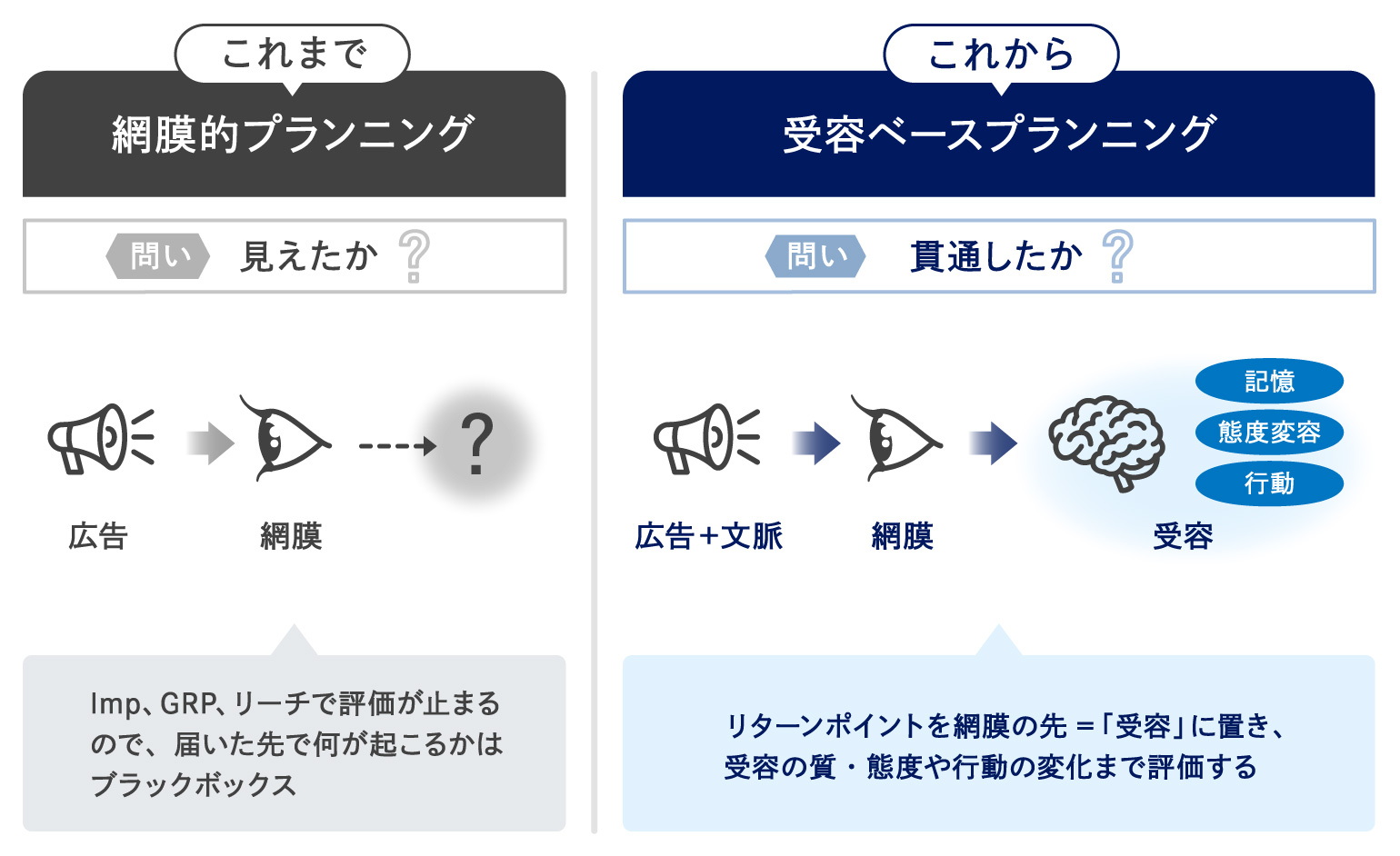
Figure 3: From Retinal Planning to Reception-Based Planning
Traditionally, variables such as timing and the “moment” have been the main factors incorporated into design to influence “acceptance,” but I believe context is also one of them.
It has long been noted that the effectiveness of commercials varies depending on the program in which they are inserted, and there have been attempts to quantify this. When a program shapes the viewer’s mood, commercials with a similar atmosphere are more readily accepted, and their ability to “penetrate” is believed to increase.
Based on this perspective, Dentsu Inc. has developed and is operating a tool that uses AI to score the contextual affinity between all currently airing programs and advertisers’ content or brands, thereby selecting appropriate program slots (\*).
* Dentsu Inc. Launches “D-IMPRESS,” an AI-Powered TV Time Advertising Management Support System
For example, an analysis conducted for a certain drama series evaluated all currently airing programs based on criteria such as “empathy toward human dramas” and “level of interest in society and human relationships.” This analysis suggested that program categories previously given low priority actually possessed “potential affinity with products and brands” in unexpected ways.
In addition to quantitative metrics such as viewership ratings and target audience penetration rates, research is currently underway to enhance “penetration”—the impact beyond mere exposure—by selecting time slots based on qualitative contextual analysis.
### Context is not something to be “decided,” but rather something to be “interpreted.” Designing it through internal observation and AI
Furthermore, beyond simply delivering ads, how context is created plays a crucial role in whether recipients discuss the content in their daily lives or post about it on social media.
Traditional planning followed a top-down approach, where companies and advertising agencies decided on a concept and delivered messages unidirectionally. However, messages delivered unilaterally from “outside” a closed world are easily rejected. What is needed is to observe and interpret from within the “ways of speaking” that are already woven throughout social media and communities.
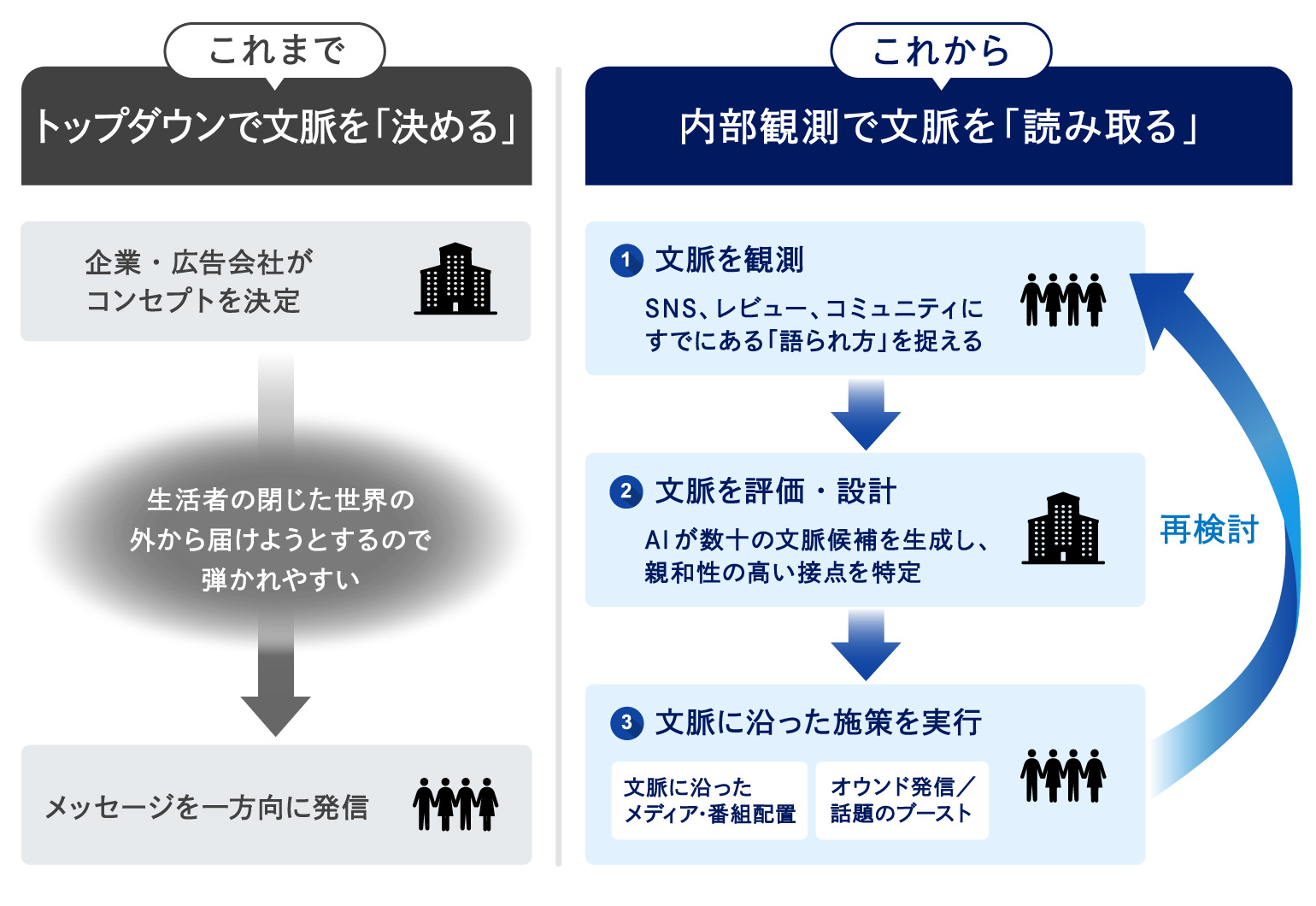
Figure 4: Rather than determining context through a top-down approach, we internally observe the context that exists in the world and use AI to explore and design it
Specifically, Dentsu Inc. has already begun implementing this approach: analyzing vast amounts of text data from reviews and social media to determine the specific contexts in which particular content or brands are discussed; then using generative AI to draft content for official corporate accounts that aligns with that ecosystem; and finally, carrying out promotional campaigns.
In a collaboration with a consumer goods manufacturer, Dentsu derived contexts and temporal patterns likely to generate buzz on social media from actual conversation data. They then had AI predict which scenes to extract from program tie-in videos and post to stimulate conversation, successfully achieving engagement levels that exceeded past trends. While human planners tend to rely on specific angles, AI’s value lies in its ability to explore possibilities comprehensively.
In this way, context can be used not only for media and program placement to enhance the reach of pure advertising but also for posts from official corporate accounts and to boost topics that are already beginning to gain traction. Rather than companies “deciding” the context, they should “align” with the context that exists in the world. We believe this is a practical way to enter the realm of consumers who are accustomed to mirror-image dialogue.
Needless to say, the characteristics of each media platform must also be taken into account. Is it appropriate to place a message from a company seeking to project a sense of reliability on a feed where short videos stream one after another? Wouldn’t a format designed for full-viewing be better received? Compatibility with context should be designed in tandem with the context that the media platform already possesses.
### Summary: “Context” as a Means of Entering the Reality of Each Individual
It can be said that consumers in the AI era are moving away from society as a point of reference and are building “castles” that reflect the world as each individual envisions it.
If we simply deliver information to them in a one-way manner, it will be bounced back by the castle walls. We need to aim for the windows of the castle—or, after discerning what is happening inside—to deliver our advertisements.
That is precisely why we must extend the design of advertising effectiveness metrics to include “whether or not the message was accepted.” In addition to the conventional “moment-based” approach, we need to overlay the unique context inherent in programs and media onto consumers and their communities. The key here is not for companies to dictate the context, but to interpret it from the narratives already present in society. AI can be seen as a tool that enables this interpretation and comprehensive exploration.
As part of the “design for selection” concept raised by Asada in the first installment of this series—in order to enter the reality as perceived by each individual consumer—we must first unravel the contexts woven throughout existing social media platforms and communities. The author believes that the scope of connection planning should be expanded to encompass this very aspect.
## Back Numbers (バックナンバー)
- [From “Reaching” to “Being Chosen”: What Is Media Strategy in the AI Era?](https://dentsu-ho.com/en/articles/9835) — 2026-08-28T06:00:00+09:00 · [Marketing (マーケティング)](https://dentsu-ho.com/en/theme/marketing)
## Author (著者)
### Takuma Hiromoto
Dentsu Inc. / Marketing Division 1 / Planner
She earned a Master of Science degree in biophysics from graduate school and, while a student, gained experience in qualitative research—including ethnography—at a consumer research firm. Since joining the company, she has provided end-to-end support—from marketing strategy development to media planning—for a wide range of clients across industries such as beverages, food, apparel, real estate, finance, IT, and entertainment. She is also a member of the company’s cross-functional AI unit, “MK AI Bridge.”
- [Person page](https://dentsu-ho.com/en/person/3784)
- Series: [Information Media White Paper \~ The Forefront of Planning 2026: “Connection Planning in the AI Era” \~](https://dentsu-ho.com/en/booklets/756)
- Latest articles: [In the AI era, the individual’s point of reference shifts from “society” to “the self.” Context-based touchpoint design that “penetrates” consumers](https://dentsu-ho.com/en/articles/9922)
Sharing: the HTML page offers share buttons for X, Facebook, LINE and Hatena Bookmark (not reproduced here).
## Related links
- [Home](https://dentsu-ho.com/en)
- [Site index (llms.txt)](https://dentsu-ho.com/llms.txt)