
Note: This website was automatically translated, so some terms or nuances may not be completely accurate.
 The Potential of AR (Augmented Reality) for the Social Implementation of the Metaverse [1/2]
Nothing beats a moving proposal. AR × Hackathon for solving challenges

Ushio Yū
Pretia Technologies, Inc.

Daiki Oshida
DENDOH Inc. / withAR Hackathon Executive Committee

Yuto Shiota

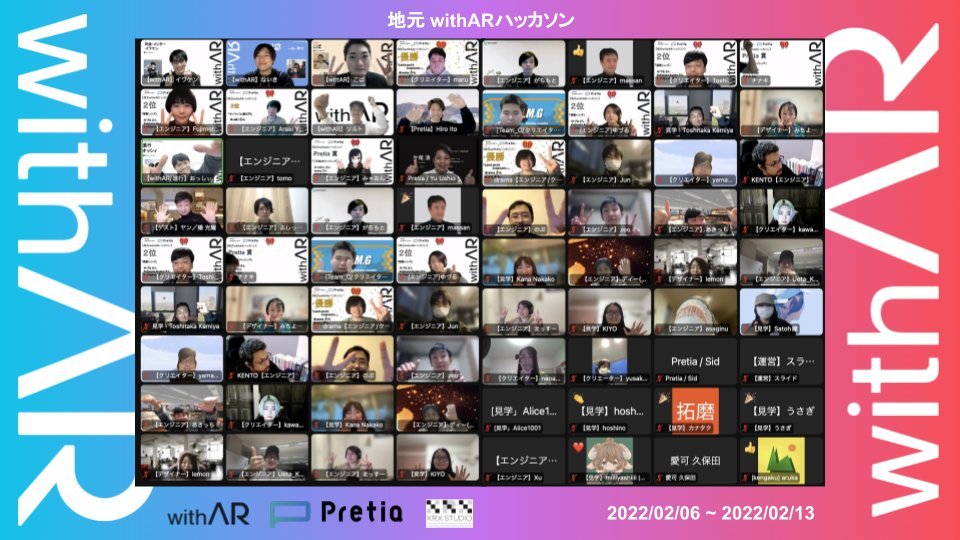
In early February 2022, withAR and Pretia Technologies (hereafter Pretia) held the " Local withAR Hackathon," an event challenging collaborations between AR and diverse industries.
This event facilitated collaborations across diverse fields, including architects, local government officials, and creative company CEOs, with Dentsu Inc. employees also participating as planners. Focusing on the theme of " tourism," a total of 17 AR solution prototypes were completed in just one week.
This series explores the potential of AR × hackathons, featuring introductions to the works born from the hackathon. The first guests are Mr. Yu Ushio, CEO of Pretia Technologies Inc., and Mr. Daiki Oshida of the withAR Hackathon Executive Committee. Dentsu Inc.'s Yuto Shiota asked them about the background of hosting the AR hackathon and new discoveries made through the event.
In the AR world, everything—advertising and entertainment—becomes an experience.
Shiota: I'm Yuto Shiota from the Business Co-creation Division. I'm also part of the Dentsu Group's cross-organizational unit "XRX STUDIO," where I lead development of metaverse projects utilizing AR/VR. For the "Local withAR Hackathon" we recently held, XRX STUDIO participated as a special sponsor, enabling collaboration that transcended corporate and industry boundaries.
Recently, partly due to the impact of the pandemic, the "metaverse" has garnered significant attention in the business sphere. Within this, AR is positioned as one of the key technologies forming virtual spaces. First, I'd like to ask Mr. Ushio from Pretia Technologies Inc. how we should organize and understand the metaverse and AR.
Ushio: We are a startup developing "Pretia," an AR cloud platform designed to enable anyone worldwide to easily access high-quality AR experiences. While our AR R&D originally focused on areas unrelated to the metaverse, we've seen increasing attention in the metaverse context in recent years.
Regarding the metaverse, I feel it's discussed primarily from three perspectives. First is the "metaverse as experience." This approach emphasizes games and communication within metaverse spaces, valuing the "experiences" and "content" found there.
Next is the " metaverse as a medium." This perspective views the metaverse as a medium, such as using VR goggles and other devices to express 3DCG experiences in the real world.
The third is the " metaverse as a business model." This is discussed in relation to terms like crypto worlds, cryptocurrencies, and NFTs within the so-called Web3 space, encompassing a worldview that includes distributing tokens and decentralized decision-making.
Finally, I perceive another perspective, a somewhat deceptive take on the metaverse: "The Metaverse as Reach." Essentially, this is the idea that simply calling something the metaverse will generate buzz and increase engagement. However, the metaverse is ultimately just one method of expression; whether reach increases really depends on the project itself.
I believe the essential value of the metaverse and AR extends beyond mere reach; it lies in driving behavioral change in the real world through digital experiences. Therefore, it's crucial to thoroughly explore "What purpose does it serve?" and "What makes it interesting?" I think the infrastructure of the metaverse will be realized once we accumulate examples of solving these problems and creating cutting-edge content.
Shioda: Thank you. I appreciate you clarifying the value of the metaverse and AR from a business perspective. On the other hand, Mr. Oshida from the withAR Hackathon Executive Committee, who is actually developing at the forefront of the AR field, how do you perceive the metaverse?
Oshida: Elements constituting the metaverse include VR, AR, and more recently Web3 and NFTs. Within this, we operate a community of engineers specializing in AR technology. What's interesting is that engineers and creators don't refer to the experiences they build as the metaverse, and users rarely use the term either. We feel "metaverse" is primarily a word used in a business context.
Within that, what we value most is the stance of "How can we enhance the value of reality? " While the metaverse often draws attention to virtual spaces, we fundamentally love reality and hold the philosophy that "reality is sacred." That's precisely why we continuously challenge ourselves to solve real-world problems with AR technology and further expand the appeal of reality.
Shioda: Thank you. I understand Pretia is also developing with AR technology. Following what Mr. Oshida said, could you share again what you prioritize in AR development?
Ushio:I believe the crucial point is not pursuing marketing goals, but aiming to solve problems. For example, if people walking around town while experiencing an AR game end up eating or drinking at local shops, it revitalizes the local economy. Or, if AR try-ons let people understand the sizing and fit of clothes online, it makes the online shopping experience more convenient and enriching, ultimately leading to business growth. It's important to build a stack of solutions to real problems.
Shioda: When viewed from the perspective of problem-solving, what unique strengths does AR offer?
Ushio: Comparing it to VR makes it clearer. VR is fully immersive, characterized by high expressive freedom within a virtual space—essentially a 100% output-driven world. AR, on the other hand, is a worldview where you input real-world information—like facial features, body shape, or even text and images—and then overlay 3DCG output.
Traditionally, obtaining output required inputting search terms or data. By reducing this input effort through spatial recognition-based auto-detection and data extraction, we can create increasingly convenient and novel experiences. For instance, in virtual try-ons, instead of manually inputting height or bust measurements, the camera could detect sizes. Or, simply walking through a city could trigger recommendations for information matching your interests—experiences that could be woven into entertainment itself.
Shioda: I see. From another perspective, it seems like the line between advertising and entertainment could become increasingly blurred.
Ushio:In the AR world, even advertising has the potential to become an experience. People enjoy the experience while naturally changing their behavior. Refining the UI/UX for this purpose is key.
"Execute fast" – Nothing beats a plan that moves.
Shioda: Next, I'd like to reflect on the "Local with AR Hackathon." Could you first tell us about the characteristics of the with AR Hackathon?
Oshida: A hackathon is a development method where engineers and creators gather to build prototypes of products or services in a short period. Our hackathon specializes in AR, and one key feature is collaboration between engineers and professionals from diverse fields—like doctors, architects, and tourism stakeholders. We also invite experts on the theme each time to provide input on real-world values and challenges.
The reason is that withAR aims to expand AR into various industries by solving real-world problems. For the same reason, we offer an open observer slot—unusual for hackathons—allowing interested individuals to participate casually. Finally, when determining rankings, we adopt a voting system where everyone—field professionals, engineers, and observers—gets one equal vote each.
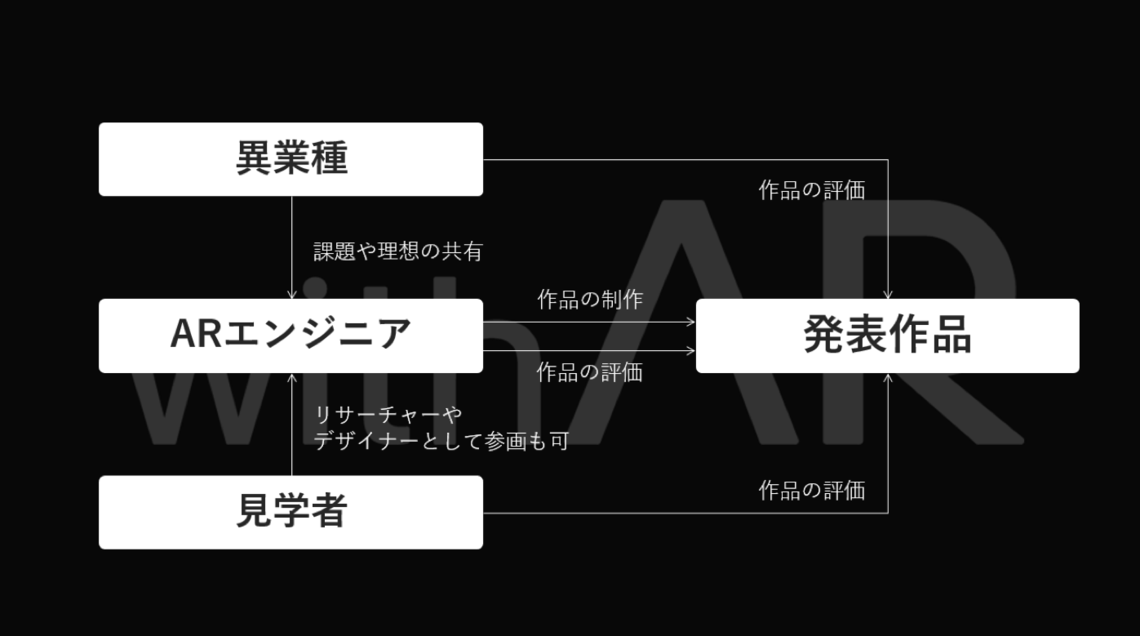
Shioda: Hackathons often invite engineers or leading professionals in the field to judge, so the one-vote-per-person system is a very unusual design. Precisely because winning isn't guaranteed by technical excellence alone, I felt this truly embodies a problem-solving hackathon. Also, this "Local withAR Hackathon" utilized the AR cloud platform "Pretia," which was still pre-launch at the time. How do you view the collaboration between your company's product and the withAR Hackathon, Mr. Ushio?
Ushio: Our company champions the value of "Execute fast = Swift execution is everything." In the AR field too, we believe it's crucial to just dive in and actually build things. By having people experience what we create, we understand customer needs and see what's possible and what isn't. We've worked on various projects with clients before, and we truly feel that " no proposal can beat something that actually works." In that sense, the withAR Hackathon perfectly embodies "Execute fast," and we thought Pretia, which makes developing AR experiences easy, was a great fit.
Oshida: Given the local theme this time, a major challenge was how to develop online while forming teams with participants scattered across the country. Using Pretia's Unity SDK feature made it relatively easy to place and share AR content on a map based on location information.
Shioda: Honestly, we initially thought AR, being a technology tied to reality, wouldn't mesh well with an online event. But when we opened the door, we saw 17 new experiences emerge and encountered many wonderful products that expanded the appeal of local areas.
Ushio: Precisely because the theme was the niche topic of "local," we hoped it would foster non-template solutions. We were delighted to see unique applications that pleasantly defied our expectations. Adding the "local" variable broadens the scope of problem-solving. Ideas emerge within contexts only locals understand, making us feel the potential for new solutions to continuously emerge.
New experiences emerge from a community that transcends the boundaries between clients and engineers
Shioda: Could you share what you learned or the insights you gained through this event?
Ushio: I realized that for new technologies to spread widely, the most crucial element is the community. Of course, the technology itself must be highly accurate and stable as a fundamental prerequisite. But the existence of a community where people can enjoy creating things using that technology, share their work with each other, and exchange opinions becomes the driving force for spreading the technology. This event reaffirmed that "nothing is more important than people."
Oshida: It was impressive to see such a passionate community emerge, with people from different industries outside engineering actively gathering designs and materials and engaging in communication.
Ushio: Observing trends in the VR space, I also feel the influence of VR game developer communities and indie game communities on the market is strong. Even if a technology doesn't initially seem widely applicable, within the community, new actions emerge one after another through mutual communication. Eventually, something crosses the threshold and spreads to the masses.
Honestly, many companies exploring AR applications often start from a place of uncertainty—"We don't know what's possible" or "We can't even define the requirements." That's precisely why I believe joining a community first—interacting with engineers, experimenting together, and deepening understanding—creates the potential to build something far beyond initial expectations. The same applies to the metaverse.
Shioda: Thank you. Hearing from both of you today reaffirmed my understanding of AR's potential to drive behavioral change in the real world, and its worldview where advertising and entertainment all become experiences. AR remains an area without definitive solutions, and precisely because no proposal can surpass something you can move and experience, joining the community to create and experience extensively alongside engineers is crucial.
Thank you for reading this article.
If you're interested in utilizing the metaverse or AR, please feel free to contact us.
【Contact Information】
Dentsu Inc. XRX STUDIO xrxstudio@dentsu.co.jp

Was this article helpful?
Share this article


Newsletter registration is here
We select and publish important news every day
For inquiries about this article
Author
Ushio Yū
Pretia Technologies, Inc.
Daiki Oshida
DENDOH Inc. / withAR Hackathon Executive Committee