
Note: This website was automatically translated, so some terms or nuances may not be completely accurate.
 Must-Read for PR Professionals! The PR Capabilities of 479 Listed Companies [1/15]
The "Eight Public Relations Capabilities" reveal your strengths and weaknesses.

Koichi Kitami
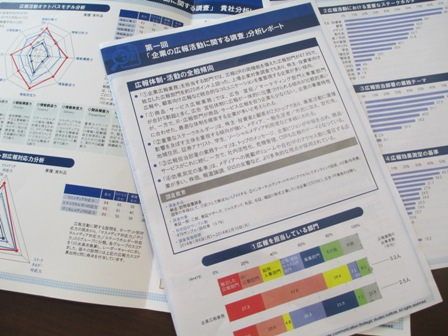
In corporate management, the PR and communications department plays a central role in societal communication activities. However, until now, no survey data existed that comprehensively assessed and analyzed the PR capabilities of Japanese listed companies. What insights emerge when we quantify the PR capabilities of Japanese companies? What challenges do PR and communications departments face?
To address this, the Corporate Public Relations Strategy Institute (within Dentsu Inc. Public Relations) was established. From January to February this year, we conducted the "First Survey on Corporate Public Relations Activities" targeting Japanese listed companies, receiving responses from 479 firms.
Over the next 15 installments, we will explain the current state and challenges of Japanese corporate PR activities identified by this survey. Part 1 covers the survey methodology and general overview.
■ "Eight Public Relations Capabilities" – Balanced Like an Octopus's Legs
Companies responded by marking activities they currently perform from a list of 80 PR-related questions.
Our institute then analyzed these responses, categorizing them into eight areas: "Information Gathering Capability," "Information Analysis Capability," "Strategy Development Capability," "Information Creation Capability," "Information Dissemination Capability," "Relationship Building Capability," "Crisis Management Capability," and "Public Relations Organizational Capability."
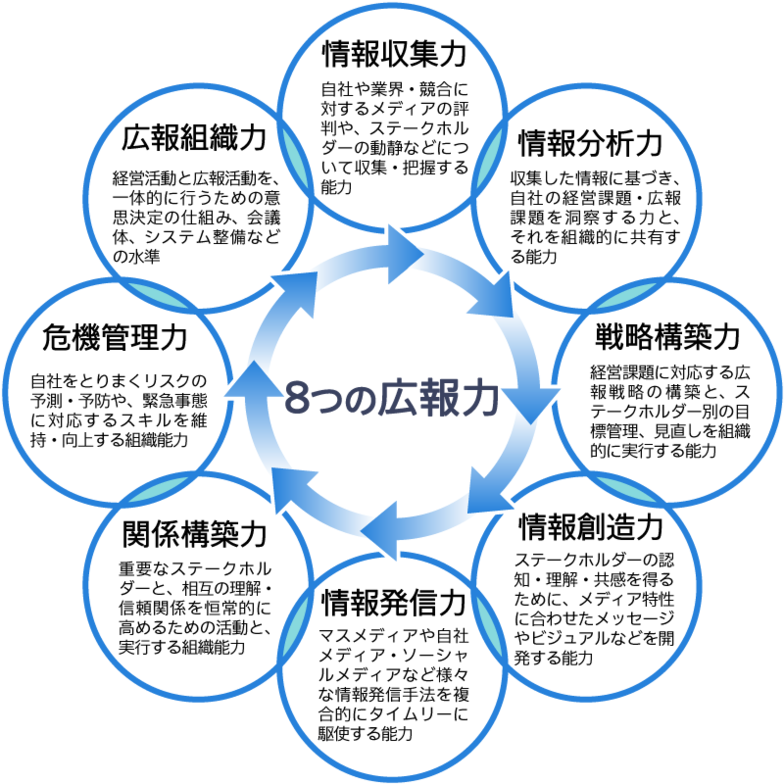
These "Eight Public Relations Capabilities" became the metrics for our institute's proprietary "Public Relations Octopus Model Analysis." Just like an octopus's arms, possessing all eight capabilities in a balanced manner enables the demonstration of high public relations strength.
We provide companies that participated in the survey with their evaluation scores analyzed using this "Public Relations Octopus Model." By comparing their company's score against the overall average and industry-specific averages, they can assess their own public relations activity level.
■ This is where listed companies fall short
Now, let's examine the analysis scores in Figure 1, the "Public Relations Octopus Model."
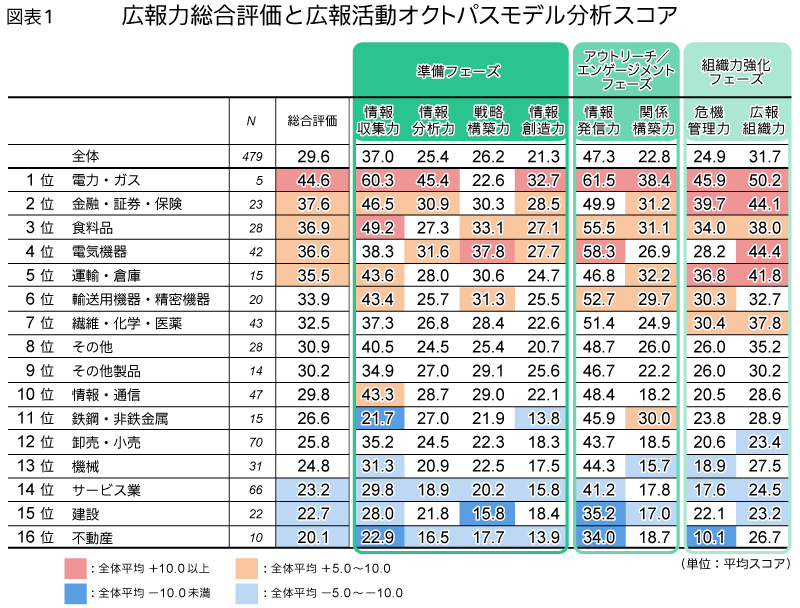
Looking at each of the "8 Public Relations Capabilities," we see that overall, listed companies score highest in Information Dissemination (47.3 points). This indicates that companies are focusing their efforts on information dissemination activities.
Conversely, the scores for the preceding stages—information gathering, information analysis, strategy development, and information creation—are notably low. This represents a key weakness in listed companies' PR capabilities that requires improvement.
In this era of information overload, simply passing on information from business units without thought won't get the message across to stakeholders. Companies must collect and analyze internal and external information, strategically construct messages and PR narratives, and then communicate effectively.
Additionally, scores for relationship-building capabilities (22.8 points) and crisis management capabilities (24.9 points) are also low.
The key challenge here is recognizing that the function of the PR department extends beyond merely disseminating information. The PR department is expected to build positive relationships with stakeholders, which is the essence of public relations. Furthermore, during crises, it is also required to serve as the command center fulfilling the duty of accountability to society.
■ Top 3 PR Capabilities...
Next, let's examine the industry-specific rankings. The industry with the highest overall score is "Electricity & Gas" (44.6 points), followed by "Finance, Securities & Insurance" (37.6 points) and "Food Products" (36.9 points). These top three industries demonstrate higher scores in "Information Gathering Capability" and "Crisis Management Capability" compared to other sectors, in addition to their strong "Information Dissemination Capability."
These industries frequently face risks with significant societal impact, such as incidents, accidents, or scandals. Establishing an appropriate PR framework is essential, making the PR department—the point of contact with society—a lifeline for the company. This is precisely why their PR capabilities tend to be consistently strong across the board, not just focused on "information dissemination."
As the saying goes, "PR is two-way communication." For PR, it's not just about one-way information dissemination; gathering information both inside and outside the company is also a crucial task.
Survey Overview:
Surveyed 3,503 domestic listed companies on the Tokyo Stock Exchange (First Section, Second Section), Mothers, JASDAQ, Sapporo Securities Exchange, Fukuoka Securities Exchange, etc., using mail and in-person drop-off methods. Responses received from 479 companies (response rate: 13.7%). Survey period: January 6 to February 10, 2014.

About the Corporate Communication Strategic Studies Institute
The Corporate Communication Strategic Studies Institute (CSI) is a research organization within Dentsu Inc. Public Relations. It collaborates with experts in corporate management and public relations (including university professors and researchers) to conduct surveys, analysis, and research on corporate communication strategies and systems.
Was this article helpful?
Share this article


Newsletter registration is here
We select and publish important news every day
For inquiries about this article
Author