Note: This website was automatically translated, so some terms or nuances may not be completely accurate.
 Art × Business Fantasy Night [2/6]
What is the Future of Art × Capitalism? (Shinobu Tsubaki × Kaori Iwasaki)
From December 7, 2020, a five-night webinar series titled "Nights of Imagining the Future Created by Art and Business" was held, hosted by Dentsu Art Hub, an internal Dentsu Inc. lab dedicated to "connecting art and business to envision a prosperous future." Each session featured dialogues and trialogues among powerhouses deeply involved in art and business from their respective standpoints, all conducted under "three keywords." The themes for these "fantasy talks," set in advance by the participants themselves, were enough to spark the imagination of the audience.
This series will delve into the essence of art, the essence of business, and the grand theme of the future created by the "multiplication" of art and business, as revealed through the webinars, from the editorial team's unique perspective.
In this first installment, we delve into the relationship between art and capitalism, drawing from the dialogue between Professor Noboru Tsubaki of Kyoto University of the Arts (also Director of the University Gallery) and Kaori Iwasaki, CEO of THE ART.
Responsible Editor: Web Dentsu Inc. News Editorial Department
"In my view, the art business is akin to agriculture" (Shō Tsubaki)
When hearing the theme "Art × Capitalism," most people probably imagine things like "the rich indulging in hobbies," "unscrupulous galleries selling works at exorbitant prices," or "Van Gogh masterpieces fetching hundreds of billions of yen at auction." In short, an image of something "shady." I must admit, I was one of those people. To be precise, I was one of those people.
Are you familiar with the profession of installer? In the art world, it refers to "professionals who visualize and materialize an artist's concept." At the start of the webinar, as a form of self-introduction, Mr. Tsubaki mentioned he participates in numerous art fairs in this role. "You could say it's like being a chef entrusted with everything from the amount of salt sprinkled to the final seasoning and plating." Right from the start, a rather mysterious story began.
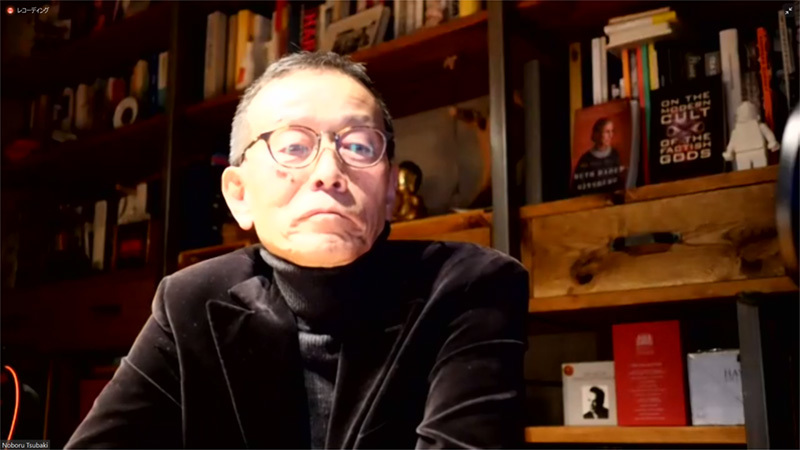
While carefully choosing words to avoid spoiling the "three keywords" introduced later, I found myself strangely convinced whenever work or romance was likened to "food" or "cooking." Am I alone in this? Following the chef analogy, Tsubaki then proposed "art business = agriculture." She wants more people to recognize the deliciousness (value) of crops (artworks) cultivated with such care. As this narrative unfolded, my editor's instincts kicked in—I wasn't about to be fooled so easily.
"Financial capitalism is no longer an absolute truth." (Kaori Iwasaki)
Ms. Iwasaki's subsequent remarks also shook me to the core. "As a banker, I hesitate to say this, but I believe the very notion that money determines all value in this world is no longer tenable in this era." Hearing such a declaration from Ms. Iwasaki, standing at the forefront of the financial industry, left me utterly dumbfounded.
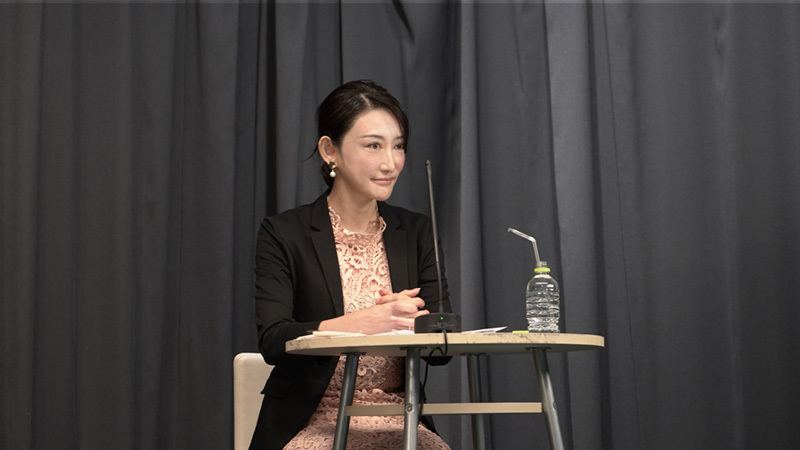
Once again, my thoughts turn to the theme of "Art × Capitalism" – specifically, to the wavering of capitalism, once perceived as an "absolute truth." The "sense of stagnation" exposed by the pandemic isn't just about economics or mental health. It's the crushing reality that everyone feels, this distrust that the capitalist social system itself has reached an impasse. If art is what rescues us from this reality, then there's nothing more fascinating or welcome.
Tonight's Keyword (Part 1): "Let's Buy"
"My own perspective on art shifted dramatically the moment art transformed from something 'to be seen' into something 'to be bought.' The catalyst was a single encounter." As soon as the first keyword was introduced, Mr. Iwasaki began his story. The encounter he refers to is not just about the artwork itself, but about meeting the artist. "The more I learned about the artist, the more I could see the background behind the work and the emotions poured into it. I wanted to know more and more about that artist. Before I knew it, I had become an art collector and an art lover. That's how it felt."
Tsubaki's comment is also intriguing. He says "I was (completely) sold by Tsubaki" is a hot buzzword lately. Why do people around Tsubaki "end up being sold by him"? Tsubaki believes it comes down to trust. That's his assessment. For instance, you can communicate directly with the artist through the internet. What sustains that direct relationship is nothing but trust. Buying art requires, above all, a direct relationship of trust, and from that arises an "experiential value" that transcends mere "exchange value."
"You know, I don't talk to people who don't buy my work," Tsubaki says jokingly. Yet, there's a clear common thread in both of their "Let's buy" approaches: "Nothing starts, nothing is understood, until you actually buy." If that's the case, then many people are prejudiced against art without even trying it. This leads us to the next keyword.
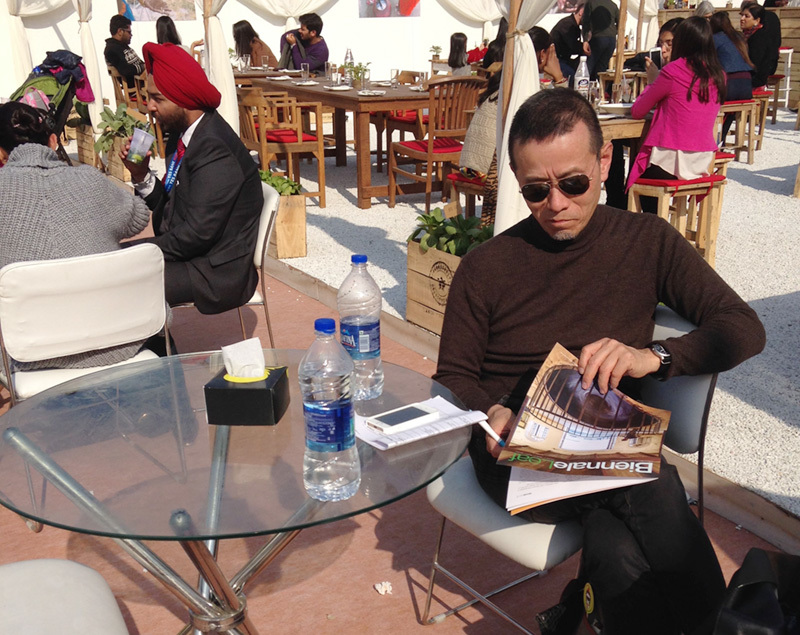
1989: "Against Nature" exhibition, U.S. tour. 1993: Venice Biennale, Aperto. 2001: Yokohama Triennale, "Insect World - Locusts." 2003 Mito Art Museum "United Nations Children's Exhibition". 2009 The National Museum of Modern Art, Kyoto "Tsubaki Noboru 2004-2009: GOLD/WHITE/BLACK". 2012 Kirishima Art Forest "Tsubaki Noboru Exhibition 'PREHISTORIC_PH'". 2019 "Palergon: Japanese Art of the 1980s and 90s" BLUM & POE LA USA. Director of the Setouchi International Art Festival 2013, 2016 (Shodoshima), Director of the Aomori Triennale 2017. Director of ARTISTS' FAIR KYOTO, among many others.
Tonight's Keyword (Part 2): After "Let's buy," comes "Let's eat."
According to Mr. Tsubaki, engaging with art on a daily basis is akin to the act of consuming food. "Food isn't something you buy just one item of and then it's over. You have to keep eating it day after day. Once you put it in your mouth, you have to keep eating it until you die. Right?" Mr. Tsubaki continues his explanation. "As you keep eating and eating, you start to understand what tastes good and what doesn't. Art is the same. You experience it, savor it, and gradually incorporate it into yourself. For me, the feeling of 'eating' art fits better than the idea of 'buying' it."
After a pause, Mr. Iwasaki shared his thoughts. "I'm not sure if you can call it a food connection, but for me, 'sharing' with someone is also a way to savor art, or rather, one way to enjoy it. That feeling when you say, 'Try a little taste. See? It's delicious, right?' Wouldn't it make you happy if more people said, 'Oh, you're right'?"
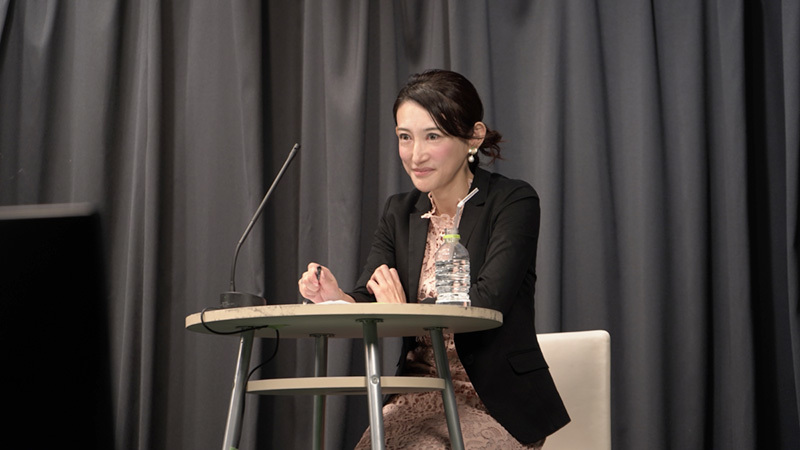
Born in Ehime Prefecture. Art collector (collection history: approx. 4 years, number of pieces owned: 120). Studied management of manufacturing in a graduate master's program. Raised by parents who enjoyed art appreciation and travel, viewing art domestically and internationally became a habit from childhood. After entering the workforce, she began attending overseas art fairs. After purchasing Kohei Nawa's PixCell work at Art Basel, she discovered the appeal of art collecting and became an art collector. Through connections with global art professionals, she strongly felt the gap with overseas markets and Japan's significant potential for greater art market vitality. She is dedicated to revitalizing Japan's art market. In 2018, she launched an in-house art club with fellow employees (currently around 90 members). In 2019, he launched "Art Branch" at SMBC Trust Bank's Nihonbashi Branch, the first initiative in Japan's financial sector to showcase Japanese contemporary artworks in one location, planning and operating projects to invigorate the art market. He currently serves as Representative Director of THE ART Inc.
Tonight's Keyword (Part 3) And, "Let's Communicate"
"That sharing topic... we've already covered it in the final topic we prepared beforehand, haven't we?" With this remark from Mr. Tsubaki, the conversation turned to the third keyword: "Let's share."
"Mr. Iwasaki mentioned he considers himself an art lover. If we could see more 'art girls' emerge, like how there are 'sweets girls,' nothing would make me happier." Iwasaki agreed, saying that the indescribable warmth and happiness felt when seeing or eating sweets is precisely the charm of art. Just like sweets, you can't help but want to share that charm with someone on social media. If that impulse is the potential (hidden power) of art, its economic impact is immeasurable. From here, the conversation rapidly moves toward its climax.
"The value of such art is further refined by time. And not just any time. Periods of 500 or 1000 years elevate an artwork's worth. Conversely, if something loses its value over time, it wasn't genuine art to begin with." Mr. Iwasaki's response to Mr. Tsubaki struck me as particularly vivid. He stated that "time" is the most terrifying, or perhaps cruelest, entity for capitalism.
Art, however, does not fear "time." Take ukiyo-e prints: originally, they were nothing more than everyday "industrial products" made to earn money. When considering the essence of art, the existence of this "magic" that elevates such everyday objects into something special seems crucial. Yet, even Tsubaki and Iwasaki cannot fathom the true nature of this "magic." Just as most of the universe's mysteries remain unsolved, even with humanity's most advanced science.
We tend to think of "deferred administration" or "deferred diplomacy" as inherently bad. Yet when things are deferred over spans of 500 or 1000 years, people can only raise the white flag and say, "We surrender." The ability to find romance in that might be one of humanity's great wisdoms.
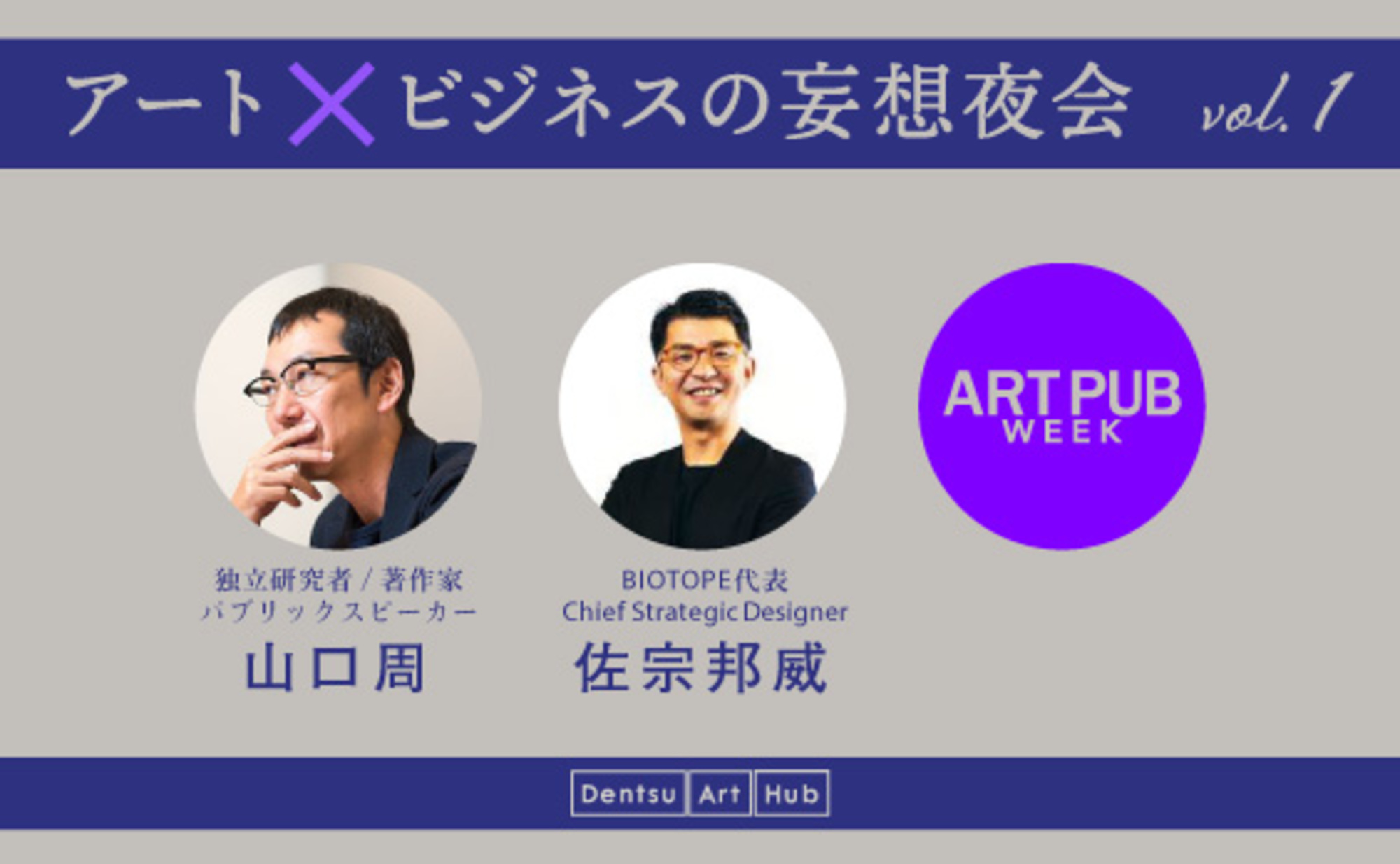
This series is an adaptation of the webinar titled "A Night of Imagining the Future Created by Art and Business," edited from Web Dentsu Inc. Denpo's unique perspective under the supervision of Kentaro Kasama (President, Arts & Brands Inc.), organizer and representative of Dentsu Art Hub.
Event Confirmed! Online Talk Event
"A Night of Imagining the Future Created by Art and Business: ART PUB NIGHT #1"
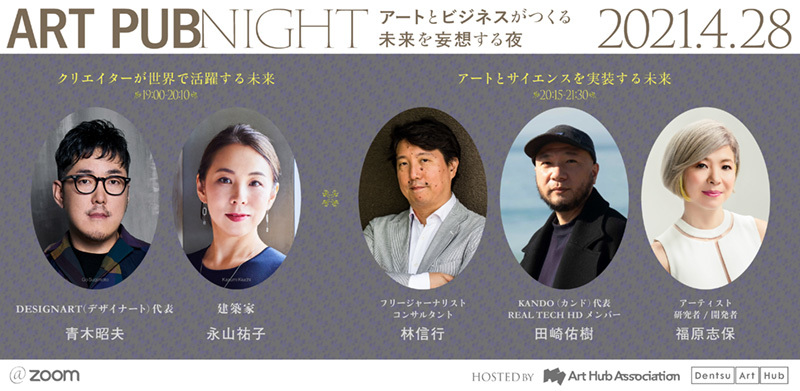
Date & Time: Wednesday, April 28, 2021, 7:00 PM - 9:30 PM
(Zoom webinar opens 10 minutes prior)
Participation Fee: Free
Format: Zoom Webinar
Registration: Limited to the first 500 registrants per session.
Register here. (The secretariat will send you the viewing URL)
Application Deadline: Wednesday, April 28
Was this article helpful?
Share this article


Newsletter registration is here
We select and publish important news every day
For inquiries about this article
Back Numbers
Author
Kentaro Kasama
Arts & Brands Co., Ltd.
President and CEO