
Note: This website was automatically translated, so some terms or nuances may not be completely accurate.
How to incorporate "environmentally friendly materials," key to advancing SDGs? Considering the new material "PLANEO™" as an example.
For companies, the importance of SDG compliance is increasing daily. Among these, environmental considerations and decarbonization efforts are critical topics, demanded across all sectors and job types. At the same time, many are likely wondering, "How should we respond?" or "Where should we start?" For those facing such questions, we introduce "environmentally responsive materials," a key to advancing SDGs.
Environmental responsiveness is becoming an essential business imperative
Alongside the spread of the SDGs, environmental awareness is rising globally. Environmental pollution and climate change caused by rising temperatures pose significant risks that could ultimately threaten our ability to live safely.
Furthermore, for companies, ESG investing is rapidly growing as the "new standard for investment." ESG investing involves investing in companies that manage their operations with consideration for the environment (Environment), society (Social), and corporate governance (Governance). In other words, the fact of "whether a company is advancing its SDGs and environmental initiatives" is increasingly becoming a factor that influences a company's value enhancement and very survival.
Many will recall the recent major news from COP26 (the 26th Conference of the Parties to the United Nations Framework Convention on Climate Change), held in Glasgow, UK, from October 31 to November 13, 2021. At COP26, nations were urged to adopt more ambitious measures to achieve the goal agreed upon in the 2015 Paris Agreement: "pursuing efforts to limit the global average temperature increase to 1.5°C above pre-industrial levels." While evaluations and discussions surrounding this content vary, one thing is certain: moving forward, no business can afford to ignore the element of "environmental responsiveness." In response to these societal shifts, here are some accessible ways to get started.
Switching current products to "environmentally conscious materials" is the first step in advancing the SDGs.
Among environmental initiatives, "reducing or eliminating plastic" is a crucial effort. For example, restaurants and fast-food chains eliminating plastic straws in favor of paper straws, or charging for plastic shopping bags to encourage the use of eco-bags, can reduce the consumption of petroleum-based plastic products. In this way, numerous "petroleum-based plastic products" are actually used within corporate activities. Many companies likely use petroleum-based plastic products for packaging and wrapping materials. Consequently, products touting "environmental responsiveness" have increased recently, achieved through simpler packaging or material changes.
Another surprisingly overlooked area is "within the company." For example, companies with employee cafeterias: what about the tableware and trays used there? Many companies may promote "environmental friendliness" for products sold to customers while taking no action internally.
That said, completely eliminating plastic may be nearly impossible in modern society. This is where "PLA (Poly-Lactic Acid)"—a plant-based plastic material—is gaining attention. PLA emits less CO2 when incinerated compared to petroleum-based plastics and possesses biodegradability (controlled soil biodegradability) under specific conditions. As an environmentally conscious material, it is gaining global attention and increasing adoption. Indeed, many companies are expressing a growing need to "adopt environmentally conscious materials like PLA." Responding to this demand, Dentsu Tech Inc. developed "PLANEO™."
An evolved "environmentally friendly material" can meet diverse needs
We hear from various companies expressing a desire to adopt environmentally friendly materials. While PLA has garnered significant attention as a solution to these needs, it also presented challenges in production and use. Among these, the most significant issue was its "low fluidity." Fluidity refers to a material's "ease of flow." Low fluidity means it takes longer to pour into molds, reducing production efficiency and resulting in lower daily output compared to conventional petroleum-based plastics. It also makes it difficult for the material to reach intricate mold details, leading to manufacturing defects and ultimately higher product costs.
Developed to address these challenges unique to PLA, "PLANEO™" significantly improves material flowability. It achieves higher production efficiency than conventional PLA while retaining PLA's environmental benefits: being 100% plant-based and biodegradable under specific conditions.
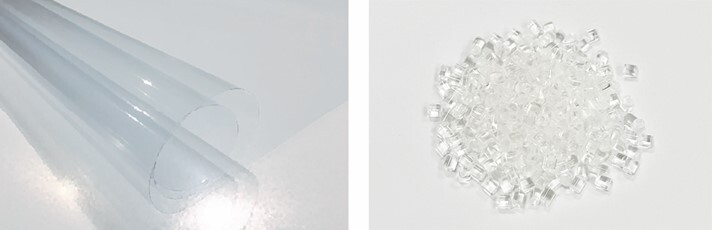
Utilizing "PLANEO™" enables the replacement of various items with environmentally conscious materials. It can even meet pinpoint needs, such as "I want to make a mascot character piggy bank from eco-friendly material." This paves the way for easily taking the first step toward "reducing plastic starting with the items right in front of us."
We recommend starting with eco-friendly promotional items. The very act of handing them to customers becomes your message.
Of course, it's challenging for companies to suddenly switch all plastic products used in their operations to eco-friendly alternatives, and many may not be ready to implement comprehensive measures all at once. That's why we recommend starting with the increasingly popular approach of "making the promotional items and premium goods given to customers from eco-friendly materials."
For example, consider giving tumblers as souvenirs to customers attending an event. If the tumblers you present with care aren't made from eco-friendly materials, the thoughtful novelty could instead leave a negative impression. Isn't it precisely this kind of attention to detail that truly conveys a message to your customers?

On the other hand, some companies may have made choices contrary to environmental responsibility, switching to "disposable" types due to hygiene concerns arising from the COVID-19 pandemic. In such cases, utilizing "PLANEO™" allows for addressing both hygiene and environmental concerns by making disposable items from eco-friendly materials.
While we introduced "PLANEO™" as an example of an eco-friendly material this time, materials are evolving in diverse ways beyond this specific example. Look around you—are there any items you use casually that could be replaced with eco-friendly materials? Reviewing such everyday items could send a positive message to customers and ultimately lead to the significant outcome of enhancing corporate value.
Society as a whole is beginning to take "environmental responsiveness" seriously, and it is becoming a crucial factor influencing corporate value. While various countermeasures exist, this article explored the importance of "starting with small, familiar steps." The things right in front of you, items used routinely at work, items given to customers. Looking at these with fresh eyes might reveal many "immediate actions" waiting to be taken. Why not start by asking yourself, "Could this be replaced with an environmentally friendly material?" as you go about your daily life?
The information published at this time is as follows.
Was this article helpful?
Share this article


