
Note: This website was automatically translated, so some terms or nuances may not be completely accurate.
What is "PLG" Practiced by Emerging SaaS Companies? Considering New Growth Strategies from a Product-Led Sales Model
Against the backdrop of the COVID-19 pandemic, cloud-based services like online meeting platforms and business chat tools—collectively known as "SaaS"—have seen explosive growth. One key reason these services gained so many users is their adoption of a sales approach called "PLG." This strategy involves first offering trial versions or feature-limited editions to get users started quickly, thereby rapidly expanding the user base. It's gaining attention as a novel sales model. This time, we explore the theme: "Can the PLG approach that contributed to the proliferation of emerging SaaS serve as a hint for future user acquisition strategies?" We'll unpack the characteristics of PLG while considering the effectiveness of this strategy across various businesses.
Getting the Product to Users Quickly: The New Strategy of PLG
In recent years, a new customer acquisition method called "PLG (Product-Led Growth)" has been gaining attention. This sales model is based on the concept that "the product sells itself." Its defining feature is embedding sales and promotional elements directly within the product itself, rather than relying on traditional methods like salespeople to sell the product. Typically, this involves first having users try a service with limited features or a free trial version. Users who experience the benefits of adoption are then guided towards a paid version offering more advanced features.
PLG, which involves minimal direct customer contact, is also seen as a promising sales strategy for the post-pandemic era and is particularly prevalent in business-oriented subscription services. It is especially well-suited for SaaS (Software as a Service), which delivers cloud-based software over the internet. Compared to installing packaged software, SaaS enables quick and easy online deployment. This simplicity aligns well with PLG strategies that encourage users to try the product casually and discover its value. "Emerging SaaS" services, exemplified by online meeting platforms that rose during the pandemic, have skillfully leveraged PLG to expand their global market presence. For more on SaaS, see this article.
PLG represents a strategy contrasting with the traditional sales-driven growth (SLG) model, where sales teams sell the product. SLG involves sales representatives visiting customers to convey the value of goods or services, expanding sales channels—a method particularly valued and effective in B2B contexts.
However, SLG often targets corporate "decision-makers," who may differ from the actual end-users. It's not uncommon for end-users to first encounter the product only after the contract is signed, making it easier for a mismatch in user experience to occur.
In contrast, PLG, which directly approaches end users, places emphasis on "delivering the product to end users as quickly as possible and having them experience its value as soon as possible." This characteristic enables it to encourage their voluntary purchase. From the user's perspective, being able to try the product before considering purchase is undoubtedly appealing. For manufacturers, it reduces the gap users feel after purchase, helping prevent early cancellations. It also reduces the manpower and costs allocated to sales. Furthermore, it enables gathering feedback on the user experience directly from actual users and incorporating it into product development.
PLG and SLG: Choosing Based on Product Characteristics and Conditions

So far, we've introduced PLG as a rapidly growing business model due to its high affinity with SaaS. Next, this chapter will explore what types of products are well-suited for PLG by comparing it with SLG, while presenting PLG case studies.
Online meeting services, which saw explosive user growth during the pandemic, are often cited as a prime example of PLG strategy success. This US-originated service prioritized exceptional product development above all else, driven by a large team of engineers. By minimizing login and connection hassles and releasing a free version with the most efficient meeting time settings, users spread globally in no time. In business settings, upgrades to the paid version, which offers unlimited time, are also progressing.
Another distinctive feature of this service was how its value spread organically through its users. For instance, employees at companies using the service would share meeting links whenever they held online meetings with clients or partners. This created opportunities for participants from other companies to experience the product firsthand. Consequently, the value of the product was naturally communicated to these other businesses.
From the above, it becomes clear that in PLG strategy, it is crucial to focus on: "developing an easy-to-use and compelling product," "enhancing the free version to acquire users," and "creating a mechanism where the product's value naturally spreads from person to person."
On the other hand, SLG is a method that involves multiple processes—marketing (email newsletters, ad delivery, SNS, etc.) → inside sales (phone calls, sales emails) → sales (negotiations) → post-contract customer support—to gradually build customer relationships and increase purchase intent. The advantage lies in the ability to communicate closely with customers, enabling flexible proposals tailored to individual needs. This is particularly useful for highly specialized products, complex tools, or offerings where users haven't fully grasped the value, as it allows for guidance on usage and education.
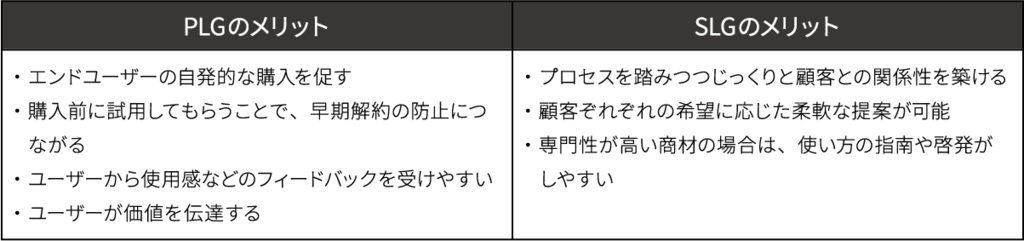
Thus, PLG is a "strategy where the product communicates its own value," while SLG is a "strategy where sales communicates the product's value." Neither is inherently correct or superior; the key is selecting the appropriate method based on your product's characteristics and your company's situation.
Now, considering the earlier examples, let's outline cases where PLG is suitable.
・Products requiring user-to-user communication
Products where communication between users is a prerequisite—such as tools for collaborative work or services requiring introductions or invitations for onboarding—can easily leverage the strengths of a PLG strategy. For example, services facilitating smooth communication between individuals or companies, like file sharing or schedule coordination, are also well-suited for PLG as they readily generate network effects among users.
・Products with low barriers to entry
In PLG, it's crucial to get users to try the product and experience its value. Therefore, it's advisable to set low barriers to entry, such as simplifying login procedures. Additionally, services with clear purposes that are easy and casual to use are generally considered more suitable for PLG.
Conversely, products that don't fit these criteria—such as medical devices handled by professionals or products requiring detailed support for use—are better suited to traditional SLG sales models rather than PLG.
User-driven PLG leads to the product's "eternal evolution"

Building on the PLG characteristics discussed above, we will now explore how PLG can be leveraged beyond the SaaS domain.
A relevant reference point is the concept of the "perpetual beta," which gained attention in the 2000s. This approach involves releasing a service while openly acknowledging its "unfinished" state, then refining the system based on feedback from general users who trial it. The advantage lies in the fact that being unfinished allows for "constant evolution." Additionally, it was groundbreaking because releasing early as a beta version, without spending excessive time on development, enabled the acquisition of numerous enthusiastic users. As a result, it could also provide an advantage in the development race against competitors where speed is crucial.
In PLG too, this concept of the "eternal beta" is likely key. First, acquire users by getting them to try it. As the service is refined, what started as an individual's tool gets shared within teams, eventually permeating the entire company and driving adoption of paid versions. Creating such a flow is ideal.
This approach—updating the product itself while many users adopt it and thereby increasing new customers—shares similarities with how the two-dimensional barcode, developed in 1994, spread. From its initial announcement, the barcode's specifications were openly accessible for anyone to use freely, leading to its adoption not only in Japan but worldwide. It evolved diversely by incorporating user needs and new application ideas, giving rise to ultra-compact versions printable in small spaces and versions incorporating read-restriction functions for privacy considerations. Today, it is indispensable in both business and daily life.
While using the 2D barcode itself is free, the company that developed it generates profits through sales of "2D barcode reading devices" and other means. This serves as a prime example demonstrating the benefits of not restricting users and providing products quickly.
The process of acquiring service users, then updating to a better form and permeating it throughout the entire market, may be applicable to various businesses. Beyond SaaS, why not consider it as one method for acquiring customers for your own products and services?
PLG, which gained significant attention with the rise of SaaS, is a new sales model that empowers the product itself to drive adoption. This approach is expected to grow increasingly important. It's advisable to first understand which types of products are best suited for this model and to strategically leverage it alongside SLG. We encourage you to consider it as a new strategic move when planning your company's growth.
The information published at this time is as follows.
Was this article helpful?
Share this article


