
Note: This website was automatically translated, so some terms or nuances may not be completely accurate.
Are Search and SNS Treasure Troves? Key Points for Enhancing Corporate Value Revealed Through Alternative Data Analysis
Have you heard the term "alternative data"? While the use of big data through AI and machine learning is advancing across diverse fields, the financial industry is no exception. Investors and financial institutions, particularly overseas, are increasingly using big data for investment decisions. This new type of data is collectively referred to as "alternative data."
In June 2022, Japan hosted the "Alternative Data Marketing EXPO," an event where experts from various fields discussed DX (Digital Transformation) initiatives using alternative data within companies and organizations. This reflects the growing attention alternative data is receiving both domestically and internationally.
This article focuses on the present and future of alternative data.Under the theme " Can alternative data, such as search data and social media posts, become a key tool for measuring corporate value? ", we explore the potential of data utilization. If you want to learn tips for leveraging big data or wish to utilize data analysis for branding, please refer to this article.
What is "Alternative Data," the economic indicator of the new era?
As the collection and analysis of big data through machine learning and natural language processing advances, various types of data have become relatively easy to obtain recently.Beyond the sales and financial data held by individual companies, the value of all kinds of data—from weather information and social media posts to satellite imagery—is now recognized. It's being used for understanding current situations, market forecasting, and trend analysis. For example, as mentioned in a previous article, weather information is already incorporated into business and advertising strategies as "weather merchandising."
On the other hand, economic statistics and corporate financial information, long primarily utilized in the financial sector, are traditionally termed "traditional data" due to their longstanding use. "Alternative data" is the name used to distinguish this from "traditional data," referring to the big data that has become newly available in recent years. The ability to leverage various types of data that were previously rarely used for analysis, such as investment decisions, has drawn intense attention from financial institutions and investors.Its use is advancing among central banks worldwide and has also become widespread outside the financial industry, such as in market research.
A key reason for the focus on alternative data is its superior "timeliness" compared to traditional data. For understanding social trends, social media posts are effective; for more granular targeting, POS data and credit card usage information are valuable. Furthermore, in rapidly changing situations like the COVID-19 pandemic, real-time information has become increasingly critical.
Traditional data, however, lacks this immediacy. Even widely used GDP figures are released only quarterly, with data published a full month and a half after the end of each quarter. Furthermore, questions have been raised about the comprehensiveness and accuracy of some consumer statistics, citing issues like sample bias during collection and insufficient coverage of emerging business models like e-commerce sites.
Search and social media information are increasingly being widely utilized as alternative data.
Let's now examine alternative data in greater detail, highlighting its differences from traditional data.
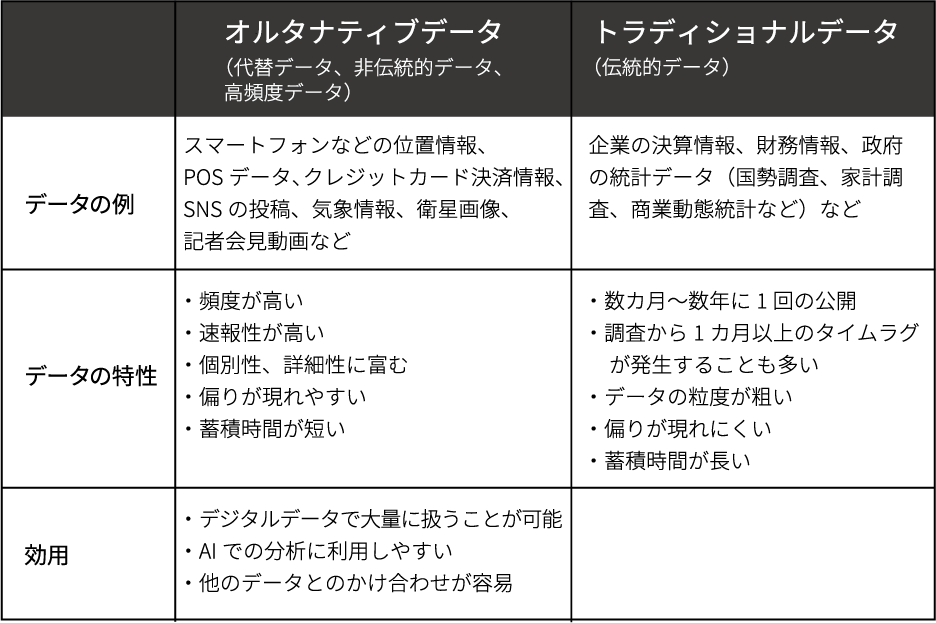
Alternative data excels in timeliness and often provides granular information at the individual level, whereas traditional data is released only every few months to years and tends to offer broader granularity, such as by prefecture or month.However, while alternative data's shorter accumulation period makes it prone to bias, traditional data benefits from long-term accumulation, making it less susceptible to bias.
The most familiar examples of alternative data include search data and social media posts. Search terms and social media posts are crucial sources for obtaining highly real-time trend information. Frequently appearing keywords reveal what the general consumer population is interested in. Skillfully utilizing alternative data can increase the granularity, or resolution, of the information.
Leveraging these strengths, the Bank of Japan incorporates alternative data into its GDP forecasting model. By integrating Google Trends, which tracks consumer demand trends via search volume, and retail sales indicators using POS data, it monitors short-term economic fluctuations.
Unlike POS data from physical stores, search data and social media posts are not limited to specific business types or sectors, offering the significant advantage of providing cross-sectional data. They capture broad consumption trends, including online spending on e-commerce sites and service consumption at venues like movie theaters and amusement parks, making them suitable as guidelines for corporate evaluation.
What Alternative Data Brings to Corporate Activities and Enhancing Corporate Value

Building on the preceding discussion, let's now consider how alternative data will impact corporate economic activities and enhance corporate value going forward.
First, alternative data, which is already transforming economic analysis, particularly in the financial sector, will likely create business opportunities for entities holding big data. Here are two examples:
Case 1: Shinjuku Senior Population Survey by Securities Firm and Mobile Carrier
In 2020, a securities firm collaborated with a mobile carrier to analyze location data from users' mobile devices, revealing a clear decline in visitors aged 60 and above to the Shinjuku area. Applying this data to macroeconomic analysis suggested that seniors were limiting outings due to concerns about COVID-19 risk. Such data helps grasp overall economic activity trends and can be used to predict subsequent consumer behavior.
Case 2: Automobile Manufacturer Monitors Factory Operations
One automobile manufacturer is attempting to optimize production by monitoring factory operations using satellite data and analyzing worker activity based on their mobile phone location data. Analyzing production activities from this acquired data enables not only operational efficiency improvements but also business forecasting.
These examples demonstrate effective use of alternative data to analyze shifts in consumer behavior and corporate production activities. As this illustrates, the analysis of various data sets—previously conducted for marketing purposes like sales forecasting—holds potential to scale up into new initiatives linked to broader economic analysis.
Furthermore, if alternative data becomes widely adopted as a guideline for understanding market trends, the nature and volume of topics and concerns surrounding a company will significantly impact its corporate value itself. In particular, online word-of-mouth from general consumers and mentions on social media are expected to become crucial indicators for gauging current corporate value. Additionally, businesses may need to be mindful not only of how they are perceived by stakeholders like consumers but also of how they appear to research institutions.
How much attention do you typically pay to search trends and social media mentions related to your company?In the coming era, for companies to sustainably enhance their value, it will be crucial not only to focus on growing their own business but also to adopt an objective stance, viewing themselves from a third-party perspective to understand how society evaluates them. Actively utilizing alternative data from viewpoints like "How much is our company searched for compared to competitors?" or "What kind of social media posts are being made about us?" may reveal hints for business development direction and brand value enhancement.
Alternative data emerged as a term to describe information beyond traditional data, which has been widely used in the financial sector. We've seen that search terms and social media posts, in particular, offer high frequency and immediacy, representing granular alternative data at the individual level. Skillfully leveraging alternative data to understand third-party evaluations and the company's current position can contribute to enhancing corporate value. In the near future, this approach may become commonplace.
The information published at this time is as follows.
Was this article helpful?
Share this article


