
Note: This website was automatically translated, so some terms or nuances may not be completely accurate.
 Between lies and reality, people live. [1/1]
What exactly is an optical illusion?
Atsuyoshi Sugihara
Meiji University
Technological evolution is profoundly transforming our society. Concepts like "virtual currency" and "virtual space" are now undeniably real. As this happens, the boundary between lies and reality becomes increasingly blurred. This series explores where we, compelled to live in the hazama between lies and reality, are headed and where we should be going. We seek insights from specialists across various fields. In this first installment, we spoke with Professor Atsuyoshi Sugihara of Meiji University on the theme of "optical illusions."
(Web Dentsu Inc. Editorial Department)
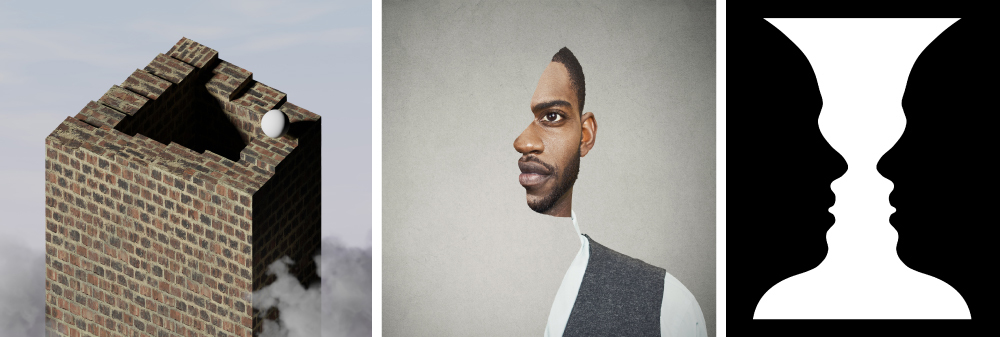
Are you familiar with "optical illusions"? Trompe l'oeil paintings probably come to mind first, but actually, these "optical illusions" quite profound. The more you understand its mechanisms, the more you start to wonder if the world we live in, and all the phenomena we believe to be true, might just be illusions. Yet, on the other hand, there's also a feeling that if it's an illusion, well, that's fine too. Even a great love affair, one that feels like you've devoted your life to it, is an illusion if you call it that.
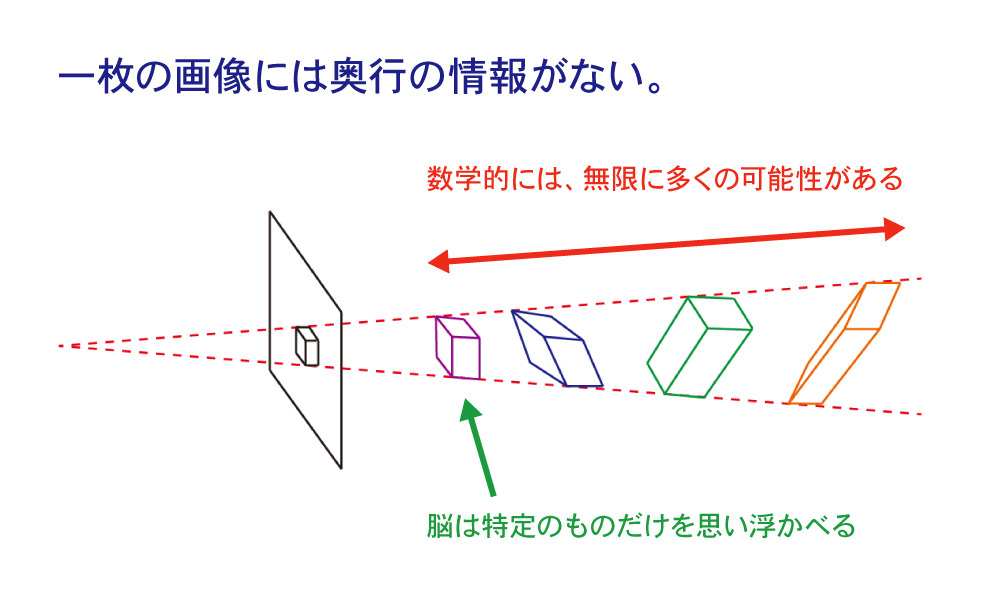
Professor Atsuyoshi Sugihara of Meiji University, who specializes in stereoscopic illusions, explains the mechanism: "The outside world is made up of 3D (space), but our eyes can only perceive it in 2D (flat). In other words, the brain arbitrarily imagines 'depth' and convinces itself, 'This is a three-dimensional object.' This is the fundamental mechanism by which humans recognize three-dimensionality, and it's the cause of stereoscopic illusions."
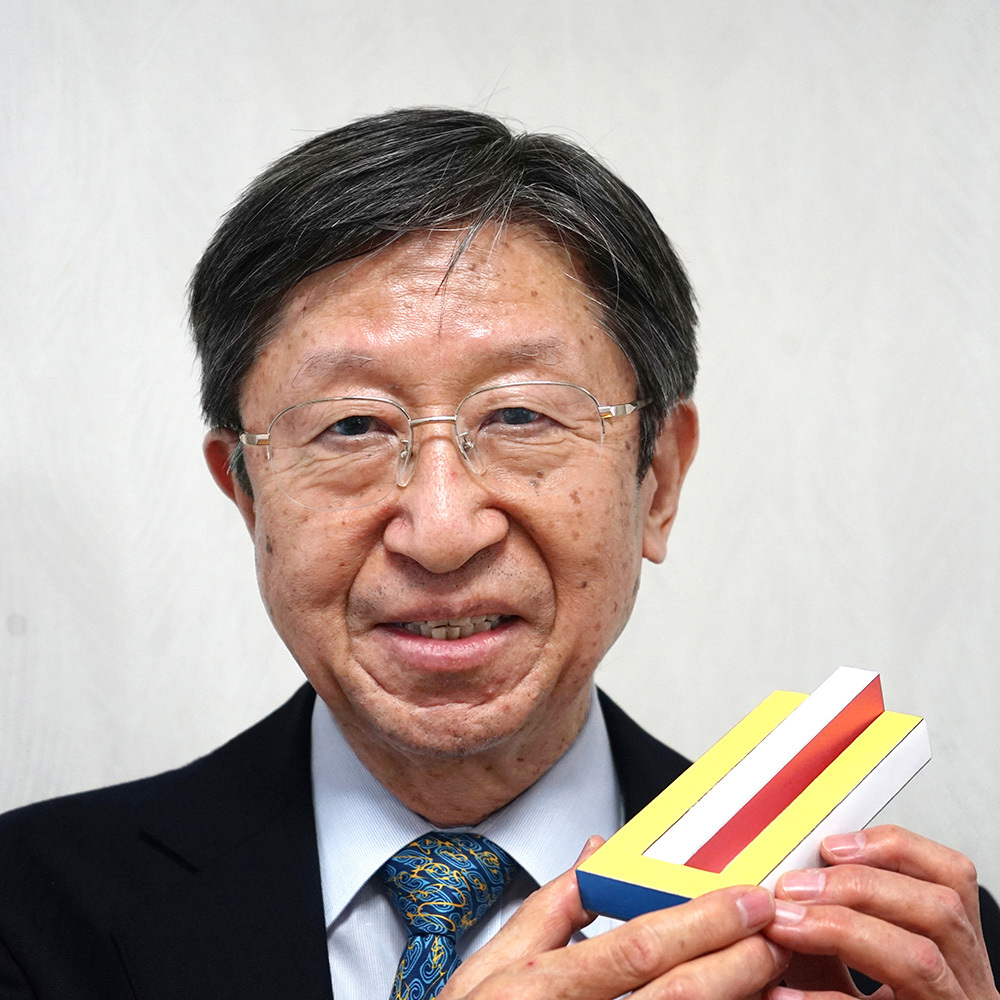
Professor Atsuyoshi Sugihara, Special Research Professor, Meiji University
Professor Emeritus, Advanced Mathematical Sciences Institute, Research and Intellectual Property Strategy Organization, Meiji University; Doctor of Engineering (Retired as Specially Appointed Professor at Meiji University in March 2019. Assumed current position in April of the same year)
For example, because the brain miscalculates depth perception, the same object can appear round from one angle and square from another. This is a stereoscopic illusion. Here's where it gets interesting: there are infinitely many real-world objects that the brain might misinterpret as square solids. We harness this infinite potential to create stereoscopic illusions.
Professor Sugihara's specific mechanism for creating stereoscopic illusions is as follows. "First, we fix the subject's viewing perspective. From that viewpoint, the number of three-dimensional objects that can be perceived as flat shapes on the retina is infinite—mathematically speaking—even if the brain doesn't imagine them. Next, we create an equation to reveal what kinds of three-dimensional objects exist. For example, we set up an equation where the positions of the vertices forming the solid are unknown variables, determining how those vertices must be placed for the solid to physically exist. This becomes the equation."
Professor Sugihara continues, "Then, from the solids solvable by the equation, we subvert the ones the brain finds easiest to imagine. The key insight here is that the human brain loves 'right angles.' It finds solids with many right angles easier to visualize. Therefore, to create strange phenomena, we simply construct a solid from the solutions of the equation that combines non-right-angled faces and angles. Using this technique, we can create strange phenomena like this."
Of course, since it's an equation, sometimes you'll reach the answer "no solution exists." That means such a solid can't be constructed, so we don't pursue it further. But, wait? If this equation actually has a solution, then this kind of phenomenon can realistically occur."
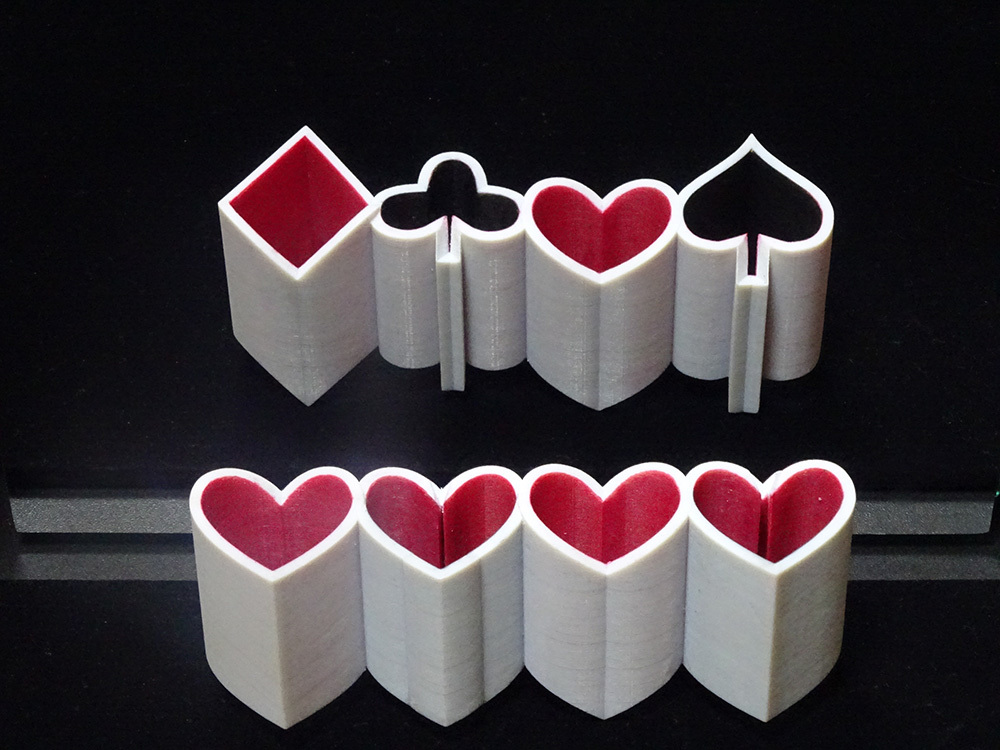
Combining equations from two perspectives. This is what we call "simultaneous equations." The strange phenomenon where something looks different from another perspective (like a heart appearing as a spade when mirrored), or where orientation or posture becomes absurd (like a heart appearing the same way even when mirrored), is revealed in its real form before our eyes by solving the simultaneous equations.
Still, simultaneous equations? It's been ages since middle school I've heard that term. Yet, balancing one thing while accommodating another—that kind of communication is something we do routinely, whether in daily family life or business settings. You could even say life is a continuous process of solving complex simultaneous equations. As I delved deeper into this thought, Professor Sugihara continued his explanation.
"With classical two-dimensional illusions, like things appearing different sizes or colors, you don't notice unless someone reveals the trick. But with three-dimensional illusions, just reflecting it in a mirror or rolling a ball can make impossible things happen. You don't need to be told; just by looking, you realize you're mistaken. The characteristic of three-dimensional illusions is that they can make the viewer feel something is off just by looking."
Something feels off. But you can't pinpoint why. Colors or lines seem distorted, yet it's your own brain warping the real three-dimensional world. It's not a lie, but a deceptively real reality. Ah, I thought, this might apply to the world of advertising too.
In advertising expression, the iron rule is: "Lying and hurting people are absolutely forbidden. But conversely, as long as you maintain that moral line, you can basically do anything" (as I, now editing this series, was taught by a senior colleague when I was just starting out).
When I brought up this topic with Professor Sugihara, he countered with a question: "The mandarins sold at supermarkets are often wrapped in orange netting, right? That uses a color assimilation illusion to make the orange color appear more vivid. Would that be considered a lie?"

I was momentarily at a loss for words, but I replied that the orange netting probably falls within the realm of presentation. However, lies like falsifying the place of origin are absolutely unacceptable. Professor Sugihara's expression was subtle.
"I see. Defining what is a lie and what isn't is difficult, isn't it? Optical illusions aren't something we deliberately create; they're everywhere in daily life, and we use them too. For example, the techniques we use with makeup and clothing to look our best are also optical illusions." No matter how many times I rewatched the actual footage, I couldn't figure out the trick behind it, but somehow, I found myself deeply nodding in agreement with the professor's final comment.
[Editor's Note]
As an editor preparing to interview Professor Sugihara, I formed a hypothesis: "People are governed by false memories (ambiguous memories)." You could also say, "Memory often lies." Take the memory of your first love, for example. Isn't it vague? Or consider painful past experiences or failures – don't you find yourself wanting to recount them to others in an exaggerated, entertaining way?
What makes Professor Sugihara's research so fascinating, I believe, is how brilliantly it reveals the "ambiguity" of human eyes and brains in a strikingly real way. This isn't deception by magicians, actors, or con artists. It's the "world of unbelievable truths" presented by an engineer. It was a strange experience, instantly shaking both mind and brain.

Was this article helpful?
Share this article


Newsletter registration is here
We select and publish important news every day
For inquiries about this article
Author
Atsuyoshi Sugihara
Meiji University
Research Professor