
Note: This website was automatically translated, so some terms or nuances may not be completely accurate.
International Welfare Exhibition in China Japanese Firms Challenge the Huge Market
The "2013 China International Welfare Expo" was held in Beijing from October 10 to 12. Organized by the central government, it is China's largest comprehensive exhibition for products and rehabilitation equipment for people with disabilities and the elderly. Now in its seventh year, this edition saw participation from 172 domestic and international companies and organizations, attracting approximately 98,000 visitors.
China's elderly services industry market size reached 1 trillion yuan (approximately 16 trillion yen) in 2010. The population aged 60 and above is projected to swell from the current roughly 200 million to 400 million over the next 20 years, with the market size expected to reach 5 trillion yuan around 2050. Furthermore, in September this year, the State Council (central government) announced deregulation measures to promote the development of related services. These include preferential tax policies and incentives for private capital investment. This presents an opportunity for Japanese companies with advanced technology to expand their business prospects.
Twelve Japanese companies participated this time, promoting products including cutting-edge welfare equipment, hair restoration technology, and barrier-free braille tiles. China is experiencing rapid urbanization alongside its aging population, creating significant demand for barrier-free infrastructure in public spaces.
Kuriyama (Yodogawa Ward, Osaka City), which handles industrial materials made of rubber and synthetic resins, has been manufacturing and selling braille tiles in China since 2011 to assist the visually impaired with walking.
The company's "M-Braille" tiles use thin resin tiles and a specialized adhesive, enhancing the integration between the tile, pavement, and adhesive.
Yasunori Okamoto, Deputy General Manager of the company's Chinese subsidiary, Shanghai Kuriyama Trading, expressed confidence: "M-Braille adapts well to uneven surfaces and offers high durability against extreme temperatures, making it well-suited for China. While priced over ten times higher than Chinese products, there is room to reduce costs by reviewing distribution expenses."
He also expressed further optimism, noting, "In 2008, the government amended laws to protect persons with disabilities and promote the welfare products industry, mandating barrier-free improvements in public spaces. With the urbanization of rural areas, demand for braille tiles should expand in the future."
■Incorporating Game Elements
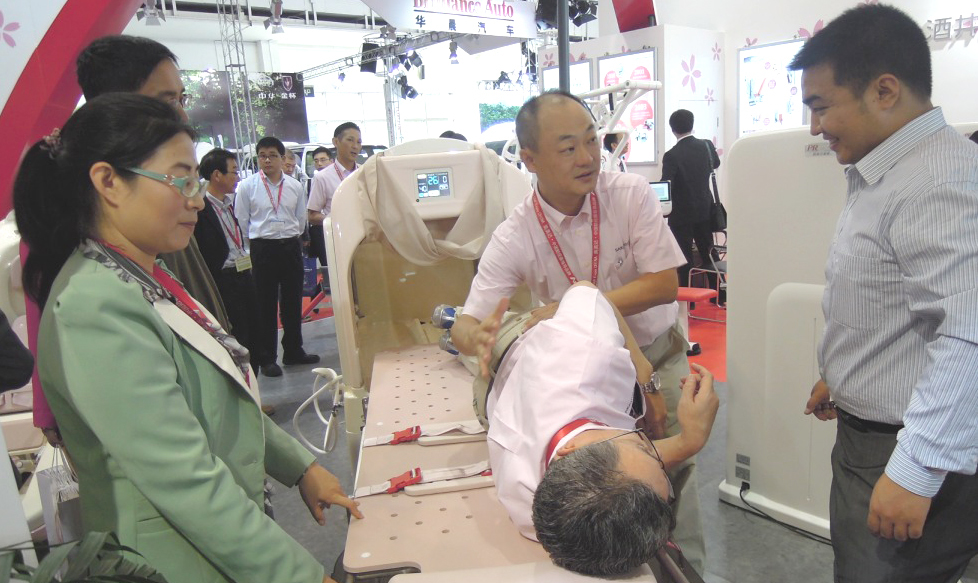
Sakai Medical (Shinjuku-ku, Tokyo), with extensive experience in "Power Rehabilitation" equipment that reactivates the neuromuscular system through low-load repetitive exercise, made its debut at an overseas trade show. They promoted their highly designed, space-saving equipment and bathing devices.
Mr. Mitsuru Yamada, General Manager of Sales at the company, stated, "We aim to expand sales channels for rehabilitation equipment in China. Alongside market research, we also want to increase instances where medical institutions use our rehabilitation equipment as monitors."
Additionally, the rehabilitation equipment for the Chinese market incorporates a scoring function into its software. "Elderly individuals experiencing physical decline and loss of confidence often have deep-rooted resistance to rehabilitation equipment. Incorporating game elements to appeal to the Chinese preference for competitive activities is one aspect of our localization efforts," he explained.
Was this article helpful?
Share this article


