
Note: This website was automatically translated, so some terms or nuances may not be completely accurate.
 Interview with the Presidents of Five Commercial Broadcasters: Outlook for BS in Its 16th Year [3/5]
Interviews with Presidents of Five Commercial Broadcasters: BS's 16th Year Outlook Part 3: BS-TBS President Makoto Hoshino
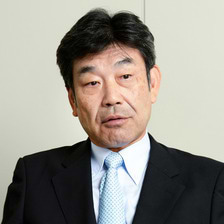
Makoto Hoshino
BS-TBS Corporation
BS digital broadcasting, which began on December 1, 2000, has now entered its 16th year. The five commercial BS broadcasters have steadily expanded their fan base and continued to grow through programming that leverages the unique characteristics of the medium. Marking the 15th anniversary milestone, we interviewed the heads of each company about the appeal and strengths of their content, their future initiatives, and asked them to share a single kanji character representing the future of BS and the thoughts behind it.

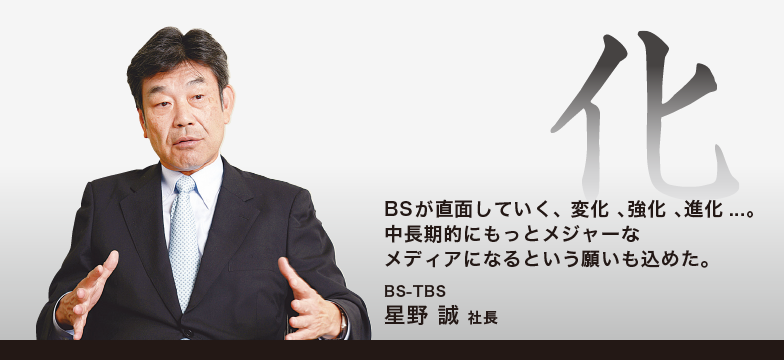
BS-TBS's Strength Lies in Its Extremely High In-House Production Rate
──It's been half a year since you became president. How do you perceive BS-TBS's appeal?
BS-TBS boasts an exceptionally high in-house production rate, accounting for 85% of our prime-time programming. I also feel the quality of these programs is very high. Over these six months, I've finally gained a comprehensive view of both our own and other stations' programming. True to our catchphrase "Satisfaction & Mood," I take pride in the fact that many of our programs leave viewers feeling satisfied after watching.
This high proportion of in-house productions has been a trend since our launch. While we initially went through trial and error regarding appropriate production budgets, now, as we approach our 15th anniversary and the threshold of maturity, I believe we are truly becoming a mature media outlet. The overall balance between program sales, revenue, and production costs has stabilized over the past few years.
──BS-TBS has led the way in BS broadcasting since its launch, consistently topping sales and driving the sector's development. Within this context, President Hoshino, what vision do you aim for in the 16th year?
The 16th year will be particularly turbulent. For instance, the roadmap for realizing 4K/8K broadcasting has been clarified, and next year marks the entrance to that era. Key terrestrial broadcasters have started offering catch-up streaming. Television and telecommunications, terrestrial and satellite signals are all intermingling, forcing us to respond in various ways. Amidst this, BS-TBS will continue to move forward powerfully as a leader.
Externally, our focus is "Maximum and Optimal." This is very straightforward: we aim for "maximum" sales and, by leveraging viewer data, to further increase the number of "optimal" programs. The mechanical contact rate survey began in April, and we aim for the top results here. To achieve this, satisfying both viewers and advertising clients with high-quality content is an absolute prerequisite.
──Could you tell us about the core content driving future growth?
First, our flagship program, "Yoshida Rui's Bar Hopping Diary." Over the past six months, whenever I've met with external parties, this is the program they invariably mention. However, the challenge is that few other program names come up.
Therefore, internally, we've recently adopted the slogan "Create a second 'Sake Bar'!" and are working to produce killer content across various genres. Already this October, we launched two news-based programs: "Monday Documentary" and "Foreign Correspondents Saw! Japan in The World." We want to successfully grow these so they become the talk of the town.
In sports, our focus is on golf. We broadcast this year's "Nestlé Japan Match Play Championship Lexus Cup," the men's professional match play championship that returned last year after an 11-year hiatus. We covered the holes on BS broadcast and also provided content for live streaming online. Unlike catch-up streaming, we remain committed to "live" coverage in sports.
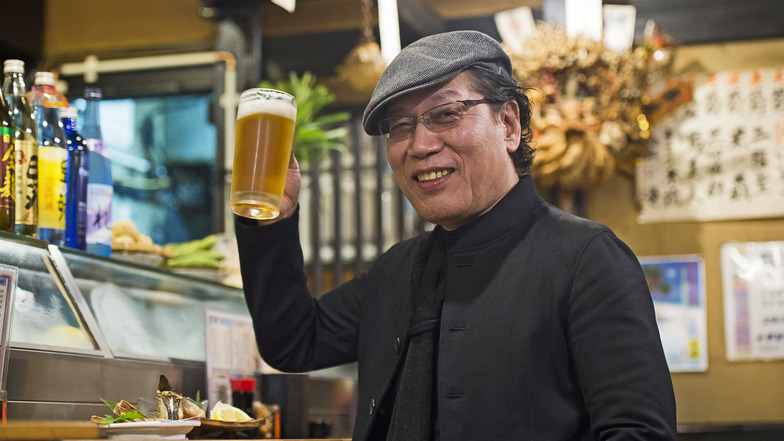
We want to function as a "public square" where people can gain information to think about society and life.
──BS-TBS doesn't carry straight news programming, does it?
While we haven't coordinated specifically with terrestrial broadcasters, my view is that we should clearly define our roles. We leave straight news to terrestrial broadcasters, while we focus on providing multifaceted perspectives and unique insights. The two new news programs mentioned earlier are based on this approach.
Beyond just news, we want to provide viewers with multifaceted information to serve as material for contemplating their future lives. My image of BS is a "public square." To ensure BS-TBS functions as a place where people come to gather material for discussions about politics, society, and how Japan is viewed globally, we will continue to focus on comprehensive programming.
BS is often said to have a more uniform programming approach compared to terrestrial broadcasters. While I don't necessarily view this as negative, as it stems from catering to similar senior demographics, we still need to propose unique content that defines BS-TBS. Simultaneously, we are exploring content targeting younger audiences, particularly in the 10 PM and 11 PM time slots.
──Could you express the future of BS in a single kanji character?
Considering the changes, enhancements, and evolution BS will face going forward, I chose "化" (ka - transformation). This also embodies my hope that BS will undergo a metamorphosis across these multiple fronts, becoming a more mainstream medium in the medium to long term.
For BS-TBS, the first change is targeting younger audiences. Then comes content enhancement. Currently, even terrestrial broadcast programs face various constraints, including production costs, so some shows might superficially resemble BS content. When that happens, we must think more creatively and propose content with fresh perspectives. In that sense, strengthening our content is indispensable.
Furthermore, in terms of evolution, we are being challenged to evolve as a media platform. We are beginning to explore new forms, including coexistence with the internet and multifaceted convergence with communications.
In terms of timing, this will likely be around five years from now, when BS celebrates its 20th anniversary. By 2020, the year of the Tokyo Olympics and Paralympics, when the future of 4K/8K broadcasting will also become clearer, I hope BS-TBS will have transformed into a central media force in society.
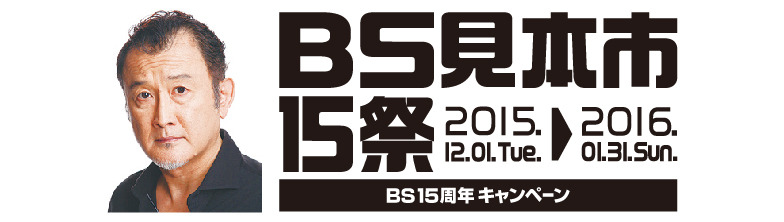
15th Anniversary "BS Expo 15 Festival"
To commemorate their 15th anniversary, the five BS commercial broadcasters will hold the "BS Exhibition 15 Festival" starting December 1 (running until January 31, 2016). During this period, they will broadcast over 60 carefully selected archive programs from all five stations, including travelogues, documentaries, and films, totaling 130 hours. Furthermore, during the year-end and New Year period (December 28th to January 3rd), the five stations will jointly present the special program "Back to the 21st Century," airing for two hours daily on a rotating basis across the stations. Actor Kotaro Yoshida will portray the "Director of the Yoshida Future Research Institute," presenting research findings on five themes of the 21st century: "Monsters," "Work," "Tokyo," "Women," and "Time."
Was this article helpful?
Share this article


Newsletter registration is here
We select and publish important news every day
For inquiries about this article
Back Numbers


Author
Makoto Hoshino
BS-TBS Corporation
President