
Note: This website was automatically translated, so some terms or nuances may not be completely accurate.
 Interview with the Presidents of Five Commercial Broadcasters: Outlook for BS in Its 16th Year [4/5]
Interviews with Presidents of Five Commercial Broadcasters: BS's 16th Year Outlook Part 4: President Shigeru Komagoe of BS Japan
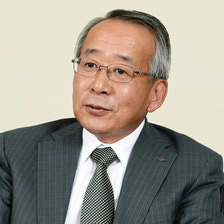
Shigeru Komago
BS Japan Co., Ltd.
BS digital broadcasting, which began on December 1, 2000, has now entered its 16th year. The five commercial BS broadcasters have steadily expanded their fan base and continued to grow through programming that leverages the unique characteristics of the medium. Marking the 15th anniversary milestone, we interviewed the heads of each company about the appeal and strengths of their content, their future initiatives, and asked them to share a single kanji character representing the future of BS and the thoughts behind it.

We should leverage BS's agility even more
──President Koson, while leading BS Japan, you are also involved in the management of TV Tokyo Holdings, TV Tokyo, and the Nikkei Inc. First, could you share your perspective on the current strengths of BS?
When BS launched, I was at the Nikkei newspaper. I saw BS as a much more agile medium compared to terrestrial broadcasting. Terrestrial TV, with its established revenue model, was an enormous presence, so BS faced immense challenges initially. However, over the past five years or so, BS has grown at a tremendous pace.
While some aspects of this process were unavoidable, the rapid development has also seen terrestrial broadcasting's business model spill over into BS, leading to situations where BS faces similar constraints. I believe the most critical focus for BS now is to break free from these constraints – in editing, filming methods, and sales approaches – and pursue the kind of "experimentation" that is difficult on terrestrial broadcasting.
The current household penetration rate for BS is 70.8% (October 2015). I consider this a commendable figure. However, we must not rest on our laurels. Each company should strive to enhance the overall appeal of BS, aiming to increase this rate to 75% or even 80%. While valuing our current main target audience, it is also urgent to broaden our base and appeal to younger generations.
──So, how would you describe BS Japan's strengths and appeal?
Broadly, there are three. First, we produce many original programs, including the "experimental" ones I mentioned earlier. Crucially, we analyze potential new viewers we want to attract, rather than just existing audiences, and create programming that captures their interest. For example, our 15th-anniversary special project "Shugoro Yamamoto: Human-Centered Period Dramas," which launched this October, aimed to attract female viewers and received an unexpectedly strong response. This made us realize that if we put in the effort, viewers will definitely respond.
Second is the strong connection between TV Tokyo Holdings and the Nikkei newspaper. News programs, especially those focused on economics, often carry a stiff, formal image and are difficult to translate into compelling visuals. However, programs like the weekday morning "Nikkei Morning Plus" have shown growth exceeding expectations, and the weekday evening "Nikkei Plus 10" seems to be gaining significant traction among business professionals. In the news segment, we will gradually strengthen our overseas coverage from the start of the year through spring.
Third is our collaboration with TV Tokyo. Since TV Tokyo still doesn't reach some areas as well as other networks, BS Japan will fill that gap for viewers in those regions. The key is how we leverage this programming synergy. Especially next year, both companies will move into new headquarters, making collaboration even easier. I believe this will be a great turning point to enhance the appeal of both networks.

"Knowing" is the foundation of media
──The partnerships with Nikkei and TV Tokyo are major distinguishing features, aren't they?
Yes, these are the two pillars of BS Japan. Of course, collaboration is already quite advanced. The era of focusing solely on print content is over. Many people watch videos streamed on the Nikkei Shimbun digital edition via their smartphones, and simultaneously, smartphones are increasingly becoming a medium for watching TV. Within this trend, increasing collaboration with Nikkei is only natural. We also believe collaboration is effective not just in programming but also in sales.
Alongside this collaboration, BS also shoulders the role of overcoming hurdles that terrestrial broadcasters struggled with. For instance, sports—content as critically important as economic programming—poses scheduling headaches due to game overruns and weather impacts. We'll explore how BS can tackle these challenges.
──Earlier, you mentioned strengthening overseas coverage. Could you share your outlook for the 16th year?
Japan needs to become more truly international. While we talk about globalization, I don't believe it simply means Japanese companies expanding overseas or Japanese players joining foreign sports teams. Globalization means Japan itself becoming international. We want to focus on providing information that shows what Japan can do, based on the premise of mixing with other countries, and offering that perspective.
Furthermore, the broadcasting industry has always been closely tied to technological advancement. Technological innovation cannot be slowed or stopped. And the Japanese are exceptionally quick to adapt to new technologies. I believe it is essential not only for us but for all companies in the industry to calmly assess the future of broadcasting and communications with clear heads and build an organization capable of swiftly adapting to change.
──Could you express the future of BS in a single kanji character?
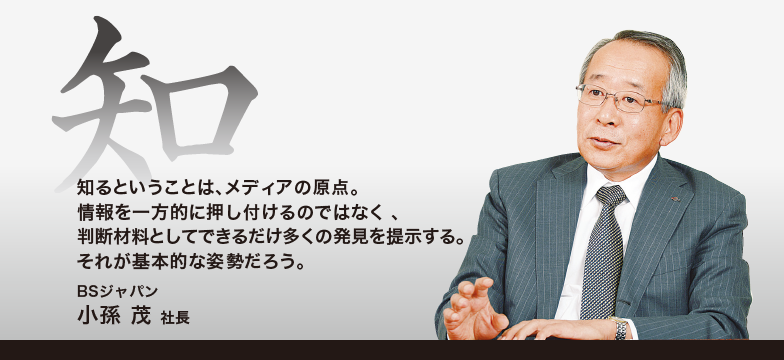
"Know" (知). Knowing is the very foundation of media. It's not about us unilaterally pushing information, but about presenting as many discoveries as possible as material for judgment. That, I believe, is the fundamental stance of media.
I think my own roots lie in "knowing" too. Since childhood, I've been a bundle of curiosity, wanting to know everything. You might think this explains why I focus on news programming, but that's not it. The joy of "knowing" is also found in travel shows, where I exclaim with the navigator, "Wait, this is an unmanned station!?"
If our role is to provide viewers with things they don't know, then the current situation where similar programs proliferate feels like we're stifling our own future development. More than from a management perspective, as a viewer, I find this incredibly wasteful. For the overall improvement of BS, I hope each company can showcase the unique strengths that only BS can offer.
BS 15th Anniversary "BS Showcase 15 Festival"
To commemorate their 15th anniversary, the five commercial BS stations will hold the "BS Showcase 15 Festival" starting December 1 (until January 31, 2016). During this period, they will broadcast over 60 carefully selected archive programs—including travelogues, documentaries, and films—totaling 130 hours. Furthermore, during the year-end and New Year period (December 28th to January 3rd), the five stations will jointly present the special program "Back to the 21st Century," airing for two hours daily on a rotating basis. Actor Kotaro Yoshida will portray the "Director of the Yoshida Future Research Institute," presenting research findings on five themes of the 21st century: "Monsters," "Work," "Tokyo," "Women," and "Time."

Was this article helpful?
Share this article


Newsletter registration is here
We select and publish important news every day
For inquiries about this article
Back Numbers


Author
Shigeru Komago
BS Japan Co., Ltd.
President