
Note: This website was automatically translated, so some terms or nuances may not be completely accurate.
Symposium at Commercial Broadcasters' Conference on "Changing TV Viewing Styles" ~ Four Experts Make Proposals for Television
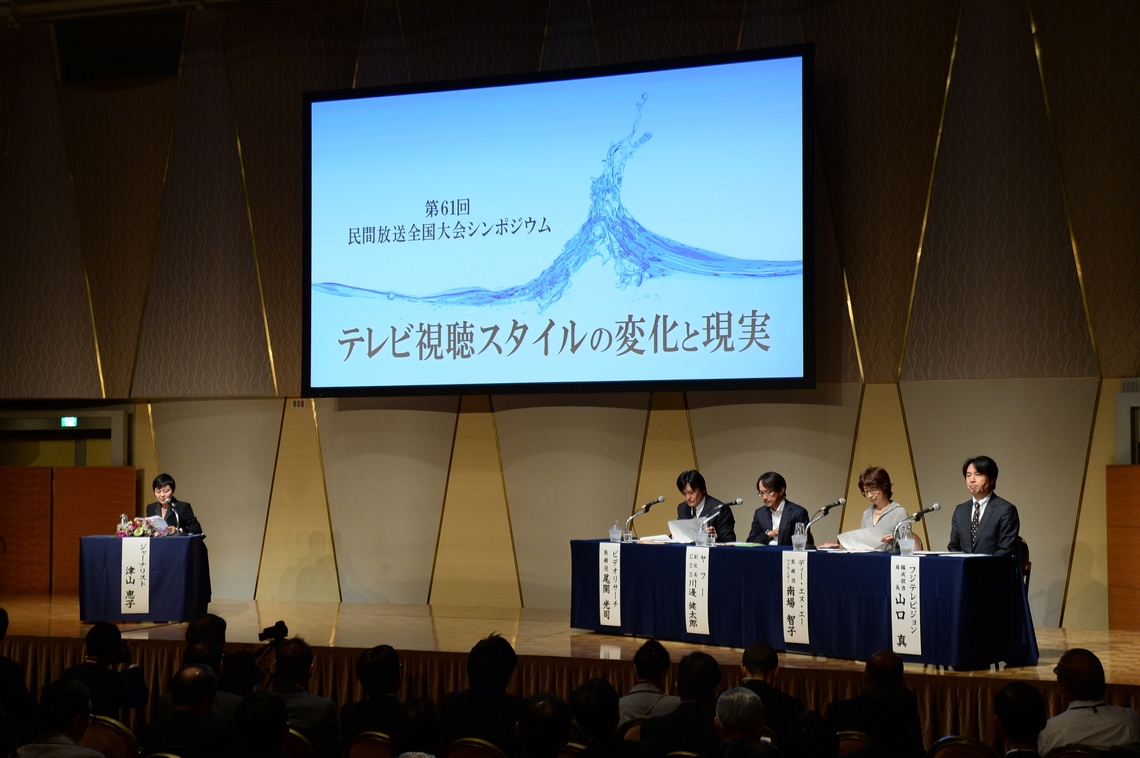
The National Association of Commercial Broadcasters in Japan (NABJ) held its 61st National Commercial Broadcasting Convention at the Grand Prince Hotel New Takanawa in Minato Ward, Tokyo, on November 6. Two symposiums were held prior to the convention ceremony.
The symposium "Changes in TV Viewing Styles and Reality" featured four panelists: Koji Ozeki, Director of Solution Promotion and Head of Interactive Business Strategy at Video Research Ltd.; Kentaro Kawabe, Executive Vice President and COO at Yahoo Japan; Tomoko Minaba, Director and Founder at DeNA; and Makoto Yamaguchi, Director of Programming at Fuji Television Network. Keiko Tsuyama, a New York-based journalist, moderated.
The discussion first focused on "timeshift" (watching programs at preferred times), "placeshift" (watching anywhere), and "deviceshift" (watching on non-TV devices). Ozeki explained efforts to measure timeshift viewing, stating, "Timeshift viewing is definitely happening, but in Japan, it currently accounts for less than about 10% of total TV viewers." Yamaguchi introduced "Hybridcast" as a common initiative among TV stations. This technology safely synchronizes and displays broadcast programs and web content together on the receiver. Mr. Kawabe explained initiatives for enjoying TV content in diverse ways through the video site "GyaO!" and its collaboration with TV stations, such as holding chat events during program broadcasts and producing sponsored content. Mr. Minaba, who has grown his business by adapting to changing devices, pointed out the trend toward "small pieces" of content that can be enjoyed quickly, emphasizing, "Changes in devices and media transform the nature of content and create new possibilities for the market."
The discussion then turned to enhancing the value of television content. Mr. Yamaguchi pointed out, "Among television content, 'news' may be most impacted by changing viewing styles. What will be crucial for future television news is analytical and explanatory power, along with editing skills." He also introduced promotional strategies for television dramas utilizing SNS. Mr. Ozeki presented data, stating, "SNS has affinity with television and can also aid viewing. Programs with more tweets tend to be watched more attentively and continuously. By analyzing tweet content, we can now assess qualitative aspects." Minami stated, "TV programs and SNS complement each other. As executives or organizational leaders, we need to grasp what's happening in the world from multiple angles. Anonymous online information, real-name information, and TV-based information each play distinct roles." Regarding "Yahoo! Search (Real-Time)," which allows real-time searches of tweets and Facebook posts, Mr. Kawabe introduced it: "TV is the most discussed topic here. Users share their excitement and the moment's buzz on their second screens, while TV stations utilize it for marketing, such as gauging program reception."
Finally, each speaker presented keywords as "Recommendations for TV Programs." Ozeki suggested "Adjusting the Barrier to Entry" and "Promoting Personalization," stating, "Unless TV programs convey the scenario of how what they're communicating relates to viewers, it won't resonate." Mr. Kawabe proposed "Integrated GRP," advocating for metrics that combine online and TV data. Mr. Minami suggested "Fragmenting TV Content into Smaller Pieces." Mr. Yamaguchi's keyword was "Adapting to the 'DJ-ization of Daily Life.'" Noting that digitalization allows consumers to arrange their free time like a club DJ, he expressed enthusiasm for creating compelling programming that makes viewers feel they must watch.
Was this article helpful?
Share this article


