
Note: This website was automatically translated, so some terms or nuances may not be completely accurate.
 The Evolving Marathon [1/2]
The "Future Vision and Potential" of Marathon Running
The Evolving Marathon

The Evolving Marathon: "Future Vision and Potential"
The Tokyo Marathon was first held in 2007. Over the following decade, the number of runners increased, and diverse races began to be held nationwide. What is the power that draws people to marathons? What potential do they hold? We spoke with key event organizers and corporate sponsors. This is the first of two parts.
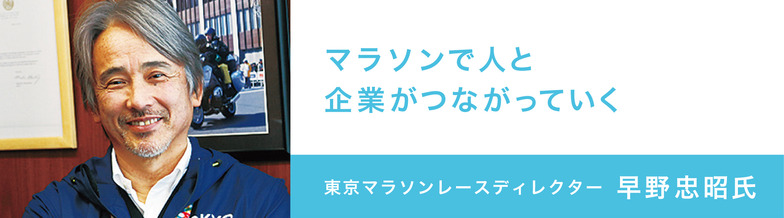
Having started in 2007, I feel the Tokyo Marathon has established a stable foundation for event management over the past decade. The Tokyo Marathon has sparked growing interest in marathon running itself year after year, leading to various events being held across the country. I hope this momentum doesn't end as a fleeting trend or mere event, but instead becomes a familiar part of daily life, establishing itself as a "lifestyle." If that happens, it will surely have a positive impact on people's health and on healthcare, which is a major challenge for Japan. I hope that going forward, all marathons, including the Tokyo Marathon, become vehicles for promoting marathon running as a lifestyle.
One initiative launched for this purpose is "RUN as ONE - Tokyo Marathon." This project partners with marathons nationwide to foster mutual exchange among runners and share operational expertise. We aim to share best practices like security and medical support programs and charity systems across the country, while also pioneering new approaches. I believe these efforts will help energize the entire Japanese marathon scene.
For marathon running to become more accessible, support from many companies is also essential. This is because people who start running often have diverse motivations and starting points beyond just "running" itself. Whether it's for dieting, to enjoy beer more, or any number of other reasons – truly, each person is different. We sincerely hope companies from various industries will support marathon running, including to leverage these diverse contact opportunities. By filtering through the lens of marathon running, new connections between people, between people and companies, and between companies themselves – connections that didn't exist before – will surely continue to emerge. Marathon running possesses this kind of power.
The sports world faces a major milestone in 2020. While building momentum toward that event is crucial, equally important is how we build on it afterward. How can we continue to generate long-term, positive impacts on society? I believe the Tokyo Marathon has the power to play a key role in this. Under this mission, I want to further evolve the Tokyo Marathon for the next decade.
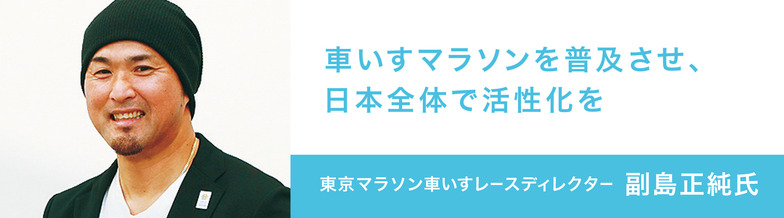
Sports are events that bring different people together. That's the appeal of wheelchair marathon racing. Its significance lies in bringing together people from different regions to enjoy themselves together. That's why I want more people to know about this sport. Holding wheelchair races alongside regular races presents various operational challenges, but I want to overcome them and increase the number of wheelchair marathon races in Japan.
The Tokyo Marathon has featured a wheelchair marathon race since its very first event. I've participated myself, and each time around 20 athletes take part. Building on this decade-long history, I hope the Tokyo Marathon can become a driving force for boosting wheelchair racing across all of Japan.
A major step forward is that, starting this year, the Tokyo Marathon wheelchair race has been recognized as an International Paralympic Committee (IPC) official event. This means it is now a competition where athletes can achieve the official qualifying standard for the Paralympics. As the second such officially recognized event in Japan, it represents a significant opportunity for Japanese athletes. The Tokyo Marathon will host a world-class wheelchair race where athletes competing domestically and internationally will compete. With increased media attention, we hope this will introduce more people to the enjoyment and appeal of the sport, ultimately contributing to raising the level of wheelchair racing in Japan.
Of course, the momentum leading up to 2020 will also be a tailwind for the growth of wheelchair marathon. It's an opportunity for many people to see the race, and we hope that by seeing Japanese athletes give their all, people will feel the appeal of the race. To that end, we plan to establish support systems for athletes and cooperation for overseas trips. Furthermore, to ensure the momentum continues beyond 2020, we want to focus our efforts on promoting sports legacy projects and charity initiatives.
For wheelchair race runners, support and encouragement from individuals and companies is a huge motivation and gives us the strength to push forward. We want to create events that allow us to repay the support of everyone who cheers us on.

The first edition received 77,521 applicants (capacity: 25,000), and in recent years, it has gained immense popularity with approximately 300,000 applicants. The official volunteer and supporter club "ONE TOKYO" also has over 400,000 members.
In 2010, it launched a charity project where donors could choose which collaborative projects to support. In 2012, it joined the Abbott World Marathon Majors (AbbottWMM) as one of the world's top races, becoming one of the world's leading races in both name and reality. In 2014, it launched a sports legacy project aimed at strengthening and developing human resources and contributing to society.
The event logo has been redesigned for this year's race. The different colored lines represent each runner, volunteer, and supporter, expressing the event concept of "The day Tokyo becomes one," where the interweaving of stories creates inspiration.
Continued in (2)
Was this article helpful?
Share this article


Newsletter registration is here
We select and publish important news every day
For inquiries about this article
Author
The Evolving Marathon
The Tokyo Marathon was first held in 2007. Over the following decade, the number of runners increased, and diverse races began to be held nationwide. In this series, we will speak with key event organizers and representatives from sponsoring companies.