
Note: This website was automatically translated, so some terms or nuances may not be completely accurate.
 Direct Voices of 3.11 [3/3]
Bringing Color Back to a Town Washed Away by Tsunami: The Challenge of Onagawa's "Spanish Tiles"
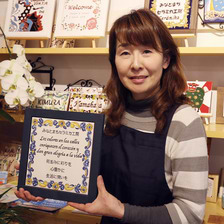
Narumi Abe
NPO Minatomachi Ceramics Studio
Mari Sakanaka
Dentsu Inc.
Five years after the Great East Japan Earthquake, the question of what constitutes true recovery remains. In this series, Dentsu Inc.'s cross-organizational team, the "Tohoku Recovery Support Network," reports on local voices from regions with which it has deep ties. Part 3 continues from Part 2 in Onagawa Town, Miyagi Prefecture. Mari Sakanaka from Dentsu Inc.'s Corporate Affairs Division, Social Contribution Department, spoke with Narumi Abe, representative of the NPO "Minatomachi Ceramica Studio."
Swept away by the tsunami, Onagawa lost its townscape. Amidst profound loss, Ms. Abe resolved to restore rich colors to Onagawa once more. Holding the hope of "brightening the town with Spanish tiles," she finally established the workshop and began activities in April 2013. Her dream is gradually taking shape, beginning to color the town as a symbol of Onagawa's recovery.
Why "Spanish Tiles"?
Sakanaka: Were you originally interested in tiles?
Abe: Before the earthquake, I enjoyed a pottery circle as a hobby with seven friends. Everyone was affected by the disaster, and one person passed away. About six months after the earthquake, just as I was starting to move to restart the circle, a series of fateful encounters happened.
Through a connection with Shigeru Ban, who designed the new Onagawa Station building, we received a donation of a pottery kiln from Kyoto University of Art and Design. We were struggling to find a place for it when, in April 2012, the temporary "Kibo no Kane Shopping Street" opened. We were offered half of the office space used by the local soccer team, "Cobaltore."
Sakanaka: Why Spanish tiles?
Abe: Around the same time the kiln was donated, the Onagawa Town Reconstruction Liaison Council proposed starting a cultural exchange program with Galicia, Spain. That's when I first learned about traditional Spanish tiles.
Since it involved pottery, I attended a tile-making class in Tokyo and tried it myself. The process of making them was truly fascinating. I ended up participating alone in a study trip to Spain organized by the class.
Coincidentally, the departure date was March 11, 2012. I was really reluctant to go; I felt strongly that why did I have to go at such a time?
However, when I visited Manises near Valencia and saw the vibrant town adorned with colorful tiles, my gloomy mood lifted and I felt energized. I thought how wonderful it would be if Onagawa could become such a sparkling town too.
Furthermore, at the museum, seeing tiles made hundreds of years ago still retaining their original colors gave me a sense of connection across time with the people who made them, as if they were speaking to me.
These tiles can color a new town, vividly revive lost landscapes, and through them, convey the current spirit of reconstruction and everyone's hard work to future generations. I returned home determined that we absolutely must use these tiles in Onagawa's town building.
This isn't something you do as a hobby
Sakanaka: So you decided to take matters into your own hands.
Abe: Wait for someone else to do it? No way. If I dawdled, the town development plan would be over before I knew it. So I decided to do it myself and started looking for ways to make it happen.
First, even just setting up a workshop required funds. So initially, I gathered small tools myself and ordered materials. When I laid out some small magnets, people were delighted, saying, "Oh, I want this!" I consulted with others about how to somehow sell them and turn it into a business. I applied for a grant from the Cabinet Office and received start-up funds.
Then, after four months of getting all the paperwork in order, we became an NPO corporation starting in April 2013.
Sakanaka: Funding must have been really tough in reality.
Abe: We started with six people back then, but since everyone had been affected by the disaster, this wasn't just a hobby. To make it a proper job, we had to create high-quality products and actively sell them.
Mastering the necessary skills took time, so we utilized a subsidy from Miyagi Prefecture's Emergency Employment Measures Fund to cover salaries for the other five members.
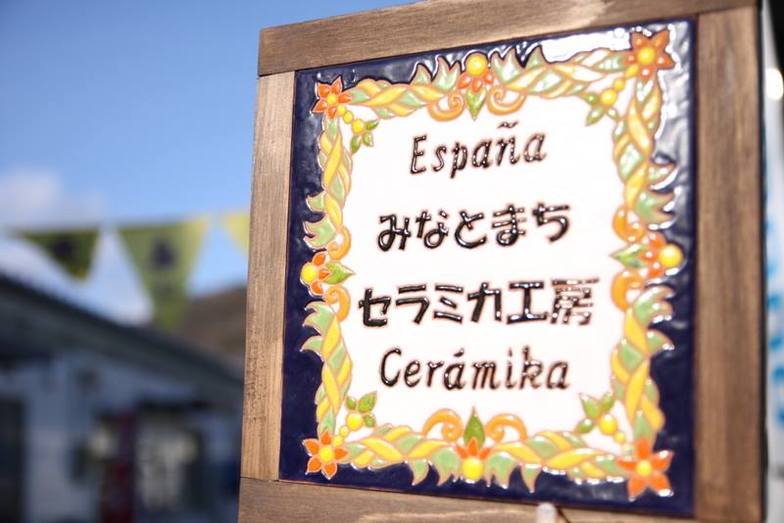
Finally, the "Onagawa Tile Walking Map" is complete
Sakanaka: Now, Abe-san's tiles can be seen all over town, right?
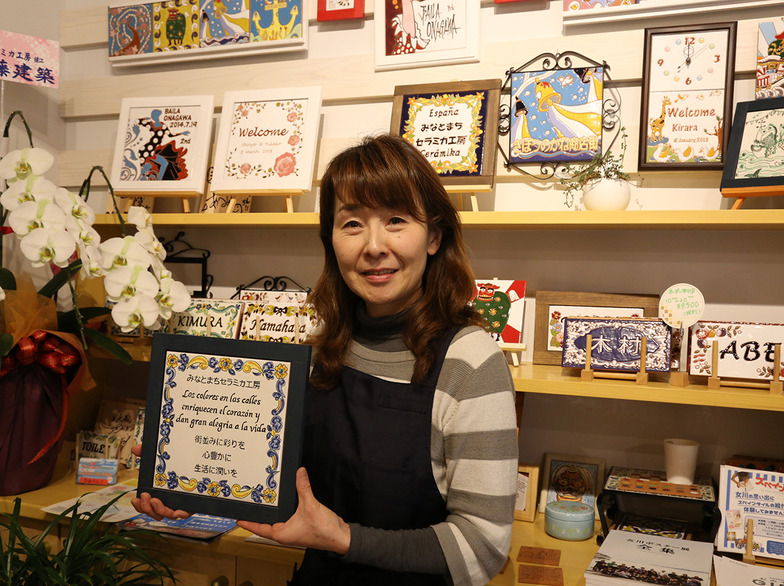
Abe: It seemed like a dream at first, but we gradually added more and more, one tile at a time. Starting with the room number plates at Hotel El Faro and the shops in Kibō no Kane Shopping Street.
Then, when we moved our office to "Seapalpia," we compiled all the tiles visible around town into the "Onagawa Tile Walking Map," a long-held dream. I really hope people will take this map and walk around the town.
Sakanaka: To have achieved this much in just three years is remarkable. Isn't this kind of initiative quite rare even nationwide?
Abe: While there are tile painting classes, I don't think there's anywhere else in Japan that makes and sells each tile individually. We're also getting more online orders. However, since each tile is handmade and time-consuming, there's a limit to how many we can produce at our current pace.
Sakanaka: So you'll need to train new makers going forward.
Abe: We currently have ten people. Last fall, when we planned a training course, it filled up immediately. If they have the skills, they can work even if it's not full-time, like while their children are at school.
And seeing tiles they've made decorating the town, knowing they'll last for centuries, is a source of joy and pride for the makers.
A Symbol of Onagawa
Sakanaka: They're so vibrant and really stand out around town, right?
Abe: Our goal is for everyone to recognize these tiles as synonymous with Onagawa. We hope many people visit from outside just to see the tiles, and that seeing them brightens the spirits of townspeople, enriches their lives, and brings smiles to everyone.
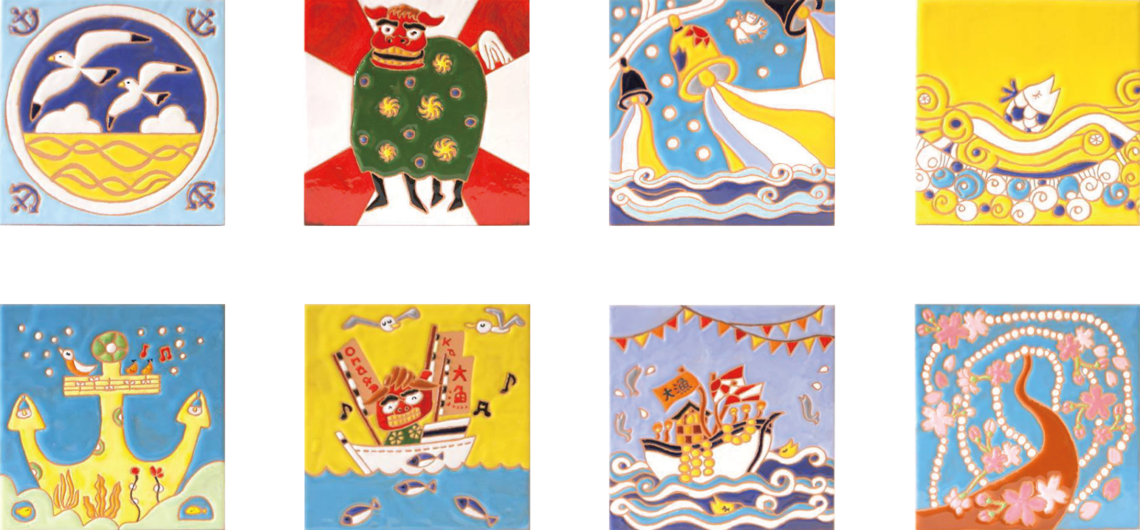
The motifs are diverse too—not just foreign cultures, but nostalgic Onagawa elements like lion dances and the red-and-white lighthouse, as well as everyday things like seafood bowls and saury set meals.
Before the disaster, Onagawa didn't have any souvenirs to boast about besides seafood. So, I'd be thrilled if young people could take pride in these tiles, saying, "Onagawa has such stylish things!"
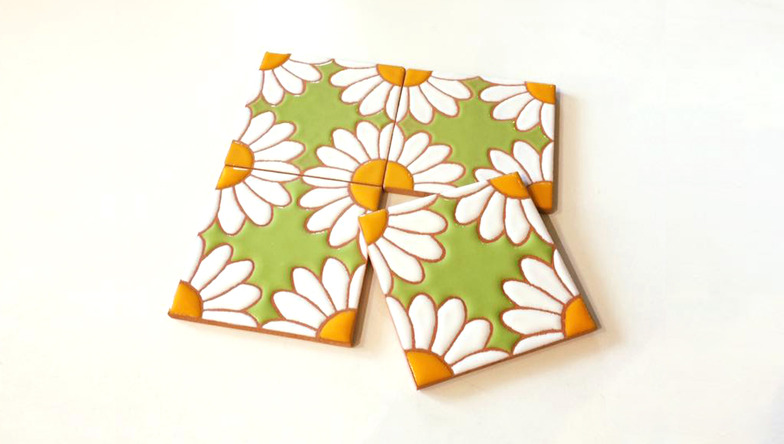
We also want to play a part in community building.
Sakanaka: Since the disaster, have outsiders coming in brought any changes?
Abe: It's incredibly stimulating. I was born in this town, yet there are so many things about it I never noticed before. All this new information coming in helps me in my own life.
Sakanaka: As housing becomes more available, what kind of town do you hope it becomes?
Abe: I'll also be living in a different place than where I lived before the disaster. That's the same for everyone. Even though we're still in the town, it's a different environment from where we used to live, so we need a new community.
Some people may find it difficult to go out, so we need to consciously create more opportunities for everyone to meet face-to-face.
Sakanaka: Rebuilding communities is a common challenge across disaster-affected areas.
Abe: Onagawa is a small town, so everyone knows each other. Even the elderly might not feel completely alone, but there are still people who can't actively go out.
Sakanaka: You mentioned that the tiles serve to connect Onagawa with its people.
Abe: We ask visitors to make two tiles at the workshop. They keep one tile for themselves and leave the other tile in the town with their signature.
The more people connect with Onagawa, the more vibrant the town becomes. If they leave a piece of themselves here, they might want to come back someday to see it again. It's our strategy to keep drawing people to Onagawa.
Sakanaka: Now I'm looking forward to visiting Onagawa again next time. Thank you very much.
Was this article helpful?
Share this article


Newsletter registration is here
We select and publish important news every day
For inquiries about this article
Back Numbers
Author
Narumi Abe
NPO Minatomachi Ceramics Studio
Representative
Mari Sakanaka
Dentsu Inc.
General Affairs Bureau, Social Contribution Department
