
Note: This website was automatically translated, so some terms or nuances may not be completely accurate.
 The "Specialized Talent" That Will Transform Your Company [1/7]
Open talent utilization drives innovation!
Junichi Kanno

Changes in Talent Utilization in Business
When speaking with clients, I sense that a truly large number of companies are utilizing external talent. This might be because my area of responsibility—creating new sales approaches that maximize sales by leveraging digital marketing techniques and sales data while incorporating communication—represents a new frontier (uncharted territory) for most companies.
Particularly in recent years, advancements in marketing technology have made it increasingly common to recognize that initiatives transcending the traditional division of labor—where "manufacturers create products, media advertise them, and retailers sell them"—are now essential.
Taking manufacturers as an example, challenges that transcend traditional frameworks are accelerating: showing videos on e-commerce sites to enhance product understanding, adapting to omnichannel strategies, and incorporating social media feedback into product development. When undertaking such challenges, companies actively seek to expand their business domains by hiring external talent, such as e-commerce experts.
How companies utilize these external talents varies significantly. Some immediately entrust teams to them; others keep internal managers in charge while placing external talent in a protective role; still others start with external talent as individual contributors. This approach likely depends on each company's culture and progress in new initiatives.
This trend isn't limited to the sales promotion field I'm involved in, nor is it a recent development. Beyond the long-standing practice of bringing in talent with specialized know-how to expand business domains, the use of external talent has recently broadened into areas like system development, M&A, marketing, and overseas expansion—especially when companies tackle new initiatives.
This trend shows no signs of stopping. While the need for innovation is being emphasized everywhere, innovation cannot emerge without taking on challenges. I believe that companies capable of effectively combining internal and external talent across various fields to create new added value are the ones that can achieve true innovation.
Recruitment = Acquiring Expertise
In this series, we will explore the concept of external talent using the term "specialized talent." One major reason companies hire externally is to acquire the specialized expertise that individual brings. In terms of bringing in expertise—such as specialized knowledge and experience not found within the company—through hiring, I believe they should be viewed not merely as external personnel, but as specialized talent.
Incidentally, throughout this series, we will deliberately avoid delving deeply into the definition of the term "expertise." Furthermore, it does not refer to knowledge in a specific field; we will use the term "expertise" solely as a concept contrasting with "in-house knowledge/talent."
For example, knowledge that is commonplace for someone working in digital marketing could be highly specialized knowledge for a corporate employee just starting to work in that field. Expertise is not something absolute that is gained by passing a single benchmark (like a certification exam). Rather, I believe it is a capability demonstrated within relationships between companies and between individuals.
However, acquired expertise holds no value if it cannot be effectively utilized. Having worked at multiple companies, including foreign-affiliated ones, I believe there are three key points for externally hired talent to function effectively, especially during the initial phase. I specifically note "during the initial phase" because while aspects like adapting to corporate culture may resolve over time, many things lose meaning if they take too long. It is crucial to leverage specialized talent immediately after joining.
First, the company must clearly communicate what it expects from externally hired specialists. Second, these specialists must demonstrate a commitment to responsibly completing their assigned tasks. Third, the company must clarify its code of conduct.
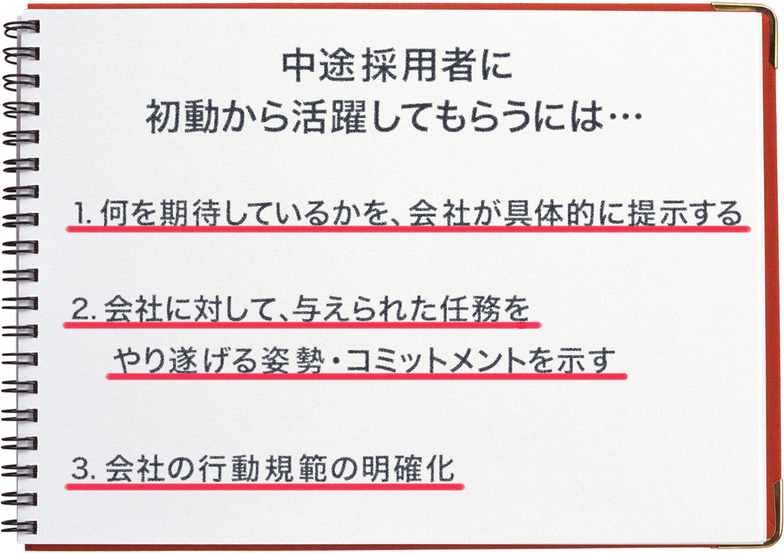
The first two points should primarily be reflected in the evaluation system. Establishing such systems is also crucial for the growth of specialized talent through evaluation. It's not uncommon for specialized talent to join a company based solely on its brand image, without a clear understanding of the company's expectations or what their specific role entails. Naturally, in such cases, they cannot immediately contribute effectively, and in the worst scenario, they may resign due to an unbridgeable gap between their initial expectations and reality.
The third point, clarifying behavioral norms, might be easily overlooked but is surprisingly important. External hires cannot get off to a smooth start unless the workplace environment is reassuring and conducive to comfortable work. Clear behavioral norms are beneficial for this purpose. For instance, approaches to work-life balance vary significantly between companies. Having a clear understanding of the expected work style allows employees to maintain an appropriate distance from the company while working with peace of mind.
To elaborate further on this point: In Japan's past, where lifetime employment was the norm, companies were like families. Consequently, employees were treated like family members. There's a saying, "What's common sense within the family is nonsense in society." This highlights how certain norms only apply within the company. These are private behavioral patterns, distinct from the company's public code of conduct rooted in its core values, mission, and strategy. The latter constitutes the corporate culture, and employees correctly understanding and acting upon it contributes to the company's performance improvement.
Specialized talent often comes from environments different from the company's own. If you try to impose private behavioral patterns unrelated to corporate strategy on such individuals, it becomes unclear where work instructions end and personal preferences begin, leaving them confused about how to work. When behavioral norms are clearly defined, people from diverse backgrounds can work comfortably while maintaining their own ways of working.
This aspect is crucial for embracing diverse values and, in that sense, is also an important point for advancing globalization.
Considering these factors, if the three points mentioned earlier are clearly defined, specialized talent can demonstrate their capabilities from Day 1.
Unraveling the Future of Talent Utilization with Experts from Various Fields
Building on these premises, we will delve into broad, general themes—such as how to cultivate and utilize specialized talent—through discussions with leading figures active at the forefront of various fields. Below, we introduce the three individuals we will be speaking with.
First, Ms. Toshiko Oka of PwC Advisory. Ms. Oka has been active on the front lines of M&A for over 20 years and has served as a member of the Ministry of Economy, Trade and Industry's Industrial Structure Council and as a director of the M&A Forum. As M&A has become a common growth strategy for companies, there has been a steady stream of professionals moving from M&A advisory firms to operating companies. We believe this trend, as a precedent from another industry, offers significant insights into utilizing specialized talent. We will discuss the evolving social role of professional firms and their changing relationship with client companies.
The second speaker is Nobuo Sato, Director of the Harvard Business School Japan Research Center (HBS JRC). Mr. Sato currently leads the creation of Japanese corporate cases in collaboration with HBS faculty in Boston, USA, while also spearheading HBS's public relations activities in Japan (including support for international students and corporate talent development). In his previous role, he was a partner at an executive search firm, supporting client companies with talent acquisition. Drawing on this experience, we will ask him about the role educational institutions play in talent development and key considerations for companies when hiring specialized professionals.
Finally, we have Ms. Makiko Shinoda, Director and CFO of Tokyo Itoi Shigesato Office. As CFO of this firm, which has a corporate culture referring to employees as "crew members," she oversees the entire administrative department, including human resources, supporting the company's high-value-added business. Recently, she has expanded her sphere of influence, including her role as co-translator of "Alliance," which ranked highly on business book charts last year. Before her current position, she worked at strategic consulting firms and foreign companies. Drawing on this experience, we will ask Ms. Shinoda, who constantly strives for innovation, about the relationship between companies and individuals that enables the development and utilization of expertise.
Through conversations with these three individuals, we will explore macro perspectives, micro perspectives, and the current state of talent utilization.
As specialized talent moves between companies, the nature of collaboration (role division) between companies will also change. Consequently, the places where expertise is cultivated and where it is utilized will diverge, forcing companies to rethink their talent strategies and altering the relationship between companies and individuals.
The underlying challenge is this: to realize a society capable of higher-level innovation in the era pioneered by IT evolution, the appropriate cultivation and utilization of specialized talent is essential.
※The next installment, "Relationships Between Society, Organizations, and Individuals Learned from the M&A Domain," is scheduled for publication on April 13.
Was this article helpful?
Share this article


Newsletter registration is here
We select and publish important news every day
For inquiries about this article
Author