Note: This website was automatically translated, so some terms or nuances may not be completely accurate.
 The more you learn, the more fascinating it gets! Para sports [4/4]
The more you love strategy, the more you'll get hooked on boccia.
"Want to join a boccia tournament?"
After a meeting, a senior colleague invited me, and I immediately replied, "I'm in!" I'd never touched a boccia ball or watched a match before, but somehow, I found myself answering with interest and enthusiasm. Maybe it was because I'd been seeing "boccia" more often lately on TV and news sites.
And so, 'Bocchare Shiodome' was born—a team formed by volunteers within Dentsu Inc. To prepare for the qualifying round of the 'Boccia Tokyo Cup 2020' on November 24th, we started by learning the rules.
Is boccia similar to curling?
What comes to mind when you hear "Boccia"?
The Paralympics? Wheelchair sports? Or maybe you know nothing about it at all.
Boccia is a sport born in Europe, designed for people with severe cerebral palsy or equivalent severe limb impairments. It is now an official Paralympic sport.
The "Boccia Tokyo Cup" we participated in is a tournament where people with and without disabilities can compete together. It's a truly inclusive event open to anyone, regardless of disability, age, gender, or nationality.
First, a brief explanation of the rules. In Boccia, two teams—red and blue—each throw six balls toward a white ball called the jack ball. The team whose ball lands closest to the jack ball wins.
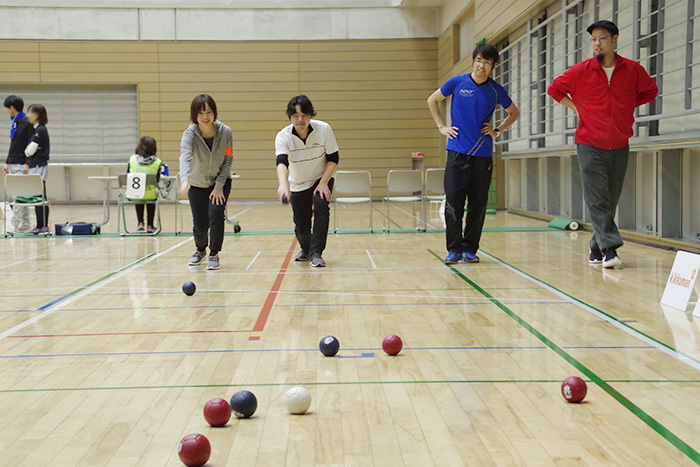
Hearing this, it might seem similar to curling, but the rules are slightly different.
In Boccia, where you place the white jack ball on the court first changes the flow of the game. You can also use your own ball to knock the jack ball and move it to a position that gives you an advantage. This can lead to comebacks, turning the game upside down in an instant.
Furthermore, in team play, which position throws, when they throw, and how they throw it all become major factors deciding victory or defeat.
"Hmm, maybe I can win after all."
That was my honest thought when I first practiced. I'm good at rolling balls straight, even if they lack power—like in bowling or golf. Trying boccia, I was amazed. The ball rolled right where I imagined, and I genuinely believed I could win at least one game.
Yes, the charm of boccia lies in how it makes you think, "Hmm, this might be easy at first glance."
It looked easy, but it was actually a battle of wits.
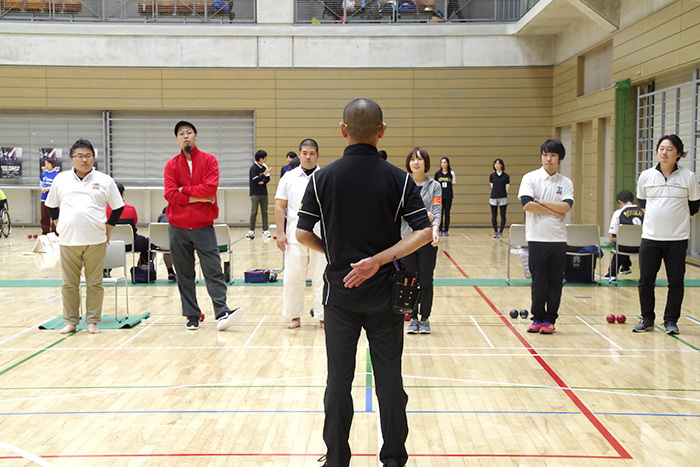
The referee's signal marked the start of the game.
First, the opposing team, going first, throws their jack ball.
"Wait, isn't that way too far!?"
We were shaken. Even though we threw just like in practice, the jack ball was completely out of reach. Just when we thought we'd hit it, it veered wildly off course. Everyone's throws rolled all over the place, as if by magic.
We were completely swallowed up by the competitive atmosphere. Actually, besides the jack ball being far away, there was another reason. That was having opponents on both sides. On the court, you line up alternately with your opponents. Meaning, when it's your turn to throw, the enemy's gaze suddenly focuses on you from both sides. An indescribable tension. So, the result was a crushing 0-4 defeat.
We left the court looking visibly dejected. I was surprised at how down I felt myself. Boccia looks simple, like anyone could play it. That's where the trap lay. Boccia is actually a battle of wits. Strategy is everything. We had one more preliminary match left. We reset our mindset and reevaluated our strategy. Right, we were a team formed by a planner, a copywriter, and an art director. Strategy formulation is second nature to us in our day jobs. We didn't care if it seemed embarrassing. If it meant getting one win. So, the strategy we adopted was...
"Place the jack ball closest to the front."
One point won through strategy.
The second match began at the referee's signal.
Feigning a long throw, I plop it down. I drop the jack ball right in front of me. I hear snickers from my opponents.
That's fine.
Perhaps the other members were getting used to the match atmosphere, or maybe it was just because the jack ball was close, but their throws shone. The result: "Bocchare Shiodome" scored its first point. We were surprised ourselves that things unfolded exactly as planned.
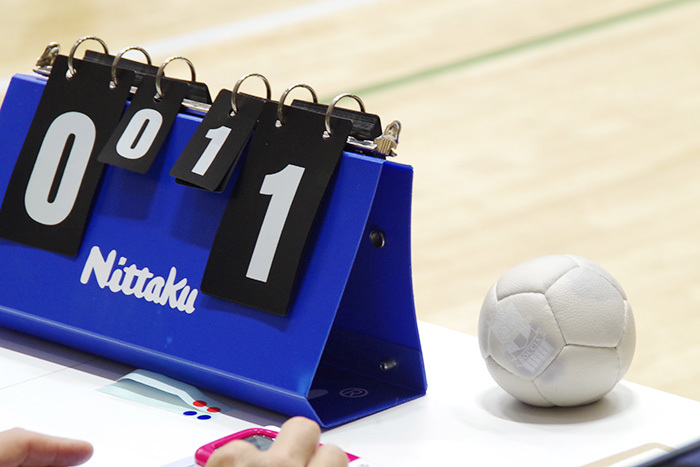
But our joy was short-lived. In the second end (Tokyo Cup matches consist of two ends), the opposing team threw their jack ball far away, and before we knew it, they scored two points. The match ended 1-2.
Although we lost in the end, we were thrilled with the single point we earned together, and the whole team finished the match with smiles. As we left the court, we were already buzzing with excitement, completely hooked on boccia: "That throw was good here," "Maybe we should try this instead," "Oh, first we need to get uniforms made!"
Someday, it will be an Olympic sport.
Experiencing boccia made me realize something.
Boccia has no concept of handicaps. Looking around the venue, there were teams with age gaps like parent and child, teams mixed with able-bodied and disabled players, co-ed student teams, and more. Boccia allows throwing by hand, kicking with the foot, or throwing while seated in a chair – anything goes. According to those familiar with the game, throwing while seated provides stability and reduces wobble. I see. I realized that could also be a strategic choice.
Because anyone can play, individuality shines through. And that individuality becomes strategy.
Boccia is fun to watch, but playing it is way more exciting. We all talked about how, if the number of players keeps growing regardless of age, gender, or disability, maybe one day boccia becoming an Olympic sport isn't just a dream.
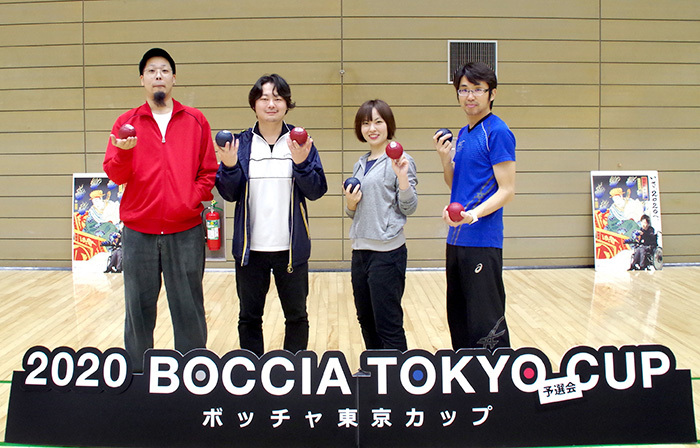
To you, who read this article to the very end. Why not give boccia a try sometime? You'll definitely get hooked!
Was this article helpful?
Share this article


Newsletter registration is here
We select and publish important news every day
For inquiries about this article
Back Numbers
Author

Satomi Kinoshita
Dentsu Inc.
First CR Planning Bureau
Copywriter