
Note: This website was automatically translated, so some terms or nuances may not be completely accurate.
Deepening Understanding of the Sport and Diversity through Hands-on Experiences "Para Sports Media Forum ~ 5-a-side Soccer ~" Held
Dentsu Inc. Public Relations and the Para Sports Promotion Network held the 25th "Para Sports Media Forum ~ 5-a-side Soccer ~" in Tokyo on February 18.
This forum, held under the approval of the Japan Disabled Sports Association, aims to promote media understanding of parasports competitions and para-athletes while improving coverage conditions. Each session focuses on a single sport. This time, the theme was "5-a-side soccer (blind soccer)."
Five-a-side soccer is a sport for both visually impaired and sighted individuals. Its rules were unified in the early 1980s, spreading primarily across Europe and South America. It became an official Paralympic sport at the 2004 Athens Games, with Brazil winning gold medals in four consecutive editions. The Japanese national team is set to make its Paralympic debut at Tokyo 2020.
Each team consists of four field players (FP) wearing blindfolds, a goalkeeper (GK) who is either sighted or visually impaired, a guide positioned behind the opposing team's goal, and a coach positioned outside the side fence of their own half. In Japan, sighted players can also play wearing blindfolds. However, in international competitions, only players medically certified as B1 (totally blind to light perception: vision limited to sensing light) are eligible to participate. The rules are based on 5-a-side mini soccer (futsal), but with the following differences:
・A special ball that makes a rustling sound when rolled is used
・To avoid dangerous collisions, FPs must call out "Boí!" (Spanish for "Go!") when approaching an opponent with the ball
・FPs wear an eye mask; teams are structured for cooperation between visually impaired and sighted players
・Fences approximately 1 meter high are installed along both sidelines to prevent the ball from going out of bounds and to help players understand the pitch size and orientation
・Protective headgear is worn to prevent head injuries (mandatory only under Japanese domestic rules)
In Forum Part 1, Reiko Takahashi, Public Relations Director of the Japan Blind Soccer Association; Masatoshi Kenmochi, Head of the D&I Business Division; and Kazuki Teranishi, a designated player for the Japanese national team, discussed the rules of the sport and the mindset required.
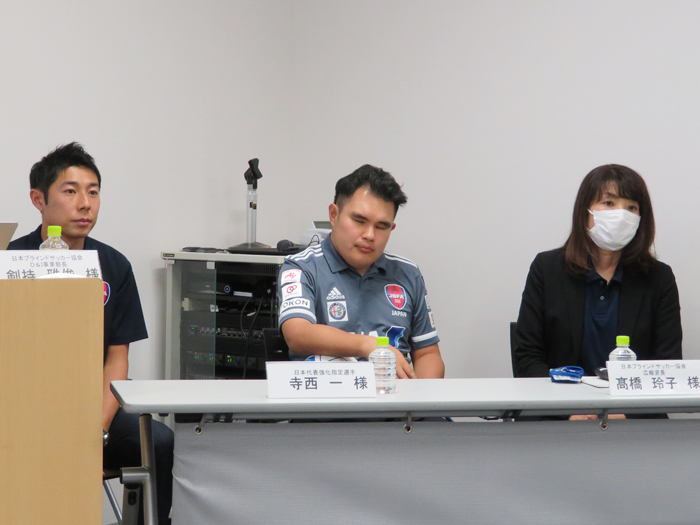
Mr. Kenmochi explained that Japan's disabled population is roughly equivalent to the number of people with the surnames Sato, Tanaka, Suzuki, and Takahashi. "While many people have friends with these four surnames, few have friends with disabilities. This signifies that people with disabilities and able-bodied individuals are not 'mingling'. Through blind soccer, we aim to realize a society where visually impaired and able-bodied individuals naturally mix and build relationships like friends, without hesitation," he stated.
Player Teranishi shared how he started blind soccer: "I began out of curiosity when a dorm instructor suggested it during my second year of junior high." Initially, he just played. However, upon entering university and meeting people with disabilities and individualities he hadn't known before, he decided he wanted to build a society where diverse people are accepted within the world of soccer. This led him to start working at the Japan Blind Soccer Association. Currently, as a designated national team training player, he aims for Paralympic gold while also serving as staff for the association.
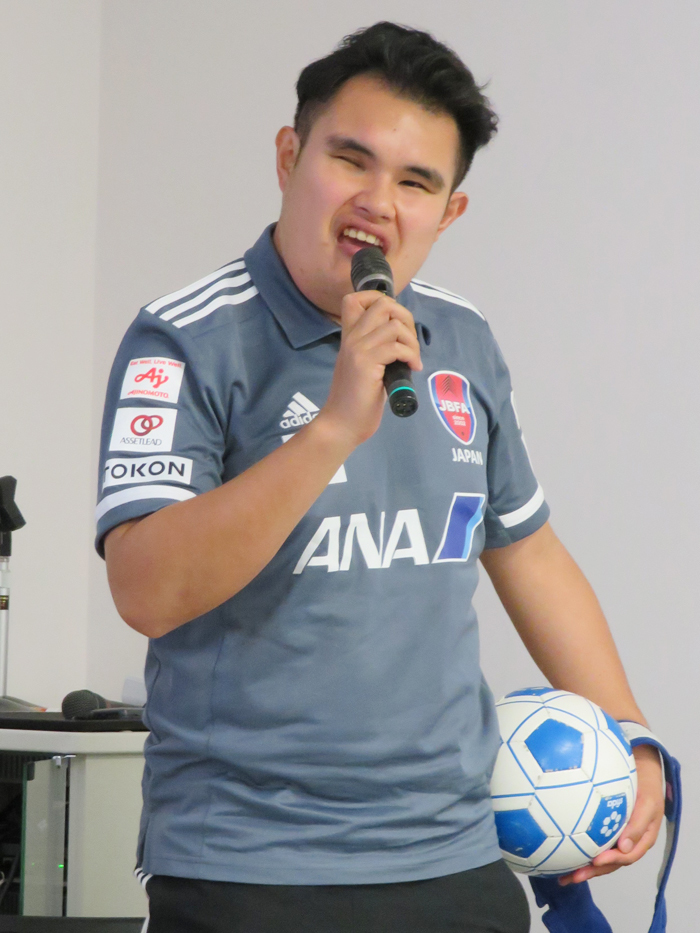
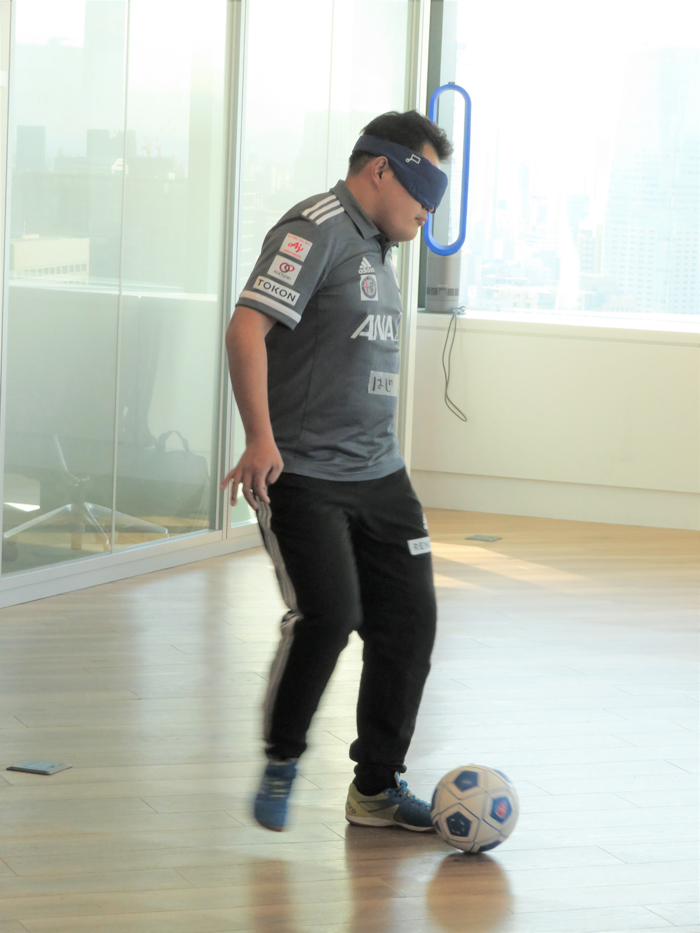
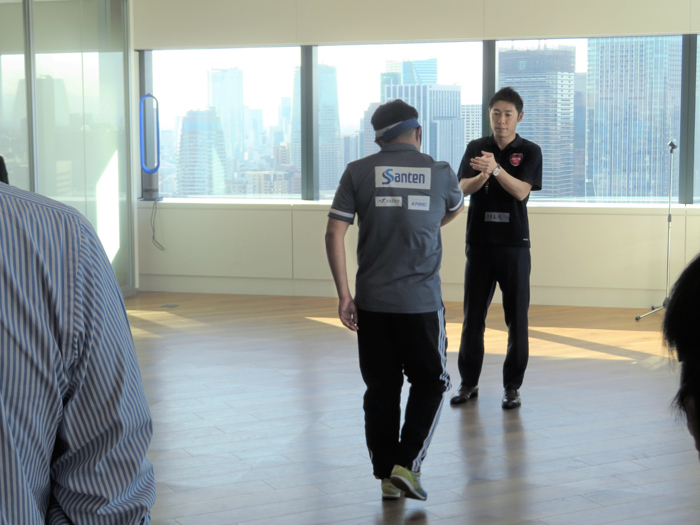
Part 2 of the forum featured an experience session of "OFF T!ME," a training program for the general public and working adults that sees 20,000 participants annually. OFF T!ME involves moving around, running, and kicking a blind soccer ball while wearing an eye mask. Participants initially felt uncertain about moving with their vision lost, but enjoyed new discoveries that fostered understanding of diversity as they tackled various challenges.
Was this article helpful?
Share this article


