Note: This website was automatically translated, so some terms or nuances may not be completely accurate.
 Dentsu Inc. BX/DX Webinar 2021: "Disruptive & Sustainable Business Transformation from the Consumer Perspective" [1/1]
【Dentsu Inc. BX Webinar】 What is the disruptive transformation required at this major societal turning point?

As society faces a period of significant transformation, what is necessary to make non-discontinuous change achievable alongside big ideas, while focusing on the very nature of corporate existence and unseen challenges?
This report covers a webinar where we examined Dentsu Group's unique approaches to "BX (Business Transformation)" and "DX (Digital Transformation)" from various perspectives, featuring professionals from different fields and external guests.
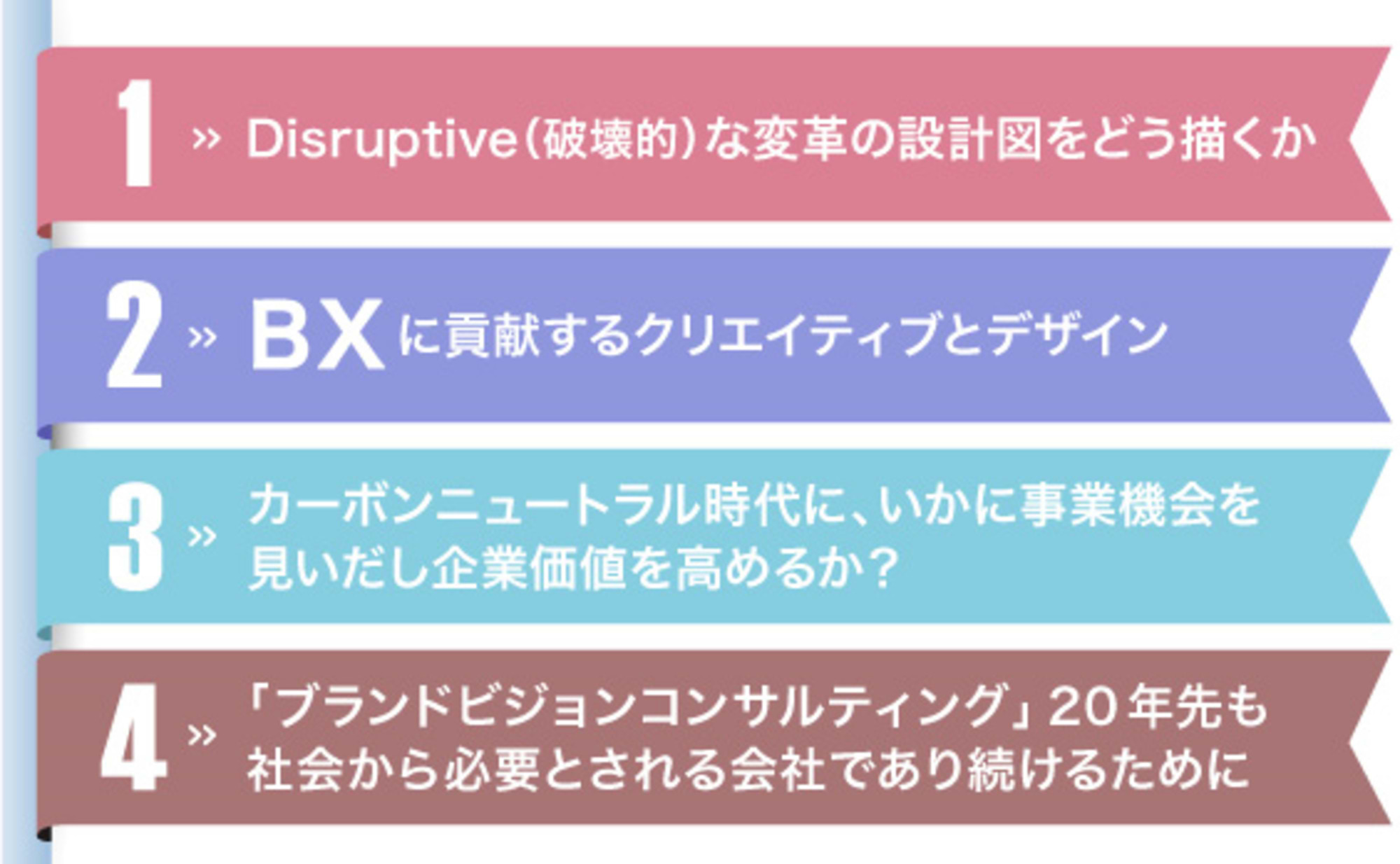
This article provides a digest of four programs from the "BX" segment.
How to Design Blueprints for Disruptive Transformation

The speaker was Shingo Yamahara from Dentsu Inc. Business Design Square, who handles the formulation of corporate mid-term management strategies/business strategies, new business ideation, and execution plan creation. Based on Dentsu Inc. Business Design Square's co-creation transformation methodology, the "Disruptive Approach," he introduced how to draw blueprints for initiating disruptive transformation from within the company.
When designing a blueprint for disruptive transformation, it is crucial to focus on the "3 Ps":
・Purpose: Redefining the target corporate vision and setting goals
・Picture: Creating a future business blueprint to enhance the resolution of the vision
・Process: Creating concrete scenarios and execution plans to realize the future business vision
When designing this blueprint around these pillars, the foundational perspective must be "Value" (customer value). "Some might think, 'Value now?'" said Mr. Yamahara. "But as DX is being promoted across all companies in recent years, the purpose behind it—'Why are we doing DX?'—is increasingly being questioned. More executives are rethinking 'What value should we provide?'" He emphasized that drawing a transformation blueprint from a "Value Driven" (customer value-centric) perspective, starting with "Value: the value customers receive," is essential.
After outlining the characteristics of each of the "Three Ps," Yamahara discussed two key points for unlocking the "human power" that generates value and drives transformation. The first is "enhancing intrinsic motivation." It is crucial to identify individuals within the company who are eager to challenge themselves with transformation and new initiatives, and to create mechanisms that motivate their passion.
The second is "extra-legal" HR and organizational responses. In large corporations, existing systems are often overly optimized for traditional core businesses, frequently creating processes that hinder disruptive transformation. For creating new business domains, it becomes necessary to introduce bold HR and evaluation systems to build new frameworks.
Finally, Mr. Yamahara emphasized the importance of "continuously pulling the lever of transformation."
"When driving transformation, conflicts often arise with existing organizational culture and systems. While respecting the company's cherished ideas and philosophy, it is crucial to create a unique vision for transformation and its path forward, building it cross-functionally within the company," (Mr. Yamahara)
Creative and Design Contributing to BX

Next up was a session by Naoki Mori, Creative Director/Business Development Director at BXCC (Business Transformation Creative Center), and Dai Hirose, Creative Director and Copywriter. Their theme was: "What value does creativity provide to BX? What role is expected of creativity?"
BXCC is a team tasked with providing Dentsu Inc. unique creative resources to BX. It aims to create value through collaboration between creators—such as copywriters, art directors, and CM planners—and new talent including business consultants, UX designers, and engineers.
First, what exactly do Dentsu Inc.'s creative teams do? Hirose introduced the company's approach to creativity and the role of creators within BXCC.
Mr. Hirose stated that the fundamental premise is that people remember things and take action when their hearts are moved. Therefore, "moving people's hearts" is indispensable in business.
So when are people moved? It happens when they encounter the "essence" of something. The creator's role is to find the "essence" where a product and people intersect, generate ideas that move people from there, and guide solutions to challenges. However, Hirose noted, "Ideas that move people don't easily emerge from stacking logic. Because ideas require 'surprise'."
Especially in today's world, where many challenges cannot be solved through additive thinking, what is required is the ability to discover the "essence," generate "surprise," and make creative leaps. "In the BX domain too, ideas that appeal to human senses and solve problems are needed. Think logically as a foundation, then leap forward with ideas. That is the power we creators can bring to the BX domain," stated Hirose.
The latter half featured a Q&A talk session, and we present part of that discussion below.
Q. What role do copywriters play in business transformation?
Hirose: What I increasingly realize is that when formulating business strategy, passion, playfulness, and the energy people possess can sometimes get lost in documents. That's where copywriters come in – by crafting statements or slogans, or starting with advertising copy and working backwards. By injecting creativity in this way, we can develop strategies with a human touch.
Mori: Business consultants approach strategy by setting a 3-5 year goal as their compass to guide projects. Creatives, however, show us a shared vision for the goal that emotionally resonates and lifts our spirits. Now that you mention it, I've seen countless times where adding creative elements to "cold prose" generates the motivation needed to drive action.
Q. Why do creative expressions move people? Can they be leveraged in business?
Hirose: I believe it's because they contain "surprise" and "essence." Business moves forward by moving people's hearts, so I think it can be utilized in business for that very purpose.
Q. What kind of training do creators undergo?
Hirose: They focus on absorbing vast amounts of inspiration. It boils down to steadily building a large stockpile of ideas.
Mori: Creators practice input and output daily, right? I believe this creative thinking is also useful in logical fields like BX. When creating something new, relying solely on logical building blocks limits ideas, yet ideas alone sometimes lack feasibility. When specialists in logic and ideas work together, I think value can be multiplied exponentially.
How can we identify business opportunities and enhance corporate value in the carbon-neutral era?

Next to take the stage were Shingo Yamahara and Akihiko Fuchi from Dentsu Business Design Square. They were joined by Yoshihiro Nobe from the strategic consulting firm Dream Incubator Inc. to discuss business transformation in the carbon-neutral era.
Since May 2021, Dream Incubator Inc. and Dentsu Inc. have been in a business partnership, launching the Sustainable Business Transformation team in August. This team aims to combine the strengths of both companies to support clients in expanding their top lines and creating new markets in the era of sustainability management.
With carbon neutrality now a core management agenda, the major challenge for companies is how to turn this significant trend into a tailwind.
Mr. Nobe stated, "While societal changes due to COVID-19 had a major impact, carbon neutrality represents an even greater environmental shift demanding adaptation and response from diverse companies."
Mr. Fuchi explained, "When you get down to the core, the conditions for business operations become stricter." He emphasized the necessity for companies, noting that simply proclaiming carbon neutrality does not create unique value. He stated that precisely because it is a difficult challenge requiring the creation of value exceeding the costs of switching to renewable energy and resource circulation, companies must tackle it early, even if it means feeling their way forward, as a management issue.
Mr. Yamahara stated, "While corporate growth and sustainability were previously even thought to be inversely proportional, the key going forward will be discovering new opportunities and creating value that allows both to coexist."
So, how should disruption be achieved? The key lies in "discovering opportunities." Merely adding carbon neutrality as a variable while maintaining existing business cycles only creates risks like increased costs. Therefore, it is crucial to identify non-linear "opportunities" within current business cycles and use carbon neutrality as a catalyst for creating new businesses.
However, in practice, many companies face significant barriers, such as "environmental investments cannot be recouped in the short term" and "no precedent = no demand, so decisions cannot be made," as Mr. Fuchi explains based on practical experience.
Mr. Nobe also commented, "I believe this is truly a critical challenge. However, there is no neat solution available. We are in a phase where we must tackle the absence of answers and the lack of precedents. Therefore, we believe the only way forward is to proceed step by step, trial and error, alongside our clients."
Mr. Yamahara added, "We frequently receive consultations on areas without precedent. Introducing something new into a business is challenging enough, but we must also tackle game-changing efforts across all fronts—considering shifts in consumer awareness and demand creation. It's not easy, but overcoming this opens the potential for significant market opportunities."
"The key is precisely how to solve these difficult problems with no clear answers. We divide the uncertainties within the company and the uncertainties in the market, synchronize both, make frequent decisions, and build a process to update business opportunities and strategies. We can design flexible projects tailored to specific business challenges and phases, so we'd be delighted if you would consult with us," said Mr. Fuchi.
"Brand Vision Consulting" To remain a company needed by society 20 years from now

The final presentation is by Mr. Nao Hatae of Dentsu Consulting Inc. Dentsu Consulting Inc. is a consulting firm invested in by the Dentsu Group. It supports clients' business growth and value creation by combining Dentsu's strengths—such as consumer insights, creativity, and execution capabilities—with the objectivity, analytical skills, and business planning expertise unique to the consulting industry.
The theme of this session, 'Brand Vision Consulting,' is one of Dentsu Consulting Inc.'s solutions. Mr. Hatae states, "It truly symbolizes the intersection of Dentsu Inc. and the consulting industry, and is well-suited for disruptive business transformation."
Amid the COVID-19 pandemic, when people were urged to refrain from non-essential outings, consumers began rigorously judging whether the products and services around them were truly necessary. As a result, the importance of "purpose" – a concept already gaining attention before the pandemic – has rapidly increased.
Brand Vision Consulting sets the client's purpose as the highest-level concept and goal, but it doesn't stop at mere slogans. It concretely derives the path to realization and accompanies the client throughout. Specifically, it creates outputs through the following three processes:
1. Defining Purpose: Envisioning the Desired Future
The key is not to focus on "objective justice" applicable to any company, but to confirm the "subjective justice" only they can achieve. This requires starting not from "what society or customers want," but from "what future they want to realize through their business." Then, they lead society and customers toward that future. "Forcing 'what must be done' rarely works. What moves people is a proactive, positive sense of mission or desire. Through facilitation, we draw out the subjective justice and desired future that exist as intent within our clients' management and employees. We reconcile any discrepancies among employees and then define the derived vision in words that carry effective weight both inside and outside the company," says Mr. Hatae.
2. "How do you define your identity?"
"We often hear from clients, 'We have a purpose and vision, but figuring out how to realize them is difficult.' Indeed, concretization can be more challenging than setting goals," states Hatae. He attributes this difficulty to the significant gap between the highly abstract question, "What future do we want to achieve?" and the concrete operational reality of "What should we tackle tomorrow?" He explains, "To bridge this gap, it's crucial to re-examine 'In what market (Where) will our business operate, and what role (Who) will it play?' "If we can define 'what kind of business/entity we are' as the overarching strategy for realizing our desired future, it becomes easier to then discuss mid-term plans and business portfolios as the methodologies to achieve that vision," says Hatae.
3. Concretization/Materialization into "Tomorrow's Operations"
This marks the stage for concrete methodologies like mid-term plans, business portfolios, new products, and new ventures. "This concretization phase is where the synergy between Dentsu Inc.'s idea generation and conceptual power and the consultant's ability to validate business viability and create plans truly comes into play," says Mr. Hatae. A key feature of the concretization/materialization phase is the wide range of options available, tailored to client needs and challenges. These span from company-wide business portfolio and HR/organizational functional strategies down to the development of individual new products/services. Hatae envisions actively pursuing collaboration with Dentsu Inc.'s TFP Bureau and leveraging the methodology of Advisor Shuji Hamaguchi.
In this way, "Brand Vision Consulting" supports the derivation of unique growth strategies for each client, distinct from other companies, through these three processes. Mr. Hatae concluded, "By combining Dentsu Inc.'s strengths with consulting expertise, we will assist you in becoming a company that society will still need 20 years from now. We encourage you to utilize our services."

Was this article helpful?
Share this article


Newsletter registration is here
We select and publish important news every day
For inquiries about this article
Author
Dentsu Inc. BX/DX Webinar 2021
Disruptive & Sustainable Business Transformation from the Consumer Perspective