
Note: This website was automatically translated, so some terms or nuances may not be completely accurate.
 How Seniors Are Mastering Smartphone Use [1/4]
Over 70% Use Cashless Payments! Investigating the Reality of Seniors and Smartphones
Tetsu Saito
The Dentsu Inc. Senior Lab is an internal cross-functional lab launched in January 2022. It builds upon the long-standing achievements of the Dentsu Inc. Senior Project, established in 2000, while significantly expanding its membership. Currently, it focuses on solving social issues in a super-aged society through various insight analyses and solution development. In July 2022, as part of the Dentsu Inc. Senior Lab's first survey, the 'Survey on the Actual State of Senior Smartphone Life' ( survey overview here ) was conducted. ( Press release here )
This series will explore, based on the survey results, the current smartphone ownership and usage patterns among modern seniors and how this has changed their quality of life. This installment introduces the reality of the rapidly advancing smartphone usage among seniors.
<Table of Contents>
▼Rapid Growth in Senior Smartphone Usage in Recent Years
▼97.8% Use Smartphones "Almost Every Day"
▼Main Uses: Communication with Close Friends and Family, Information Search
▼Surprisingly Advanced Cashless Payments Among Seniors
▼Peak Smartphone Replacement Period: 5-10 Years Ago
▼More Women Report "Mastering" Smartphone Use
Rapid Growth in Smartphone Use Among Seniors in Recent Years
In recent years, smartphone usage among seniors has rapidly increased. In 2021, smartphone usage rates were 70.0% for those in their 60s and 40.6% for those in their 70s. Compared to 2019, two years prior, these figures show an increase of over 10 percentage points each. This may reflect smartphones gaining renewed attention as a means of connecting people during the ongoing unique circumstances of the COVID-19 pandemic.
(Source: Ministry of Internal Affairs and Communications "Communication Usage Trends Survey: Reiwa 1/Reiwa 3" Internet Device Usage)
Seniors are often perceived as digitally challenged. However, smartphone usage among the elderly is growing. How are today's seniors mastering smartphone use? What changes in their lives do they feel through smartphone usage?
97.8% use smartphones "almost every day"
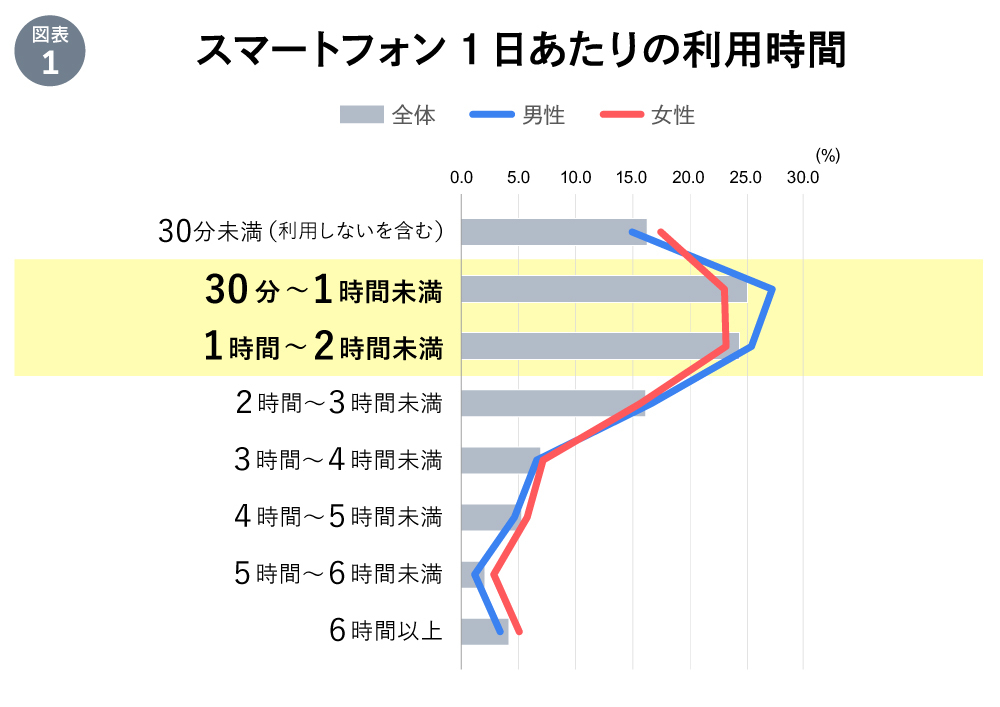
First, regarding smartphone usage frequency: 97.8% reported using their device "almost every day." For usage time, over half spent between 30 minutes and under 2 hours daily, revealing seniors' regular smartphone integration into daily life.
Breaking it down by gender, women tend to report using their phones for 3 hours or more more often. In fact, it seems a certain number of seniors may be quite dependent on their phones. (Figure 1)
Main uses are communication with close contacts and information searches
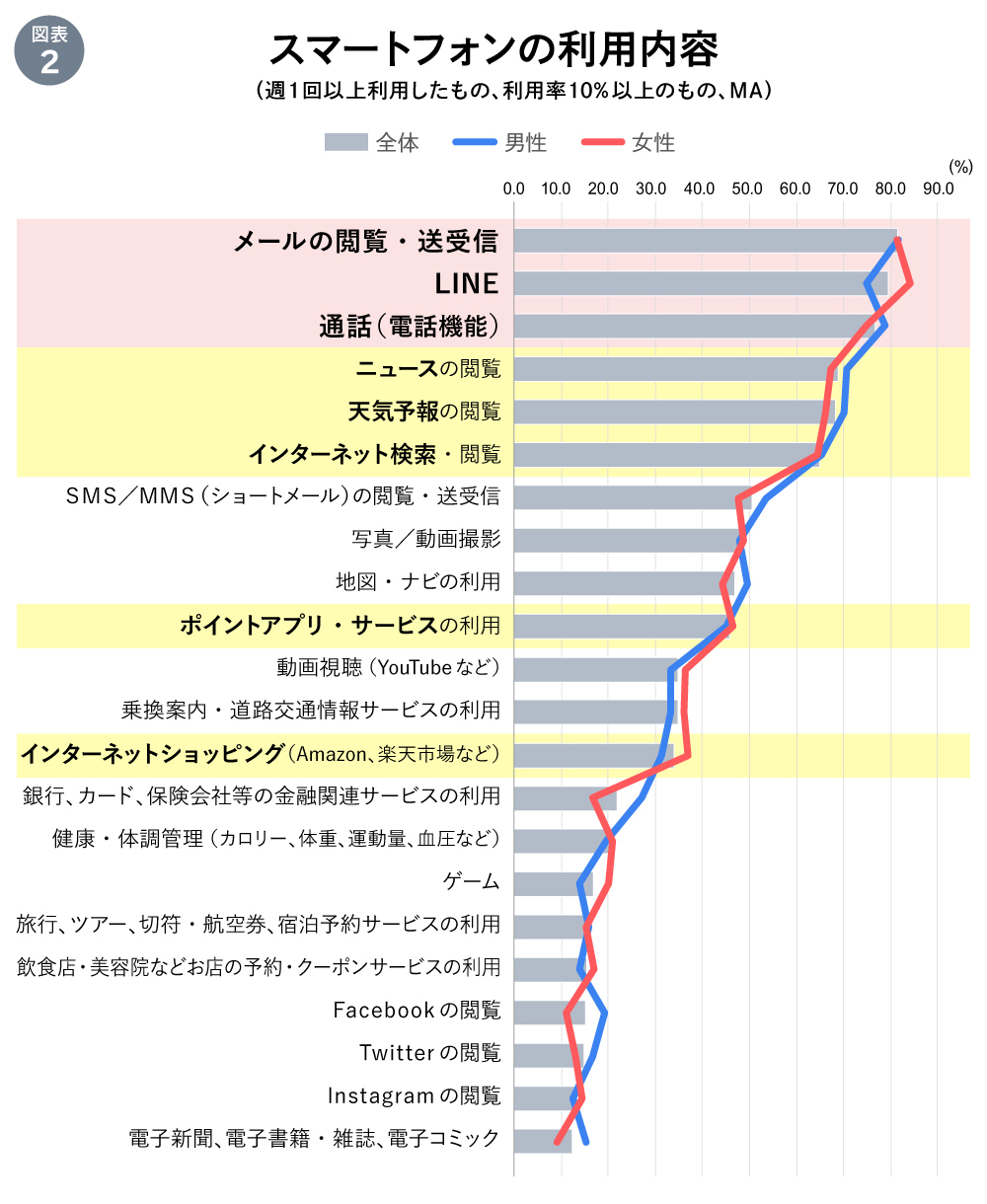
So, what exactly are they using smartphones for? Looking at the "Usage Activities" in Figure 2, the top three are "Email," "LINE," and "Phone Calls." "LINE" usage is notably higher among women than men, indicating it is widely supported by many senior women as a communication tool.
Ranked fourth and beyond are "News browsing," "Weather forecast viewing," and "Internet search/browsing," continuing the trend of search and browsing activities. These tasks, traditionally performed on PCs, appear to have shifted to smartphones with their widespread adoption.
Furthermore, "Using point apps/services" and "Online shopping" account for about 30-40%, indicating that smartphone-based shopping-related activities are progressing reasonably well.
On the other hand, reservation-related activities like "booking tours" or "making restaurant/salon appointments," as well as using SNS like Facebook and Twitter, still don't have particularly high usage rates. It's fair to say that their current primary use is as a communication tool for close family and acquaintances, and as a tool for obtaining information.
Surprisingly Advanced Cashless Payments Among Seniors
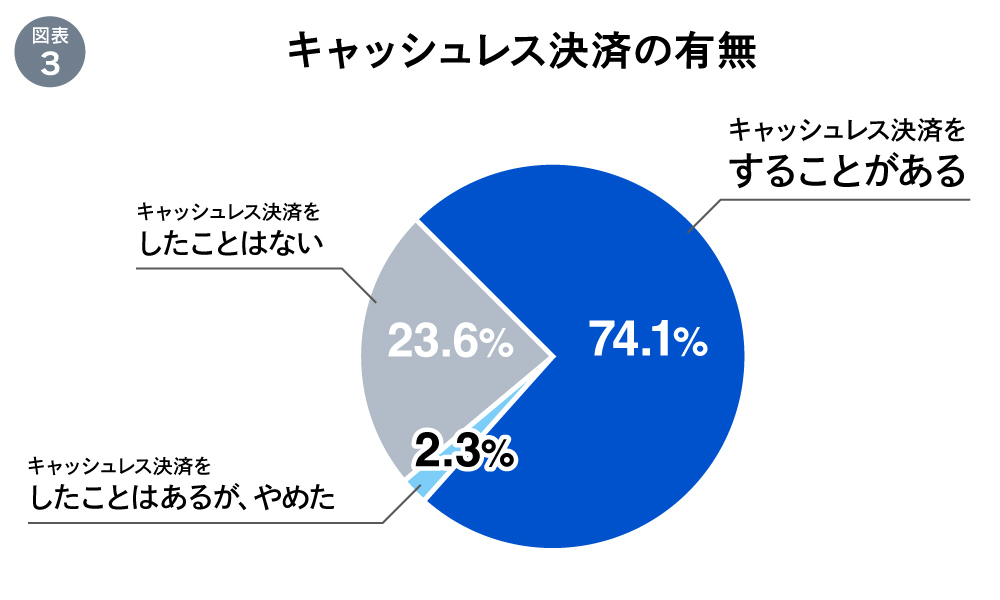
Amidst this, the experience with cashless payments was surprisingly high. A relatively large 74.1% of respondents overall answered that they had "used cashless payments" (Figure 3). Among payment types, "PayPay," "d-barai," "nanaco," and "auPay" showed relatively high usage rates.
So why is cashless payment progressing among seniors? One possible reason is the provision of My Number Points, aimed at promoting the adoption of My Number Cards in recent years.
Looking at the My Number card adoption rate by age group, while the overall average is 45.9%, the rate generally exceeds 50% among those in their 60s to early 80s (Source: Ministry of Internal Affairs and Communications, My Number Card Issuance Status as of the end of July 2022). This trend may also be driving cashless usage among the senior generation.
Peak smartphone switch period was 5-10 years ago
Figure 4 shows responses to questions about smartphone ownership timing. Regarding when respondents switched to smartphones, "over 10 years ago," "about 3-5 years ago," and "very recently to less than 3 years ago" each accounted for just over 20%. However, "5-10 years ago" was the most common at 33.1%, indicating that the peak period for seniors switching to smartphones was 5-10 years ago.
Figure 5 shows the reasons for acquiring a smartphone, broken down by length of ownership. The highest response rate across all time periods was "because everyone around me started using smartphones." However, the shorter the ownership period, the higher the proportion citing "because my family recommended it" or "because the previous mobile phone (feature phone) was expensive." This highlights seniors switching to smartphones often due to family encouragement or incentives like discount plans.


Women are more likely to report being "very proficient" with smartphones
Figure 6 shows responses regarding smartphone proficiency.
The percentages for "I think I can use it well (including 'very well')", "I can't say either way", and "I think I can't use it well (including 'not at all')" were each roughly one-third.
Figure 7 breaks down who feels proficient and who feels less so by gender and age group.
Overall, a higher percentage of men responded "I think I can use it well," while a higher percentage of women responded "I can't say either way." However, the percentage of women who responded "I think I can use it very well" was higher than that of men. Notably, the percentage of women in their 70s who responded "I think I can use it well" was also high.


This time, we explained the overall usage situation based on the Dentsu Inc. Senior Lab "Survey on the Actual State of Senior Smartphone Life" report. Next time, we will focus on explaining how seniors' lives have changed through smartphone use.
[Contact Us]
Dentsu Inc. Senior Lab
Email: senior-lab@dentsu.co.jp
[Survey Overview]
Survey Title: "Survey on the Actual State of Smartphone Use Among Seniors"
Target Area: Nationwide, Japan
Subject Criteria: Men and women aged 60–79 who use smartphone functions other than email and calls at least once a week
Sample Size: 1,000 respondents
Survey Method: Online survey
Survey Period: July 11, 2022 - July 12, 2022
Research Agency: Cross Marketing Inc.
If you enjoyed this article, you might also like:
・How well do seniors use smartphones? ~ The latest media trends among seniors ~

Was this article helpful?
Share this article


Newsletter registration is here
We select and publish important news every day
For inquiries about this article
Author