
Note: This website was automatically translated, so some terms or nuances may not be completely accurate.
 How Seniors Are Mastering Smartphone Use [2/4]
Senior Women Finding Happiness Through Smartphone Use
Tetsu Saito
This series, based on the results of the "Survey on the Actual State of Smartphone Use Among Seniors" conducted by Dentsu Inc. Senior Lab ( survey overview here ), explores the current smartphone usage patterns of seniors and how it has changed their quality of life. Last time, we explained the actual state of smartphone use among seniors. This time, we will look at how seniors' lives have changed through smartphone use.
Senior Women Who Feel Their Lives Have "Improved" with Smartphones
Figure 1 shows responses to whether life has improved or worsened due to owning a smartphone. The results reveal that while only a few percent responded that life has worsened, 60-70% responded that life has "improved a lot" or "improved." Furthermore, the percentage of women who responded "improved a lot" is significantly higher than that of men.

Women Find "Communication and Emotional Value" in Smartphones, Men Find "Practical Value"
So, specifically, what aspects of smartphones did people perceive as benefits that made them feel their "life improved"? Figure 2 shows this broken down by gender.
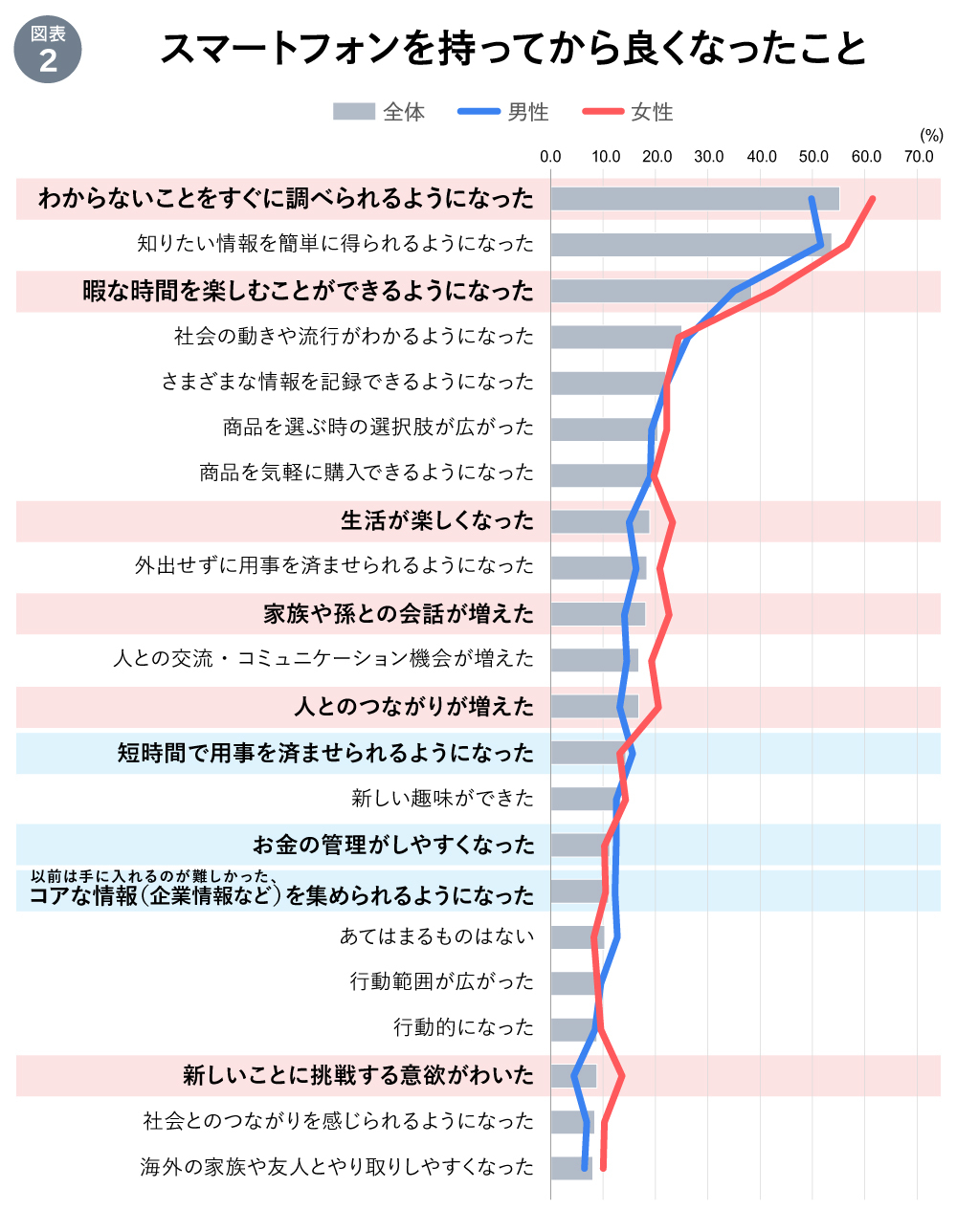
As immediately apparent, women show higher scores across more items. Notably, women scored higher than men on items like: "I can look up things I don't know immediately," "My life has become more enjoyable," "Conversations with family and grandchildren have increased," "I can enjoy my free time more," and "My connections with people have increased." Additionally, they scored higher on items such as "I feel motivated to try new things."
Conversely, men scored higher than women on items like "I can finish errands in less time," "Managing money has become easier," and "I can gather niche information (like corporate data) that was previously hard to obtain." Observing these differences reveals that women primarily find emotional value in smartphones through increased conversation and connections, while men find rational value.
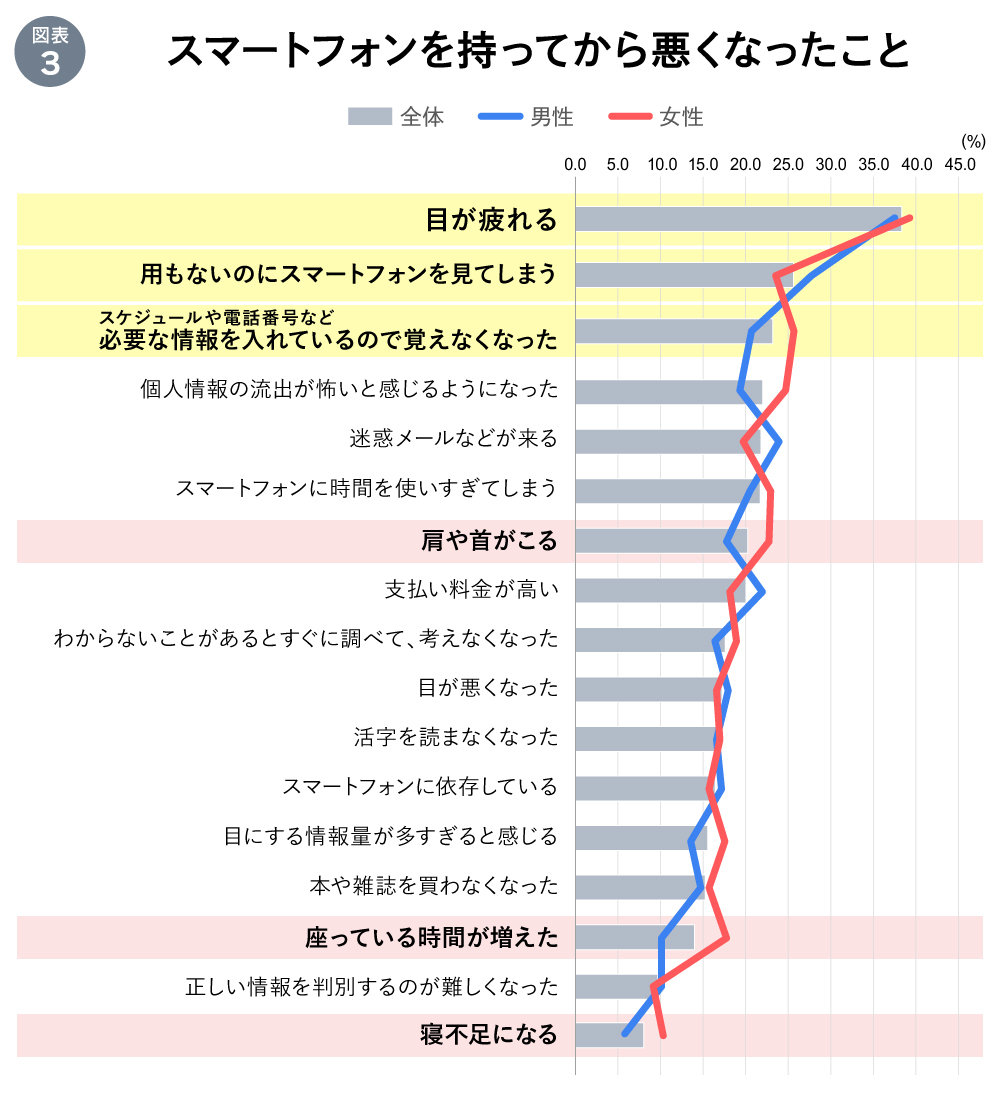
Regarding negative effects, the top three complaints were "eye strain," "checking my phone even when I have no reason to," and "I no longer remember necessary information like schedules or phone numbers because I store them on my phone." These are likely similar concerns across generations.
While gender differences in negative impacts aren't as pronounced as in positive ones, more women reported "increased sitting time," "stiff shoulders or neck," and "insomnia." Daily usage exceeding three hours is also more common among women, highlighting that some senior women experience fatigue and sleep deprivation due to excessive use.
What kind of apps "enrich life"?
Figure 4 shows the app names (open-ended responses) cited by those who answered "significantly improved/improved" regarding "changes in life due to smartphone ownership," organized again by gender and category.
For men, search, SNS, news, and online shopping ranked highly, showing they value highly convenient apps. In contrast, for women, SNS topped the list instead of search, with LINE being overwhelmingly the most cited. Video viewing, ranked 7th for men, was 3rd for women, and cooking apps ranked 6th. This highlights how women utilize smartphones more broadly across daily life compared to men.
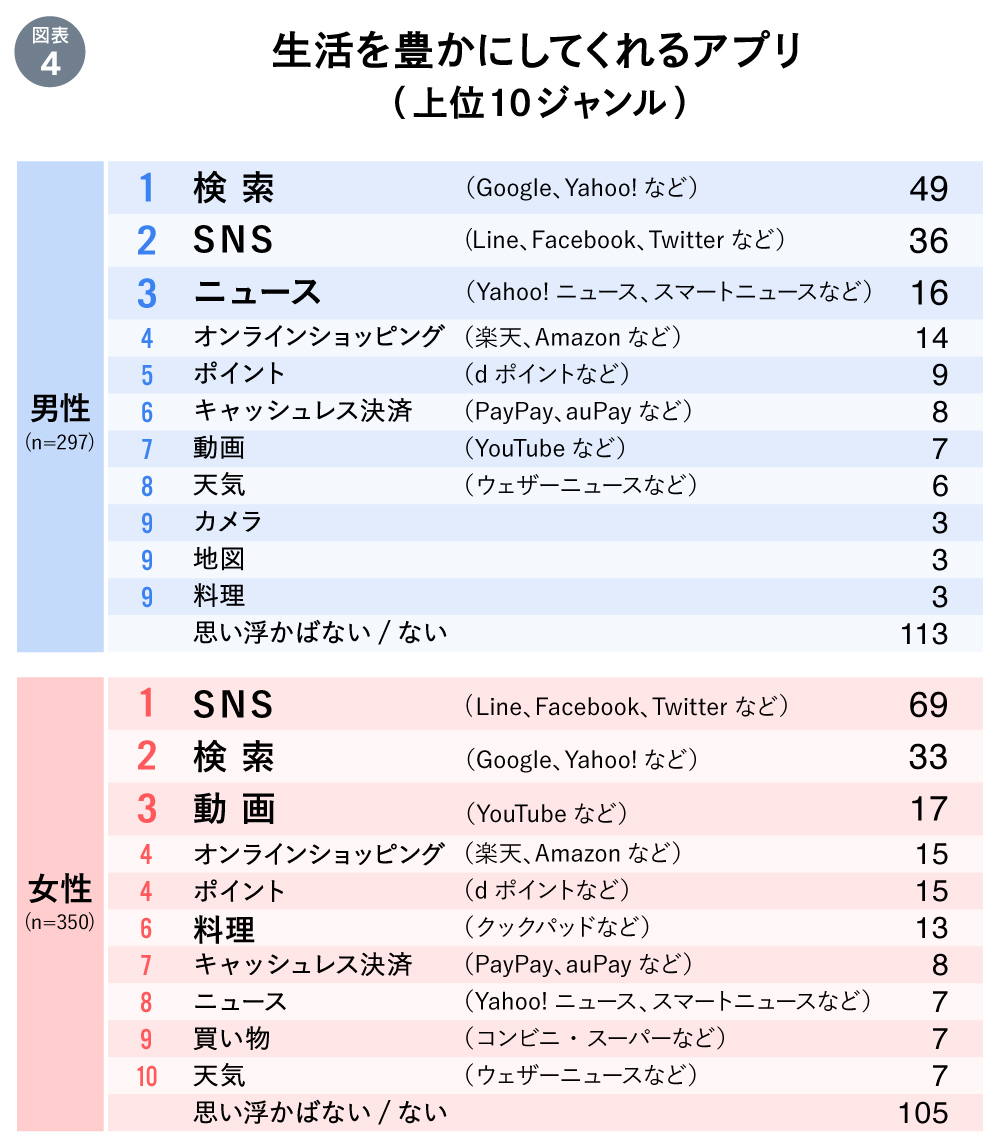
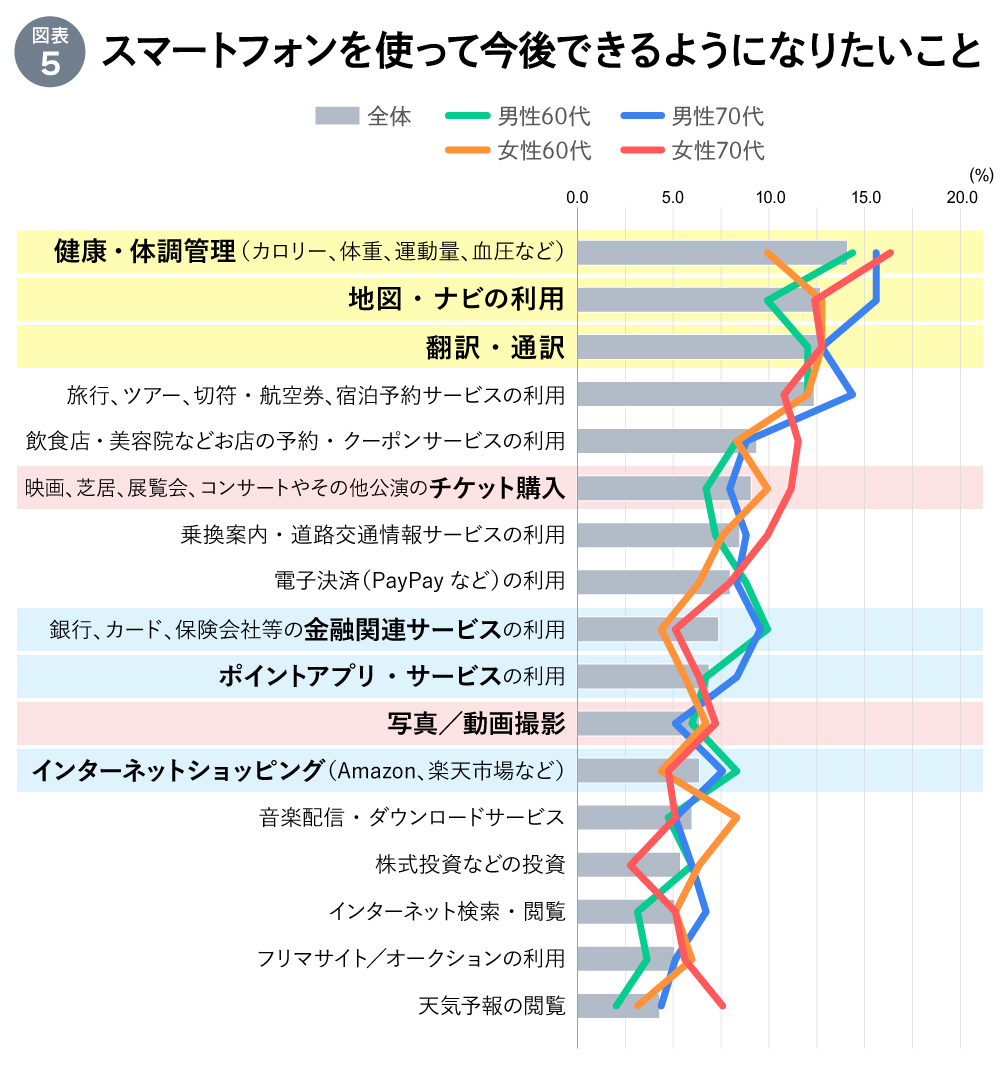
Figure 5 shows what respondents want to be able to do with their smartphones in the future (apps they want to try), broken down by gender and age group. This reveals that for both genders, those in their 70s have higher app usage needs than those in their 60s. The app with the highest demand is "health and wellness management," followed by "maps and navigation" and "translation and interpretation."
Looking at gender differences, men show higher demand for "financial services," "point apps/services," and "online shopping," while women express greater interest in "ticket purchasing" and "photo/video capture." However, even the highest usage intentions are only around 16%, making it difficult to conclude that potential demand is exceptionally high.
To promote the adoption of these apps, it is crucial to clearly communicate the benefits of consistent use beforehand.
"Life has improved significantly." Senior women are making extensive use of smartphones
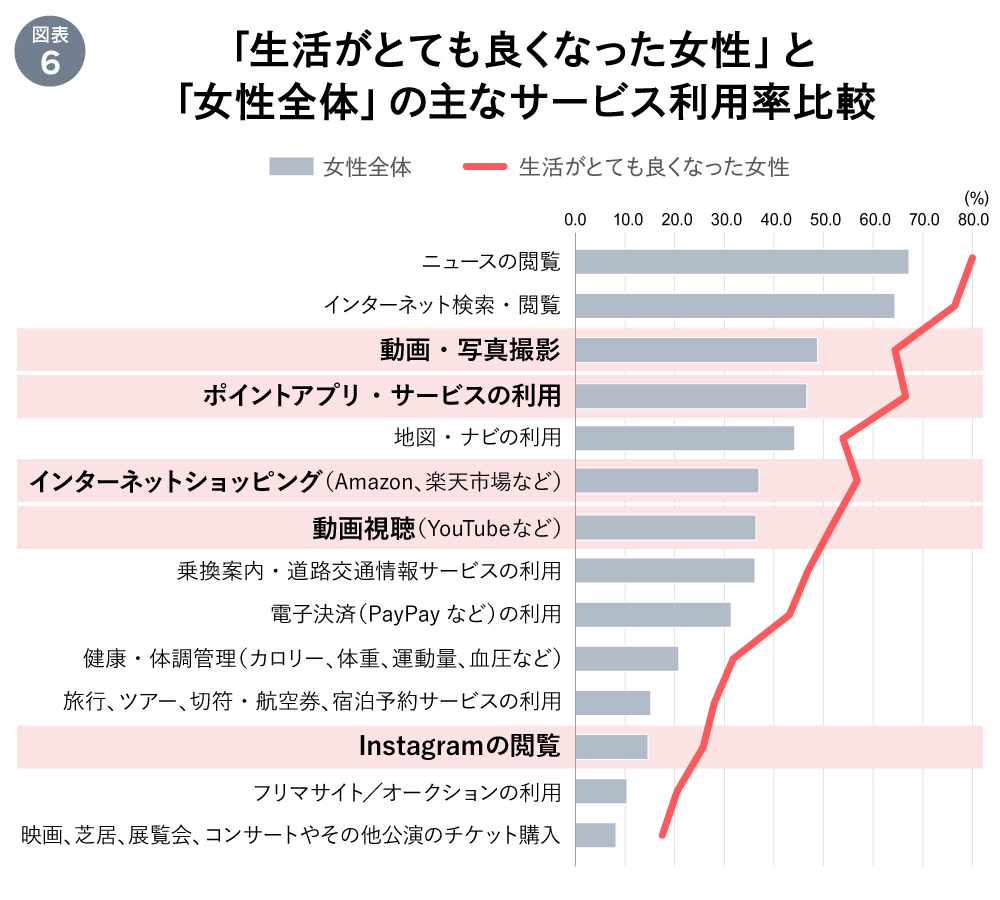
As seen so far, women overwhelmingly outnumbered men in reporting that owning a smartphone improved their lives. Finally, we'd like to introduce the characteristics of women who responded that their lives "improved significantly."
The majority of these women consider themselves "proficient smartphone users." They also showed very high usage rates for "online shopping (Amazon, Rakuten Ichiba, etc.)," "point apps/services," "video viewing (YouTube, etc.)," and "video/photo taking." Notably, their social media viewing, particularly Instagram, was also high.
To reiterate, while women generally value smartphones primarily as communication tools for social networking and conversation, the senior women who reported their lives "improved significantly" were found to feel this improvement came from mastering even more apps, extending to "entertainment" and "shopping."
This concludes the overview of the "Survey on the Actual State of Senior Smartphone Use." For more detailed information, please contact Dentsu Inc. Senior Lab below.
【Contact Us】 Dentsu Inc. Senior Lab
Email: senior-lab@dentsu.co.jp
[Survey Overview]
Survey Title: "Survey on the Actual State of Smartphone Use Among Seniors"
Target Area: Nationwide, Japan
Subject Criteria: Men and women aged 60–79 who use smartphone functions other than email and calls at least once a week
Sample Size: 1,000 respondents
Survey Method: Online survey
Survey Period: July 11, 2022 - July 12, 2022
Research Agency: Cross Marketing Inc.

Was this article helpful?
Share this article


Newsletter registration is here
We select and publish important news every day
For inquiries about this article
Back Numbers
Author