Note: This website was automatically translated, so some terms or nuances may not be completely accurate.
 How Seniors Are Mastering Smartphone Use [3/4]
Visualized in the Data Clean Room! Cluster Classification of Seniors × Smartphones
This series, based on various surveys conducted by Dentsu Inc. Senior Lab, explores the smartphone usage patterns of today's seniors and how it has changed their lives. This installment attempts to cluster seniors (classify them by type) based on actual smartphone usage data.
About Dentsu Inc. Senior Lab:
An internal cross-functional project at Dentsu Inc. focused on developing insights and solutions through research on seniors, with the theme of "Solving Social Issues in a Super-Aged Society."
Homepage: https://www.projects.dentsu.jp/seniorlab/
Smartphone Usage Patterns: The Key to Senior Marketing Clustering
Smartphones have become critically important in corporate marketing activities, and senior marketing is no exception.
As introduced in the first installment, as smartphone adoption among seniors advances, some are now adept at using payment apps. On the other hand, there are seniors who barely use apps at all, relying their phones solely for calls.
Thus, seniors cannot be lumped together as a single group. When devising marketing strategies, it is essential to cluster them based on their actual smartphone usage patterns—that is, to perform "clustering." Therefore, Dentsu Inc. Senior Lab classified smartphone users according to their app usage and visualized the characteristics of each cluster (age composition, number of days various apps are launched, movement data based on location information, attitudes and values, etc.).
Using the data clean room "dds," seniors were classified into 4 clusters
Recently, more seniors are using shopping-related apps like e-commerce and QR code payments, as well as informational apps like news and weather forecasts. However, some use these apps daily, while others have only used them a few times.
Therefore, to uncover the "true smartphone usage patterns of seniors" – difficult to grasp through asking surveys alone – we leveraged the data clean room "dds (docomo data square)" for analysis. By utilizing NTT DOCOMO's vast data infrastructure, which many seniors use, we achieved senior clustering.
Within "dds," various service data is linked to arbitrary ID groups assigned to users (such as account identifiers or advertising identifiers; personal information like names, addresses, phone numbers, or email addresses is not included), enabling analysis while protecting privacy.
※1 = Asking survey
Surveys conducted using questionnaires or interviews. Often used to understand usage patterns, conscious awareness, and verify effectiveness.
※2 = Data Clean Room
※3 = dds (docomo data square)
A data clean room provided by NTT DOCOMO. As Japan's first initiative (※4), it enables analysis of the effectiveness of advertising from TV commercials, web ads, and digital OOH ads to actual product purchases at the individual ID level (※5) within a privacy-protected environment.
For details: https://dentsu-ho.com/articles/7972
※4 = As of August 3, 2020, according to docomo research.
※5 = An ID refers to any unique identifier assigned to a user, such as an account identifier or advertising identifier. The ID itself does not contain personal information such as the user's name, address, phone number, or email address.
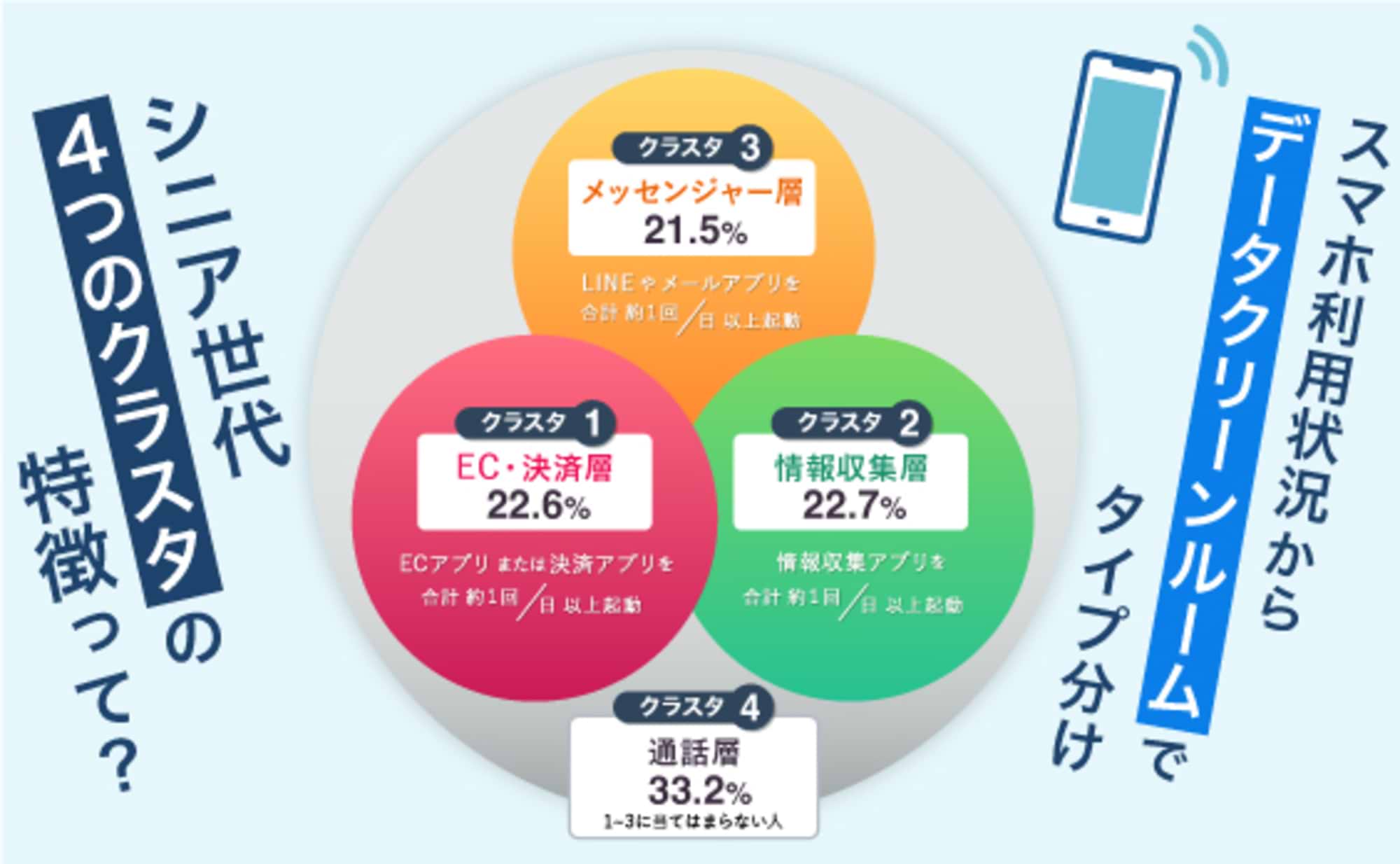
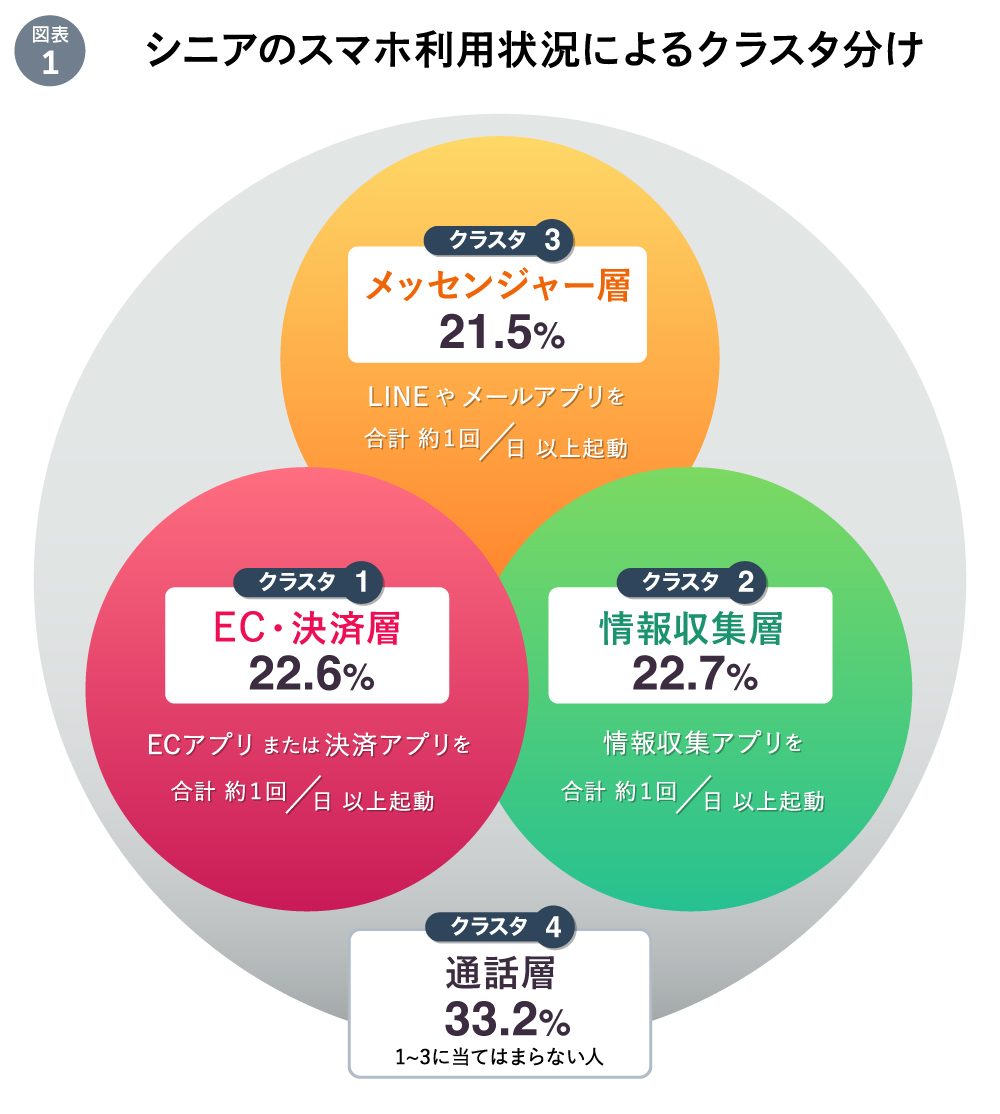
Clusters were broadly categorized into the following four groups, starting with the most smartphone-literate segment:
① "E-commerce & Payment Users (22.6%)" who routinely use e-commerce and code payments
② The "Information Gathering Group (22.7%)" who actively access desired information via apps like news services
③ The Messenger Segment (21.5%), whose primary uses are LINE and email
④ The "Callers" (33.2%), who use their phones only for calls, similar to feature phones.
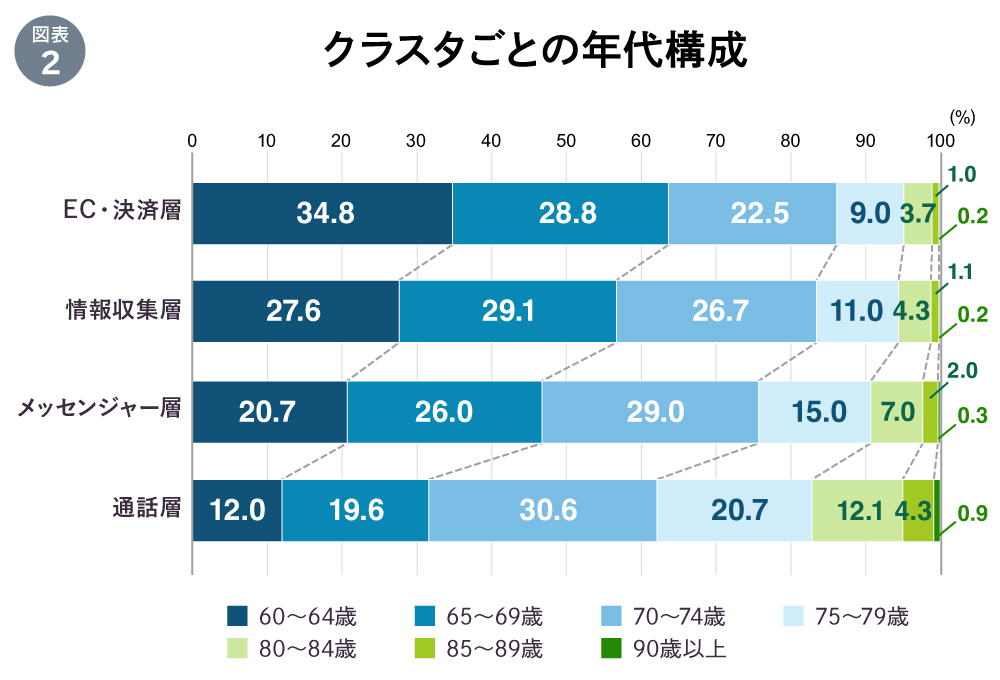
The age composition of each cluster shows: ① The E-commerce/Payment Group is relatively the youngest, followed by ② the Information Gathering Group and ③ the Messenger Group. In the ④ Call Group, those aged 70 and above account for about 70%. This confirms that smartphone literacy and usage patterns correlate with age. Let's now examine the characteristics of each cluster.
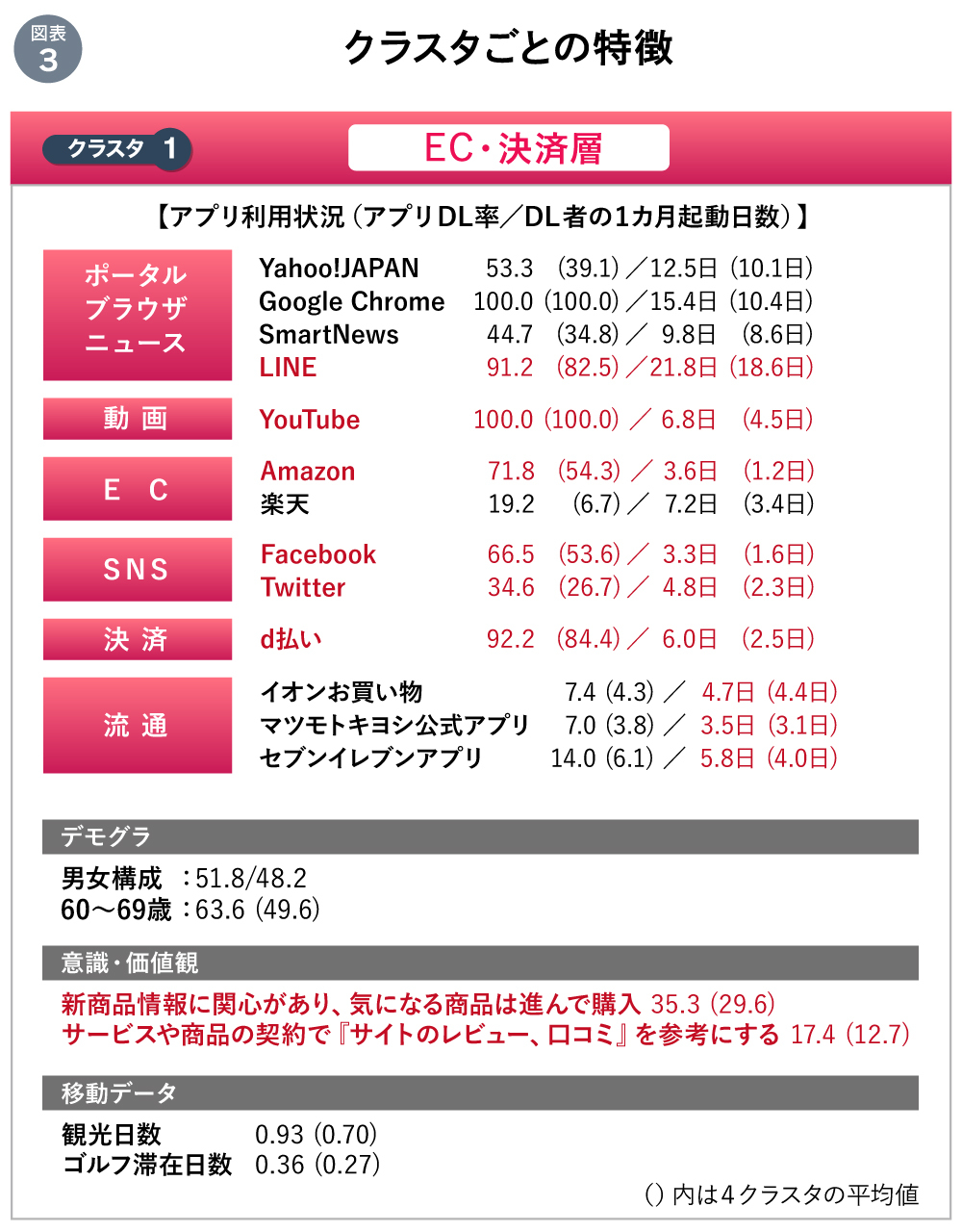
The active, new-product-sensitive "E-commerce/Payment Group" and the "Messenger Group" that frequently uses communication tools. Introducing the characteristics of the four clusters
① Characteristics of the "EC/Payment Layer"
This is the youngest cluster among the four, with those aged 60-69 comprising over 60%. They are highly information-sensitive, extensively using YouTube, SNS, cashless payments, and e-commerce. They also frequently launch apps, skillfully integrating smartphone apps into their daily lives.
They show strong interest in new products and often reference reviews and word-of-mouth when shopping. Mobility data also reveals active lifestyles, including tourism and golf. This group defies the stereotype of "seniors needing special treatment."
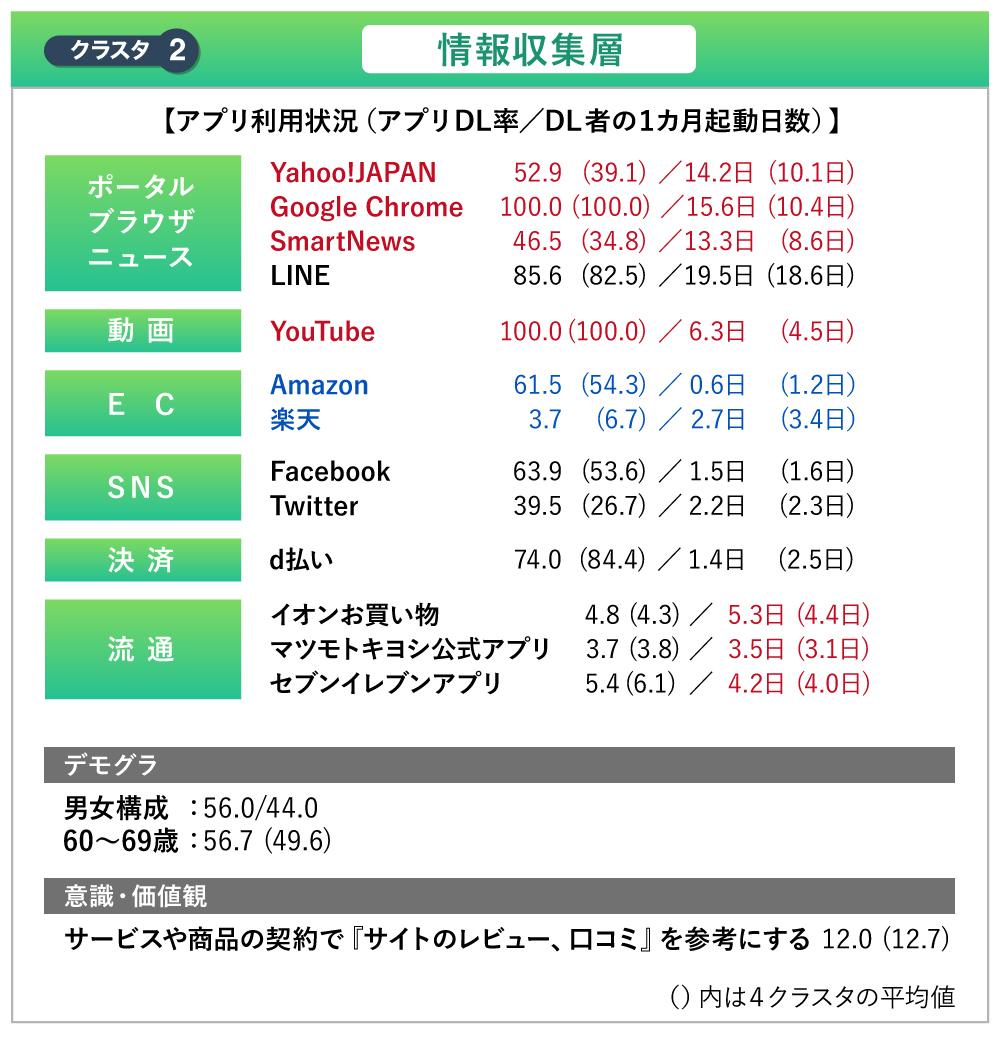
② Characteristics of the "Information Gathering Group"
Those aged 60-69 make up 56.7%, representing over half of this group. Their smartphone use is primarily for information gathering, with higher usage rates for portal apps and news apps. They also use YouTube regularly.
However, they have yet to fully embrace e-commerce or mobile payments. This suggests many are comfortable using smartphones to some extent but still harbor concerns about mobile payments. They also appear to rely less on website reviews and user feedback.
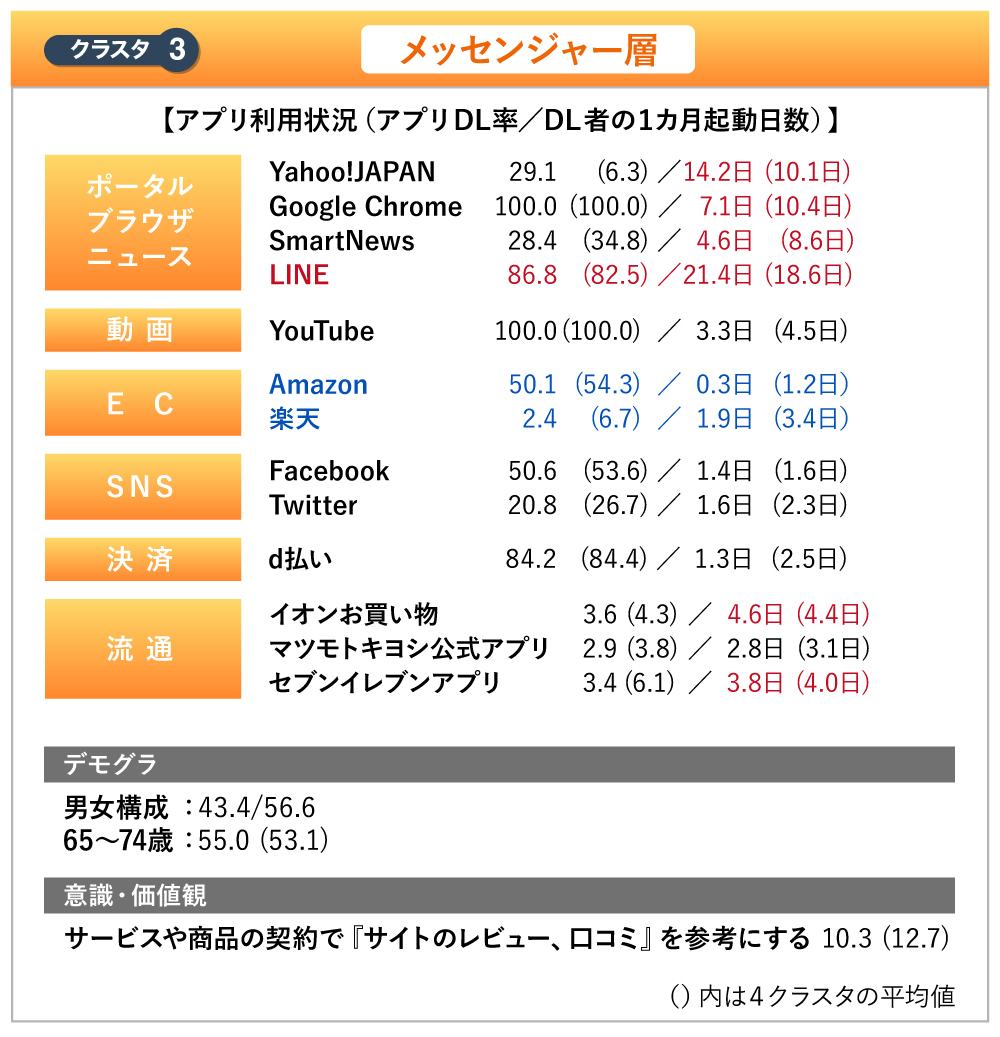
③ Characteristics of the "Messenger Segment"
Those aged 65 to 74 make up about half of this group, and it is the only cluster with more women than men. Usage of messenger tools like LINE is high, suggesting they use them to stay in touch with friends and family. The primary purpose of smartphone use appears to be communication with friends and family. Similar to the "Information Gathering Group," e-commerce and mobile payments are not widely used.
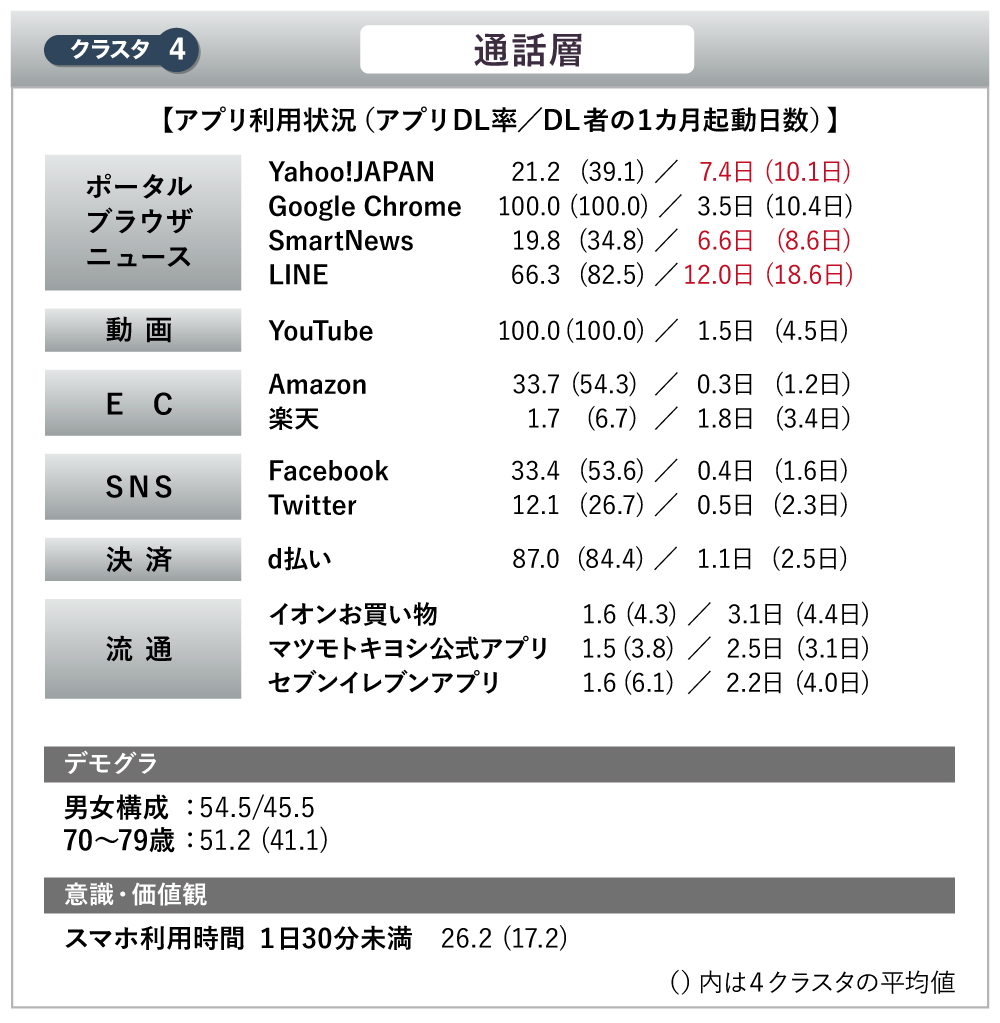
④ Characteristics of the "Callers"
This is the largest cluster among the four, including the highest proportion of older seniors, with those in their 70s making up about half. They tend to be less sensitive to new information and reluctant to try new products. Daily smartphone use is very brief, limited mainly to checking news and weather. App download rates are generally low, suggesting this group relies primarily on mass media for information gathering.
Evolve senior marketing through cluster-specific approaches!
As shown above, even within the "senior" demographic, smartphone usage varies significantly by individual. However, by examining and adjusting approaches tailored to each cluster based on their distinct smartphone engagement patterns, efficient and effective marketing becomes possible.
Next time, we'll introduce examples of approaches to each cluster using the data clean room "dds" and discuss PDCA.
As we rapidly enter the "era of 100 million smartphone users" through accelerated DX, we hope that through the evolution of senior marketing, "products and services that seniors will love" will become widely known. For any questions or feedback, please contact Dentsu Inc. Senior Lab.
[Contact] Dentsu Inc. Senior Lab: senior-lab@dentsu.co.jp Contact: Koiso / Matsumi
【Overview of Data Used for Analysis】
・Clustering and app usage data
Subjects: Docomo smartphone users aged 60 or older with accessible app logs
Period: September 1, 2021 - November 30, 2021
・Mobility data
Number of days within the period from December 1, 2021 to December 31, 2021
・Attitude and value data
NTT DOCOMO survey
Survey Period: October 2021 Target Population: Men and women aged 60 and over

Was this article helpful?
Share this article


Newsletter registration is here
We select and publish important news every day
For inquiries about this article
Back Numbers
Author

Tatsuya Koiso
Dentsu Inc.
First Integrated Solutions Bureau
Solution Director / Head of Dentsu Inc. Senior Lab