Note: This website was automatically translated, so some terms or nuances may not be completely accurate.
 How Seniors Are Mastering Smartphone Use [4/4]
A Smartphone-Based Marketing Solution for Seniors, Leading the Way in a Super-Aged Society
This series, based on various surveys conducted by Dentsu Inc. Senior Lab, explores the smartphone usage patterns of today's seniors and how it has transformed their lives. Previous installments covered the actual state of smartphone adoption among seniors and the categorization of usage patterns, which will be key to future marketing.
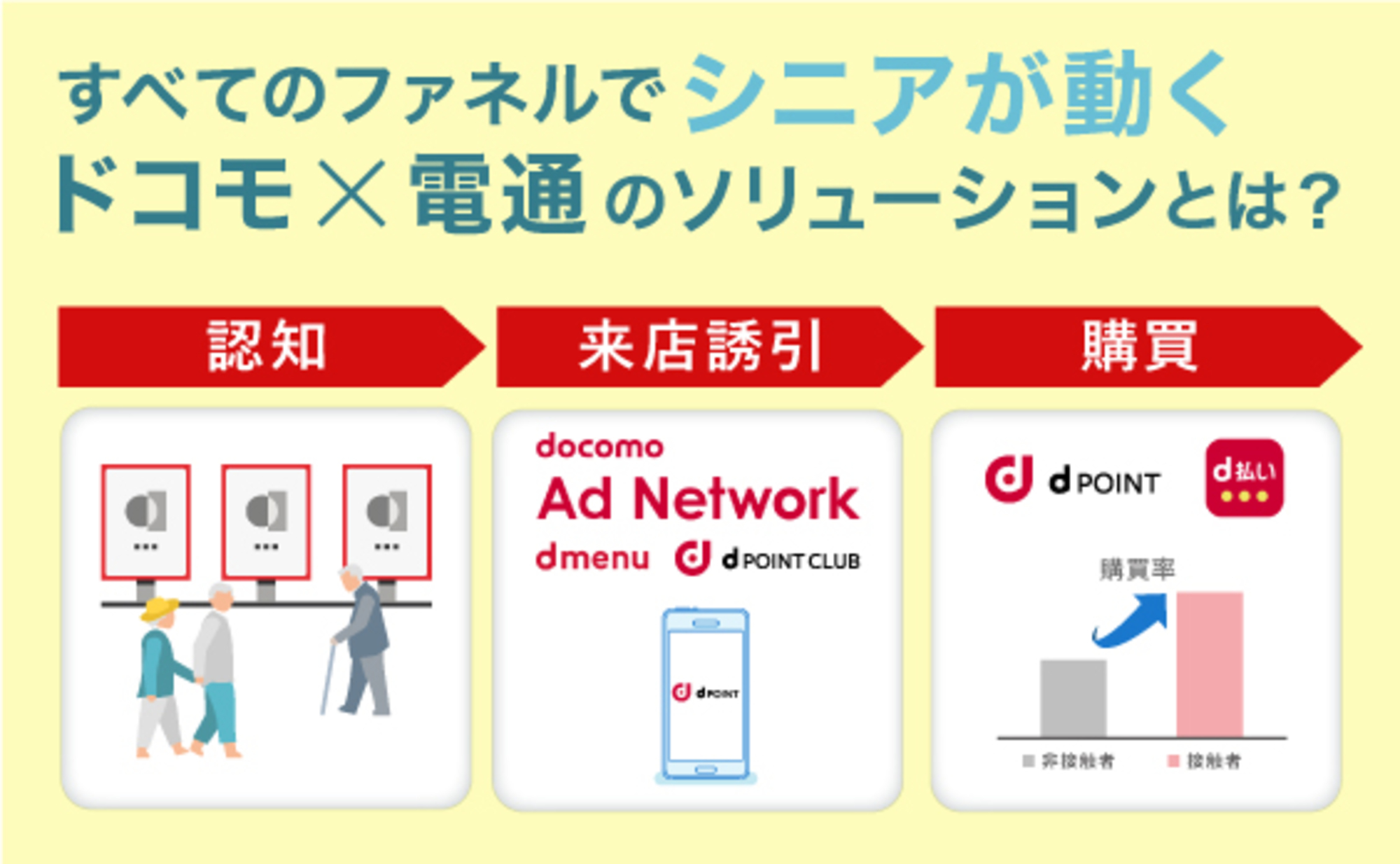
This time, we introduce the "Smart Senior Solution," a marketing solution for seniors utilizing the data clean room (※1) "dds (docomo data square※2)".
About Dentsu Inc. Senior Lab:
An internal cross-departmental project at Dentsu Inc. focused on "solving social issues in a super-aged society" through research on senior insights to develop various insights and solutions.
Website: https://www.projects.dentsu.jp/seniorlab/
※1 = Data Clean Room
※2 = dds (docomo data square)
A data clean room provided by NTT DOCOMO. As Japan's first initiative (※3), it enables analysis of ID-level (※4) effectiveness measurement—from exposure to TV commercials, web ads, and digital OOH ads to actual product purchases—in an environment that safeguards privacy.
For details: https://dentsu-ho.com/articles/7972
※3 = As of August 3, 2020, according to Docomo research.
※4 = An ID refers to any unique identifier assigned to a user, such as an account identifier or advertising identifier. The ID itself does not contain personal information such as the user's name, address, phone number, or email address.
Leverage data to reach seniors across the entire funnel!
As introduced in our previous article, smartphone usage among seniors has become commonplace.
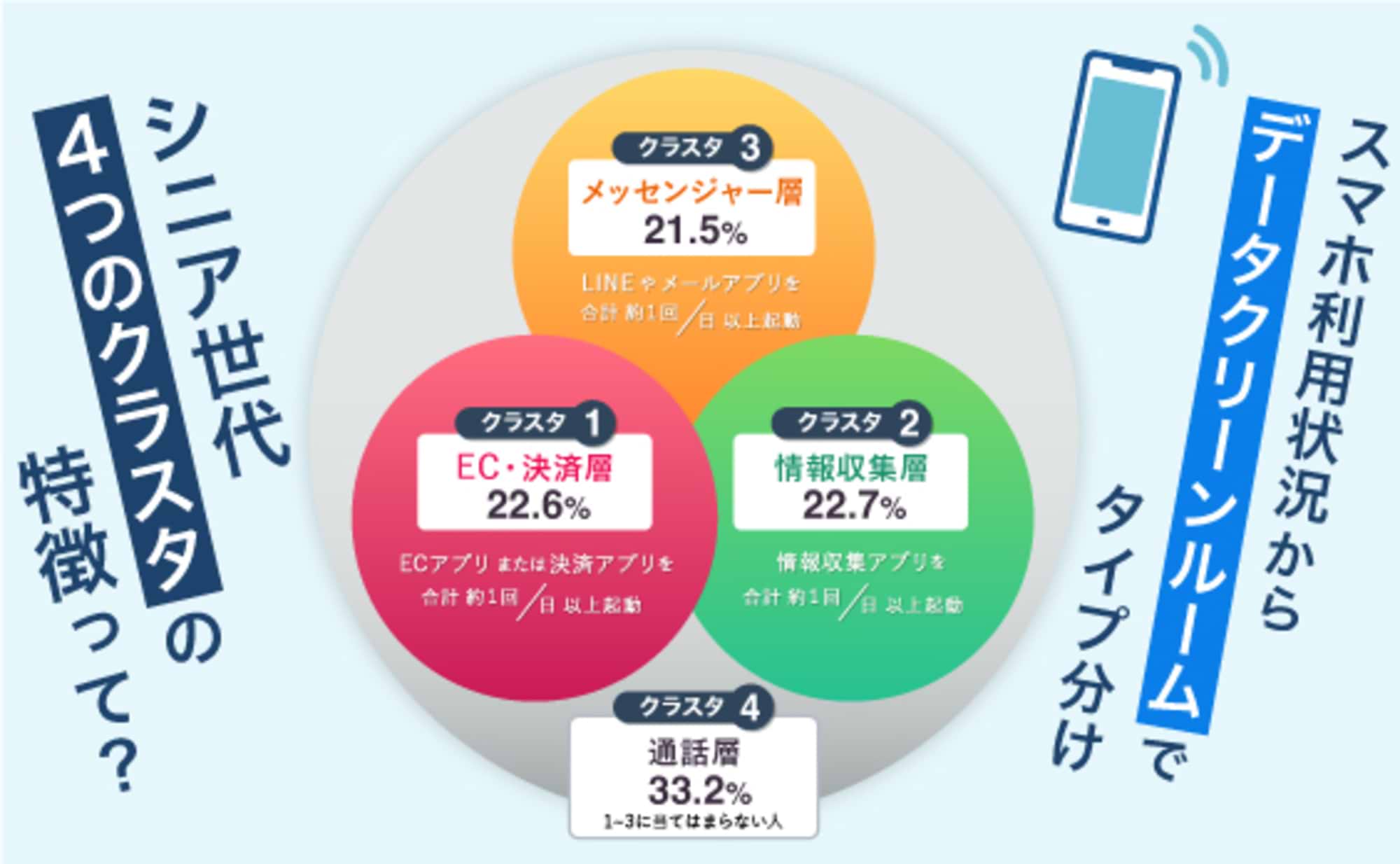
At Senior Lab, we used dds to categorize seniors into four clusters based on their smartphone usage patterns. Among these, the "E-commerce & Payment Segment" (※5), who proficiently use e-commerce and code payments, and the "Information Gathering Segment" (※5), who actively access information via apps like news and information services, regularly utilize browser apps, news apps, and SNS. This demonstrates that digital media is effective for reaching seniors.
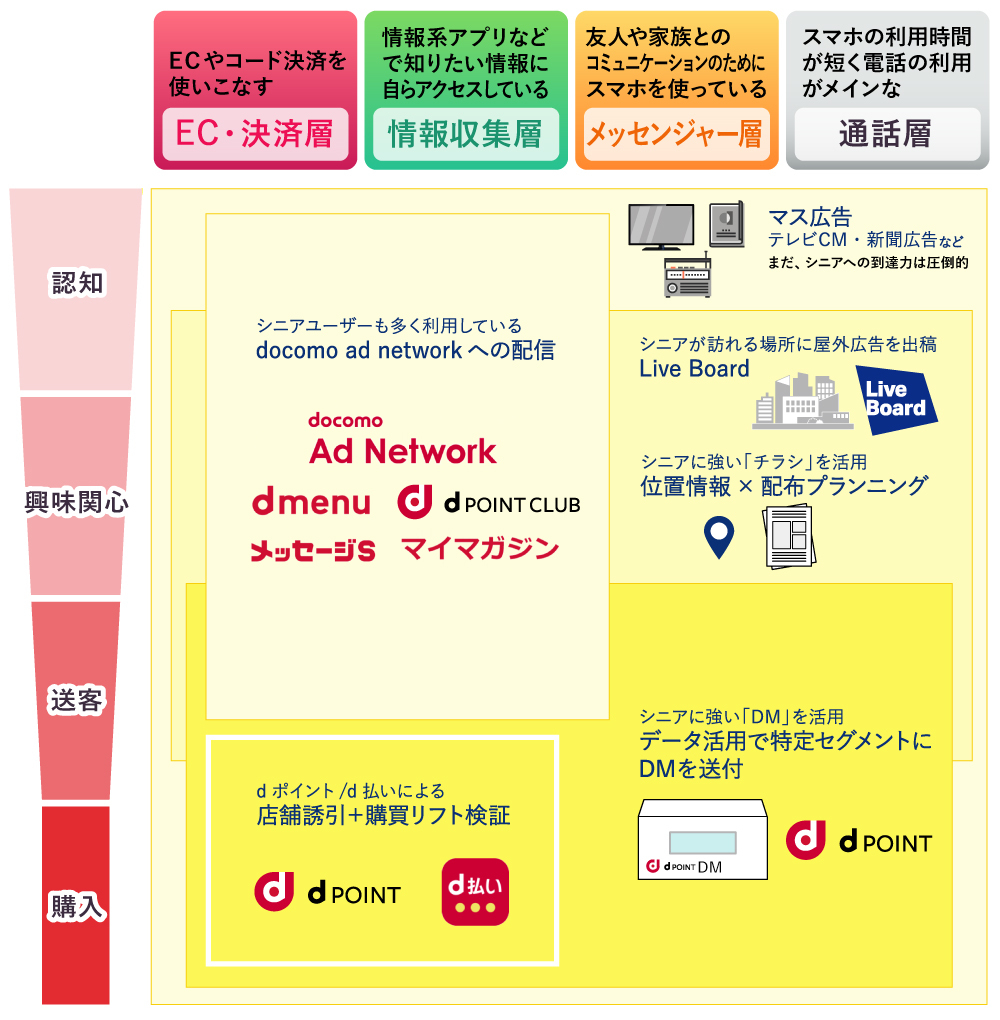
Beyond digital media, by leveraging smartphone location data and interest data linked to dds—obtained with prior user consent (※6)—it becomes possible to approach seniors across the entire funnel, as shown below.
※5 = Refer to the previous article for detailed definitions of each cluster
※6 = NTT DOCOMO handles user personal data based on its independently established "NTT DOCOMO Personal Data Charter." It also provides users with tools like the "Personal Data Dashboard " to manage their consent status.
Evolving Outdoor Advertising and Insert Flyers with Location Data
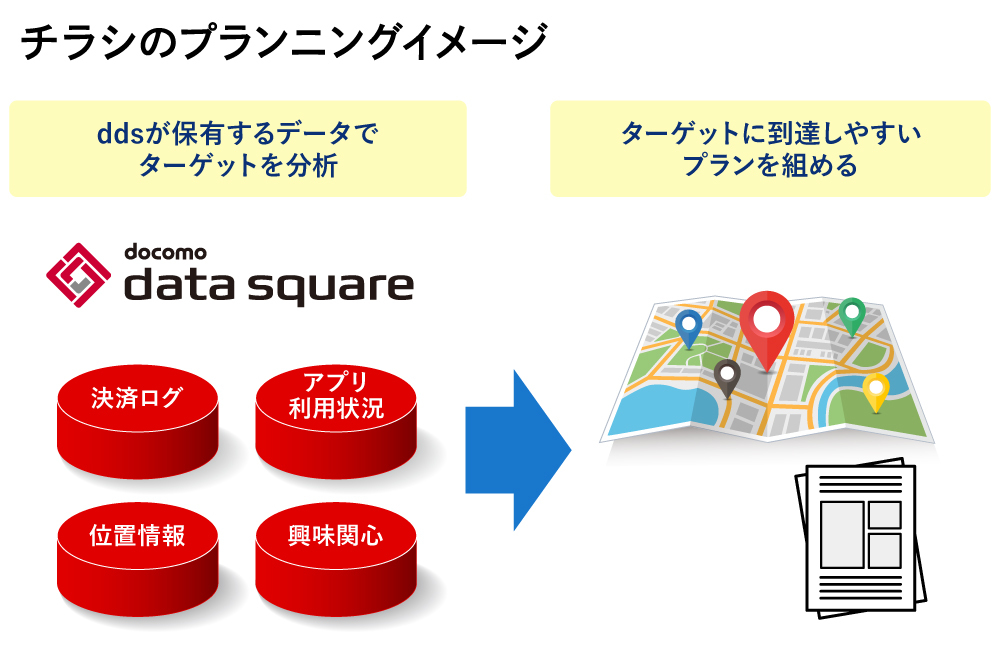
dds enables efficient planning and effectiveness verification for outdoor advertising and insert flyers based on smartphone location data and seniors' interest data.
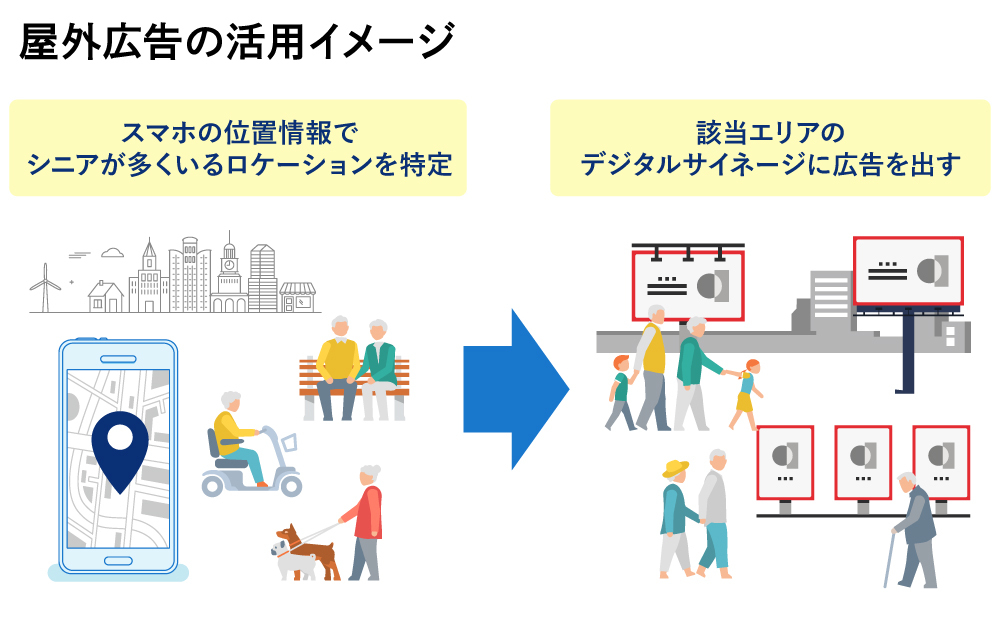
For outdoor advertising, utilizing LIVE BOARD ( details here ) digital signage allows us to identify locations frequented by specific groups, such as "seniors interested in health foods" or "seniors interested in sports." This enables us to deliver valuable information to the target audience at appropriate contact points.
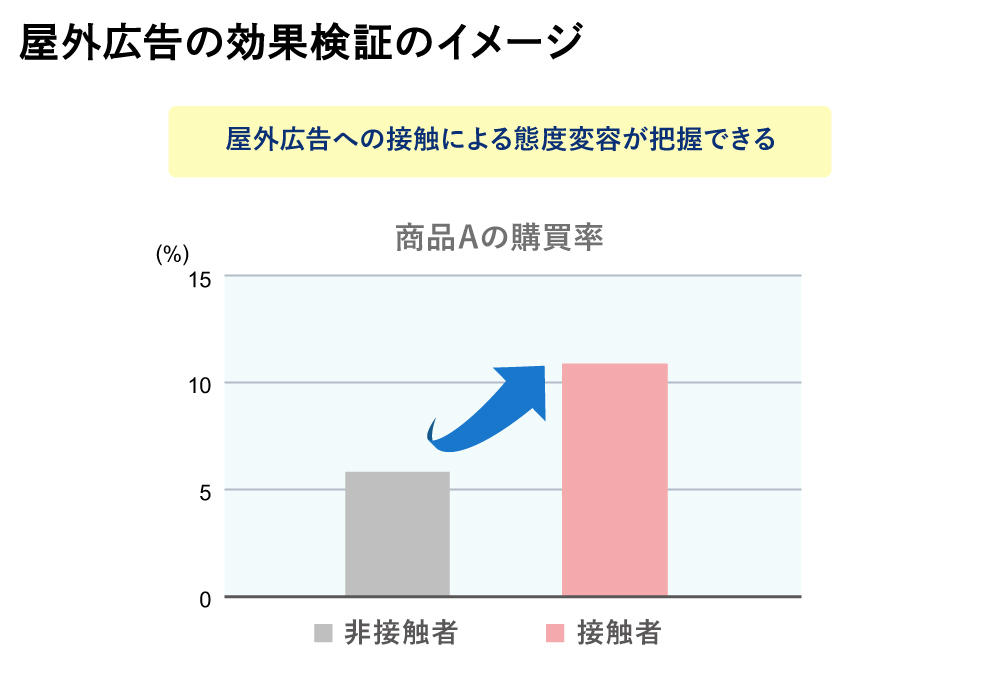
Furthermore, after ad placement, we estimate exposure (or non-exposure) to outdoor ads based on smartphone location data (non-personally identifiable) and verify whether it led to attitude changes among seniors (such as shifts in purchase rates or app download rates), making ad effectiveness visible.
Insert flyers remain a highly effective information touchpoint for seniors. According to NTT Docomo research (※7), they rank as a powerful touchpoint for "frequently viewed ads," second only to TV commercials, making their effective utilization essential. Here too, by leveraging non-personally identifiable data such as residential location and interest data estimated from dds's smartphone location information, we can create more effective plans that reach the target audience more easily.
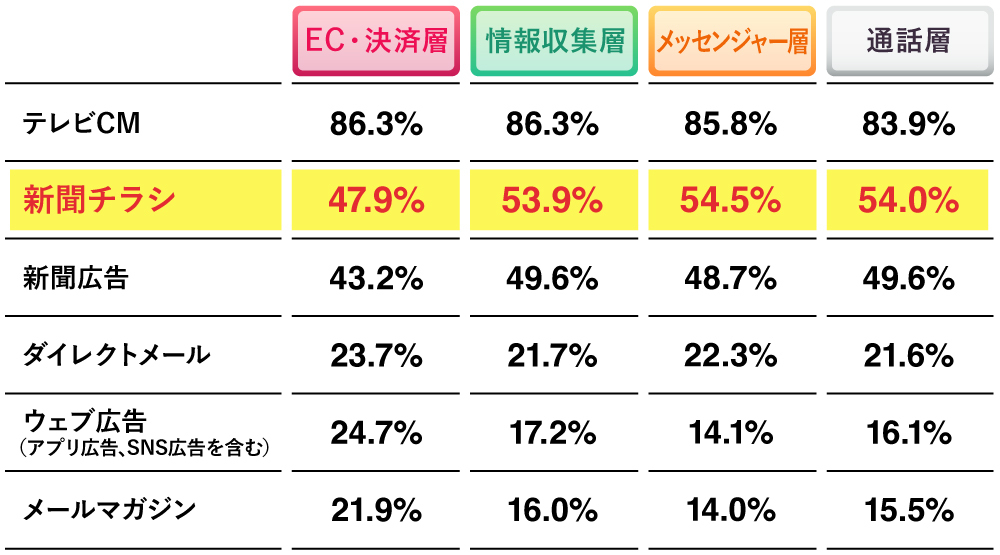
※7 = NTT Docomo survey
Survey Period: October 2021 Respondents: Men and women aged 60 and over
Now possible: "In-store attraction" and "purchase lift verification" for seniors!
In 2021, Docomo announced the "Docomo Advertising Sales Promotion Package." This enables targeting and purchase lift verification using purchase data from stores accepting d Points and d Payment, in addition to distribution leveraging attribute data (such as gender and age) and location information across Docomo media and SNS.
This package is also an effective tool for targeting seniors. As analyzed in the previous article, the "e-commerce/payment segment" already routinely uses SNS and cashless payments, while the "information gathering segment" is adept at using portal apps. Therefore, it is possible to drive seniors to physical stores through advertising and verify purchase lift.
The diagram below illustrates an example of utilizing the solutions introduced so far.
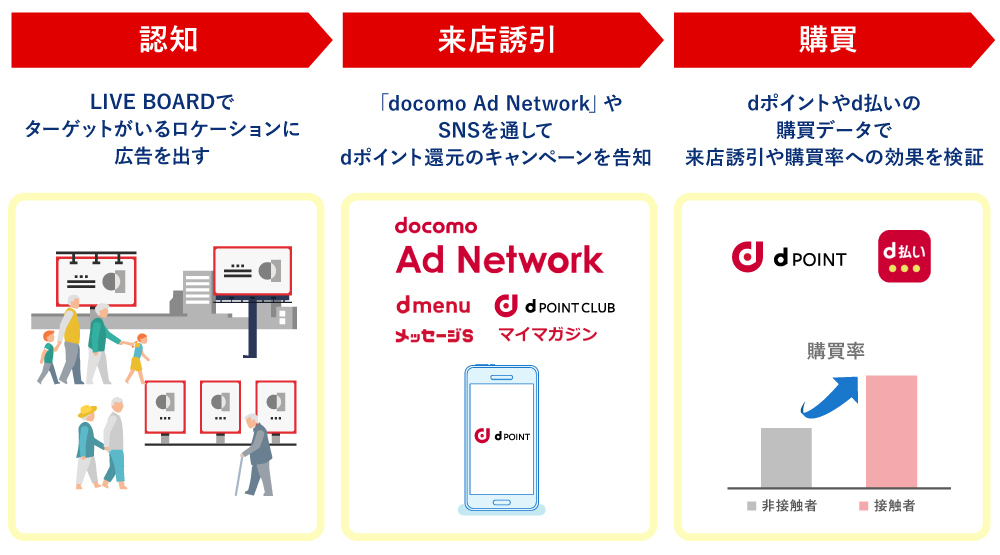
First, ads are placed via LIVE BOARD at locations with high target audience density to build awareness for new products. Next, ads through "docomo Ad Network" and SNS promote d Point rebate campaigns to strengthen store visit incentives. Subsequently, purchase data is captured when visiting seniors make payments using d Pay or d Points. By analyzing this data to distinguish ad exposure versus non-exposure, the effectiveness on store visit incentives and purchase rates can be verified.
Such initiatives enable not only the implementation of smartphone-based digital promotions but also the creation of customer experiences that benefit consumers. For seniors, this means gaining access to desired information and earning points.
Achieving Precise Targeting with Paper DM × Data Utilization
Similar to insert flyers, paper direct mail (DM) remains a powerful touchpoint following TV and newspapers. As shown in the aforementioned survey data※7, DM also ranks highly, making its effective utilization essential.

Docomo has obtained permission to send DMs from a large number of its approximately 85 million d Point Club members, many of whom are seniors. Since dds accumulates data such as gender, age, location, and interests, it can efficiently send DMs by creating segments like "active senior men who enjoy travel" or "senior women interested in beauty," as shown below. Carefully explaining product or service features via DM effectively motivates seniors to take action. By refining DM targeting, companies can efficiently deliver precisely the information seniors seek.

The Era of Precise PDCA in Senior Marketing
Until now, "PDCA" might have strongly evoked images of younger to middle-aged individuals adept at using digital devices. However, as seniors have become more proficient with smartphones, dds can now implement precise PDCA based on actual behavioral data for seniors as well.
We have additional solutions and detailed data not covered in this article. If you are interested in senior marketing, please contact Dentsu Inc. Senior Lab.
[Contact] Dentsu Inc. Senior Lab: senior-lab@dentsu.co.jp Contact: Koiso / Matsumi

Was this article helpful?
Share this article


Newsletter registration is here
We select and publish important news every day
For inquiries about this article
Back Numbers
Author

Matsunari Yoshitomo
Dentsu Inc.
4th Integrated Solutions Bureau
Solution Planner