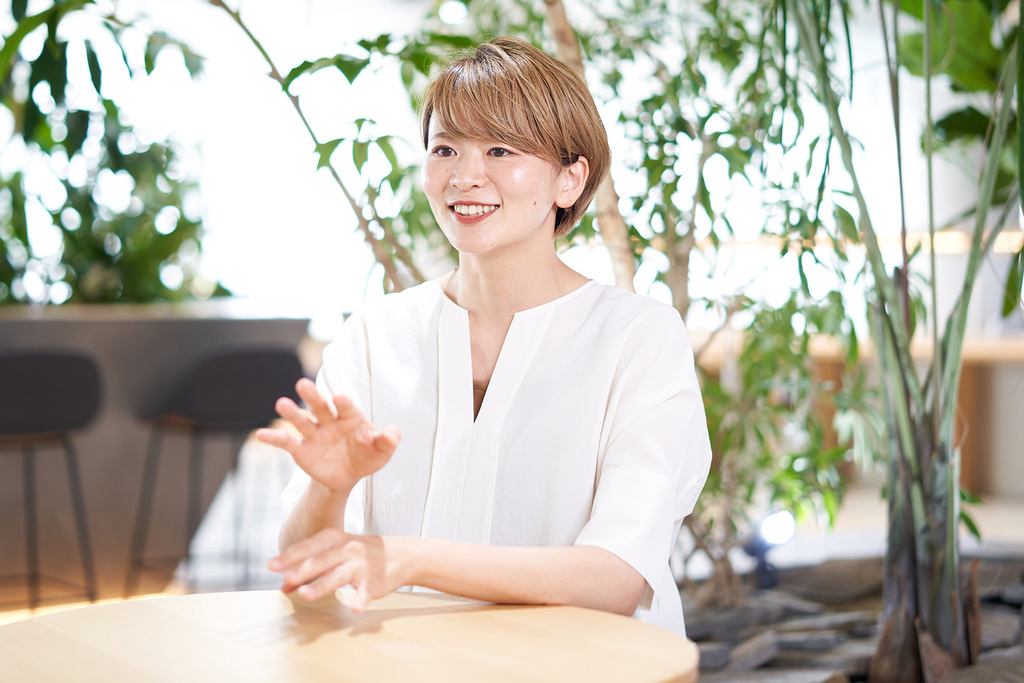
In this second part of our interview with Sayaka Katsutani of Dentsu Digital Inc., who was involved in its development, we hear about the challenges faced by the companies consulted and the future of the Sustainability Room.
A Sustainability Perspective is Essential for New Businesses
Q. It's been about a year since the release of the "Sustainable Future Design Program." How has the response been?
Katsutani: We've received more inquiries than expected from companies saying, "We want to launch new businesses aimed at creating a sustainable society." Sometimes the theme is already defined, like women's well-being or carbon neutrality. Other times, even if sustainability wasn't initially the stated goal, the resulting themes naturally align with sustainability.
Furthermore, in the actual solution delivery phase, we combine this 'Sustainable Future Design Program' with multiple other solutions provided by Dentsu Digital Inc. By tailoring the solutions themselves each time based on the specific theme at hand, we help clients effectively drive their business development.
Sayaka Katsutani, Dentsu Digital Inc.
Q. What kinds of challenges do client companies typically bring to us?
Katsutani: The specific challenges vary by theme. For instance, with themes like carbon neutrality, we often hear concerns such as, "Will only a small group of highly conscious consumers be interested? Won't this just become an extension of CSR?"
Q. How does the "Sustainable Future Design Program" respond to such concerns?
Katsutani: The theme of carbon neutrality is too broad, so we break it down into specific touchpoints where consumers can engage with it in their daily lives. We also design motivation cycles using mechanisms like gamification and community building, even for those initially uninterested. This connects the benefits for consumers with solving societal challenges.
Q. In today's world, sustainability and SDGs perspectives are indispensable when launching new ventures. You regularly engage with various client companies. How do you perceive each company's sense of urgency regarding sustainability?
Katsutani: Previously, when developing a new animal-related service, incorporating social issues surrounding animals like rescue dogs and cats captured consumers' interest and drove business growth.
While this is just one example, consumers react more sensitively than one might imagine to a company's stance on sustainability. I believe sustainability is now an indispensable perspective for any business going forward. In fact, even services where the core theme might seem somewhat removed from sustainability are increasingly incorporating sustainability elements somewhere.
Q. How do you envision developing this solution going forward?
Katsutani: Rather than just the "Sustainable Future Design Program" alone, we want to respond to client companies' needs by arranging other solutions from the Sustainability Room as required. The case studies in the "Sustainable Future Design Program" contain many useful tips, so we plan to continuously update that aspect.
The depth of commitment to social issues changes the approach to business development
Q. It's been about a year since the release of the "Sustainable Future Design Program," and societal conditions and consumer awareness are evolving. I wonder if there might be an approach where sustainability isn't explicitly emphasized upfront, but rather integrated later into projects as they are consulted on. What are your thoughts?
Katsutani: I think that depends on the level of commitment to the social issue. If the goal is "to gradually raise consumer awareness by incorporating sustainability elements into new services," then you can add sustainability elements during the normal business development process.
However, when tackling social issues head-on, I believe processes beyond standard business development become necessary. Social issues are inherently complex, involving multiple intertwined challenges. Approaching them from a single angle often fails to solve the problem. Many cases cannot be achieved by a single company alone, requiring diverse alliances, which in turn increases the scale of the business. The considerations differ, so our approach to supporting these projects also changes.
Q. The Sustainability Room team possesses expertise in social issues. Do you have specific areas of specialization?
Katsutani: The "Sustainable Future Design Program" broadly covers SDG themes based on case studies. We also offer solutions like the "Social Pain Compass," which analyzes consumer voices on social media to gather social grievances, and "REVERSE CONSULTING for SUSTAINABILITY," where we develop projects alongside Generation Z, who show high interest in sustainability. Additionally, we are currently developing "SUSTAINABLE COMMUNITY," which focuses on solving social issues within communities.
Q. What exactly is "SUSTAINABLE COMMUNITY"?
Katsutani: It's a planning approach that doesn't separate the themes of "social issues" from "people." Instead, it views the accumulation of individual challenges as "social issues" and starts by identifying the directly related individual challenges to design services.
For example, topics like alcoholism often carry an atmosphere where it's difficult to speak openly. Yet, the reality is that far more people struggle with such issues than we might imagine. Despite many individuals, including family members, being troubled, it's often hard for these struggles to surface.
We wondered if the community itself could become the solution to these challenges.
Creating communities that foster horizontal connections can generate positivity. For instance, cases like litter cleanup—where "working together is better than going it alone"—can be accelerated by leveraging the power of community.
Q. What social issues or themes are you currently interested in addressing through your business?
Katsutani: Areas like carbon neutrality and diversity, which I've been deeply involved with through projects, are topics I personally find interesting and encounter frequently in daily life. Addressing these themes through the efforts of a single company alone will take time to significantly change society. However, they also hold great potential for changing people's lifestyles and enabling the development of new businesses. As Dentsu Digital Inc., we also want to contribute to building a sustainable society through supporting new business development.
Today, a sustainability perspective is indispensable in corporate new business development. The depth of engagement with social issues fundamentally alters the development process and scale of the venture. Therefore, I suggest starting with small trials in areas directly linked to your company's existing business.
The information published at this time is as follows.
Transformation Lead Room Sustainability Room, BIRD Division Service Innovation Business Unit Product Management Group
Group Manager
After serving as a product manager at an operating company where I was involved in launching multiple new ventures, I joined Dentsu Digital Inc. in 2021. Currently, I provide end-to-end support for client companies creating new services, from vision formulation and service design to directing MVP development.