Note: This website was automatically translated, so some terms or nuances may not be completely accurate.
Here are several hints for fostering bottom-up DEI.
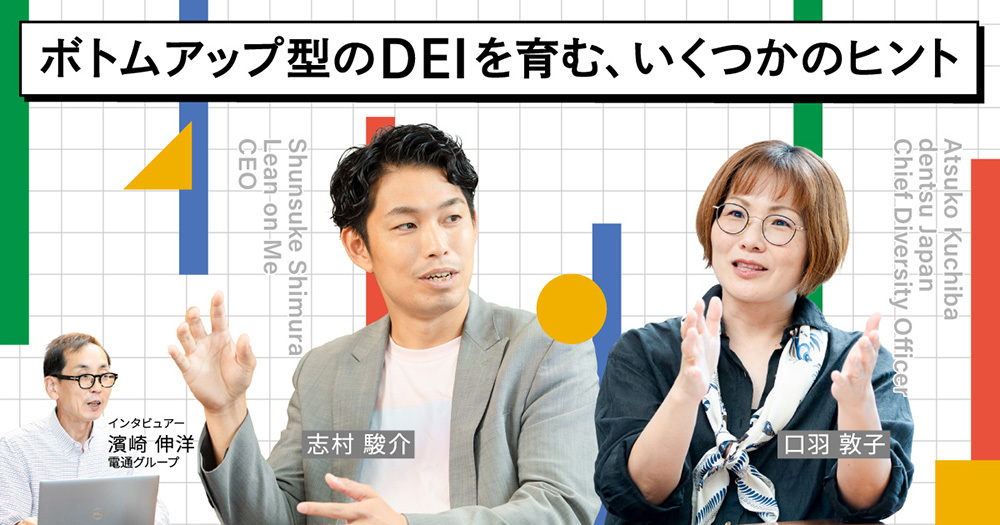
DEI (Diversity, Equity, Inclusion) is now frequently discussed in the context of "management challenges" at many companies. The key lies in top-level "leadership." However, no matter how much leaders wave the flag, nothing changes unless the front lines take action. How can each individual employee on the front lines make DEI their own responsibility and take action themselves? This is a question troubling many executives.
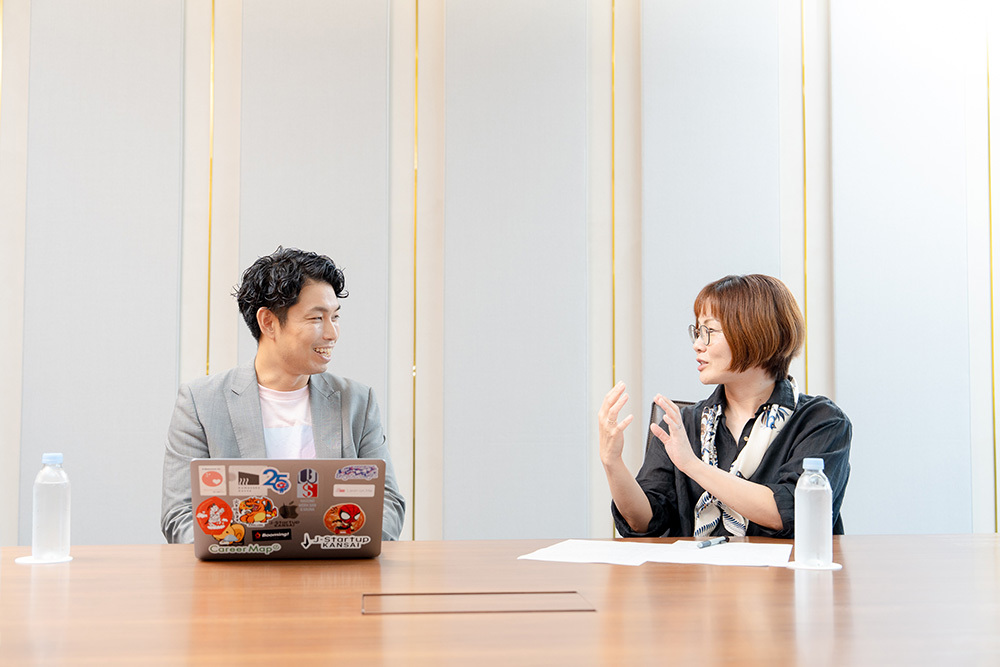
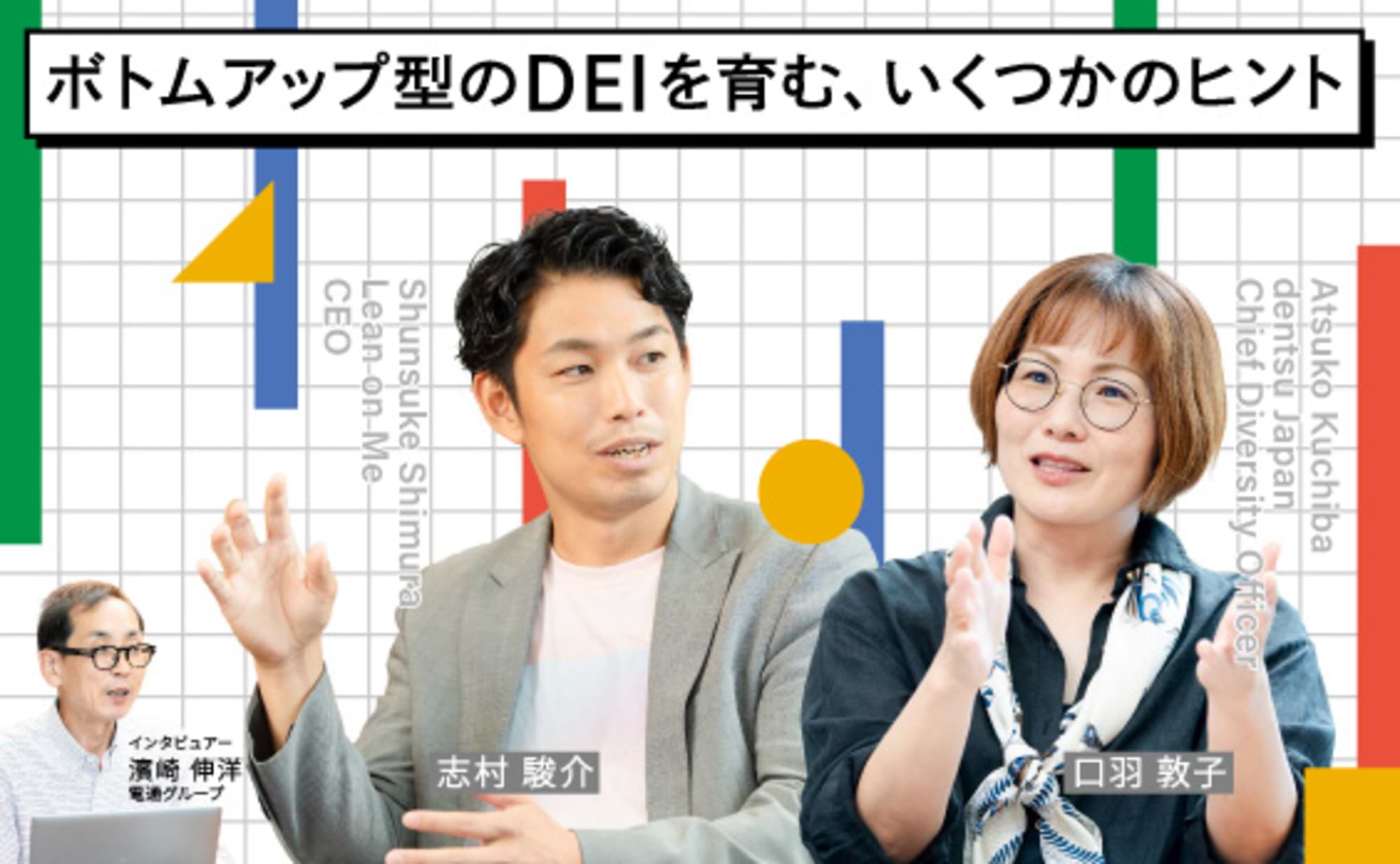
This time, focusing on the theme of "Bottom-Up DEI," Atsuko Kuchiba, Chief Diversity Officer at dentsu Japan, held a discussion with Shunsuke Shimura of Lean on Me Inc., a company providing e-learning content to disability welfare facilities and corporate workplaces. The session was moderated by Nobuhiro Hamasaki, who also leads DEI initiatives at dentsu Japan.
Both unconscious bias and abuse begin with ignorance.
Hamazaki: This is your first meeting, right? Please introduce yourselves.
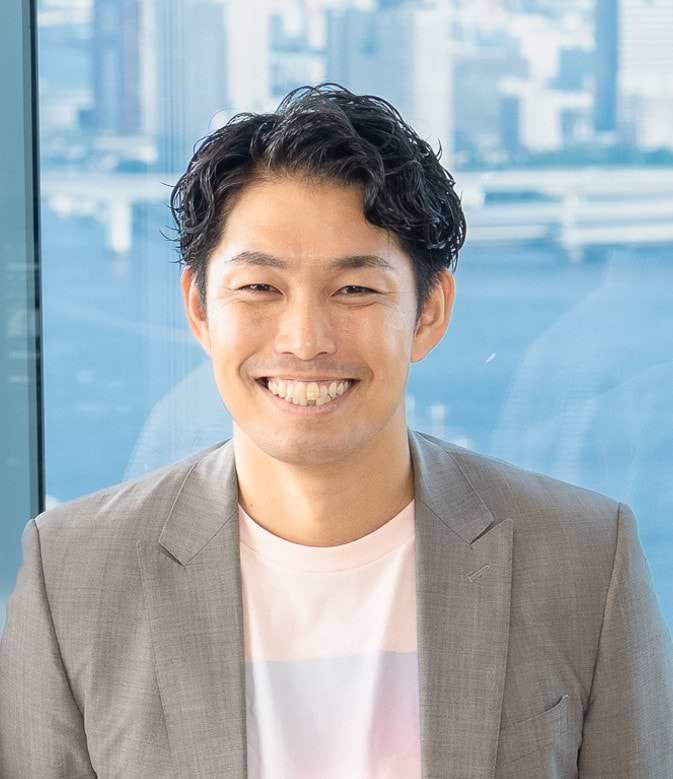
Shimura: I founded Lean on Me Co., Ltd. in 2014 and have served as its CEO ever since. My brother has Down syndrome, and my mother worked at a welfare facility, so supporting people with disabilities became a personal cause for me early in life. After graduating university, I worked at a facility myself. I struggled with how to support people with disabilities other than Down syndrome. I studied extensively and experimented, and I wanted to share these experiences with others facing similar challenges, which led me to start the company.
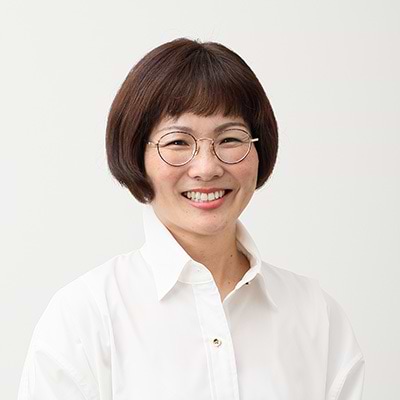
Kuchiba: The Dentsu Group operates globally. Within that, I handle Diversity, Equity, and Inclusion (DEI) and Sustainability for the Japan Group, dentsu Japan. I also serve as a director for Dentsu Solari Inc., a Dentsu Group subsidiary that employs people with disabilities.
My career at Dentsu Inc. began as a local employee at Dentsu Inc. Thailand. Later, while working as a planner in Tokyo, I realized I wanted to pursue what I truly desired: working with people with disabilities to reveal the unique world and possibilities they see to society. That led me to where I am today.
Hamazaki: I understand you founded a company providing e-learning content based on your experience working at a facility. Why "e-learning"?
Shimura: As someone with a family member who has a disability, I naturally expected facilities to have staff with specialized knowledge providing support. But that wasn't always the case. Of course, some staff provided appropriate support, but others did not. I even witnessed acts bordering on abuse. Not all facilities are like that, of course. But what I saw with my own eyes is also a fact. I started wondering why there was such variation in support methods between individuals. The reason is that there are no official qualifications for supporting people with disabilities, especially those with intellectual disabilities. Training is mostly taken by management. Frontline staff, especially non-regular employees, are too busy to attend even if they want to. Yet, it's these very people who provide the actual support on the ground.
As a result, support provided based on individual assumptions becomes inconsistent, leaving the disabled person themselves in a difficult situation. I began to think the problem lies less with individuals and more with the systems and structures for acquiring knowledge.
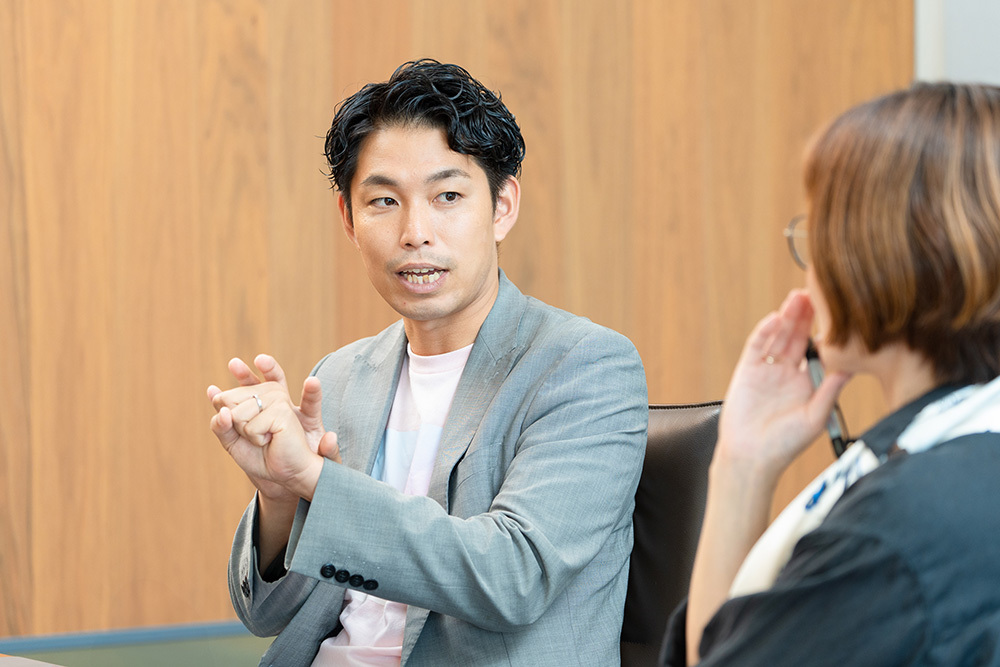
Kuchiba: I completely understand what you're saying, Mr. Shimura, about knowledge gaps being one cause. When companies try to promote DEI in the workplace, there are always people who resist or say it doesn't concern them. Ironically, these are often the ones lacking knowledge. This is precisely what "unconscious bias" is – unintentionally hurting someone through unconscious prejudices or assumptions. While we call it a lack of knowledge, it might be more accurate to say they didn't have the time or opportunity to learn, rather than that they simply didn't want to.
Systematize the act of "learning."
Shimura: It's the same everywhere – the very people who need the knowledge are constantly swamped.
Hamazaki: That's why "e-learning" is so valuable – it allows learning even during busy periods. That said, while e-learning is common for language or business skills training, it's rarely heard of in the welfare field. How did people react when you launched this initiative?
Shimura: Initially, it was hard to get people to understand. Since this industry is based on face-to-face interactions, we often heard, "What can you possibly teach through videos?" The turning point was the COVID-19 pandemic. During that time, in-person training became difficult, and with many facilities and companies operating under stay-at-home orders, inquiries to our company surged.
Kuchiba: That pandemic period fundamentally changed society in many ways, didn't it? At DEI, the widespread adoption of remote work during that time made balancing childcare and work much easier, significantly lowering the barriers for everyone to thrive.
Shimura: As the number of content participants grew, new challenges emerged. For instance, the more skilled the staff member, the more likely they were to prioritize the needs of the people with disabilities in front of them over their own needs whenever they had free time. So, we shifted from just providing content to offering annual plans as well, helping them build a "system" for continuous learning. One facility director shared, "Lately, I've started having conversations with staff based on knowledge of disability characteristics."
Kuchiba: I share that same dilemma—the very people who need to learn most often put themselves last. That's why dentsu Japan's DEI promotion also emphasizes making "learning" a sustainable "system."
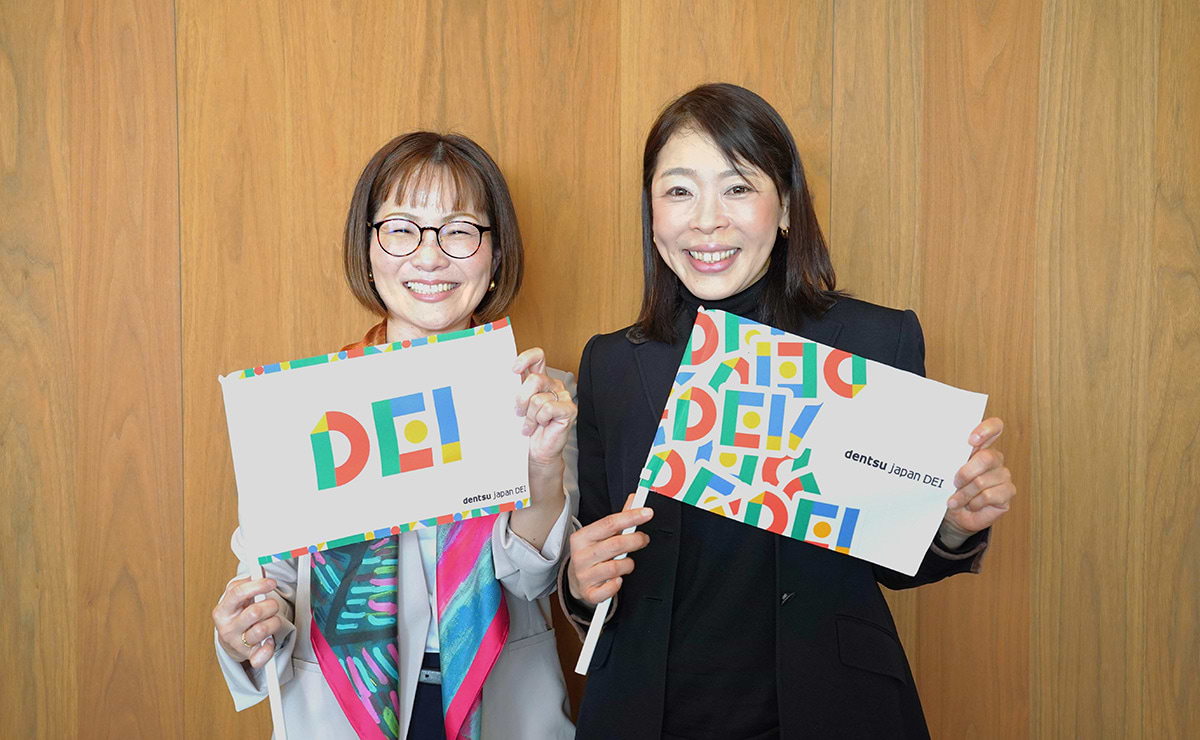
Our "DEI Park" initiative, designed for cross-group learning and reflection on DEI, centers its programs around sharing accurate knowledge and dialogue with those directly affected. We no longer hear statements like "women raising children can't handle management roles." We've seen firsthand how simply inputting knowledge can positively shift the awareness and actions of a significant number of employees.
A key point of this initiative is that the program is scheduled as part of annual working hours. Participants are assigned from each department every time, and it runs at a pace of once every six months. Even people uninterested in DEI participate as part of their "work," and before they know it, they've moved beyond "ignorance."

The decisive factor for bottom-up change is installing the "lens."
Hamazaki: Ms. Kuchiba, you've been advocating for "bottom-up DEI" for some time now.
Kuchiba: Ultimately, DEI boils down to whether you have a "lens" within yourself. A lens that makes you notice the differences and discomforts right in front of you. Only then does it become personal. If it doesn't become personal, no amount of top-down efforts will translate into action. That's why I believe it's crucial for each individual to install this "lens."
Shimura: Ultimately, DEI is about communication between people. It's about exploring how to interact appropriately with others. Since it's about relationships between people, the challenges and concerns vary for each individual. Perhaps that's why we've prepared about 2,000 pieces of content – to enable exploration tailored to each person's "lens."
Kuchiba: DEI is about exploring how we relate to others—exactly. Everything starts with the person right in front of you. Rather than being told "DEI is important" from above, understanding what the person next to you is struggling with feels like it leads to much more action.
Hamazaki: It's clear both of you are committed to creating an environment that truly responds to the curiosity and exploration happening on the ground.
Earlier, Mr. Shimura mentioned that since it's about human relationships, challenges and concerns vary from person to person. How do you extract the themes for the content you create?
Shimura: Listening to the voices of those on the front lines is definitely the primary method. Beyond that, we also monitor government policies and legal reforms, and respond to broader societal trends. Recently, we created content on "end-of-life care" addressing the aging of those directly involved. We've also started experimenting with converting content into text using AI.
Kuchiba: Actually, AI utilization is a new challenge we're also starting at Dentsu Solari Inc. We're trying to feed past records of responsible employees into AI and use it for initial responses when struggling with how to handle situations. We hope this will provide hints for support approaches we wouldn't have thought of on our own.
Shimura: Problems always have warning signs. The strength of AI is that it can reflect past data it has learned and offer advice based on signs the person themselves might not have noticed.
Kuchiba: If we feed an AI that's learned all of Lean on Me's content the problems occurring on the ground, that would be absolutely unbeatable!
We want to break through the strengths and limitations of the "Japanese model."
Hamazaki: Mr. Shimura, you also have experience working at facilities in the US. What differences do you see between Japan and overseas in how they approach working with people with disabilities?
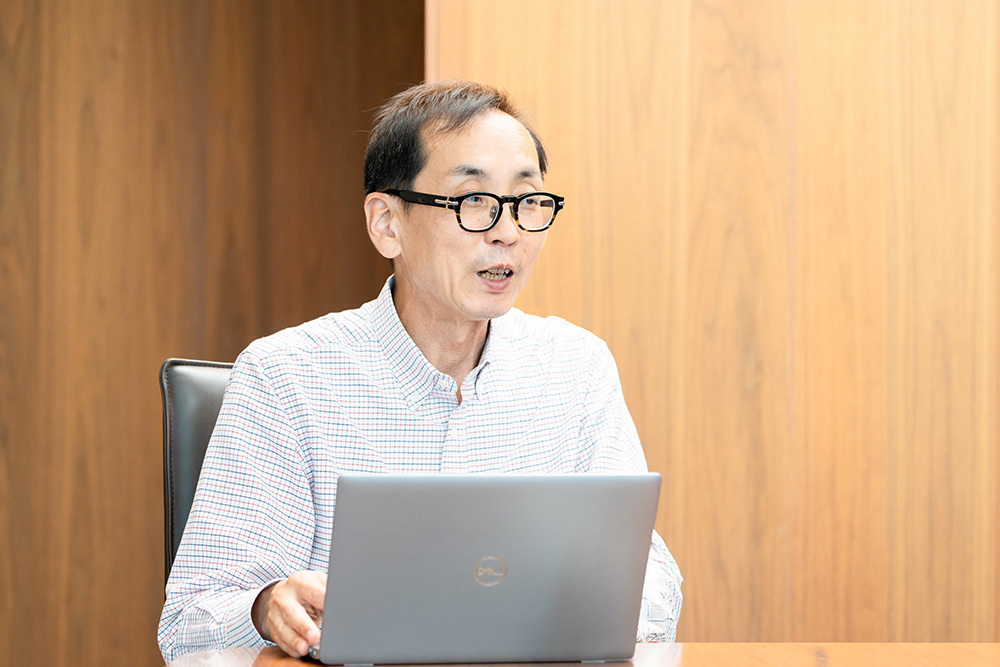
Shimura: Japan tends to judge things based on "efficiency," doesn't it? When I worked in Oregon, I accompanied a woman with Down syndrome to the gym for mobility support. She struggled to enter the access code needed to enter the facility. In Japan, a support worker would often just do it for her. But in the US, they let the person do it themselves. She tried many times and finally managed it. In the US, they don't take away the "right to fail" or the "right to grow."
Kuchiba: That's an interesting story. Where do you think that difference comes from?
Shimura: In Japan, people with disabilities might still be seen primarily as "support" recipients. When I travel abroad with my brother, airport staff there speak directly to him. But in Japan, airport staff speak to me instead. There seems to be an assumption that people with disabilities are supported by family or caregivers.
At the Osaka-Kansai Expo, I helped with accessibility training for staff as an official advisor. What I emphasized there was, "First, speak directly to the person themselves."
Hamazaki: That's wonderful. Of course, learning about reasonable accommodations one by one is important, but it feels like all of that could be summed up in that one phrase: "Speak to the person first."
Shimura: When it comes to support for people with severe disabilities, Japan has an exceptionally robust government system, unmatched globally. In Thailand, for example, it's not the government but people helping each other. It's hard to say which approach is better.
Kuchiba: The same is said about corporate employment. The "special subsidiary" system, dedicated to hiring people with disabilities, is a model unique to Japan. Overseas, it's often perceived as segregating people with disabilities. However, it actually has its merits. Direct corporate employment of people with intellectual disabilities, as seen in Japan, seems quite rare globally.
Hamazaki: The existence of these special subsidiaries also allows companies to accumulate expertise, right?
Kuchiba: I recently served as a judge for Cannes Lions 2025, and the jury chair was Google's accessibility leader. She has a hearing impairment, and her statement, "I'm not here to be supported, I'm here to change society," really stuck with me.
Shimura: That's great. People overseas really know how to say things that hit home. When I interviewed the head of New Zealand's disability agency before, the phrase "Knowledge is power" also really stuck with me.
Kuchiba: In that sense, Shimura-san's "Please speak directly to the person first" is also a phrase that really resonates. Just that one simple act of speaking directly to the person feels like it can start changing the world.
Hamazaki: So bottom-up change is about transforming society through the accumulation of small revolutions by each individual. Thank you both, Shimura-san and Kuchiba-san, for today.
・dentsu Japan's DEI site:
https://www.japan.dentsu.com/jp/deandi/

Was this article helpful?
Share this article


Newsletter registration is here
We select and publish important news every day
For inquiries about this article
Author
Shimura Shunsuke
Lean on Me Co., Ltd.
Chief Executive Officer
Atsuko Kuchiba
Dentsu Japan
Executive Management, Chief Diversity Officer / Director, Dentsu Solari Inc.

Nobuhiro Hamasaki
Dentsu Group Inc.
Director