Note: This website was automatically translated, so some terms or nuances may not be completely accurate.
 Where to start? Internal Communication [8/9]
The Imperial Art of Leadership in the Reiwa Era! Top-Level Communication Evolves into the "Total Production Strategy"
As the range of stakeholders with whom companies must strengthen relationships diversifies, the importance of top-level communication is receiving renewed attention.
This focus stems from the significant influence top executives' statements and personalities have on a company's brand image. Furthermore, their words and actions serve as the pivotal point for ensuring consistency in communication across all stakeholder groups.
Furthermore, in internal communications, it's not just direct messages to employees or dialogue forums like town hall meetings that matter. External exposure through media coverage, advertising, and conferences undoubtedly influences employee engagement when they encounter such information.
While "one-off" training in speaking and behavior, such as media response or speech coaching, is widely available, a methodology for a "Total Production Strategy" – one that develops messages aligned with corporate brand strategy, manages personal image, and systematically enhances the quality and quantity of top-level communication based on this foundation – remains unestablished.
This article clarifies how top executives should communicate effectively and consistently with various stakeholders during the period from their appointment until they establish a solid reputation. Naota Nakamachi, Senior Consulting Director at Dentsu Inc., explains the fundamental concepts of the "Total Production Strategy," the management approach for achieving this.
<Table of Contents>
▼The Increasing Importance of "Top Communication"
▼Do Japanese Corporate Leaders Lack Their Own Words?
▼ The "Total Production Strategy" Now Required for Top Executives
▼Approach ①: The New Leader's Debut Strategy
▼Approach 2: Basic Principles of Image Strategy
▼Approach 3: Organizing the Roles of Each Communication Initiative
The Increasing Importance of "Top-Level Communication"
This series has covered various themes, but the sophistication and complexity of management agendas continue to advance—including business restructuring, group reorganization, DX, sustainability management, human capital management, and DEI promotion. Many companies are increasingly recognizing the importance of corporate branding, and top communication, as one of its key tools, is drawing significant attention.
Below are findings from a survey conducted by Corporate Communications Strategy Institute at PR Consulting Dentsu Inc. among PR officers at listed companies.
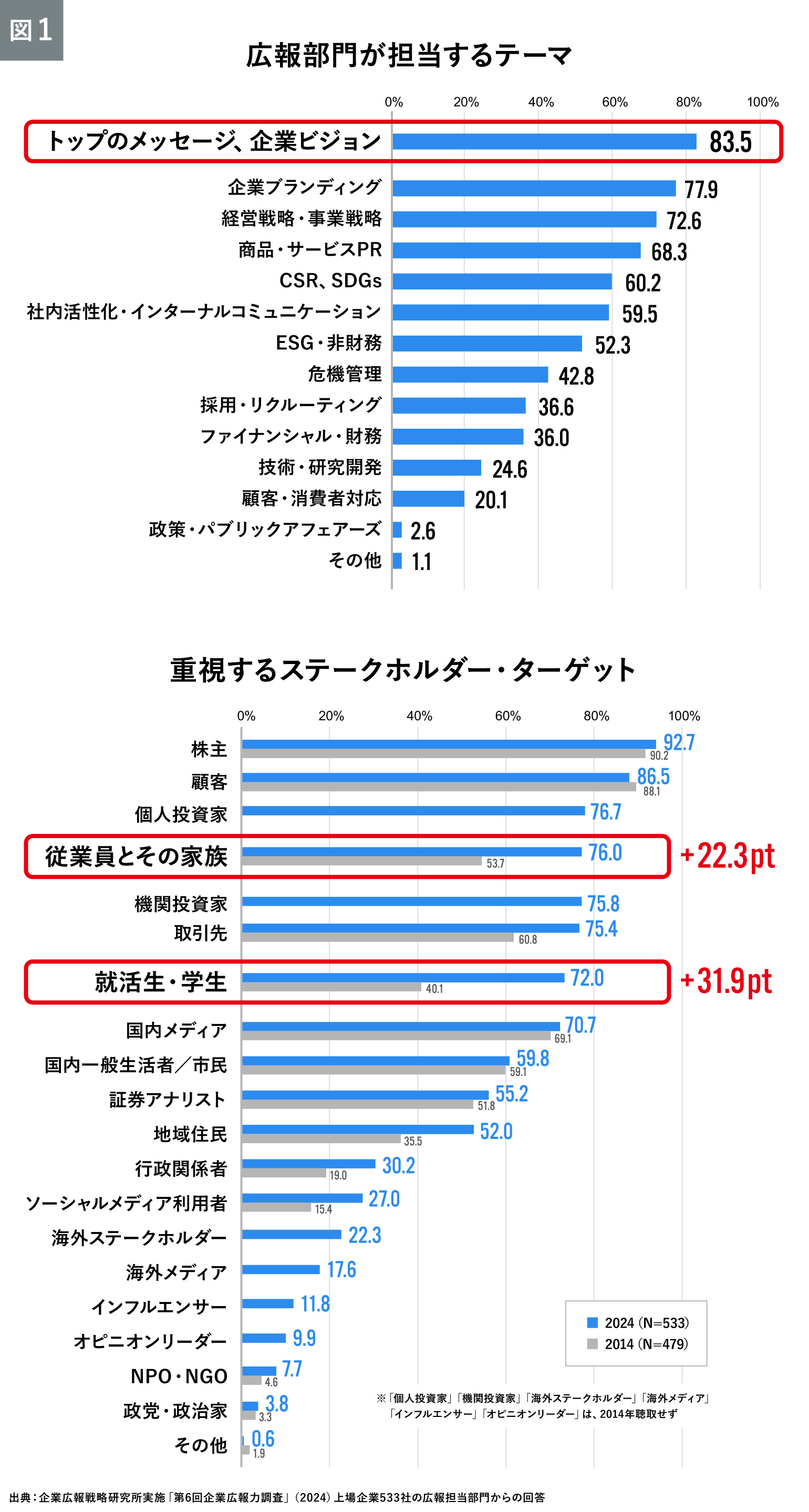
The theme most frequently handled by PR departments is "communicating top management messages and corporate vision" both internally and externally. Furthermore, over the past decade, the importance placed on "employees" and "job seekers/students" (future employee candidates) as key stakeholders in corporate communications has significantly increased, alongside traditional stakeholders like shareholders and customers. This suggests that many companies now need to advance integrated communication strategies targeting both internal and external stakeholders.
Do Japanese company leaders lack their own words?
However, very few companies strategically leverage the presence of their top executives as part of corporate branding. For example, does any of the following sound familiar in your company?
- Official communications, starting with the "Top Message" on the corporate website, often amount to nothing more than a "digest of management strategy," lacking the "authentic voice" that conveys the leader's unique personality and passion.
- When discussing business strategy or organizational culture in media interviews, they rely on "generic keywords seen at other companies," failing to deliver "messages that stand out from competitors and grab news headlines."
- The CEO's exposure plan is not strategically formulated, remaining either "reactive (waiting for media inquiries)" or "ad hoc."
In many Japanese companies, top-level communication is limited to the role of "speaking on behalf of management strategy." It is not yet common for the president themselves to internalize the importance of top-level communication as a personal responsibility and strategically drive it forward. Consequently, the content discussed often leans heavily toward numerical targets like profits, or the company-wide policies can come across as lacking genuine conviction. As a result, communication is not only ineffective with external stakeholders, but it can also create distance between the leadership and employees.
The "Total Production Strategy" Now Required of Top Management
Developing a top-level Total Production Strategy means adopting an approach opposite to the "common practices in Japanese companies" mentioned above.
Specifically, it involves the following approach:
- Top messages should not only include keywords from management strategy but also carry the leader's own voice.
- Incorporate a "stakeholder perspective" that considers differentiation from competitors and media exposure effectiveness, not just messages from the company's viewpoint.
- Establish milestones based on the timeline from immediately after taking office to the formulation of the new mid-term management plan, or based on the annual activity calendar, and promote them systematically.
This can be easily understood by comparing it to the process a record company uses to make an artist major. When debuting an artist, they establish a unique position distinct from other artists while also considering the "hot trends" in the music scene at that time. Then, they release a new album that serves as their "calling card" for that period and tour various locations. Alternatively, they maximize exposure through media interviews and appearances on music programs, while also activating communication with fans to achieve major status.
The same principle applies to top management production strategy. When a new leader takes the helm, they must convincingly communicate, in light of the company's environment, "Why this person is becoming the top leader" and "What value they are expected to deliver going forward."Furthermore, the long-term and mid-term management plans and vision formulated after the top executive's appointment become their symbolic "business card." By regularly communicating the validity and progress of these plans and visions, and fostering communication with various internal and external stakeholders, it is essential to cultivate expectations for the company's sustainable growth and enhance engagement.
Here, we introduce several fundamental approaches for formulating a production strategy.
Approach ①: New Leader Debut Strategy
Top-level communication begins the moment the appointment of a new president is confirmed. The announcement of a new leader is a topic of intense interest to both internal and external stakeholders, often attracting a high volume of media inquiries. Therefore, we recommend preparing the following sheet as a foundation for consistent and effective communication during the numerous exposure opportunities that follow the appointment announcement.

The key point is to maximize expectations for the company's growth, using the new leader's arrival as the hook. To achieve this, you need to prepare a story answering "Why this leader?", "What can they achieve?", and "What is the basis for this?", along with keywords that succinctly express these points. Think of U.S. presidential elections for a clear example: candidates always present a catchy one-liner that encapsulates their platform. The same principle applies to corporate leadership communication.
Approach ②: Basic Principles of Image Strategy
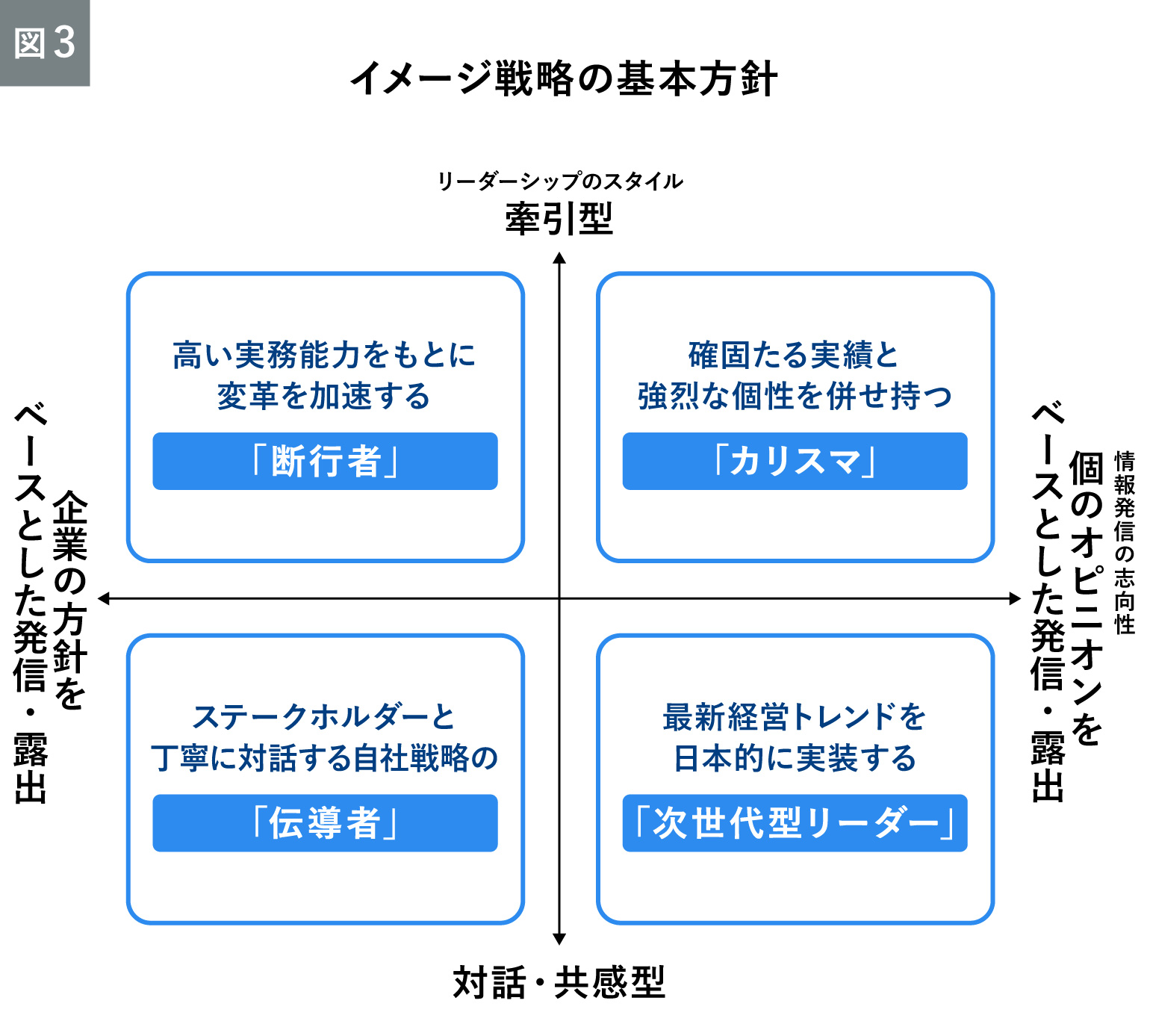
When branding a leader, it's crucial to identify their personality and express it appropriately. Below is a typology categorizing leaders into four types based on two axes: "Leadership Style (Pull-type or Dialogue/Empathy-type)" and "Information Dissemination Orientation (Personal Opinion or Corporate Policy)."
1. The "Charismatic Leader" with Solid Achievements and a Strong Personality
This type is common among founders or owner-CEOs. They have forged their path and established their current position through exceptional ability and personal charisma, possessing a unique philosophy. It is no exaggeration to say that the leader's very presence is the corporate brand. For this type, beyond corporate information, their business philosophy, insights into the economy and society, and even their worldview attract significant attention from external stakeholders, including the media, and can become a powerful centripetal force.Creative approaches that fully leverage this individuality are essential for all communication initiatives.
2. "Next-Generation Leaders" Implementing the Latest Management Trends in a Japanese Context
Many possess extensive overseas experience or backgrounds in launching new ventures. They are well-versed in the latest management trends while demonstrating a strong awareness of implementing them in ways suited to Japanese companies. This type of leader prioritizes dialogue with stakeholders, including employees, and consciously communicates in their own words. As they tend to gain support easily from younger generations, they are expected to be effective in recruitment and enhancing the engagement of young employees.Many companies effectively utilize interactive content featuring dialogues with internal and external stakeholders, as well as experts from academia and the sports world.
3. The "Conductor" of Corporate Strategy: Engaging Stakeholders with Care
This type is common among top executives who are company veterans who steadily built their track record in core business divisions. They prefer to accurately communicate the company's strategy rather than prominently showcasing their own personality.This is arguably the most common type in Japanese companies. When discussing their career, they tend to emphasize a sincere commitment to customers and the community, along with relevant anecdotes. They also possess the depth to humbly incorporate stakeholder feedback. For this type, it is crucial for the responsible department to translate the management strategy into impactful keywords and have them communicate these. Additionally, actively setting up opportunities for dialogue with stakeholders is vital.
4. The "Decisive Implementer" who accelerates transformation based on strong practical skills
This type is often chosen when facing adversity. They are logical and decisive, and if they identify factors hindering growth, they will push forward with transformation at speed, even if it involves painful decisions. Consequently, their role as a top-down "Decisive Leader" driving change is often emphasized. While their "walk the talk" approach is seen as reliable by business media and investors, it can create a psychological distance from general businesspeople and employees.Consciously increasing communication that highlights their human qualities is essential.
In corporate communications, enhancing engagement among job seekers and young employees is a critical contemporary theme. Consequently, a dialogue-oriented, empathetic leadership style tends to be well-received. However, the personalities and charms of top executives vary greatly, and there are limits to promoting approaches that don't align with their inherent qualities. It is crucial to maximize the strengths of the leader while consciously compensating for aspects that could become negative factors.
Approach 3: Defining the Roles of Each Communication Strategy
Below are key points outlining the roles owned media (company-owned communication tools), earned media (media coverage), and paid media (advertising/sponsorships) should fulfill in top-level communication.
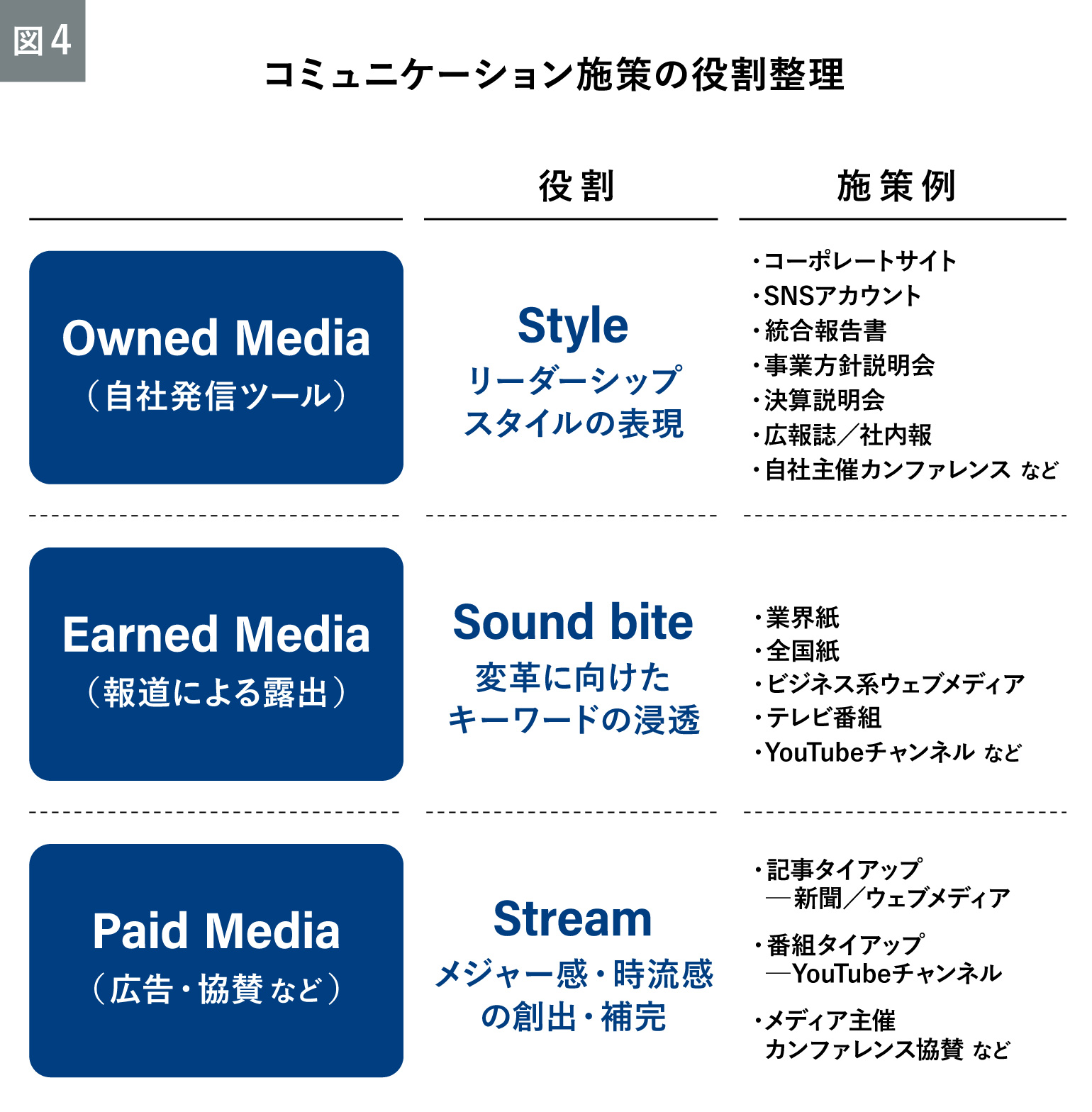
Owned media—such as corporate websites, social media accounts, integrated reports, and PR/internal newsletters—are touchpoints where company policies can be fully reflected. They are therefore best suited for showcasing the leader's "Style": their leadership, character, and visual presence. Increasingly, companies are leveraging video to effectively communicate the leader's persona and their engagement with stakeholders.Furthermore, business strategy and financial results briefings, along with their supporting materials, can broadly be considered owned media. It is crucial to clearly convey the top leadership's commitment to sincerely answering even "uncomfortable questions."
Regarding earned media (coverage through news reports), the most critical point is whether effective "sound bites" (short, quotable statements used in articles or programs) can be crafted.Industry publications tend to faithfully report the company's key strategic messages. However, for national newspapers and terrestrial TV news programs, exposure volume and quality become extremely limited without keywords tailored to the media's characteristics. If the CEO has soundbite-worthy statements, they should be actively leveraged. If not, developing them becomes the department's opportunity to demonstrate their expertise.
Next, we'll explain strategies for increasing exposure through paid initiatives, such as article or program tie-ins and sponsoring speaking appearances at media-hosted conferences. These measures are effective when aiming to create a "Stream" (a sense of major significance or being in tune with current trends) during important company moments like announcing a mid-term management plan, launching a strategic product, or celebrating an anniversary. Recently, especially in B2B industries, more companies are aiming to boost recognition by having their top executives appear on business video media.A key feature is that many companies also utilize this as internal communication for employees, leveraging the fact that content is stored long-term on platforms like YouTube or can be repurposed on their own websites.
This article has introduced only the most fundamental approaches. However, the actual "Total Production Strategy" formulation project involves analyzing the company's and competitors' media coverage, securing media interviews and interviews with the top executive, and developing a roadmap of initiatives aligned with the company's annual calendar of activities. This is advanced in parallel with formulating the corporate communication strategy.Leveraging its strengths in corporate branding, PR expertise, and integrated communication design capabilities, the Dentsu Group supports the formation of favorable images and evaluations of top executives, thereby enhancing corporate value.
Was this article helpful?
Share this article


Newsletter registration is here
We select and publish important news every day
For inquiries about this article
Back Numbers


Author

Naota Nakamachi
Dentsu Inc.
Marketing Division 4, Brand Consulting Department Manager
Senior Consulting Director