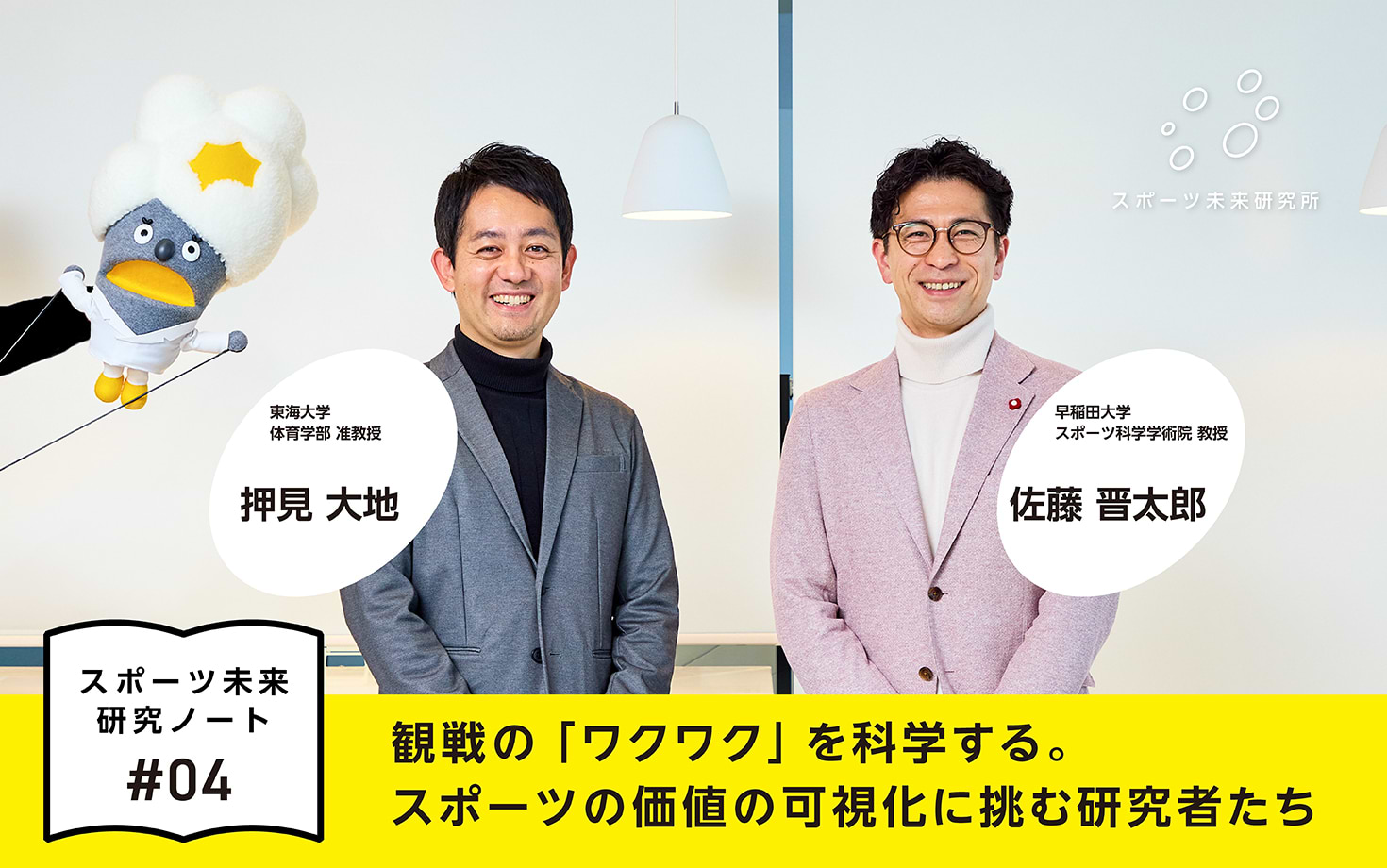
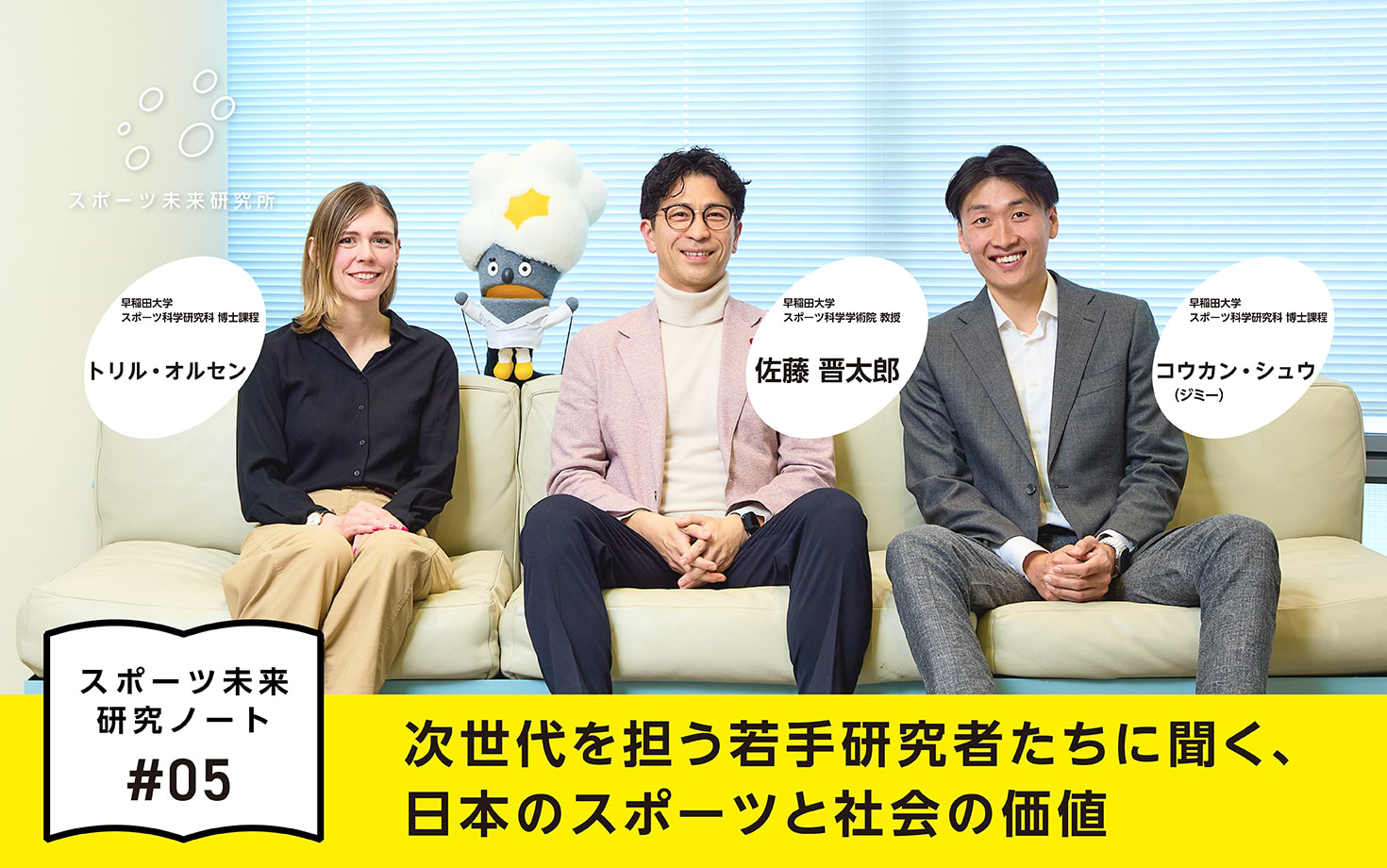
"Sports Future Research Notes" explores the value of sports through qualitative and quantitative analysis. Continuing from the previous session, we welcome Professor Shintaro Sato of Waseda University as our guest. Together with two international doctoral researchers from the Sato Laboratory, we discuss the value of sports, Japanese sports culture, and the societal significance of research. The interviewer is Yuki Nakatsuka of the Sports Future Research Institute.
Beyond the Chaos of Diversity: The Sato Lab—A Place for "Intersecting" Learning
Nakatsuka: First, could you introduce the "Sport & Entertainment Management Lab." led by Professor Sato? I'd also like to hear about what the lab values and the kind of researchers you aim to cultivate.
Sato:Our lab aims to contribute to solving various societal challenges by leveraging sports and entertainment. We emphasize cutting-edge education, research, and practice, and actively welcome international students. Currently, we have 19 members including myself, 12 of whom are from other countries. While Waseda University as a whole is promoting internationalization, and we want to contribute as part of that organization, more fundamentally, our members simply have a strong awareness of diversity, so we actively embrace it.
In research, I believe it's crucial to be mindful of the connections between the individual (micro), organizational (meso), and societal (macro) layers. However, graduate students are young and naturally tend to start with micro-level themes driven by their personal interests. While that's perfectly fine, I encourage them to gradually develop a perspective on how their research connects to the organization and society.
Nakatsuka: Indeed, I get the impression that Professor Sato's lab attracts a very internationally diverse group of students. How do you feel this internationality and diversity influence the research?
Sato: As you mentioned, we have students from Bosnia and Herzegovina, Norway, China, and South Korea. Beyond their countries of origin, we also have students with backgrounds in Spain, the United States, and the United Kingdom – truly diverse members. While this environment could be seen as "international," I find the term "diversity" fits better.
In a diverse environment, "chaos" inevitably occurs first. Values like "This is how it is in my country" or "This is how I think" collide. But by overcoming that chaos, a moment arrives where the vertical layers of individual, organization, and society intersect with the horizontal layer of diverse cultural backgrounds. When vertical and horizontal intersect, it allows for a broader diagonal perspective. I believe we can weave such intricate threads.
Nakatsuka: In this work of "weaving threads," is there anything you consciously focus on?
Sato: Respecting each individual's background is, of course, fundamental. But simultaneously, wherever you go, there exists a majority culture in that country. If diversity runs rampant on its own, every organization would become the same. So, for a laboratory based in Japan, Japanese culture forms the foundation. Therefore, I aim to build a "highly diverse Japanese organization" that incorporates diverse cultures while keeping our roots firmly planted in Japan.
Nakatsuka: Thank you. Our Sports Future Research Institute has the slogan "Let's expand sports." Do you see any overlap with the approach of the Sato Laboratory?
Sato: I believe there is significant overlap. That said, when we talk about "expanding," the question becomes: what exactly are we expanding?I believe adding the "spice" of Japanese sports is crucial. Rather than offering the same sports values worldwide, it's vital to expand while preserving the uniquely Japanese approach to sports. When I actually guide overseas researchers to Japanese sports venues, they're all incredibly delighted. That's because Japanese sports culture is fresh and appealing. Instead of merely imitating America or Europe, I think what's needed in this era is to expand by leveraging the individuality and uniqueness inherent in Japanese sports.
Nakatsuka: I see. It's precisely because your lab is so diverse that this perspective of rediscovering and protecting Japan's strengths emerges.
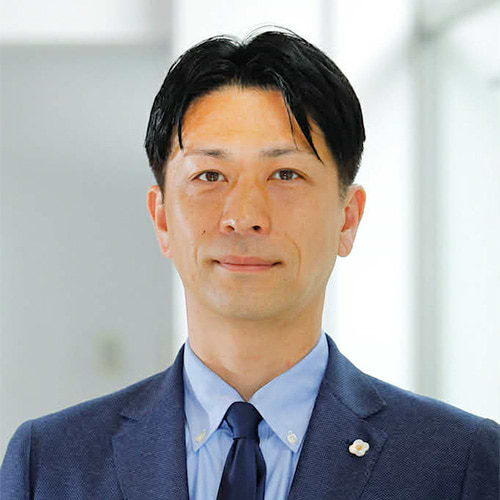
Shintaro Sato (Professor, School of Sport Sciences, Waseda University)
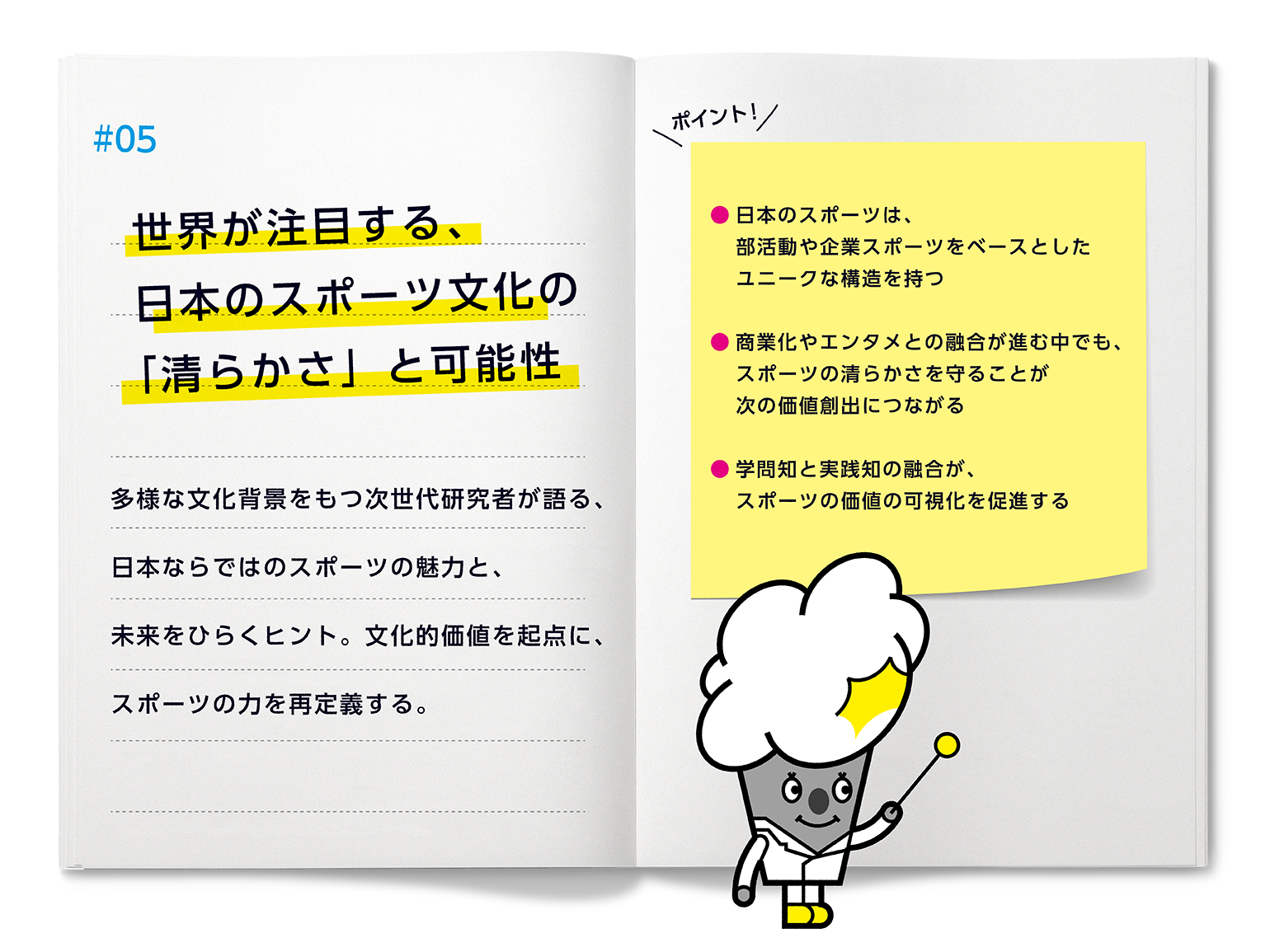
Japanese sports culture is fascinating as a research subject. Why overseas researchers are taking notice
Nakatsuka: Next, we'll hear from two graduate students in Professor Sato's lab. Could you please introduce yourselves?
Trill: I'm Trill Olsen. I'm from Norway and worked for six years before pursuing an academic path. During my three years studying at a Norwegian university, I developed an interest in the Olympics and even came to Waseda University as an exchange student back then. I also studied Japanese language and culture during my student days.
Jimmy: I'm Koukan Shu (Jimmy). I was born in China and lived there until age 11, then traveled to various countries through tennis.I lived in Spain for seven years starting at age 11, then spent the next seven years in the United States, continuing to play tennis at an American university. After that, I built my career in the sports field, working for a Major League Soccer (MLS) team and then returning to China to gain five years of practical experience at the Beijing 2022 Winter Olympics and Paralympics Organizing Committee. Currently, I'm enrolled in the doctoral program at the Sato Laboratory, engaging with sports from both practical and research perspectives.
Nakatsuka: Could you both share why you chose Japan as your research base and decided to join the Sato Laboratory?
Trill: During my undergraduate years in Norway, I read many of Professor Sato's papers and articles. His work on the Olympics and sponsorship was particularly impressive, making me think, "I want to study under this professor." When considering my master's program, I inquired about open positions, went through interviews, and ended up joining the lab.
Jimmy: In my case, I felt Japanese sports are uniquely significant both as a market and a culture, holding an important position internationally. As a young researcher, I believed Japan was the optimal place to deeply study sports. As I progressed with my research, I came across Professor Sato's research paper on the postponement of the Olympics due to the pandemic and was greatly drawn to it. I decided to pursue graduate studies, thinking I could gain essential learning under this person.
Sato: Both of you are currently working on a research project focused on DEI. It's a very broad field, but could you tell us again which specific perspectives you're focusing on?
Jimmy: I view DEI not as a "subject" in itself, but rather as a "driving force that pairs exceptionally well with sports." For instance, it enables us to advance diversity and inclusion—goals that have been difficult to achieve—through the medium of sports. I feel sports are exceptionally well-suited as a mechanism to catalyze change in society.In our recent research on the World Athletics Championships conducted with Trill and others, we focused on diversity and highlighted the role of the World Championships as a platform that respects diverse backgrounds.
Nakatsuka: That perspective of seeing it as a driving force is refreshing. So you view DEI not as an end goal, but as a means to move things forward.
Jimmy: Yes. From that perspective, we researched how events like the World Championships promote diversity. We particularly feel that, compared to other sports, the World Championships demonstrate a stronger stance of welcoming more diverse backgrounds.
Nakatsuka: Trill, what insights did you gain from your research?
Trill: Using quantitative data, we analyzed the perceptions of people who watched the World Championships via TV broadcasts.What emerged was that perceiving DEI—diversity, equity, and inclusion—strengthens the sense of "we are all connected" more than a sense of unity based on nationalism. In other words, the tendency was for stronger empathy and solidarity to arise from feeling "I feel everyone is a comrade because I sensed diversity, equity, and inclusion" rather than "I feel everyone is a comrade because I'm Japanese."
Nakatsuka: I think the mainstream view for international sporting events has traditionally been "supporting one's own country," but perhaps we're seeing a shift in that now.
Sato: It's hard to pinpoint the exact turning point, but I believe this World Athletics Championships was an event that helped propel this new feeling. Of course, the editing and direction by the broadcasting networks also played a role, but it seemed the emphasis was more on "celebrating human potential together" than on "competing as a nation."
Nakatsuka: Thinking about it that way, the Tokyo Olympics and Paralympics motto, "United by Emotion," might have been a symbolic event too. Back then, amid the pandemic, spectators couldn't attend, making it hard to release or share emotions. But at the World Championships, we finally saw the return of spaces where emotions could be expressed. That might be part of the trend.
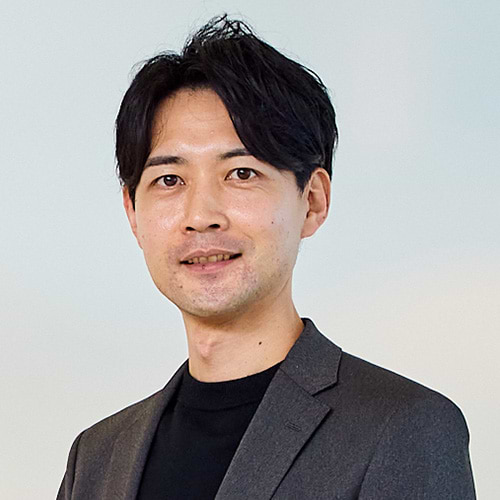
Trill Olsen (Sato Laboratory, Graduate School of Sport Sciences, Waseda University)
How to blend the purity of sport with business and entertainment?
Nakatsuka: Trill and Jimmy, what possibilities do you see for Japanese sports and society? What do you think is needed to make that future more interesting and exciting?
Trill: Compared to Europe, especially Norway, I feel Japanese sports have a very unique structure. It's the existence of a sports culture rooted in schools, universities, and companies.
While community and private clubs are the main drivers in Europe, Japan has a multi-layered foundation supporting sports: club activities in junior high, high school, and university, plus corporate sports. For example, the immense popularity of school-based tournaments like the Koshien High School Baseball Tournament and the Spring High School Volleyball Tournament is a uniquely Japanese appeal.
Nakatsuka: Indeed, this school- and company-based sports culture might be uniquely Japanese.
Jimmy: I already find Japanese sports incredibly exciting. For instance, you see middle-aged and older folks happily exercising at gyms, or golf courses packed even on weekdays. Sports are deeply rooted in daily life, and that alone is exciting enough.
On top of that, I believe the key to reaching the next level is "the fusion of sports and entertainment." Some companies and teams are already doing this. Adding entertainment elements to stadiums and ballparks creates a more emotionally stirring experience. In other words, by adding extra value to the sport itself, the experience is elevated, potentially attracting a wider audience.
Nakatsuka: That's a very interesting perspective. However, some might worry that if the entertainment elements become too strong, it could diminish the pure appeal inherent to sports. What are your thoughts on that?
Sato: Allow me to elaborate on that. I believe the core value of sports lies in its "purity." This is a value deeply connected to things like the sweat and tears of club activities and youth.In the past, "purity" and "business" were often seen as opposites. I don't view them as conflicting axes. Rather, I believe business is necessary precisely to protect that purity, and incorporating entertainment is also crucial. Some might criticize that emphasizing purity blinds us to what's happening behind the scenes.
Purity, business, entertainment. These three elements are not something that shifts with the times; they can coexist. It's not about black or white; what is required of sports going forward is how to harmonize them.
Nakatsuka: With that premise in mind, Professor Sato, could you share again what aspects of Japan's sports world you, as a researcher, perceive as unique or holding potential?
Sato:Researchers coming to Japan from overseas are uniformly struck by the "purity" that remains in Japanese sports. Take Koshien, for example. Many are moved not just by the games themselves, but by the athletes' attitudes and passion. Of course, as mentioned earlier, Koshien and club activities face various challenges and debates. Yet, there is a universal appeal in that "unadulterated, straightforward attitude." I believe such purity remains deeply ingrained in Japan today.
What I mean by "purity" is a state where there is absolutely no impurity in what one is doing. The key challenge is how to integrate business and entertainment perspectives into this. How can we preserve these values inherent in Japanese sports while connecting them to the future? I feel this is one of the themes entrusted to us researchers.
Shu Koukan (Jimmy) (Sato Laboratory, Graduate School of Sport Sciences, Waseda University)
"Let's expand sports" together, moving forward
Nakatsuka: Professor Sato, could you share your expectations for young researchers contemplating the future of sports, from your own perspective? Of course, please extend this message not only to Trill and Jimmy from your lab but to all young researchers engaged in sports-related studies.
Sato: As a fundamental premise, I believe it's perfectly fine for everyone to have their own approach. Ultimately, as long as each person becomes a distinguished researcher, whatever path they take is the right one. That said, what I particularly want to convey to young people in this era is: "Focus on volume and speed." It might sound a bit old-fashioned, but I truly believe this is essential.
Today, you can access video streaming services in under 10 seconds and instantly enjoy entertainment.With so many environments set up to provide passive, enjoyable experiences, people are easily drawn to these casual leisure activities. While "research" is an exciting endeavor, it inevitably requires steady effort and the willpower to engage with it proactively. That's precisely why I want young researchers to avoid being swept away by easy stimulation and instead adopt an attitude of actively seeking out experiences for themselves.
Focusing on "numbers" and "speed" is, in other words, about "going out to gain experience." When you're young, the most important thing is simply to step up to the plate and increase the number of times you swing the bat. You can't hit a single or a home run unless you start by swinging the bat. Accumulate a wealth of experience without fearing failure. I believe that builds the fundamental strength needed to become a researcher.
Nakatsuji: Finally, as a researcher, is there anything you expect from the companies supporting sports or from the business world, like ours?
Sato: Honestly, it boils down to one word: gratitude. I've been involved in sports management research for a long time, and I've seen how many corporate people truly work hard to support sports. Having witnessed that firsthand, it would be presumptuous of me to say I expect anything.
I am simply grateful for the money they invest to energize sports, for the environments they create, and for the practical support they provide. I sincerely hope we can continue co-creating a better future for sports and society together.
Nakatsuka: Thank you. Finally, could you share what "the value of sports" means to you, Trill and Jimmy?
Trill: "Connection Inspiration." I chose "connection" and "inspiration" because I believe sports unite people across national and social divides, creating shared celebrations in our increasingly fragmented society. Witnessing others' challenges and achievements also sparks hope, motivating people to take their own steps forward.
Jimmy: "HAPPINESS PURPOSE." I chose "Happiness" and "Purpose" for two reasons. First, I believe the fundamental purpose of any endeavor is to support people in living happy lives. Second, I want to provide concrete tools and pathways for how sports can cultivate happiness and purpose.
Professor, School of Sport Sciences Director, Sport & Entertainment Management Lab.
消費者行動分析を主要な研究トピックとし、Journal of Sport ManagementやSport Management Reviewなど国際主要学術誌に多くの論文を発表している。スポーツやエンターテインメントの力を社会に還元することをライフワークに掲げている。
Trill Olsen
Waseda University
Graduate School of Sports Science
Doctoral Program (Sato Laboratory)
Researching the value, meaning, and well-being generated by sports at organizational, societal, and individual levels, with a focus on corporate sports, sponsorship, and sporting events, from an international comparative perspective.
Sports Business Solution Division, Growth & Solutions Department 2
Senior Producer/Planner
After joining the company, he worked in the Direct Marketing and Sales departments before transferring to the Soccer Business Office in 2020. He worked on sports sponsorship strategy development and activation planning. Since 2024, he has been promoting projects focused on creating value for sports content, including new business development, centered on "solving challenges through sports" in his current position.

 Visualizing the value of sports. "Sports Future Research Notes" [5/7]