
Note: This website was automatically translated, so some terms or nuances may not be completely accurate.
ADFEST 2026: How to Unleash “Unseen Creativity,” as Discussed by Naoki Tanaka, CCO of Dentsu Lab
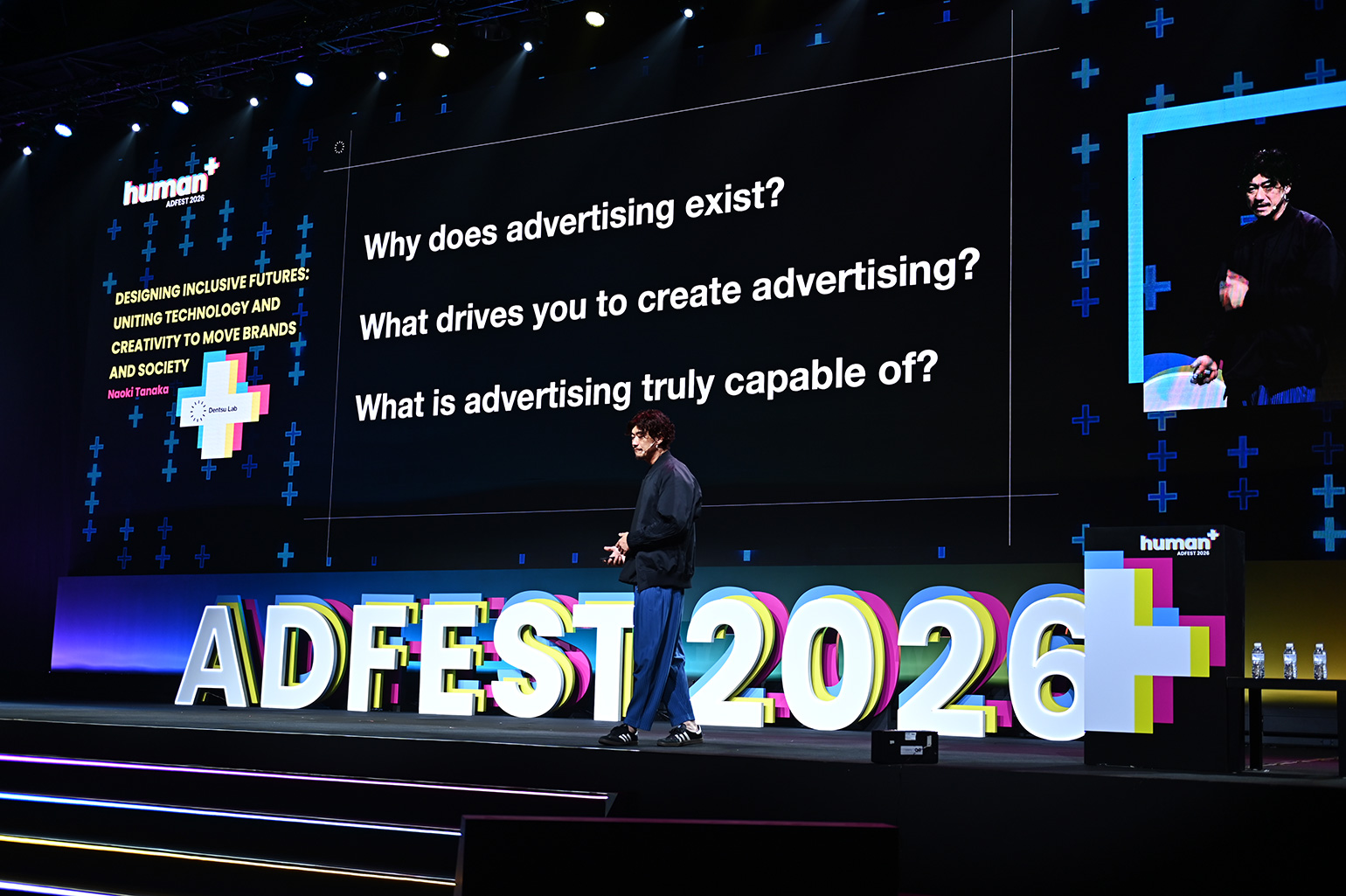
At "ADFEST 2026," one of the largest advertising festivals in the Asia-Pacific region, held in Pattaya, Thailand, from March 19 to 21 this year, Naoki Tanaka, Chief Creative Officer of Dentsu Lab, took the stage to deliver a presentation titled "Designing Inclusive Futures: Uniting Technology and Creativity to Move Brands and Society."
What is advertising? Why does advertising exist? Why do we create advertising?
The lecture, which began with these fundamental questions, eventually expanded into a discussion of the projects Tanaka has been working on for approximately five years. The starting point was “Project Humanity,” a challenge he has pursued alongside NTT, and the series of initiatives leading up to his latest project, “Waves of Will.” These efforts continue as initiatives that transcend the boundaries of advertising to reexamine the very nature of creativity itself.
Changing the world through the creativity of a single individual
“There is creativity in the world that has yet to be seen.”
What led Mr. Tanaka to this conviction was an encounter at the Tokyo 2020 Paralympics. Despite physical limitations, there existed a rich potential for expression that had never before been brought to light. If we could create a system to draw out that creativity, how would society change? “Project Humanity” began with this question as its starting point. What sets it apart is that it always begins with “an individual’s challenge.”By deeply engaging with the individual and expanding the solution to society, this approach forms the very core of the project.
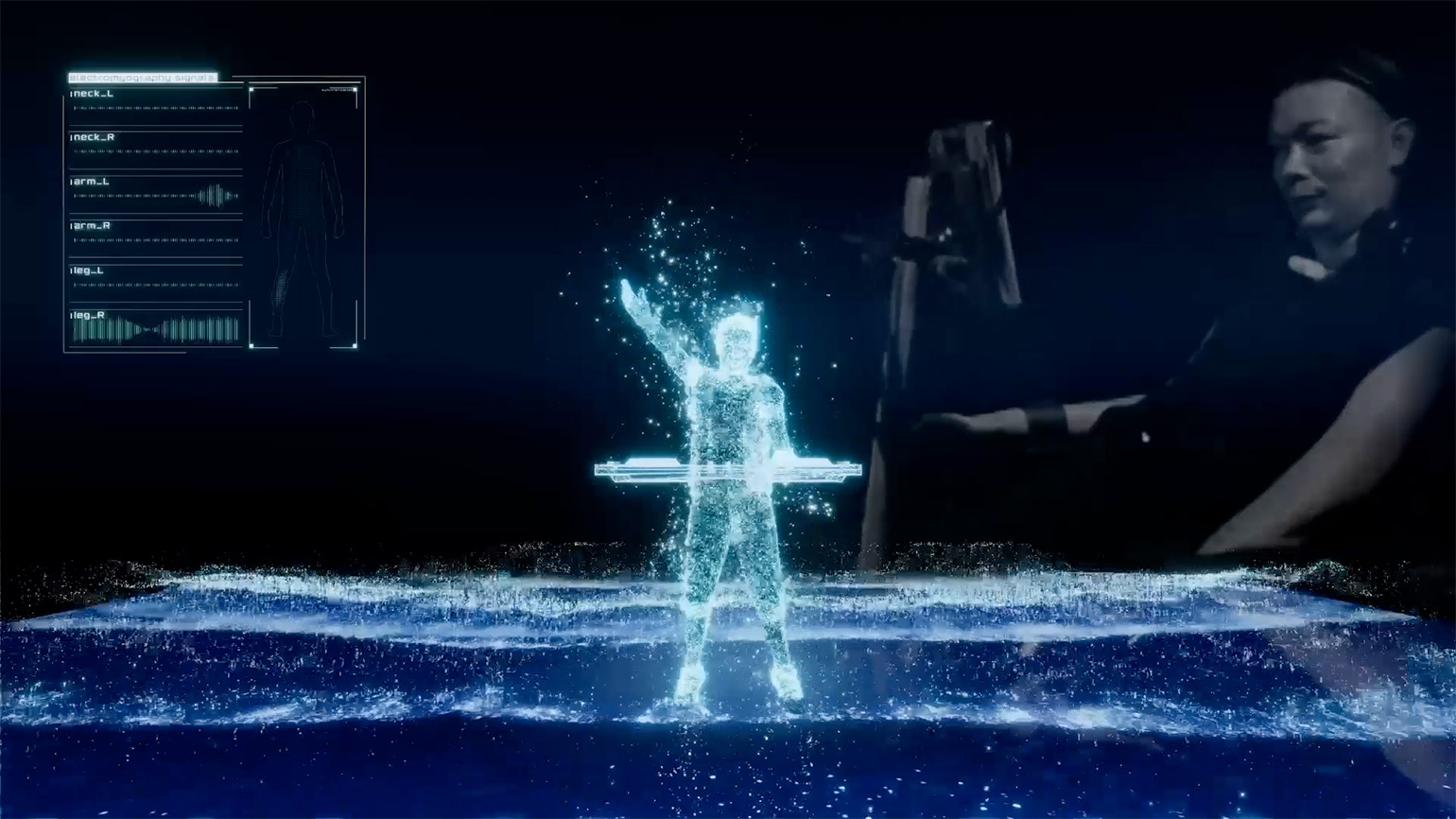
The concept of regaining lost physical abilities
At the center of the project is EYE VDJ MASA (Masatane Muto), a person living with ALS (amyotrophic lateral sclerosis). ALS is a disease that gradually robs the body of its freedom.Patients lose the ability to move their muscles, and eventually even communication becomes difficult. However, Mr. Tanaka saw another possibility there. Could we “redesign physicality”? One answer to that question was the development of an interface using electromyographic (EMG) signals, in collaboration with NTT Human Information Science Laboratories, which specializes in EMG analysis. By reading subtle biological signals and converting them into avatar movements, this technology enables expression that transcends the limitations of the physical body.
Thanks to this technology, MASA was able to perform DJ sets through an avatar and interact with audiences once again. For him, the most agonizing aspect was “being unable to respond to the audience.” The moment he overcame that barrier, his creativity began to reconnect with society.
Interfaces Erase Social Boundaries
This initiative extends beyond individual experiences. The interface developed by NTT and Mr. Tanaka is being expanded into games and esports under the name “Interface of Humanity.” It creates an environment where anyone can participate on the same playing field, regardless of physical limitations. In this space, the very distinction between “can” and “cannot” loses its meaning.
Furthermore, applications in education and the workplace are also being considered. Tanaka describes this trend as “innovation that begins with one person and spreads throughout society.” The liberation of creativity is not intended for a select few, but is opening up to everyone.
Communication as Human Dignity
The project delves even deeper.
In the final stages of ALS, patients lose all bodily functions and even the means to communicate their intentions. This condition is also known as “locked-in syndrome.” Mr. Tanaka views this not merely as a medical challenge, but as “a matter of human dignity.”
This led to the development of an interface using brainwaves. Research on brain-computer interfaces is being conducted worldwide. However, many of these require surgery or large-scale equipment such as fMRI scanners. They are also expensive and not accessible to everyone. On the other hand, simpler systems suffer from accuracy issues.
Together with NTT, Tanaka is attempting to overcome these challenges by utilizing “real-time machine learning” and “motor imagery” (the mental image of clenching one’s hands). By overcoming the limitations of conventional technologies—such as “accuracy,” “time lag,” and “dependence on external stimuli”—they have built a system that users can operate intuitively through their own will. This system serves as the foundation for realizing a “society where communication is possible until the very end.”
The Possibilities of Expression Guided by Brainwaves
Using this technology, an ALS patient co-created a ballet performance script and selected movements in real time. Despite being unable to move their body, they selected choreography and controlled movements on stage using brainwaves. The script was also created using the same interface.
What is “expression of intent”? What is “dancing”? What is the “body”? What is a “human being”? This endeavor, which challenges these very premises, has greatly expanded the possibilities of expression.
Even if one cannot stand, one can still express oneself. This fact reaffirms the inherent freedom of creativity.
Innovation Born from Imperfection
Toward the end of his lecture, Mr. Tanaka referred to “kintsugi,” a traditional Japanese technique.
Explaining this philosophy—which involves repairing broken vessels and viewing the traces of repair as beauty—he described it as “a concept that transforms imperfection into value.” Furthermore, Mr. Tanaka stated, “Innovation, too, is born from gaps and constraints,” adding, “What is important is not to focus on what is complete, but on the ‘unfulfilled parts,’ and not merely to repair, but to move people’s hearts and excite them.”
Tanaka also emphasized that “listening to a single voice” is the starting point of innovation. “In an era dominated by vast amounts of data and algorithms, it is the authentic voice of the individual that serves as the starting point for new creation,” he said, highlighting its importance.
Can Advertising Become a Catalyst for Social Progress?
Global advertising spending continues to grow and is projected to reach $1 trillion by 2026. Regarding this situation, Tanaka pointed out that the question is whether these massive resources will be “limited to merely stimulating consumption, or utilized as a force to transform the very structure of society.” He further expressed the view that “it is possible to contribute to companies and brands while simultaneously making society better, and advertising is a field capable of achieving both.”
He concluded by saying:
“We are all catalysts and can become creators.”
He presented the perspective that creativity is not the exclusive domain of a select few, but something anyone can possess. This lecture offered many insights into approaches for unleashing that potential.
Was this article helpful?
Share this article


