
Note: This website was automatically translated, so some terms or nuances may not be completely accurate.
 The Present and Future of Design and Innovation by frog [49/49]
Harnessing AI: A New Era in Marketing

frog
This article is based on content originally published in "Design Mind," a design journal operated by frog, and is presented under the supervision of Noriaki Okada of the Dentsu Inc. BX Creative Center.

In this article, we explain how AI is transforming the content supply chain (*1) and dramatically enhancing marketers’ capabilities.
*1: A system that optimizes the planning, production, management, and distribution of content as a single, integrated process.
The Next Goal: AI-Native Marketing
For decades, marketing has been a profession that required a delicate balancing act. On one hand, there is the desire to expand reach; on the other, the desire to connect with customers on a one-to-one basis.
For many years, striking the right balance between these two goals was considered impossible. Marketers were often forced to prioritize one and compromise on the other. However, thanks to advancements in AI, the era where it is finally possible to reach a wide audience while connecting with each individual has arrived.
The Current Content Supply Chain at a Stalemate
Traditionally, marketers had to choose between “scale” and “connection.” Mass media, such as television and print, could achieve broad reach but offered limited opportunities for personalized engagement with users. Then, digital innovation and social media (SNS) introduced new tools, enabling omnichannel delivery.As reach expanded, connections were strengthened. Yet in practice, reach was typically prioritized. This was because, with clear metrics and a wealth of tools, it was easier to evaluate and achieve reach targets than to cultivate genuine connections with customers.
As the arena for building engagement expanded to the omnichannel, fragmentation also increased in the marketing world. In such an environment, marketing—which should be an inherently creative field—can sometimes come to resemble a logistics operation.Attempting to connect with each individual across multiple platforms, in various formats, and with distinct customer segments leads to a complex content supply chain. As a result, many marketers began to feel that they were merely managing traffic rather than building connections through creativity.
<Key Steps in the Content Supply Chain>
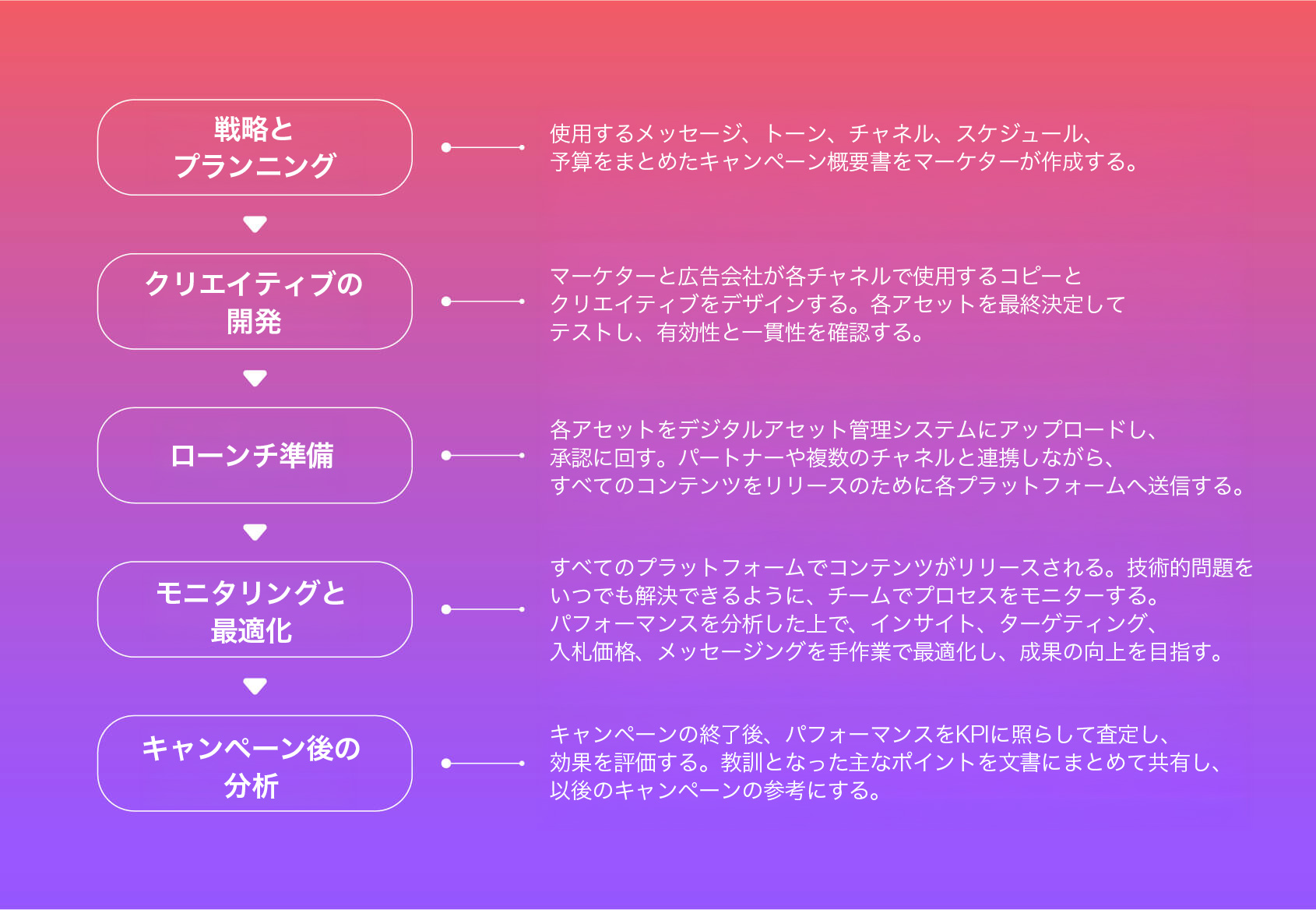
The traditional content supply chain was plagued by recurring issues that were difficult to resolve.
- Strategy and Planning: Unclear objectives, misaligned expectations, and vague definitions of the target audience.
- Creative Development: Slow approvals, manual asset revisions, inconsistent quality.
- Release Preparation: Disjointed workflows, missing cultural opportunities.
- Monitoring and Optimization: Insufficient tracking, slow optimization cycles, and incomplete data.
- Post-campaign analysis: Difficulty interpreting performance data and applying lessons learned.
Because of these deep-rooted issues, marketers end up spending more time managing processes and coordinating data transfers than building meaningful connections. And it’s not just marketers who are struggling. Brands, too, are missing out on growth opportunities and losing touch with consumers due to the increasing complexity of the content supply chain.
Furthermore, today’s consumers quickly stop engaging with content that feels irrelevant or insincere. Even if you send notifications about items left in shopping carts, address customers by their first names in messages, or display product recommendations based on recent Google searches, all these standard tactics become futile if they are ignored.
Given these challenges, it comes as no surprise that the latest CMO Insights Report from frog and the Capgemini Research Institute—a research arm of Capgemini —reports that only 18% of companies are confident that personalizing customer interactions has successfully improved their results.Furthermore, only 31% of marketers are fully satisfied with their ability to unify customer data sources (Salesforce’s “State of Marketing” report, 9th edition). The content supply chain has become a bottleneck for content.
Unless marketers can reduce the time spent managing the content supply chain, they will continue to be hampered by the limitations of human capacity. In this context, artificial intelligence (AI) holds the potential to free marketers up so they can focus on strategy and storytelling.
5 Paradigms AI Brings to the Content Supply Chain
The advent of AI does not mean marketers will become obsolete. Human intuition will continue to drive the advancement of marketing techniques. However, AI will become an indispensable tool for dynamically generating and managing campaigns, content, and insights. By leveraging AI, marketers will be able to further enhance their ability to build personalized connections at scale.
Marketers will finally be able to deliver one-on-one messages to a wide range of target audiences while fully benefiting from the automation and acceleration enabled by AI. There will no longer be a need to spend time manually scrutinizing every detail of data to optimize campaigns, or struggling to obtain approvals and compile briefs.AI also plays a crucial role in orchestration (*2). By streamlining complex, siloed ecosystems and eliminating the need to manually connect fragmented systems, it saves marketers valuable time.
*2 = The integrated management and optimal coordination of multiple elements, processes, and tools
By using AI as a support tool, you can rationally optimize campaigns based on real-time results derived from performance metrics. This leads to solutions for reach-related challenges (when, where, and how to deliver), allowing marketers to focus on building connections (what to communicate, to whom, and why).
The concept of “marketers harnessing AI” will continue to evolve, and AI-powered content supply chains will give rise to the following five new marketing paradigms.
〈Five New Paradigms in Marketing〉
- Intelligent Creativity
Marketers can use human creativity as a driving force to quickly bring ideas to life and expand the scope of creative and content production. - Real-Time Relevance
Optimization by autonomous AI will support the creation of dynamic campaigns, allowing brands to move away from static, sluggish campaigns that often miss critical timing. This will also enable them to actively contribute to shaping the culture of the times. - Online Workflows and Ecosystems
AI-powered workflow coordination replaces complex content supply chains and manual management. Repetitive tasks are automated, streamlining workflows across teams. - Next-Generation Measurement and Insights
AI transforms measurement into a process that is “proactive, continuous, and immediately actionable.” Marketers will be able to track performance in real time and gain predictive insights to guide decision-making. - New Agent-Based Spatial Engagement
As consumers begin to entrust AI agents with filtering information and interacting with others, marketers will need to design experiences that cater to two distinct types of contact points: human and AI. They must establish a presence in ambient systems (*3) that blend into daily life, as well as in voice interfaces and mixed reality (MR) environments.
*3 = Systems that naturally blend into users’ lives and environments, automatically taking optimal actions when needed.
Practical results will emerge from these five new paradigms, leading not only to improved business performance but also to greater satisfaction among marketers.
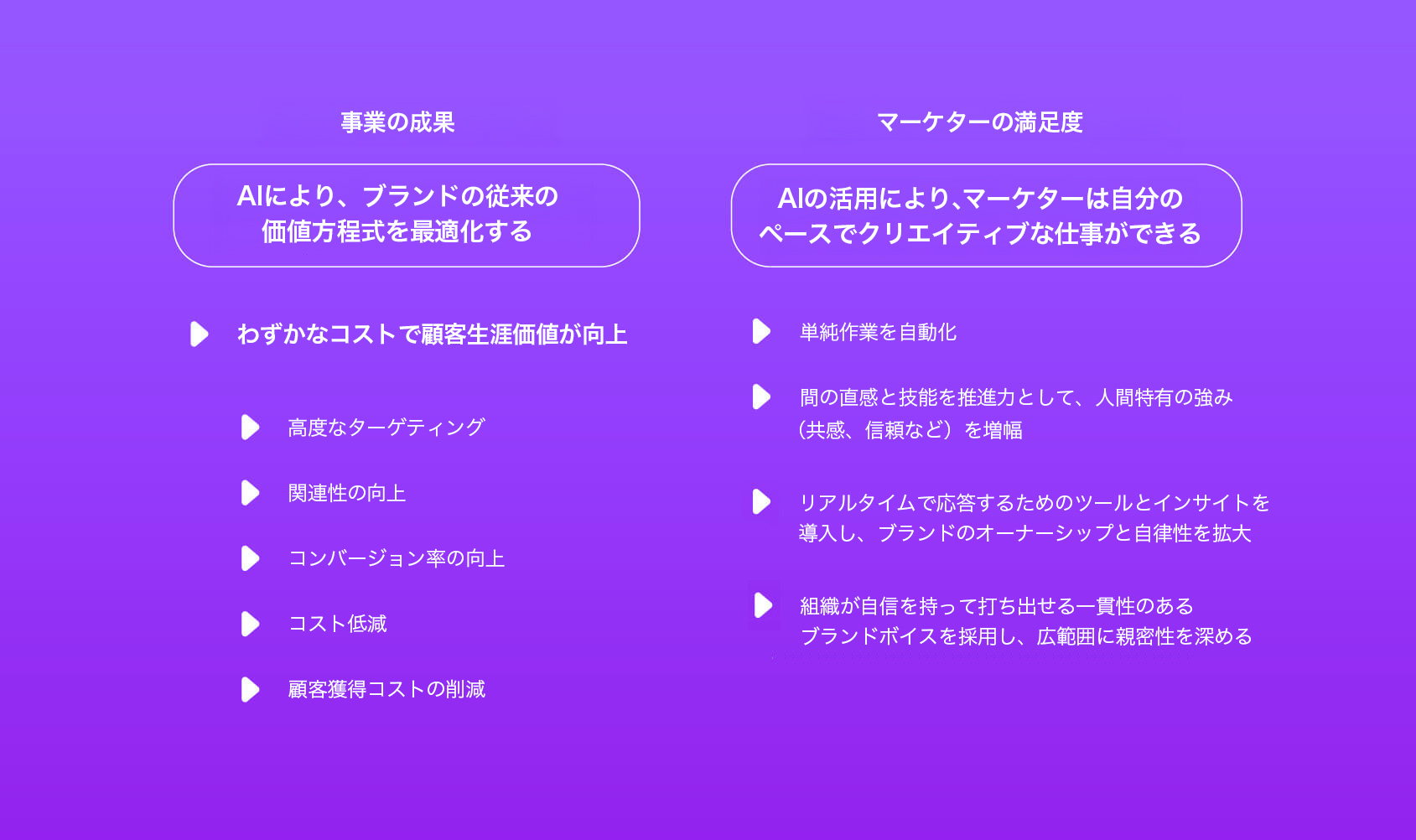
How will marketing change in a future where AI is widespread?
Agent-type AI—autonomous “proxies” that act on behalf of brands and consumers—will further drive the transformation of marketing. By utilizing agent-type AI, marketers will not only gain the opportunity to return to creative work but will also need to maximize their creative abilities. More than ever before, they will be required to become exceptional “brand stewards” who protect and nurture brands.
At frog, we view the next generation of marketers as “multi-faceted professionals who develop their own skills and blaze new trails to build strategies.” Future marketers who leverage AI will likely take on the following roles:
- Creative Orchestrator: Using AI to continuously generate ideas and a wealth of content.
- Cultural Operator: Devising strategies to ensure the brand keeps pace with cultural shifts.
- System Administrator: Establishing clear rules and escalation points for team collaboration using AI.
- Insight Validator: Interpreting data alongside AI to maintain a competitive edge.
- Experience Builder: Leverage large language models (LLMs) to enhance brand strength and maintain a presence in consumers’ minds.
Marketers Grow Alongside Customers
Just like marketers, consumers are also adapting to the next new shopping environment, where social commerce, AI, zero-click search, and other innovations are becoming increasingly widespread. If anything goes wrong, there is a risk that the loyalty marketers have worked so hard to build will crumble. However, the five new paradigms introduced earlier also provide a roadmap for maintaining—and hopefully strengthening—the bond with consumers.
With the right support, marketers can bring all the necessary pieces together to build a consistent brand voice and expand their connection and reach with customers like never before. Marketers who embrace these new paradigms and evolve alongside consumers will be the ones to succeed in the future.
So, what does this AI-powered marketing mean for consumers? It means they can expect a constant stream of authentic content from their favorite brands. Furthermore, that content will become increasingly relevant to them, making it more engaging. Most importantly, that content will be trustworthy, leading to the building of lasting trust in the brand.
The Dawn of a New Era in Marketing
At frog, we are constantly thinking about how we can leverage AI to achieve our goals, meet growing demand, and connect more deeply with the world. We have explored five new paradigms for marketers utilizing AI, while also examining how marketing departments can make these paradigms a reality for marketers. We believe this process broadly consists of three steps: consideration, activation, and finally, scaling.
It all starts with asking the right questions.
- Marketing Strategy: What does a future with widespread AI adoption mean for our brand and marketing?
- Proof of Value: Can we actually deliver tangible value?
- Clarifying the Next Steps: How can we make this effective for our brand?
- Large-Scale Deployment: How can we apply this to everything?
The advent of mass printing, radio, television, and the internet has, each time, expanded human social and cultural interactions. AI is simply the next step in that process.Marketers are already leveraging these technological advancements to transform creative perspectives and find the right balance between “reach and connection” that everyone has been seeking. And now, a new era of marketing is about to begin. Marketers who embrace AI will be the ones to weave the narrative of this next chapter.
Was this article helpful?
Share this article


Newsletter registration is here
We select and publish important news every day
For inquiries about this article
Back Numbers


Author