
Note: This website was automatically translated, so some terms or nuances may not be completely accurate.
 The Present and Future of Design and Innovation by frog [48/49]
Enhancing DesignOps with AI-Powered Design Systems
frog
This article presents content originally published in "Design Mind," a design journal operated by frog, under the supervision of Mr. Noriaki Okada of Dentsu Inc. Creative Center.
DesignOps (Design Operations) refers to the functions and teams that enable efficient and effective design work within an organization.
This article explains how to strengthen DesignOps, which is crucial for adapting to next-generation organizational paradigms while transitioning to agent-based digital product design.
<Table of Contents>
▼Reset Design and DevOps Models to Build a Stable Foundation for the Future
▼Guidelines for Riding the Wave of Innovation
▼Interpreting Emerging Signals
▼ The Question Isn't " What" Happens, But "When"
▼Agent-Based AI and Synthetic Design
▼How design and business leaders should prepare for this shift
Reset Design and DevOps Models to Build a Stable Foundation for the Future
The world today, emerging from the global COVID-19 pandemic, is highly uncertain, intensifying pressure on corporate design teams to prove their investment value.
Specifically, team leaders feel they must quickly identify new forms of value, deliver results that translate into modern success metrics, and achieve this with minimal effort. Fortunately, emerging technologies—such as AI in product design—offer leaders not only the means to fulfill these responsibilities but also the opportunity to exceed expectations.
That said, design team leaders must confront various difficult challenges. These include overcoming departmental silos within the organization, dealing with legacy technology debt, and balancing "bets" on the future with unfinished business from the past while driving innovation at a pace suited to each.
Yet, while navigating these harsh realities of corporate transformation is undeniable, there lies an opportunity to build a more stable foundation for the future by redefining established design and DevOps models.
Thanks to the rapid evolution of generative AI and production tools for design and development, design teams can automate workflows, expand creativity, and achieve the fundamental goals of DesignOps (see here for details). AI-powered design holds the potential to reduce time to market while enabling workforce reduction and streamlining internal capabilities.
※1 DevOps = A concept and methodology that strengthens collaboration between Development and Operations, integrating software development and operational processes.
Guidance for Riding the Wave of Innovation
Design team leaders worldwide are streamlining design and DevOps functions to create new forms of value in design. In this context, frog is seeing increased demand for client support focused on forward-looking strategies.
Questions frog often receives
- How can we advance our design and DevOps initiatives at a manageable scale to achieve meaningful impact?
- How should we allocate team members between day-to-day operations and future-focused innovation work?
- What are the most critical capabilities and skills as the team evolves?
- Which parts of the design process can be automated or augmented with AI?
- What role will our Design Language System (DLS) play in this new context? What can we do in the short, medium, and long term to achieve efficiency?
With these questions in mind, frog seized this opportunity to explore a series of "future scenarios" with our Global Innovation Team in Milan. This yielded valuable insights with significant potential to benefit clients facing future challenges in the DesignOps domain.
Assuming DLS will remain the backbone of DesignOps in the short to medium term (within the context of generative AI, design automation, and agent-based customer experience [CX]), we will focus on the final question about DLS. This is because considering its answer leads us to reexamine the human-woven fabric and the roles and responsibilities surrounding it.
※2 Design Language System (DLS) = A system of rules and guidelines for achieving consistent design across brands and products.
Interpreting Emerging Signals
The design platform "Figma" has evolved toward building token-oriented product design processes powered by AI. Meanwhile, app development tools like "Replit," "BOLT," and "Glide" have realized no-code processes from conception to build.Furthermore, generative content creation tools like "Adobe Firefly," "Midjourney," and "Sora" have emerged in rapid succession in recent years. Within this landscape, we identified a gap that could be filled by a near-future product design process grounded in an AI-powered intelligent design system.
As we began exploring future scenarios, we hypothesized that it might be possible to rethink how design systems are integrated into the design process. We proposed combining the inspiration-driven processes of the initial exploration phase (mood boards, visual direction, style guidelines, brand expression) with the development of a product foundation applied to core components (※3), thereby automating the first few stages of the development process.
Now, let's consider "From Concept to DLS."
If the workflow becomes shorter, more efficient, and produces unexpected results, what kind of impact would that have on the teams using it?
※3 Core components = Essential parts or elements that form the foundation or center of a system.
・Project Background
We used frog's design language system, Metachrosis DLS, as our foundational input and employed "Figma" as our main platform. Building on this, we explored how to encode design tokens within the system so that AI could process multimodal sensory intent and content in real-time, converting it into immediately usable designs.
We prototyped a plugin within Figma's architecture and created a verification prototype capable of converting text and images into design instructions. This revealed both the potential for workflow efficiency and areas needing improvement. Making specific directional tweaks to the input images for the plugin directly influenced the DLS output in real time, enabling iterative refinement and consideration of brand research at the system level.
This iterative cycle between input and output serves as the starting point for continuous exploration of the nuances and variables within design instructions.
The localized "Token to Design Language" generation script within this prototype can be considered a substitute for a narrowly scoped language model tailored to a specific brand. This model will become the engine driving future brands and their design and development teams, dynamically evolving and transforming based on the context and information from users.
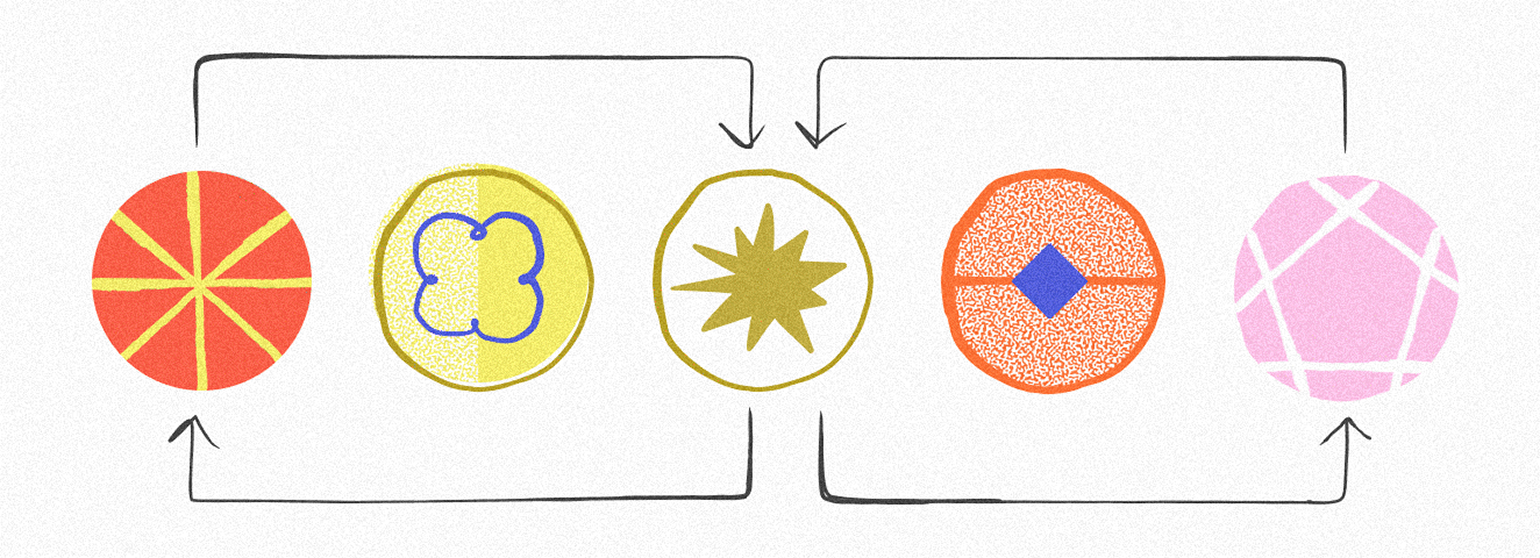
・Future Workflow
This internal frog project exemplifies several themes likely to be prevalent in next-generation computer-assisted processes.For example: "experimental construction of AI tools using AI for both input and output," "co-copyright coordination," "co-curation with AI," "constraints when using AI APIs," and ultimately, "tactical challenges in making DLS tokens 'AI-friendly' (preparing them in a form easily understood and utilized by AI)."
Furthermore, patterns confirmed by prototypes emerged in the day-to-day operations of frog's various programs. Here, DLS's role expanded across various aspects of brand and product expression, and team structures began to diverge from norms established in the design field over the past decades.
The question is not "what" but "when"
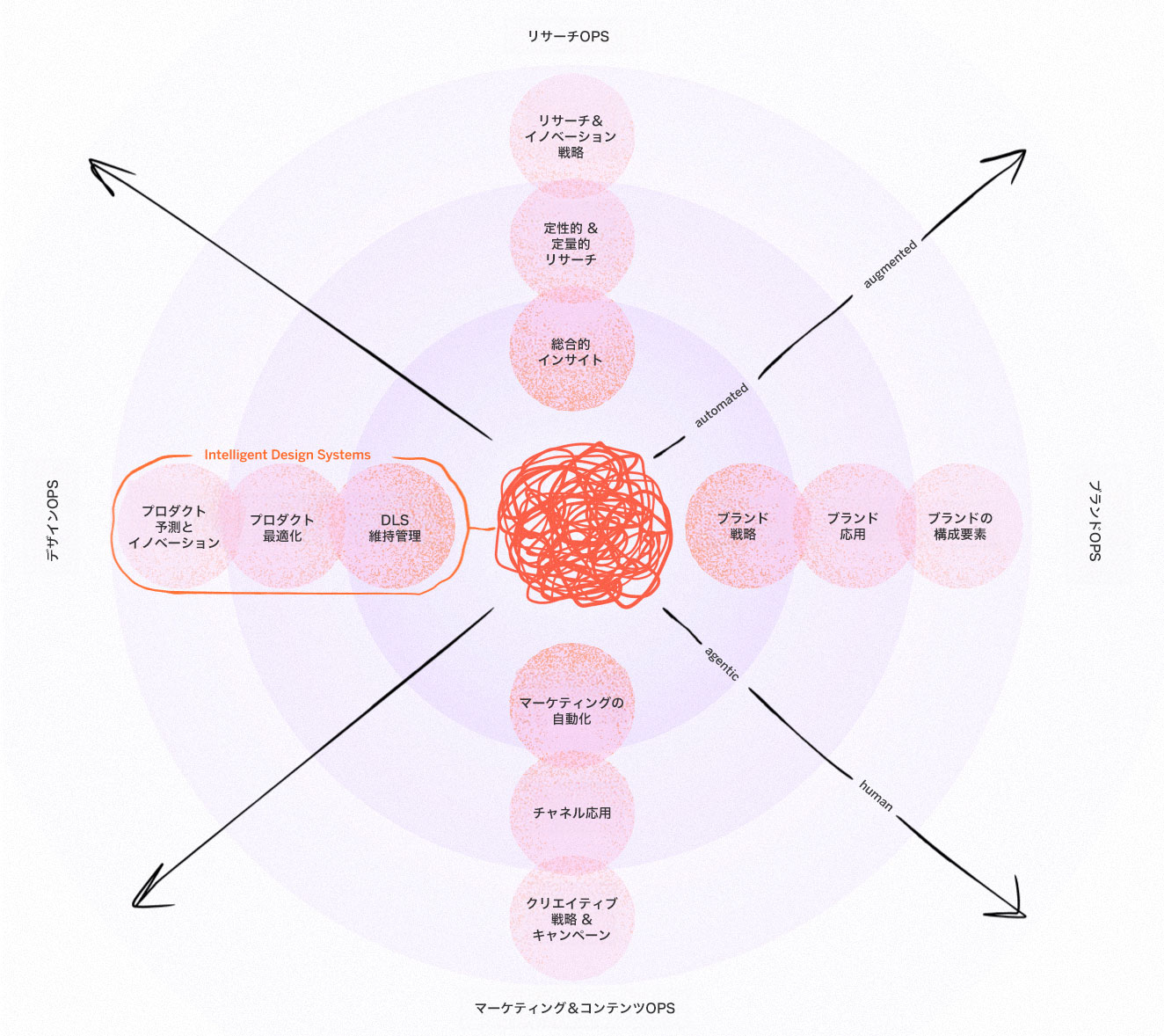
While many of frog's clients currently build teams considering members' specialties, years of experience, and job levels, we predict that team member characteristics will increasingly relate more directly to innovation mindset and the product lifecycle itself.
In other words, the established classifications and roles typically used in team formation (product design, service design, interaction design, visual design, user experience/user interface) will generally shift based on how each member perceives their role in building and deploying the product.
Placing these categories on an axis, they fall somewhere between "general" and "specific." General roles are "horizontal," spanning multiple domains and serving to connect teams (across brand, marketing, product, and service departments). Specific roles, conversely, are "vertical," focusing on specialized work within a particular domain to enhance product precision and accelerate development.
[General Roles]
An evolving DesignOps team can cover multiple general opportunity areas, but the following two are critical domains requiring priority focus:
Product Strategy and Research
- Identify new or evolving product opportunity areas where strategic "bets" should be made.
- Investigate emerging consumer behaviors and develop strategic concepts.
- Analyze and generate insights from current industry trends and macro trends.
- Develop and curate roadmaps for future-proof products and services.
Design System Management and Automation
- Maintain, refine, and curate dedicated AI models to support specific brands.
- Collaborate with brand, marketing, and business teams to co-develop brand attributes and expressions within these models.
- Serve as the repository and librarian for asset inventories and cross-product applications.
- Drive the tooling and automation of process functions across the entire product portfolio (directly integrated into no-code-oriented prototyping processes).
[Individual Roles]
Beyond members handling general responsibilities, the team is further strengthened by adding members with specialized expertise in specific domains. These members combine design and technology across one or more domains to shape the unique characteristics of the product.
Prototyping and Building
- Design and evolve customer experiences, flows, and feature concepts based on emerging industry needs.
- Rapidly build prototypes and construct the product experience by combining DLS bootstrap features, no-code prototyping, and manual fine-tuning based on the above flows and features.
- We iteratively test and validate built features with end users.
- Provide sufficient detailed designs in collaboration with the development team to complete and release the product experience.
Product Improvement
- Continuously monitor product performance and its degradation through data, analytics, and real-time testing.
- Build scalable, automatable evaluation models for product performance simulation and A/B testing.
- Design and develop micro-interventions for product optimization.
- Report and document insights for other departments to feed back into the production process.
While these roles and responsibilities are not novel in the DesignOps world, we anticipate that a significant number of designers may be displaced over the next few years. More importantly, the effort required to manage these tasks will be drastically reduced. A single person handling the operational space between general and specialized roles could potentially become the starting point for an effective, minimal DesignOps team.
The approach to talent evaluation is shifting from emphasizing specialized fields to emphasizing practical abilities, underpinned by the fundamental assumption and expectation that innovation occurs throughout the entire product lifecycle. Furthermore, the platforms for individuals to acquire and apply skills are expanding. In the near future, it is reasonable to expect that members of AI-powered DesignOps teams will spend roughly equal time on routine tasks and on building or refining tools.
Therefore, innovation consciousness means continuously refining production methods and styles (along with the engines and models that support them) while designing for users and the business.
Agent-Based AI and Synthetic Design
Such paradigm shifts will help build the foundations and platforms for integrating agent-based AI, or "synthetic design," into workflows. When AI models are placed at the heart of DesignOps teams and leveraged throughout (automated) product processes, team members will gradually be able to delegate relatively simple, automatable tasks to agents for execution.
As a clear result, relatively small teams of human designers will manage the "system of systems," curate the brand, and design and develop the fundamental elements of the product experience, while automating other tasks in the synthetic design process and delegating them to agents.
This paradigm shift will make it increasingly difficult for all brands to differentiate themselves and achieve market effectiveness as they pursue optimization for efficiency and compete on process and execution.Products, brands, and narratives will become increasingly homogenized and indistinguishable. Consequently, cultivating taste, human rationality, creativity, and a sense of innovation will become more crucial than ever. To make excellence stand out amidst mediocrity, strong leadership and proactive campaigning will be key.
Quality standards across the entire customer experience will rise, while tolerance for mediocrity will decline. This new reality should arrive within the next two to three years. The foundational elements shaping this situation are being established right now. The time is approaching.
How Design and Business Leaders Should Prepare for This Change
Such a paradigm shift will help build the foundation and platform for integrating agent-based AI, or "synthetic design," into workflows. When AI models are placed at the heart of DesignOps teams and leveraged throughout the (automated) product process, team members will gradually be able to delegate relatively simple, automatable tasks to agents for execution.
As a clear result, relatively small teams of human designers will manage the "system of systems," curate the brand, and design and develop the fundamental elements of the product experience, while automating and delegating other tasks in the synthetic design process to agents.
This paradigm shift will make it increasingly difficult for all brands to differentiate themselves and achieve market effectiveness as they pursue optimization for efficiency and compete on process and execution.Products, brands, and narratives will become increasingly homogenized and indistinguishable. Consequently, cultivating taste, human rationality, creativity, and a sense of innovation will become more crucial than ever. To make excellence stand out amidst mediocrity, strong leadership and proactive campaigning will be key.
Quality standards across the entire customer experience will rise, while tolerance for mediocrity will decline. This new reality should arrive within the next two to three years. The foundational elements shaping this situation are being established right now. The time is approaching.
How Design and Business Leaders Should Prepare for This Change
To navigate the paradigm shift brought by AI for design, begin building future-ready teams guided by these six principles.
- When developing AI architecture, incorporate a holistic perspective. AI models can become the driving force behind brand consistency.
- Establish a collaborative model that spans brand, marketing, and product departments. Break down departmental silos and work toward shared goals.
- Develop strategies to achieve both overarching product goals and specific objectives. Secure team members with the necessary skills and experience while keeping an eye on the future.
- Advance automation while also strengthening investment in talent. Recognize that higher-level processes and tools can sometimes emerge organically from within the team.
- Pilot and evaluate DLS strategy initiatives. Invest in the design system, evolving beyond dormant Figma repositories.
- Entrust the helm to a visionary leader who proactively charts the course. Finding the right leader is key to steering the team in the correct direction.
※4 Repository: In IT and software development, this refers to a location for storing and managing data, code, files, etc.
When we began the internal initiatives introduced here, we adopted a unique approach: we attempted to simulate the future by building its prototype ourselves. It was, in essence, Futurecasting through construction. We anticipate that the next phase in the DesignOps domain will be an era of disruptive transformation and innovation. Therefore, we make the same recommendation to our partner companies and clients who are actively tackling challenges across various industries.
Somewhere within the process of strategizing, thinking, and shaping, there exists a "sweet spot" where magic happens and new value is about to emerge. Please enjoy every moment of that process as you move forward.
Was this article helpful?
Share this article


Newsletter registration is here
We select and publish important news every day
For inquiries about this article
Back Numbers


Author