
Note: This website was automatically translated, so some terms or nuances may not be completely accurate.
 The Present and Future of Design and Innovation by frog [46/49]
Turn future visions into reality with "Strategic Foresight"

frog
This article presents content originally published in "Design Mind," a design journal operated by frog, under the supervision of Mr. Noriaki Okada of Dentsu BX Creative Center.

"Strategic foresight" means creating an organization's forward-thinking perspective based on sufficient information. There is no need to fear the future. By adopting a forward-looking viewpoint, we can shape a future that fits our circumstances.
Adapting to Future Changes
The story of how Kodak, once the world's largest photographic film manufacturer, went bankrupt with the advent of the digital photography era has been told many times. It is usually presented as a cautionary tale. However, there is an interesting story behind it that is often overlooked.
From 1974 to 2006, Kod ak owned a reactor loaded with approximately 1.6 kilograms of enriched uranium in a secret underground research facility in Rochester, New York. This reactor was used for neutron radiography*1 experiments and was, in a sense, an investment in cutting-edge technology research. Thanks to this research, Kodak was always at the forefront of new photography and imaging products. However, everyone knows what happened after that.
*1 Neutron radiography: A non-destructive testing technique similar to X-ray or gamma ray radiography.
The challenge isn't just adapting to the major transformations driven by new technologies and improved data literacy. It also requires finding ways to proactively contribute toward a better future.
To succeed, it is essential to forge a path characterized by innovation, resilience, and adaptability while navigating an ever-changing, complex world. The key lies in continuous business transformation—imagining what comes next and creating entirely new business models, products, and services.
This requires answering difficult questions. For example: How do you maintain brand consistency in an era where AI-powered bots mediate interactions between companies and customers? How do you sustain competitive advantage in a market where consumers increasingly value a company's environmental initiatives and ethical track record? What is the first step to take to realize your vision for the future? You must seek answers to these questions.
Realizing strategy as a creative act
Strategic foresight refers to the discipline and mindset that enables organizations to effectively anticipate and respond to future uncertainties. This approach serves as the starting point for companies to continuously reinvent themselves, ensuring their strategies can adapt to the various factors influencing market conditions. Ultimately, the ability to predict future changes only holds value when accompanied by the capacity to transform one's organization based on those insights.
Strategic foresight has been mainstream in business strategy for decades, practiced in various forms from scenario planning to adaptive strategy development. At its core is the recognition that the path to the future is neither linear nor predictable. Therefore, a "culture of adaptability" is needed to prepare for multiple possible futures.
Fundamentally, strategy is about creating options, addressing challenges, and seizing emerging opportunities. This requires a multifaceted approach that breaks free from the constraints of conventional thinking. At frog, we believe strategy is a creative act. It is the product of human imagination, curiosity, and intuition, existing in symbiosis with design, data, and technology. Strategy provides direction; design shapes the path; data informs the approach; and technology enables execution.
The empirical perspective traditionally favored in consulting tends to prioritize quantitative analysis and data-driven insights. While this approach has its merits and yields valuable information, it must be combined with other methods to capture the nuanced, qualitative aspects of strategic challenges and opportunities. The future cannot be fully captured in a spreadsheet. It is a living, breathing landscape filled with infinite possibilities.
Effective use of Strategic Foresight creates opportunities and coherence across diverse aspects of business at various scales. Let's explore a few examples.
- Launch new ventures and make bold choices based on real-time needs.
. - Transforming brands and positioning them as innovative organizations relevant to today's era
. - Delivering connected product and service experiences that expand the boundaries of possibility
Deepening customer engagement and discovering new ways to enhance loyalty. - Discover new ways to deepen customer engagement and increase loyalty.
- Identify the capabilities essential to securing the organization's future viability.
Classification of Future-Oriented Strategic Paradigms
Each organization builds a unique relationship with the future based on its distinct background, culture, and circumstances. This relationship significantly influences how the organization perceives and prepares for what lies ahead. Depending on the timing and context, the future may be perceived as a threat, an opportunity, or a flexible entity capable of shaping a solid vision.
Through our work with clients, frog has identified four primary categories of strategic foresight:
Future Shield Type
(Protecting the organization from undue impact caused by unexpected harmful events)
We call situations where an organization must adapt reactively to ensure its survival a "future-shield." This is not necessarily the result of foolishness. Life is not always predictable. It's possible to hold strong, knowledge-based convictions about what might happen in the future, only to find those convictions were ultimately wrong. In such situations, the challenge is to course-correct and adapt to the new reality while minimizing potential damage to the organization's members, products, revenue, and brand.
Over the past 50 years, frog has witnessed numerous examples of this challenge across various industries. Amid rapidly changing media consumption habits and industry structures, we supported a major non-profit news agency in identifying future challenges and potential opportunities and developing a response strategy. We also collaborated with a large hardware manufacturer seeking to revitalize its struggling inkjet printer division through innovative product concepts. This client adopted a vision frog developed by combining Gen Z research with future thinking, enabling them to discover a new niche market.
Future-Proof
(Mitigating risks to existing plans based on expected outcomes)
"Future-proofing" essentially means implementing strategic measures and activities to prepare for potential future problems or adverse effects from change. It involves adopting a "defensive posture" utilizing risk management elements, enabling a company to detect reactions to individual events and respond through a series of actions designed to predict and mitigate impacts. This approach is typically adopted by mature, large corporations. Such companies have numerous components constantly in operation, requiring time, flexibility, and advance planning to respond effectively when conditions deteriorate.
frog recently used this approach to help a global leader in air traffic control and airport operations drive bottom-up transformation and activate ideas. By understanding how its role was changing amid evolving mobility, this client generated multifaceted strategic ideas. It successfully embedded diffuse strategic thinking throughout the organization while continuously growing its core business.
Future-Ready Approach
(Adapting to change by detecting and analyzing new opportunities)
Future-ready organizations envision the future from an adaptive and forward-looking perspective, positioning themselves to capitalize on emerging opportunities. This approach distances itself from deterministic methods, instead focusing on the probability of events occurring. It asks not "what is most likely to happen?" but "what could potentially happen?"
Envisioning possible futures inherently leads to building flexible strategies. Alongside core strategies, organizations can activate contingency plans tailored to specific scenarios if events unfold differently than anticipated. For example, frog was commissioned by a major global tech company to forecast how the metaverse would impact human life over the next decade. This project demanded a compelling narrative that captured diverse dimensions while providing a clear long-term strategy enabling the client to identify their position within that future ecosystem.
Future Shape Approach
(Identifying new shifts in business or culture and proactively assessing threats)
Companies pursuing "future-shape" often possess strong convictions and proactively seek to define the future they envision. Such firms tend to challenge the prevailing herd mentality within their industries. While this future-shape approach may be perceived as "risky" or "ambitious," it also holds the potential for substantial rewards. This is because they focus on the broad ecosystem where the organization believes the greatest value lies. This approach is inherently somewhat idealistic. To realize the future vision and foster shared understanding and collaboration among stakeholders, the organization must clearly articulate its vision, goals, and the path to achieve them. It can be described as an approach aimed at building the systems and surrounding environment necessary to construct the desired future.
frog was commissioned by one of the world's largest infrastructure conglomerates to develop a flexible, adaptive emergency response strategy to secure its position as a central player in future mobility and energy storage. This effort resulted in a series of ambitious yet practical activities designed to generate significant short-term impact while aligning with the company's long-term direction. By introducing new business areas, strategic partnerships, and a future-oriented organizational mindset, the company established itself within a few years as one of the most innovative players in its industry.
Applying Diverse Perspectives to Strategic Foresight
To fully unlock the potential of strategic foresight, we must consider the future from multiple perspectives and remain agile in adapting to uncertainties. Unfortunately, there is no universal formula. The right approach depends on the multitude of influences shaping the circumstances within and around each organization. Generally speaking, at frog, we adopt three perspectives when thinking about the future. The key is determining which approach (or combination of approaches) is right for your organization.
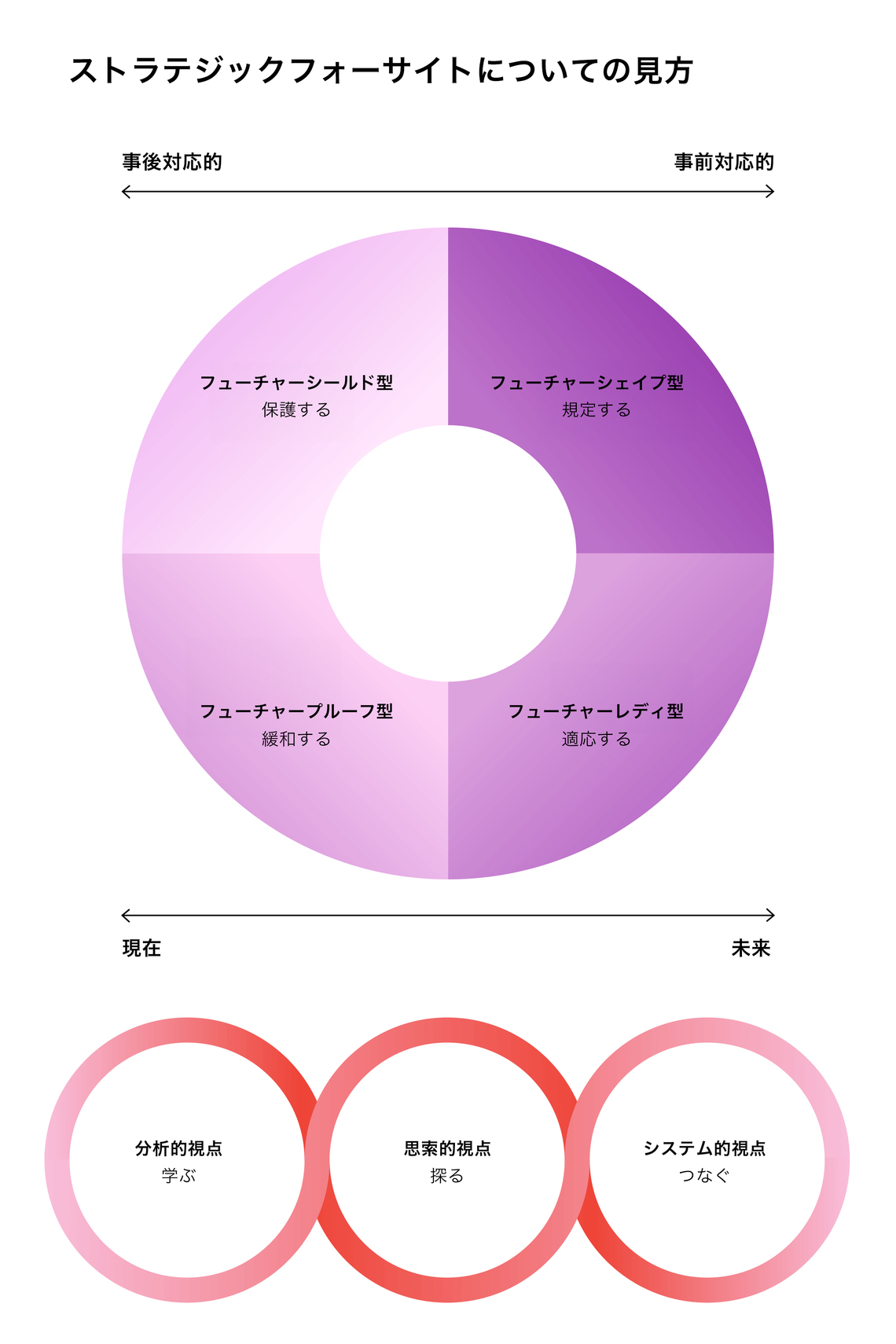
Analytical Perspective
Learn from past data to guide future-oriented decision-making
Using the "Analytical Perspective" involves estimating the future based on information about the past. Typically, it allows for the analysis of vast amounts of data to construct rich, compelling insights. Such insights can withstand rigorous scrutiny of past events and may lead to the establishment of best practices or the avoidance of potential risks. However, because this perspective derives views about the future solely from past events, using it alone can result in an inherently reductionist way of thinking. When the future begins to unfold in ways that deviate from established patterns, this approach risks becoming counterproductive.
Contemplative Perspective
Exploring a wide range of future possibilities through creative and divergent thinking
In contrast, there is an approach called the "contemplative perspective." By deeply considering the variables and events within individual topics and explaining them holistically, it encourages thinking beyond established frameworks, embraces divergent viewpoints, and fosters constructive dialogue.
For example, at frog, we collaborated with MACHINA, a brand merging wearable technology and fashion, to envision fashion's survival strategies in the face of the climate crisis. This approach utilizes methods like brainstorming, brainwriting, and wildcards. However, to achieve effective outcomes with this technique, preparing and aligning the tools and processes used for reflection is crucial. While such generative practices are useful, creating lasting value requires deeper levels of thinking. Techniques like "Two-minute futures," often devised through a few workshops, risk remaining superficial. Upon closer examination, they may show cracks, potentially limiting the value they bring to an organization.
※2 Brainstorming = A group idea-generation method where multiple people contribute ideas
※3 Brainstorming = A method where sheets are circulated like a memo board, using others' ideas as hints to expand one's own thinking
Systemic Perspective
Connecting various systems to build flexible, adaptive strategies
Finally, we present the "Systemic Perspective." Here, we apply design principles to strategy and innovation, using a suite of tools to explore the gray areas between two things. By leveraging logical thinking, imagination, intuition, and systems thinking, we explore various possibilities of "what could happen" and envision a desirable future state. By considering the connections and causal relationships among various variables, seeking feedback loops and weak signals, and synthesizing insights gained from analysis, we can achieve a deep and detailed understanding of the world surrounding the organization.
Shaping New Realities and Potential Futures
Returning to the episode introduced at the beginning, Kodak subsequently adapted to the situation and achieved a turnaround. Today, Kodak is recognized as a pioneer that revolutionized photographic technology and continues to lead the way in forging new paths. Most recently, it developed an entirely new, dedicated IMAX film for Christopher Nolan's 2023 film "Oppenheimer."
The path Kodak took offers a vital lesson for other companies. Even industry-leading giants cannot escape the waves of change. In today's world, where change not only persists but accelerates, it's worth asking how organizations can proactively identify and embrace emerging developments and market shifts without falling behind.
Ultimately, organizations poised for success invest time, effort, and resources into thoroughly exploring conceivable futures through imaginative thinking. We must not forget that our perception of reality is often constrained by cognitive biases, deep-rooted mental models, and past subjective opinions. Recognizing this and systematically considering what might happen in the near future enables change that resonates across cultural divides within an organization, breaking free from "precedent-following" thinking.
So, how is your organization preparing for the unknown future? Are you merely following well-trodden paths? Or are you forging new ones? Please consider this.
To learn more about "Strategic Foresight," please read frog's article "Rethinking Strategic Foresight in the Age of AI and Algorithms. " It explains why recent developments in AI are fundamentally transforming the nature of future thinking.

Was this article helpful?
Share this article


Newsletter registration is here
We select and publish important news every day
For inquiries about this article
Back Numbers


Author