Note: This website was automatically translated, so some terms or nuances may not be completely accurate.
 A Few Things I Know About Owned Media [2/4]
Owned Media: How to Study It (For Golden Week)
As I mentioned last time, the web's trends shift rapidly, demanding constant learning. However, I believe no field in advertising and its surrounding creative domains is as accessible for study as the web.
First, there's an overwhelming number of publications available. From somewhat pricey specialized books to paperbacks, countless new titles are released every month, allowing you to choose materials suited to your level.
Second, the web world has a thriving culture of sharing insights and knowledge. While methods for generating ideas are often proprietary and hard to systematize, technical trends can be found through searches without needing books. In fact, this information is often available much faster than in books.
Third, almost without exception, you are all web users. While the amount of time spent online varies by individual, including smartphones, it's likely a considerable amount. You are already heavy users. All that's left is to articulate your impressions (complaints or praise) when interacting with the web, and to do so using language that resonates within the industry. This is something that can be cultivated through practice.
So, just before this perfect opportunity of Golden Week (lol), I'll introduce how to study owned media.
Start with Content
Here, I'll briefly cover the key points to focus on.
Always keep these four fundamental elements in the back of your mind when identifying owned media challenges: "Content," "Information Architecture," "Design," and "Operations."
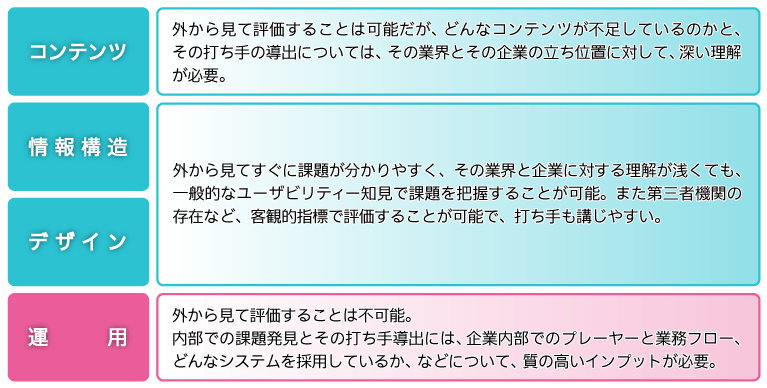
First, learn to identify issues from the user's perspective. That's the starting point for discovering problems through the user's eyes. As you can see from this table, the three elements observable from the outside are "Content," "Information Structure," and "Design."
There is a specific order in which to examine these three. To put it simply, you should check them in the order of "Content," "Information Structure," and then "Design." Going even further, I believe that "Content" and "Information Structure" together determine over 80% of an owned media platform's quality.
Whether it's a corporate site, a membership site, a product site, a brand site, or an e-commerce site, the most valuable element for users is the content. Only content can provide solutions to users. Furthermore, owned media almost invariably attracts users in a highly motivated state—users actively seeking information as a solution. Compared to other media, users arrive in a significantly more receptive state. This also means users can become extremely critical if solutions aren't provided or if it takes too long to deliver them.
Therefore, the first thing to check on owned media is the content.
Essential Requirements for Content
While "information architecture" and "design" are certainly important, studying everything during Golden Week is very challenging. So, let's focus on thoroughly studying content first. Content can be divided into two types: "Basic Content" and "Original Content."
▼Basic Content
Basic content refers to universal information such as company profiles, product/service overviews, and specifications. The key requirement for this content is "accuracy." While it isn't the type of information frequently revisited, it reliably provides solutions to users. However, this basic content struggles to convey "the company's unique character." To differentiate from competitors, focus on elements like "accuracy," "timeliness," and "usability."
▼Original Content
The "original content" is what deserves careful consideration in owned media. What users seek is content overflowing with the company's unique character—information they cannot obtain through search engines or other sites.
Original content comes in various forms. Special content that explains products or services more clearly and appealingly is one type, while CSR reports (though many companies have shifted to integrated reports in recent years) are another type of content that truly showcases a company's originality.
The book 'Think Like a Publisher: 27 Secrets of Content Marketing', which I'll introduce at the end of this column, clearly summarizes these types of content. I highly recommend referring to it.
The volume of original content, compared to basic content, is the most significant factor determining the value of owned media. To put it bluntly, I believe "it's perfectly fine to pursue quantity first." Producing high-quality content from the start is extremely difficult (and high quality doesn't necessarily mean high user engagement). While gradually updating high-quality content is an ideal goal, unless the content is truly exceptional, users won't revisit it repeatedly. A bigger problem is that sites with infrequent updates feel uncomfortable for users. The better approach is to mass-produce content first, then improve its quality within that volume. I believe the mindset that "output volume itself drives quality improvement" is more effective. This digresses slightly, but when pursuing "mass output × content quality = owned media power," operational efficiency becomes a major challenge. I hope to write about operations in more detail at a later opportunity.
"Timeliness" is also crucial. While highly time-sensitive content itself isn't inherently bad, owned media is fundamentally suited for building long-term user relationships. We should leverage this philosophy in our content too. Rewrite popular content slightly, archive it, and make it searchable. Consistent, steady effort will inevitably boost your site's power.
And crucial for original content is "presentation." This doesn't mean creating flashy Flash content, shooting tons of videos, or giving your writing a humorous personality. It means pursuing the most appropriate expression for the content itself.
For instance, are you endlessly explaining things with "text + photos" when diagrams or infographics would make the content clearer? Or, for substantial text-based content, is the overall structure immediately understandable? Is it print-friendly? And so on.
The same applies in real life: "How you say it" is just as important as "What you say." Always remember that even brilliant ideas or outstanding originality can be significantly impacted by how they're presented.
【Content Check Items】
● Is the volume of original content sufficient? Is it relatively greater than basic content?
● Are you overly focused on quality? Consider how you feel when visiting a website with infrequent updates.
● Is the site flooded with time-sensitive content? Are you skimping on the effort needed to build site authority over the medium to long term?
● Is the content presented appropriately? Are you defaulting to "text + photos" from the start?
Multi-device compatibility requires "priority based on device context"
Have you ever encountered an app or smartphone-optimized site and thought, "This is hard to navigate" or "There are too many elements"? Don't you find it surprising how few sites are actually easy to use in the context of smartphone usage? For example, you might want to quickly search for a service station (SS) while driving, but the site isn't optimized for smartphones, or it uses the exact same information structure as the PC version, making it difficult to find what you need. This happens because the context of smartphone usage hasn't been properly considered.
This becomes even more pronounced with apps. While it's often unavoidable for websites to be designed with PCs as a baseline to some extent, apps can be designed by extracting only the necessary parts. This means it's possible to create designs that are thoroughly aligned with the user's context. Yet, we still see apps that are overloaded with unnecessary features, making them slow; apps that require constant communication for every function; or apps with overly complex navigation... This isn't so much a case of "priorities showing through" as it is "priorities not being set" in the first place.
Take the SS search example mentioned earlier. For website optimization, it makes sense to include corporate information, as there is demand for such details. However, the moment it becomes an "app," users seek even more of a "function/tool" aspect compared to the website.
In other words, multi-device support requires "priorities tailored to each device's context." It's not just about the priority of information (as a solution). The fundamental question is: Is smartphone optimization sufficient, or should an app be developed? Should the focus be on rich expression or lightness? Is the goal push-based or pull-based?
There's no single right answer here. Differences exist by industry, and budget and internal resources also play a role. What's crucial is " setting priorities while understanding the context of the user's device."
For those thinking, "I don't want to study so much during Golden Week," here's a learning method you can do while having fun: smartphone sites and apps.
Many people travel during Golden Week. Even just in the travel sector, there are various websites and apps available, so be sure to try using different ones. Booking travel tickets, reserving hotels, using delivery services, finding restaurants, checking drive-by information... These are perfect for consciously putting yourself in the "user" role. When studying at a desk, as we've discussed before, you inevitably need to "role-play" the context in which users search or explore information. However, if you actually use smartphone sites or apps out of genuine need, you'll likely find yourself forming honest opinions as a regular user.
Learning industry terminology is also important
Finally, here's a Golden Week study tip for owned media. As mentioned at the start, countless books cover the web, and reading them alone offers substantial learning. Since we've discussed content-related study methods, I'd like to recommend books that complement that.
While there are many excellent books on web content, I'd like to highlight books related to Dentsu Inc. employees. After all, this Dentsu Inc. News is Dentsu Inc.'s flagship owned media (laugh).
Not just owned media, but the web world is flooded with all kinds of foreign terms. Just understanding them is a challenge, but because the industry itself has a short history, the terminology itself hasn't been fully standardized yet. To gain a correct understanding, you need to increase your daily intake of information and grasp the broader meaning each term holds in the wider world.
Owned Media Communication: 21 Rules for Success
I'm a bit embarrassed to mention my own work (lol), but I'd like to introduce it. About two years ago, I wrote about timeless fundamentals that wouldn't become obsolete with changing times, and I still believe it covers the basics that remain relevant today. You can't study everything at once, but I think it can serve as a compass to guide you on where to start learning.
Think Like a Publisher: 27 Secrets of Content Marketing
For detailed insights, I recommend reading authorinterviews or reviews. This book meticulously organizes essential considerations for content strategy, grounded in extensive case studies. Chapter 20, "Auditing Your Content," is particularly essential reading, even from a professional perspective.
Long Engagement
SHARED VISION
I recommend reading these two books together. They clearly illustrate how social media trends have evolved. While this column focuses on owned media, a deeper examination of owned media immediately reveals that social media cannot be avoided. It's not about prioritizing one over the other; it's about balance and different approaches. In other words, deepening your knowledge of social media will naturally help you grasp how to frame content for your owned media.
While writing this piece, I realized that I've been neglecting some fundamental studies myself, caught up in the busyness. I plan to dedicate this Golden Week to studying (lol).
Looking forward to next time! ♪
Was this article helpful?
Share this article


Newsletter registration is here
We select and publish important news every day
For inquiries about this article
Author

Kazuki Fukuyama
Dentsu Digital Inc.
Owned Media Division
Group Manager