
Note: This website was automatically translated, so some terms or nuances may not be completely accurate.
 Communication technology connecting individuals and businesses [2/4]
Biological Signal Technology

Tsuyoshi Mizukawa
This time, we explore the potential for communication between companies and individuals using biosignal technology. Biosignals refer to biological phenomena like heart rate, brainwaves, pulse, respiration, and perspiration, quantified by sensors. Therefore, biosignal technology here means technology that quantifies human biological phenomena via sensors and analyzes/interprets them using specific algorithms.
Device miniaturization enhances real-time capability, portability, and continuity
Among biometric technologies, sports watches with heart rate monitors have become widespread. These devices detect the faint electrical signals generated by the heart muscle's contractions via sensors, convert them into electrical signals, and perform various analyses based on the signal patterns. Applying this technology in the wellness field enables analysis to determine, for example, whether a heartbeat is normal or irregular.

The above flow may seem like the same old scene where a doctor looks at an ECG with concern, but it has actually transformed into something entirely different.
For instance, wearing a T-shirt embedded with electrodes captures the faint electrical signals of the heartbeat. These biosignals can then be transmitted via Bluetooth to a smartphone or sent to the cloud via the internet. The results of the analysis and interpretation can then be displayed on the smartphone.
In other words, the miniaturization of devices has significantly enhanced real-time capability, portability (wearability), and continuity. Here, let's recall the three essential elements for communication technology mentioned in Part 1:
① Real-time capability ② Ease of implementation ③ Continuity
Portability (wearability), essentially, refers to ease of implementation, cost aside. In short, the process of "biological information → sensor-based electrical signal conversion → analysis and interpretation → result display" has become achievable in a space-saving, low-cost, high-speed, and continuous manner.
Expanding Communication Possibilities Across Industries
In the near future, apparel manufacturers may release T-shirts embedded with ultra-thin electrodes while distributing free analysis apps. Gifting such a T-shirt to elderly parents would allow daily monitoring of their health via smartphone.
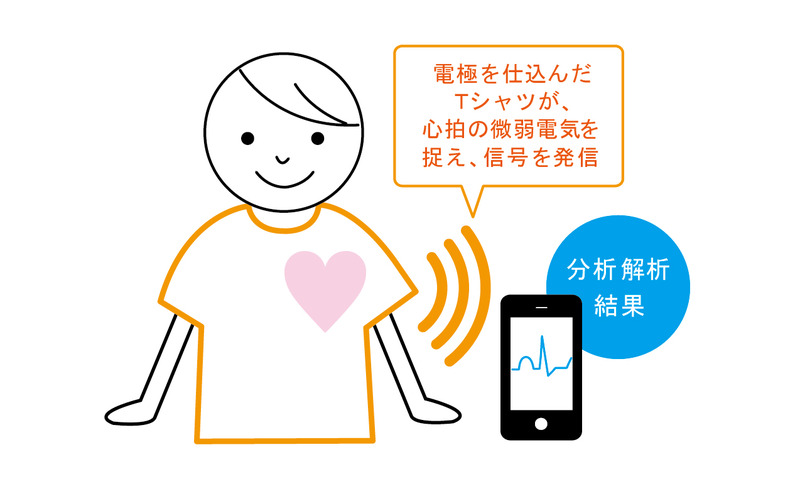
This isn't just for the elderly. Young people attending yoga classes could wear these T-shirts to monitor their breathing patterns. Yoga instructors could then guide students based on their breathing patterns. In such cases, attending a yoga class might become unnecessary; lessons could be completed right at home in front of a computer.
What about car manufacturers? With a T-shirt that tracks heart rate and an analysis app, if a driver experiences a cardiac issue, the system could detect it. It could then send instructions from a smartphone to the car to slow down, ultimately bringing it to a stop on the shoulder.
Furthermore, if drivers wore small EEG sensors, drowsiness could be detected from brain waves. This could enable countermeasures against drowsy driving, like having a smartphone play wake-up music. For bus companies, taxi companies, and transport firms, this could become a communication technology between the company and its employees.
What about airlines? Most aircraft seats come equipped with headphones. Just imagining what services could be provided if these headphones incorporated brainwave sensors is fascinating. One obvious idea is music selection automatically tailored to passengers' brainwave patterns during the flight. The system could maintain brainwave patterns associated with comfort or automatically select music designed to enhance that pleasant state. But it's not just music. Passengers sometimes struggle to choose which movie to watch onboard. Brainwave data could also recommend films based on their state. Brainwave recordings of reactions to movies could chart satisfaction levels. Furthermore, the brainwave data of frequent flyers could be leveraged not only for music but also for onboard merchandise, enabling the recommendation of products tailored to their preferences.
Biometric information like brainwaves and heart rate is the ultimate personal data, requiring careful handling. However, if individuals and companies mutually agree to utilize biometric-based services, the potential for communication between them could expand infinitely.
Was this article helpful?
Share this article


Newsletter registration is here
We select and publish important news every day
For inquiries about this article
Back Numbers
Author