
Note: This website was automatically translated, so some terms or nuances may not be completely accurate.
 Communication technology connecting individuals and businesses [3/4]
3D printer

Tsuyoshi Mizukawa
Recently, 3D printers have been attracting significant attention. It's even said that 3D printers will spark innovation across all industries. Why are they drawing so much attention? The reason is their wide range of applications – they can be used "across all industries." Just as the internet impacted every industry, 3D printers are also expected to influence every industry.
New Possibilities Emerge Across All Industries
Traditionally, printers meant 2D inkjet printing on paper, with advancements limited to print quality and speed. The shift to 3D has expanded the technology and concept, opening possibilities for application across all genres. Essentially, the materials and techniques used for 3D printing determine the application field.
In fashion, 3D printing with plastics or rubber instead of traditional fabrics could create previously unseen complex shapes, textures, and tactile sensations. Beyond clothing, new products like shoes, nail art, and false eyelashes seem likely.
The same applies to food. Using chocolate as a material for 3D printing could create chocolates with shapes never seen before. Changing the shape might even change how we eat it, potentially altering cultures and customs. The same goes for pizza delivery. An era where users design their preferred pizza shape via smartphone and receive a custom-designed pizza at their doorstep might not be far off.
At tourist spots, photo-taking services exist. Placing a 3D printer there could evolve into a service instantly creating dioramas from photos taken, offering them as travel souvenirs.
In medicine, 3D printers can not only create realistic teaching materials that replicate complex human organs, but they can also be used to create organs for transplantation, as well as prosthetic arms and legs.
The current state of 3D printers resembles that of bulky mobile phones in the past.
People from various fields are simultaneously thinking about what they can do with 3D printers and putting those ideas into action, which will drive innovation. Innovation arises when things that were previously sophisticated and expensive are replaced by something more accessible. "Accessibility" means reduced time and cost compared to traditional methods, dramatically increasing the number of times possibilities can be pursued. The "accessibility" of 3D printers includes the following:
・High-speed output capability
・Low-cost precision modeling
・Ability to print with diverse materials
・Consequently, enabling the creation of numerous prototypes
・Used across various industries
・Used by professionals and amateurs, men and women of all ages
・Anyone can become a creator (or rather, it will become commonplace to use them)
That said, 3D printers exist for both commercial and personal use, and both are still evolving. While prices have dropped, they will likely continue to evolve and become even more affordable. The current state of 3D printers might resemble that of the bulky mobile phones of the early 90s. Precisely because of this, to foster innovation with 3D printers, it's crucial for people from diverse fields to start using and thinking about them now.
Companies Utilizing 3D Printers for User Engagement
When companies utilize 3D printers for advertising campaigns, the following initiatives can be considered from the perspective of letting users experience 3D printing:
・Giving away original 3D-printed novelty items
・Placing 3D printers in stores to encourage visits
・Offering 3D printing experiences via web (apps)
・Offering 3D printing experiences at event venues
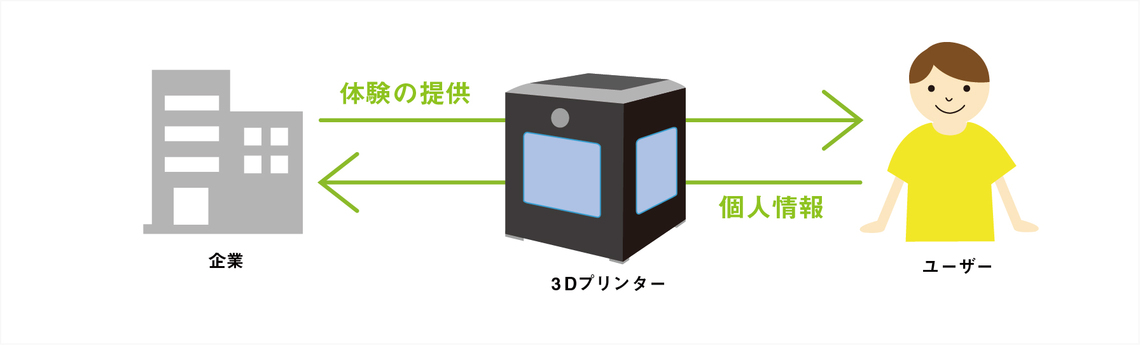
Potential subjects for 3D printing include faces generated from user photos or product characters. Alternatively, companies could solicit new product designs from users, then actually 3D print and display or gift the best submissions. In essence, this offers users the following experiences:
① Letting them imagine what the 3D object will look like
② Have them actually create their imagined design (on-site, or via web/app)
③ Observe the manufacturing process (on-site, or via web/app)
④ Present the finished product (let them touch it)
Through steps ① to ④, considering what to communicate to users and what can be achieved together with 3D printers will also connect companies and individuals. However, 3D printers won't advance just by thinking about them; you won't understand anything unless you try using them. Companies should think and act at the same pace as users, without overcomplicating things. To put it bluntly, companies could simply ask users what they'd like to try with 3D printing. Alternatively, they might consider introducing several affordable 3D printers and starting to use them.
For individuals, if buying a 3D printer outright is difficult, trying it out at a workshop or studio that has one available is a good option.
3D printers possess the capability to "materialize personal information." This ranges from a user's shoe size to dental impressions, body parts, organs, and even DNA. These represent the ultimate form of personal information. Needless to say, companies handling such data must exercise particular care regarding this aspect.
Was this article helpful?
Share this article


Newsletter registration is here
We select and publish important news every day
For inquiries about this article
Back Numbers

Author