
Note: This website was automatically translated, so some terms or nuances may not be completely accurate.
 Communication technology connecting individuals and businesses [4/4]
Real-Time Dynamic Analysis (Geo-Sensor)

Tsuyoshi Mizukawa
Do you know what real-time dynamic analysis (hereafter referred to as geosensors) is?
In reality, Geo Sensor isn't a single technology, but rather a collective term for several sensing technologies. We can expect various types of Geo Sensors to emerge in the future.
Geo-sensors are technologies that capture "people," "time," and "space" in real time.
Among geo-sensor technologies, the most well-known and important is GPS.
While everyone knows the term GPS, few know what it stands for. It is an abbreviation for Global Positioning System, meaning a satellite positioning system. Nowadays, many mobile devices come equipped with GPS functionality, enabling real-time tracking of their location. When indoors and satellite signals are unavailable, the mobile device communicates with antennas at ground-based base stations to determine its position using the nearest base station.
Let's define geosensors as technologies that capture "people," "time," and "space" in real time. Literally, this means analyzing movement in real time, where "movement" can refer to people or objects like vehicles. Furthermore, both people and objects can be singular or multiple.
From the perspective of service providers, the target could be either an individual customer or multiple customers.
In other words, companies use geosensors to capture detailed information about "people," "time," and "space" while
① Service provision to individual customers (CRM)
② Providing services to multiple customers and developing services (marketing)
This means companies can simultaneously capture detailed information on "people," "time," and "space" using geos
Public institutions build geosensors, and companies utilize those services
Businesses with physical stores are beginning to track their customers within the store (using customer smartphone apps and iBeacons installed in the store) and leverage that information for CRM and marketing. However, tracking customer movements outside the store requires geo-sensors.
In such cases, it would likely be cost-inefficient for individual companies to build their own geo-sensor systems. Therefore, a model where public institutions build the geo-sensor infrastructure and companies collaborate by utilizing that service is conceivable. For example, what about a "Disaster Geo-Sensor System"? During natural disasters like earthquakes, typhoons, or floods, this system could display evacuation routes on individuals' mobile devices, provide real-time location information for pre-registered family members, and communicate not only individual movements but also traffic congestion levels and information about affected versus safe areas.
Furthermore, even without dedicated public geosensors, businesses are already capturing people's movements from mobile phone base station data and selling it as marketing data. As these marketing data companies accumulate individual information as collective intelligence, they gain previously unknown insights, creating valuable marketing data. Consequently, customizable APIs tailored for individual companies will likely increase.
Individuals provide their information to companies in exchange for valuable goods and services.
From the consumer's perspective, however, using geosensors for personal benefit is already becoming commonplace. Joggers wearing smartphones on their arms can use dedicated apps to track their running routes, distances, and pacing. Wearing a separate heart rate monitor that syncs via Bluetooth with the app allows them to monitor and record their real-time heart rate.
In this way, individuals first use geo-sensors in areas of personal interest, gradually building their literacy around the technology. Beyond simply managing their health with jogging apps, other possibilities are likely to emerge. Consumers can now visualize valuable life logs (personal information) through technologies like geo-sensors.
This raises the possibility of a new form of communication: rather than companies seeking out personal information, individuals could proactively provide their data to companies in exchange for beneficial products or services. For example, someone who jogs regularly and maintains a healthy heart rate might share this information with a life insurance company and receive a more affordable premium plan.
While companies will likely never stop "advertising" to consumers, a new form of communication called "individual-to-company communication" (individual-to-company communication) could emerge.
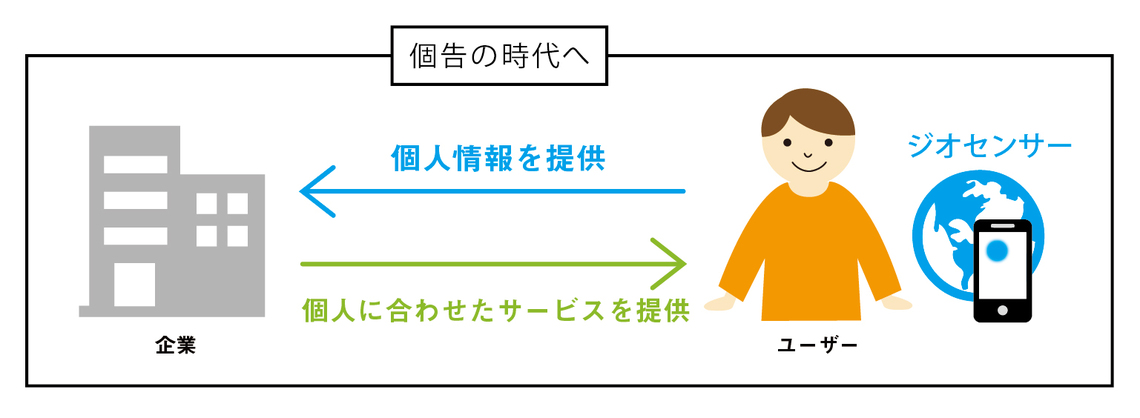
While this series is titled "Communication Technology Connecting Individuals and Companies," we may be heading toward an era defined by "Communication Technology Connecting Individuals to Companies."
Was this article helpful?
Share this article


Newsletter registration is here
We select and publish important news every day
For inquiries about this article
Back Numbers


Author