
Note: This website was automatically translated, so some terms or nuances may not be completely accurate.
 The New Value Brought by the Internet [6/6]
[Ryo Tateishi × Ken Magun Dialogue] Athletes and the Internet (Part 2)

Ken Magun
Dentsu Inc.

Ryo Tateishi
[Part 2] Athletes and SNS—As Tools for Information Sharing and Communication
Many top athletes now use SNS to send and receive information. It's an era where they connect not only with friends and fans but also with rivals both domestic and international via SNS. For athletes who travel constantly and sometimes feel isolated, what role do Twitter and Facebook play? We asked about their approach to SNS and its impact on their competitions and daily lives.
SNS as a Communication Tool
 |
|
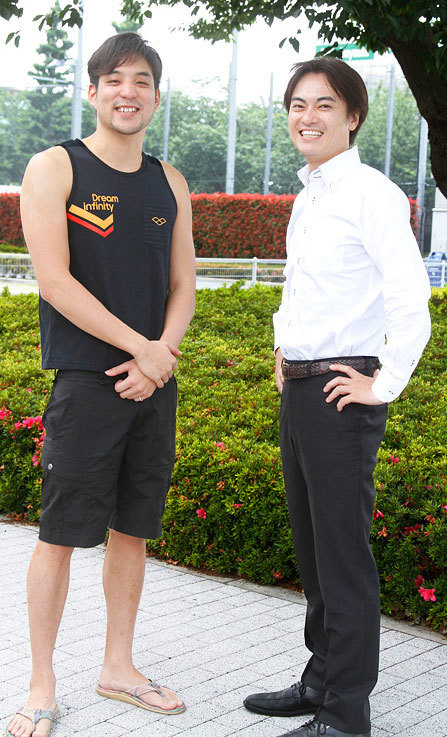
The two have remained close friends since graduating university. Their conversation remained relaxed throughout. |
Magun: So far, we've heard about how Mr. Tateishi utilizes the internet. You mentioned it helps with planning your training schedule and gathering information while in the U.S. Next, let's talk about communication through SNS and other platforms. Thinking about it, you're connected not only with friends and fans but also with rivals via Twitter and Facebook, right? Even while training in the U.S., you stay connected with other top swimmers and university athletes training in Japan. Out of pure curiosity, what happened on Twitter and Facebook when you won the bronze medal at the London Olympics?
Tateishi: I posted about winning the medal immediately. Then, I got a huge flood of messages from acquaintances and friends, and even messages from people I didn't know started coming in. It exploded instantly. I replied to everyone via email, but there were too many messages on Facebook and Twitter to respond to individually. I posted a collective message saying "Thank you."
Magun: After winning that bronze medal, you'd get those kinds of compliments, but leading up to the 200m breaststroke final at the London Olympics, was social media a positive influence during that process?
Tateishi: I think SNS is incredibly convenient and an effective way to share information. It lets me express gratitude to supporters and share updates like "I'm competing in this event" or "I'll be on this TV show." Of course, it's also useful for gathering information, but fundamentally, I see it as a communication tool. As for what I post myself, it's just self-indulgence.
Magori: Speaking of athletes using media to share information, Tachiiwa-san started quite early, about three years ago. After winning the bronze medal, I heard your Facebook friends exceeded 5,000. Recently, your TV appearances have increased too. Do you consciously differentiate between traditional media and Twitter/Facebook?
Tateishi: I'm not that skilled. I also don't think it's something you need to overthink. Of course, since it's public, there are things you should and shouldn't say. But if doing it meant feeling that kind of stress, I'd rather not do it at all.
Magun: What role do social media play in your swimming life, like during practice or races?
Tateishi: For example, if I post something like "Please cheer me on," people reply with "Do your best," which really gives me strength. Even when I feel like I didn't perform well, hearing "Keep pushing" makes me want to try harder. In that sense, it provides emotional support. For instance, being in the US can get lonely. That's why I tend to post more frequently when I'm overseas (laughs). Also, when things aren't going my way, seeing how my rivals are doing or their recent updates through SNS helps me get back on track.
Beyond communication tools, I also have high hopes for technology
Magori: What communication tools or technologies do you think would be beneficial for the future improvement of sports, especially competitive swimming?
Tateishi: I'd love panoramic footage of competition venues. For example, the upcoming Pan Pacific Championships are happening soon, but even searching online, it's hard to find footage showing the entire pool venue. An app that lets you see the entire venue in 360 degrees would be great for sharing information among athletes. We want to see the venue's layout, including the flow of movement. That's because when we arrive, we first look for the restrooms. At last year's World Championships, there were a lot of stairs inside the venue. To reduce fatigue, we'd like to find routes that avoid stairs. That's from the athlete's perspective.
Magun: From the perspective of general fans or the broader swimming community, are there any tools you think would be useful?
Tateishi: It might be good to have a constant overhead camera view showing the entire pool. Beyond just seeing how swimmers are doing compared to the leaders, it would be great if we could more easily capture videos of each swimmer's technique, including underwater footage. Underwater filming is quite difficult, so it would be nice to have equipment that makes it easy to do even at regular pools. It would also allow swimmers to compare themselves to others.
Magun: From a coaching perspective, mastering the techniques of top swimmers is something we really want to achieve.
Tateishi: Swimmers like me or Kosuke Kitajima have quite complex techniques. Breaststroke is unique for everyone, varying based on joint flexibility and muscle strength. Still, underwater footage has increased at major competitions. You can see detailed underwater footage at events like the All-Japan Championships or the US Nationals. However, in the Grand Prix Series held in Europe and elsewhere, underwater footage is basically absent; you only get overhead, bird's-eye views.
Magori: I believe you can only grasp about 20% to 30% of how good or bad a stroke is by watching from the poolside.
Tateishi: Underwater footage is indeed crucial. Movements visible above the water's surface are ultimately just momentum carrying the swimmer forward. This has gotten quite technical, but essentially, when camera technology and communication tools like SNS evolve and integrate further, what athletes and fans seek will become more accessible. Moving forward, I'll continue utilizing the internet and SNS in my own way for daily information gathering and communication, aiming for the 2016 Rio Olympics.
Was this article helpful?
Share this article


Newsletter registration is here
We select and publish important news every day
For inquiries about this article
Back Numbers

Author
Ken Magun
Dentsu Inc.
Digital Business Bureau