
Note: This website was automatically translated, so some terms or nuances may not be completely accurate.
 <Analysis> Corporate Crisis Communication [1/3]
Sharpening the "Crisis Detection Sensor" of Top Management and Implementing Three-Pronged Risk Management

Kuniaki Shirai
K&D Consulting

Personal data leaks, compliance violations, product accidents... Crises that can arise in business activities have become increasingly diverse and complex in recent years. Furthermore, the proliferation of social media has dramatically accelerated both the potential for crises to occur and the speed at which rumors spread. How should companies prevent imminent crises before they strike and prepare for the worst? And when problems do arise, how should they fulfill their accountability to society and the press? We asked three experts about the nature of "crisis communication" in light of recent social conditions.

Mr. Shirai, who has consistently worked in crisis management and strategic PR for various clients throughout his 30-year career at Dentsu Inc., established a new crisis management consulting firm, K&D Consulting, this April, welcoming crisis management communications authority Mr. Atsushi Kuze. He now explains the ideal form of crisis communication that management should consider.
The Era of Managing Crises Based on the Assumption of Human Goodness is Over
Increasingly, corporate crises stem not only from serious issues like personal data leaks, whistleblowing, or fraud, but also from previously unthinkable events—such as an employee's prank photo posted online escalating into a social problem. Furthermore, practices once considered industry norms are now facing public condemnation.
Moreover, in the online world, negative information spreads with tremendous force not only through news outlets but also via social media. Once a scandal erupts, a negative spiral occurs, escalating at an extremely rapid pace. Consequently, a single misstep in response can not only damage a company's reputation and brand image but, in the worst cases, even threaten its very survival.
Leading companies in their industries attract far greater media attention than second or third-tier competitors. This holds equally true for companies led by so-called one-man executives or those where the founding family retains control. When such companies face negative situations, the news value is inherently high, raising the bar set by the media. Therefore, thorough preparation and training in crisis communication are absolutely essential.
How to prevent trouble before it occurs, or if a problem does arise, how to respond correctly to pave the way for resolution and recovery. All of this ultimately depends on how sensitive top management is to potential crises on a daily basis – whether they possess that "sensor function."
"If something happens, will our company be okay?"
That constant awareness, that ability to think this way – it can only be described as a sense. I believe crisis management awareness is precisely the essence of a leader's sense. If this sense is weak, one tends to underestimate the situation at hand or trivialize it, thinking "it'll probably work out somehow." This can rapidly escalate a crisis.
Crisis communication requires a three-pronged approach
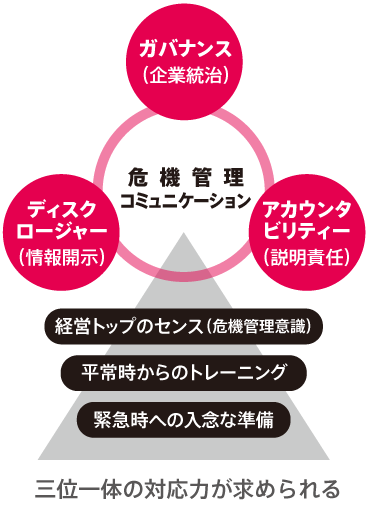
In crisis management communication,
① Governance, ② Disclosure, and ③ Accountability form a trinity of required capabilities. Supporting this demands top management's instinct for crises, along with training during normal times and meticulous preparation for emergencies.
I consistently tell executives and crisis management leaders that "a three-pronged approach is essential." These three critical pillars are "Governance," "Disclosure," and "Accountability." The fundamental principle of crisis communication is ensuring these three elements function effectively and sufficiently, both during normal operations and when a crisis occurs.
① Governance
Governance relies heavily on leadership from the top management, but we must not forget this is a double-edged sword. While strong leadership is often associated with so-called one-man executives, it can also lead to misdirection. What is required in negative situations is decisiveness and integrity. However, the instinct to protect the company often takes precedence, leading to self-defense. Such an attitude risks being perceived by the media as neglecting consumers and customers.
Furthermore, and this is also common in companies with strong-willed leaders, a culture can become ingrained where executives anticipate the president's mood or feelings and avoid conveying negative information. In such companies, if a scandal were to occur, the president would only then become aware of the actual risks that had been lurking. If a company only learns about its internal state after a scandal breaks, it cannot possibly fulfill its obligations for disclosure or accountability. This is a classic case of controlling the company while governance is completely dysfunctional.
② Disclosure
Regarding disclosure, determining the appropriate scope of information during interviews or press conferences is crucial. While maintaining transparency is fundamental, emergency responses sometimes involve situations where sufficient information gathering and analysis about actual events haven't been completed. In such cases, it may be better to deliberately avoid disclosure to prevent confusion.
However, and this is crucial, for points that cannot be explained, the company must carefully communicate why it cannot explain them. If there are unknowns, it must exhaustively explain exactly what is unknown. If the company fails to adequately explain the reasons for the unknowns and instead says something like, "Please excuse us on that point for now," journalists will perceive it as a cover-up.
③ Accountability
Accountability is another key point in media relations. While press releases should be concise during normal times, they must be meticulously crafted during emergencies. Regardless of the media outlet, the context of a news story is undoubtedly influenced by the reporter's impressions on the scene. In this sense, even a single press release must not neglect efforts to enhance reporter satisfaction.
Frequently Asked Questions are called FAQs. Anticipate all possible FAQs for a press conference and include them in the release. After thoroughly covering this, create detailed Q&A sections for any points missed in the FAQs. This two-tiered preparation ensures a press conference that leaves no room for reporter dissatisfaction.
Regarding accountability, I'd like to add one more point: While it's standard practice to have the top executive present at press conferences when major issues arise, sending untrained top management creates new risks. While last-minute rehearsals are necessary during emergencies, regular training during normal times remains crucial.
*
Governance, disclosure, and accountability. Without this trinity functioning soundly within a company or organization, crisis communication will utterly fail when the moment comes. It's all too common for companies to simply post news releases on their official websites without any further action, even after scandals occur, raising serious doubts about their corporate stance. It becomes a truly ironic outcome: owned media actively utilized during normal times suddenly exposes the company's fragile corporate structure the moment a scandal occurs.
The word "crisis" originates from the Greek "kairos," meaning "turning point." A crisis is precisely that pivotal moment determining a company's fate. Shouldn't we recognize that preparations at every level—from routine training to rehearsing emergency press conferences and preparing materials—become major turning points deciding a company's future?

K&D Consulting
Founded in April 2014 by Atsushi Kuze, a leading crisis management and public relations consultant with a career spanning former Mainichi Shimbun reporter, head of a foreign PR firm, and political secretary, and over 2,000 crisis response cases, and Shirai. The firm provides consulting services in crisis management, including accident, incident, and scandal response; risk management to prevent crises; and top-level communication.
Was this article helpful?
Share this article


Newsletter registration is here
We select and publish important news every day
For inquiries about this article
Author
Kuniaki Shirai
K&D Consulting
President and CEO