Note: This website was automatically translated, so some terms or nuances may not be completely accurate.
 The Secret to Successfully Launching a New Business [1/4]
Exploring the Concept and Birth Story of Air Register! Interview with Recruit Lifestyle's Koutaro Sasaki (Part 1)

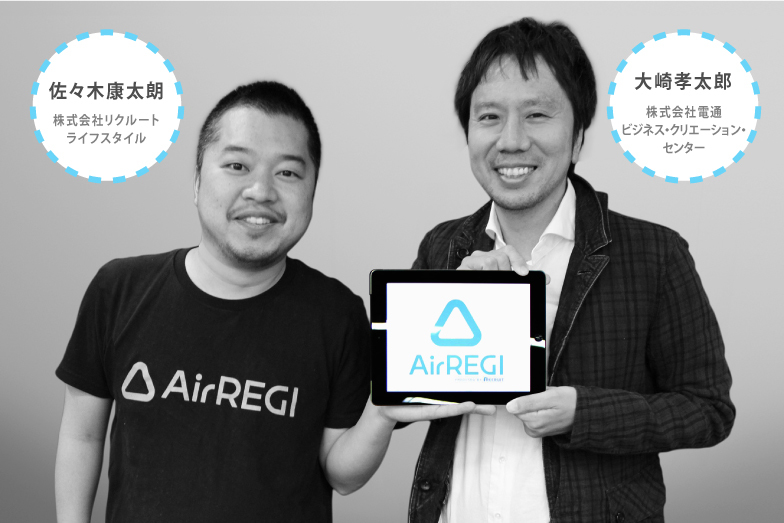
Kotarō Sasaki
Recruit Lifestyle Co., Ltd.

Kotaro Osaki
Dentsu Inc.
What is necessary to launch, develop, and succeed with a new business?
This series invites key figures behind successful cases to reveal their secrets through interviews.
In the first and second installments, Kotaro Osaki of Dentsu Inc. interviewed Kotaro Sasaki of Recruit Lifestyle, a central figure in launching the free and easy-to-use POS register app* "Air Register," about "The Concept and Birth of Air Register."
*A POS register is a cash register equipped with POS (Point of Sale) functionality.
Features of Air Register and Target Users
Ōsaki: First, please introduce the service overview of "Air Register."
Sasaki: Air Register is a "free and easy-to-use POS register app." Since fitting seamlessly into store operations is crucial, we continuously develop it with fewer screens for simplicity and meticulously refine the UX, including button placement. By the end of November 2014, we surpassed 100,000 accounts, and in January 2015, we released an English version, now available in 134 countries and regions.

Key features include standard checkout functions, plus sales management and customer management to track who bought what and how much. For restaurants, we offer seat management and reservation systems. Retailers benefit from inventory management using barcode scanners. We plan to continue integrating cashier-related operations into its functionality. Furthermore, the ability to manage information via the cloud and check it anytime, anywhere has also received significant positive feedback. In small businesses, the owner and the on-site manager are often different people. The ability for the owner to manage the store by checking sales information, vacancy information, etc., from anywhere using a computer or smartphone is a major advantage.
*UX (User Experience) refers to the experience a user gains through a product or service.
Osaki: Beyond the benefits of the register function itself, the essence of the service seems to be the ability to monitor all operations in one place and issue appropriate instructions through it.
But since many stores already have cash registers, wasn't it difficult to encourage switching from existing systems?
Sasaki: Cash registers range from tens of thousands to millions of yen, which is expensive for small business customers. In fact, many shops don't even have one. Recognizing this situation, we thought offering Air Register for free would drive adoption. Another goal of Air Register is to enhance the usefulness of information by digitizing what was previously managed on paper. Previously, as part of business support for customers listed on our "Hot Pepper Beauty" platform, we developed "Salon Board," a reservation management system for salons and estheticians. Digitizing paper information there reduced operational burdens and enabled customer acquisition support. Based on that experience, we believed offering a free POS system to digitize paper information would drive adoption.
The POS system concept existedtwoyears beforethe project started
Osaki: I see. Next, I'm most curious about the business launch itself. Given existing businesses like Hot Pepper, I can easily imagine the considerable challenges involved in proposing a new venture and launching the service. Could you share the catalyst for launching this business and the hurdles you overcame?
Sasaki: The Air Register project started in April 2013 with a team of 5-6 people. The service launched in October. We proceeded with a "let's just give it a try" mindset, which I think was unusual for Recruit. By June, just two months after the project began, we had created the app that became the foundation for Air Register. I believe the project didn't get shelved and actually materialized because having a tangible product served as a compelling argument.
Osaki: Just two months! Hearing that timeframe makes it sound like you smoothly gained management approval and moved into business development.
Sasaki: Actually, I myself had been envisioning a register system for about two years before the project started, and my predecessors had also proposed register systems multiple times. Everyone intuitively sensed the potential of a register business, but we couldn't find the right materials to justify commercialization. While proposals were repeatedly rejected by various people, the breakthrough came from two ideas: providing real-time seat availability information to general consumers and enabling the use of online Recruit Points at physical store locations.
By proposing integration with "Hot Pepper Gourmet" to reflect real-time seat availability from Air Register, and offering the "Air Wallet" app to consumers enabling QR code use for spending Recruit Points in stores, we gained the company's buy-in. While market timing played a role, it took hard work from everyone, including our predecessors, and about two to three years to finally identify the drivers for commercialization.

Osaki: So, presenting synergies with existing services, plus showing an actual product rather than just a concept, led to management's approval. The key prerequisite was that "strong commitment to the business" – never giving up, no matter how many times it was rejected.
AirRegister's Rollout and Adoption
Osaki: Even with extensive customer touchpoints through existing services like Hot Pepper and strong sales capabilities, achieving 100,000 accounts must have been challenging. For instance, the so-called digital divide—where many small business owners have strong reservations about digital devices—seems like a significant barrier to adoption.
Sasaki: That's a frequently asked point. While the digital divide certainly exists, I believe our strong customer engagement capabilities helped overcome it. We have sales representatives who visit physical stores monthly or weekly to provide usage support. Furthermore, I think a major factor in driving adoption was the sense of expectation it created – people were willing to try it because it was Recruit's sales team suggesting it. Our group's high customer engagement capabilities fostered that trust and enabled us to provide post-implementation support.
Osaki: Sales strength. That's Recruit Lifestyle's major weapon, right? And then you combined that with another weapon: technology.
Next question: Are Air Register users in Japan concentrated in major metropolitan areas?
Sasaki: While it might appear concentrated in metropolitan areas due to the higher number of stores there, usage is actually spread evenly across the entire country.
Osaki: On the other hand, launching overseas in 134 countries and regions all at once through app stores must have been incredibly challenging in terms of language support, right?

Sasaki: We assumed most users would be in English-speaking or English-capable countries, so we launched with an English version first. Startups can move quickly overseas despite some risk, but large corporations find it difficult. We asked ourselves, "If they can do it, why can't we?" Embracing Recruit's entrepreneurial spirit for global expansion, we decided "just launch it" was key—just like AirRegi's original birth. Launching with only English was crucial. Management's support for this was also significant.
Reduced operational burden and easierbooking are AirRegi's benefits
Osaki: What benefits does implementing Air Register bring to both the store and the end-user (the customer)?
Sasaki: Our goal is to simplify store operations. For example, previously, reservation tasks were handled on Salon Board, while payments were processed at the register—separate systems. By integrating Air Register with Salon Board, we enable one-stop handling of both reservation and payment tasks, contributing to reduced operational burden. This is why many stores adopt it. Furthermore, in 2014, 22 million online reservations were made via Hot Pepper Gourmet, and Air Register should have contributed to a portion of these. This is because customers can now make reservations by viewing real-time availability information. For stores, it reduces operational burden; for consumers, it makes reservations easier. I believe Air Register contributes to both of these points.
※Part 2 is scheduled for publication on April 14.
Was this article helpful?
Share this article


Newsletter registration is here
We select and publish important news every day
For inquiries about this article
Author
Kotarō Sasaki
Recruit Lifestyle Co., Ltd.
Kotaro Osaki
Dentsu Inc.
Business Production Bureau