Note: This website was automatically translated, so some terms or nuances may not be completely accurate.
 The Secret to Successfully Launching a New Business [2/4]
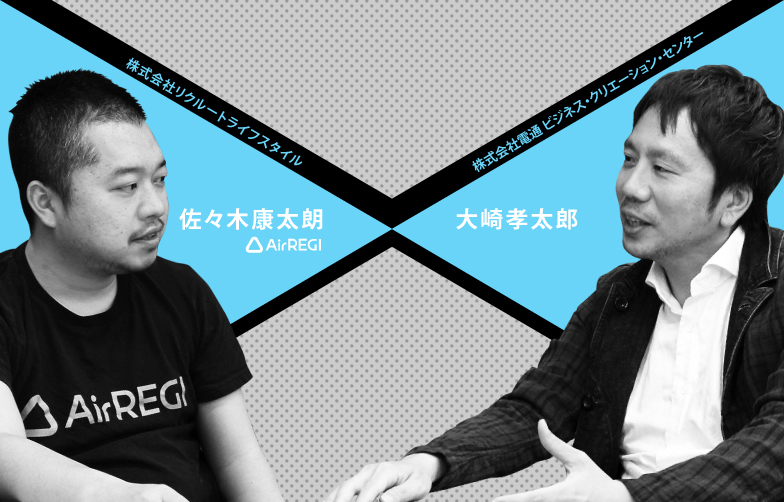
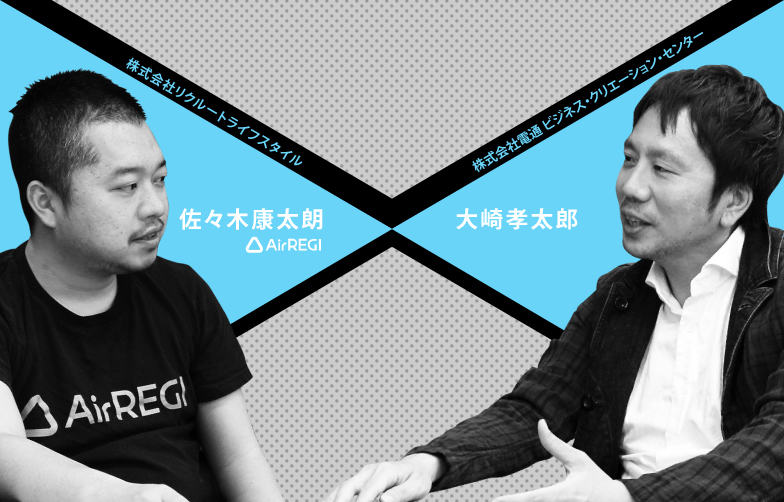
"The Development Philosophy and Future of Air Register" Interview with Mr. Yasutaro Sasaki of Recruit Lifestyle (Part 2)
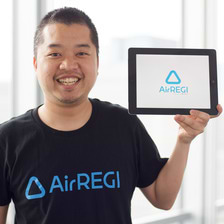
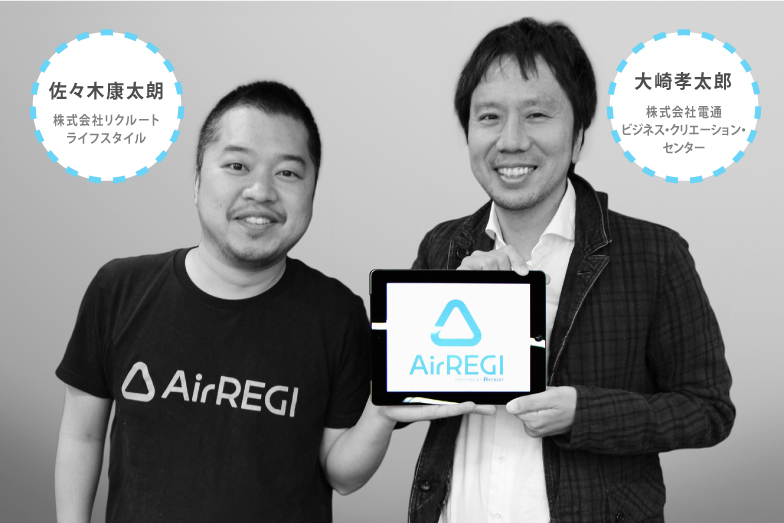
Kotarō Sasaki
Recruit Lifestyle Co., Ltd.

Kotaro Osaki
Dentsu Inc.
Continuing from the first installment, Kotaro Osaki of Dentsu Inc. interviews Kotaro Sasaki of Recruit Lifestyle about Air Register, a new venture achieving success. They discussed its competitive strengths, the particular focus during development, future plans, and integration with other services.
Air Register's Strengths and Competitive Landscape
Osaki: The POS system field seems to have many competitors and intense competition. Could you tell us about the competitive environment?
Sasaki: There are major players domestically, and considering overseas expansion, a significant number of competitors exist. To leverage Air Register's strengths, I believe we must focus on refining the UX. It will be essential to cultivate developers who can accurately assess the UX by frequently visiting stores that actually use the system. Furthermore, domestically, the assets we've built up over time are substantial, so maximizing our customer engagement capabilities to build competitiveness is crucial.
Recruit Points and AirRegister Integration
Osaki: Air Register has a feature to link with Recruit Points. Will you be advancing O2O (Online to Offline; driving customers to physical stores through online services) in the future as part of store support, utilizing discount coupons and such?
Sasaki: While Air Register's primary purpose is simplifying store operations, we must also consider supporting customer acquisition. The core of Recruit's business is maximizing matches between consumers and businesses. How effectively we can drive customers to stores using Air Register and Air Wallet is a crucial point.
Osaki: You're also running campaigns for Air Register and Air Wallet, right?
Sasaki: In February-March 2015, we ran an Air Wallet campaign exclusively in Fukuoka. Centering on Tenjin and Daimyo, we successfully enabled Recruit Points usage at hundreds of stores. We definitely want to continue these types of campaigns going forward.
While Air Wallet can be used nationwide, we hadn't previously established a system to boost consumption by targeting specific regions. Outside the Tokyo metropolitan area, most consumer spending occurs within a few kilometers of where people live. With this campaign, we tried to increase local consumption using Air Wallet by focusing on specific areas and expanding the number of places where Recruit Points could be used. We want to keep challenging ourselves to increase consumption and, consequently, increase matching opportunities.
Osaki: So, through Air Register and Air Wallet, we'll be supporting regional revitalization.
Refining the UX and integrating with other services
Osaki: I heard this project started with a team of 5 or 6 people. How many people are currently managing the service?
Sasaki: Currently, it's a team of about 200 people.
Osaki: Wow! When a team grows that rapidly over two years, it involves reassignments and transfers from existing projects. Coordinating that internally must be quite challenging.
Sasaki: I do feel it's challenging. However, since upper management has communicated the message that Recruit Lifestyle as a whole is focusing its efforts on Air Register, I feel the members who joined are approaching it positively.
Osaki: Beyond feedback from sales reps visiting stores, do you conduct user research to inform development and UX improvements?
Sasaki: Yes. I believe one of our strengths is that even those involved in core UX aspects actually visit stores and conduct extensive interviews. Since the service only exists to be used, there are many aspects we can't understand without hearing directly from the field. We place great importance on that on-the-ground perspective in our development. Some things work as intended, while others don't. Rather than getting overly excited or disappointed by each outcome, we must focus on refining the service quickly and efficiently.
Osaki: I understand you personally operate restaurants and have implemented Air Register in your own stores. Does that store-side perspective influence Air Register's development?
Sasaki: Since joining the company, I've worked on improving management interfaces for businesses like Jalan and Hot Pepper Beauty. I've always felt that the real, raw feedback from stores directly impacts our business. However, while I felt this, I couldn't pinpoint exactly what it was. So, I decided to take the plunge and opened a restaurant myself in June 2013. Actually running a store made me clearly understand what I expected from Hot Pepper GOURMET, Air Register, and Recruit.
For example, I gained a real understanding of how even advertising fees, which Recruit might take for granted as routine payments, can be easily forgotten or feel like a huge burden for small shops. That was a major learning experience.
Osaki: The Recruit Group has a strong image of developing everything in-house, but with Airレジ, it integrates with third-party services like the credit card payment system "Square" and the cloud accounting software "freee." I feel this is a rare case.
Sasaki: We see that as a new challenge too. While Recruit has often built everything in-house before, many startups expand their services by connecting with cool third-party services. We see no reason not to do the same.
Also, cloud technology has made partnerships and integrations easier, which is part of the current trend. We want to actively pursue more integrations with other services going forward. We're also considering actively seeking out and investing in user-friendly services. It would be counterproductive if our desire to build everything ourselves slowed down service evolution and made things less convenient. If using a convenient service helps make stores more convenient, then we should use it.
Osaki: While Air Register is strongly associated with food and beverage establishments, what other sectors are you focusing on?
Sasaki: Food and beverage establishments account for about half. As a new challenge, we're also considering adoption in areas where we currently have no presence. For example, we're putting effort into retail formats.
Since supporting small businesses was our original purpose, I personally believe areas without chain operations are a good fit. I feel stores like variety shops and apparel retailers could be major targets.
Osaki: What do you see as the future challenges for AirRegi?
Sasaki: From a product perspective, as mentioned earlier, refining the UX is undoubtedly crucial. Since it's now used by stores across various business types, we need to polish the UX even further. Providing a UX that satisfies everyone across all business types quickly is extremely difficult. However, refining the UX is both a key feature and a challenge for Air Register, so we must continue working on it.
Osaki: I feel Air Register has the potential to become a core service for the entire Recruit Group going forward.
Thank you for today.
Was this article helpful?
Share this article


Newsletter registration is here
We select and publish important news every day
For inquiries about this article
Author
Kotarō Sasaki
Recruit Lifestyle Co., Ltd.
Kotaro Osaki
Dentsu Inc.
Business Production Bureau