
Note: This website was automatically translated, so some terms or nuances may not be completely accurate.
From Indonesia★Japanese-Style Learning Centers Are Hot!
Japanese education businesses are actively expanding into Indonesia's education industry market. Against a backdrop of a large young population and rising income levels, new Japanese cram schools are entering the market while existing companies are expanding their operations, making it a market attracting attention as a new growth area. This is reported by NNA, which distributes economic information on Asia.
"Education leads to higher income." According to a survey by market research firm Nielsen, 90% of respondents in Indonesia agreed with this statement, the highest percentage globally. Education expenses account for 14% of household spending, ranking 6th among the 58 countries and regions surveyed, exceeding the global average of 8%.
Furthermore, the 2010 census shows the highest population distribution is among children aged 5 to 9 years old at 9.79%. Children aged 0 to 4 years old and those aged 10 to 14 years old also have high proportions at 9.54% each.
Osaka Education Research Institute, which operates the cram school "Risshikan Seminar," revealed that after conducting after-school learning programs at local elementary schools as part of a business survey, students' grades improved significantly. Furthermore, all participants stated they "grew to like math" ( 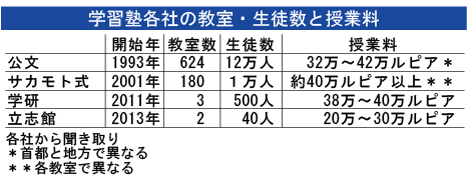 ), leading the institute to conclude there was significant room for growth and decide to expand. The institute opened two learning centers in Surabaya, East Java, in September. While current enrollment is around 40 students, they plan to increase this to over 100 by the end of the year.
Benesse Holdings also opened a representative office in Jakarta. Collaborating with local major cram school operator Primagama Bimbling Braja, it has started trial "Shinken Zemi" classes for elementary school students in Jakarta and Yogyakarta.
Among existing players, Kumon Educational Institute opened new classrooms this year in Bandar Lampung, Lampung Province, and Mataram, Lombok Island. It operates 624 classrooms across 12 cities nationwide, serving approximately 120,000 students. Plans are in place to expand into new cities on Kalimantan or Sulawesi Island next year.
Gakken Holdings opened its first classroom under a licensing agreement in September, following its two directly operated classrooms. It plans to open six more classrooms within the year.
The importance of education is well recognized even among low-income households, and the education industry is seen as a promising market going forward.
Was this article helpful?
Share this article


