
Note: This website was automatically translated, so some terms or nuances may not be completely accurate.
 Everything About Wakamon [44/56]
Matching "Collective Personalities": University Clubs and Corporate Business Creation
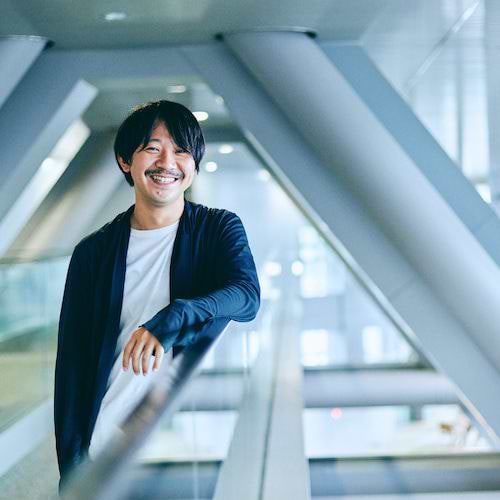
Yuichiro Kojima

Since 2012, Dentsu Inc. Youth Research Department (commonly known as Dentsu Wakamon) has provided the "Circle Up " app for university clubs. It has now grown into a platform for university students, with 2,000 clubs and 35,000 members nationwide.
Recently, they've also been involved in projects connecting clubs with companies, such as the music festival " SOUND YOUTH " by Sony Music Entertainment's band club, the event " NOROSHI " by Yoshimoto Creative Agency and comedy clubs, and the hackathon "Clothes Hack TOKYO " by fashion brand WEGO and fashion clubs.


Why focus on university clubs now? This column explores the changing values of young people and the potential for business creation through collaborations between university clubs and companies.
82.8% of first-year students join clubs. The club participation rate keeps rising.
"Young people these days don't join clubs, do they?"
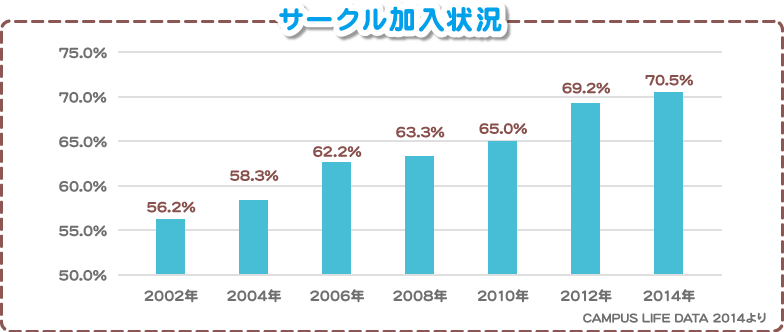
Whether due to perceptions of apathy or timidity, we often hear such comments both inside and outside the company. However, statistics show this club participation rate has been steadily rising over the past 12 years.
The latest survey shows the overall club participation rate among university students is 70.5%. Focusing solely on first-year students, it's a remarkable 82.8%*1. When multiplied by the university enrollment rate*2 (48.0%), it calculates that one in three Japanese people aged 19 to 23 belongs to some kind of university club.
※1 CANPUS LIFE DATA 2014 ※2 School Basic Survey (FY2014)
Producing "In-Groups": Young People's New Sense of Belonging
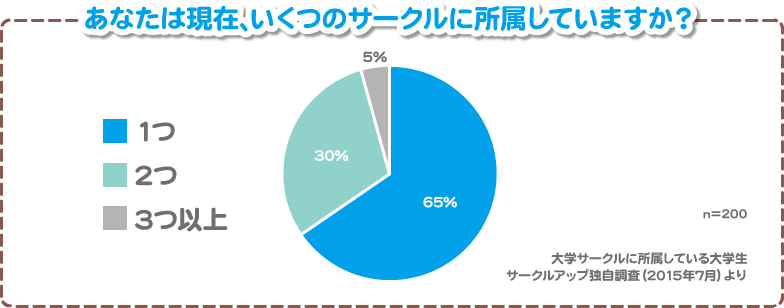
Why are more young people joining clubs? As shown in the 2015 Youth Comprehension Survey, university students feel they belong to 7.4 groups on average—more than high school students or working adults. This data reflects this generation's heightened sense of connection and camaraderie. Furthermore, a Circle Up survey found that 35% of university students belonging to clubs are members of multiple clubs.
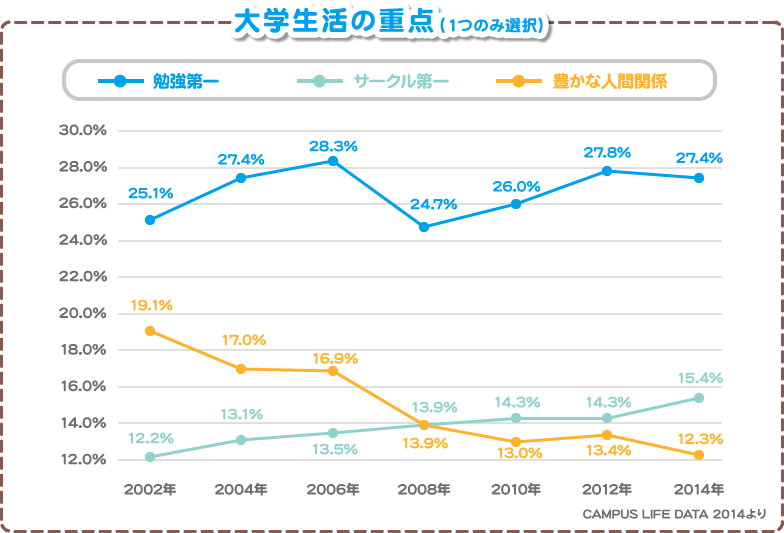
However, while the number of communities they belong to increases, their diversity is diminishing. For example, surveys over the past 12 years show that while "studies first" remains nearly constant as a priority in university life, the proportion prioritizing "clubs first" has increased, while "rich human relationships" have decreased.
Rather than broad but shallow connections, might "maintaining multiple moderately close and moderately deep relationships" represent a modern version of camaraderie?
Matching "group personalities".
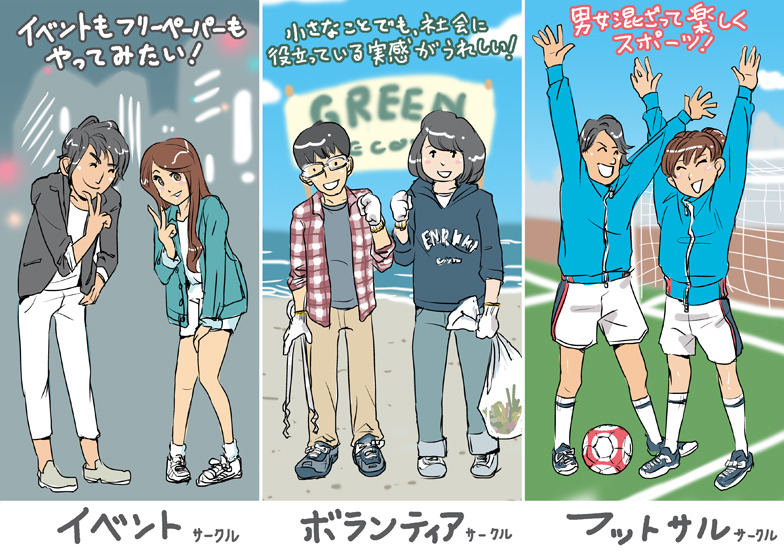
What's most noteworthy about these university clubs—which could even be called a boom—is that they are "groups connected by shared values." In recent marketing, it's said that consumers are increasingly difficult to grasp using traditional demographic perspectives like gender, age, or residential area.
This is precisely why clubs—groups connected by shared values—represent an extremely valuable segment. Capturing consumers through "group personalities" like "typical of XX club" or "like XX society" is a perspective essential for future marketing.
And of course, this "group personality" applies to companies too. Companies are also "groups connected by shared values." For example, capturing group personalities like "ad agency-like" or "Dentsu Inc.-like" and matching them with university clubs. The project introduced at the beginning is a co-creation business born from two such groups connected by shared values. It is absolutely not just corporate sponsorship of a student event.
Grasping and connecting these group personalities—this, too, is the mission of Circle Up and the Youth Research Department, bridging the gap between companies and young people.

【Wakamon Profile】
The Dentsu Inc. Youth Research Department (commonly known as Wakamon) is a planning team that engages with the real lives and mindsets of young people, primarily high school and university students. We seek insights from their present to find hints for brightening and revitalizing the near future. By anticipating the future based on their insights, we realize new businesses that foster better relationships between young people and society. Currently, 14 project members are based across our Tokyo headquarters, Kansai branch, and Chubu branch. We also share updates on the Wakamon Facebook page.
Was this article helpful?
Share this article


Newsletter registration is here
We select and publish important news every day
For inquiries about this article
Back Numbers


Author