
Note: This website was automatically translated, so some terms or nuances may not be completely accurate.
 Two Goldfish in the Brain [2/3]
On the happiness of having eight million gods in Japan
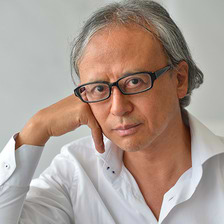
Yuya Furukawa
Furukawa Hiroya Office, Inc.
Special release of "The Two Goldfish in Your Brain" originally published in AdTae.
To commemorate Yuya Furukawa's first book , "All Work is Creative Direction" (published by Sendenkaigi), the popular Adtai column "The Two Goldfish in Your Brain" returns in a six-part series. Using various masterpieces of film, music, and novels he's encountered as references, he explores the mechanisms and thinking behind advertising creativity.
February of this year.
At the Academy Awards, a year dominated by 'Birdman,' two speeches stood out.
One was by Patricia Arquette, winner of Best Supporting Actress. She made a direct appeal for correcting the gender pay gap in Hollywood. In response, Meryl Streep and Jennifer Lopez enthusiastically applauded her, a scene broadcast worldwide. It was somewhat surprising that the gender pay gap was an issue in a place like Hollywood.
The other was Graham Moore's acceptance speech for Best Adapted Screenplay for The Imitation Game. The film depicts the life of British mathematician Alan Turing, who is said to have decrypted the Nazi Enigma code during World War II, significantly contributing to the Allied victory and hastening the war's end. While he is also known for discovering the principles of computing during the decryption process, he struggled throughout his life with being different from others, including his homosexuality.
After thanking those involved, Graham Moore delivered the following speech:
"When I was 16, I tried to kill myself. I felt like I didn't belong anywhere. But here I am today. So I want to dedicate this moment to all the young people out there who feel like they don't belong. You do belong. Please stay weird. Stay different. It's okay to be who you are. Your time will come. And when you stand in this place someday, please pass on the same message." This speech was widely discussed online as the most moving moment of this year's Oscars.
About four months later.
This time, the Tony Awards ceremony took place in New York. Many of you probably watched it, as Ken Watanabe was nominated for Best Leading Actor in a Musical for 'The King and I'. There, Alex Sharp, who won Best Leading Actor in a Play, gave a speech. The winning play, The Curious Incident of the Dog in the Night-Time, coincidentally features a genius mathematician named Christopher as its protagonist. He concluded his speech with these words:
"The young protagonist of this play is different from most people and is often misunderstood. I dedicate this award to young people who struggle in the same way."
Coincidence? Or does it reflect something about the current state of America?
Mid-June, Cannes Lions.
This year saw the introduction of a new category: the Glass Lion. It is defined as being "awarded to work that contributes to the elimination of gender discrimination."
Considering the essence of Cannes Lions – "viewing everything from the perspective of creativity" – I personally found it difficult to support this category. Categories shouldn't be created around issues. Whether a theme is socially good shouldn't be a judging criterion; the competition should be solely about ideas and their results. That's why I believe many of this year's winning entries were "correct but boring."
The silver lining was that Jury President Cindy Gallop firmly declared, "The purpose of this category is to be eliminated." She truly lives up to her reputation as the Queen of New York.
Meanwhile, it's August.
Pharrell Williams released a new song. He always excels at pinpointing the perfect big concept for the moment, like a brilliant creative director. Or rather, he is a brilliant creative director. After "Lucky" and "Happy," just when you let your guard down, this time it's suddenly "Freedom." Both the song and the clip are what you'd call protest-song-like. Honestly, it was unexpected.
In August 1969, the legendary headliner at Woodstock was the then-unknown Richie Havens. Apparently lacking many original songs, he improvised a piece based on the gospel classic "Sometimes I Feel Like a Motherless Child." That became his signature song, "Freedom." Dr. King's "I Have a Dream" speech was just six years earlier, in August 1963. Considering the dire circumstances of the Vietnam War's final stages, it feels almost inevitable that a black singer-songwriter with gospel roots would shout "Freedom" in an impromptu performance.
But in August 2015, is there really a "feeling" that demands Pharrell shout "Freedom" – not just in America, but globally? Is there truly such a shared sense of intolerance and constriction? I honestly don't know, so I want to understand.
From the perspective of the average Japanese person, America gives the impression of being an advanced nation when it comes to recognizing human diversity. It's a country with an atmosphere diametrically opposed to Japan, where conforming to others is valued. America is seen as a model of democracy, a country that places value on everyone having different opinions. This differs from Japan, which tends to implicitly demand conformity. In Japan, there's even a negative term for this lately: "peer pressure."
America holds fairness—accepting all others—as a vital principle. People gather from around the world seeking opportunity, and this is the source of America's strength. While opinions vary, I personally believe this fairness and openness represent America's greatest strength, surpassing military or economic power. Why? Because military and economic power are quantitative and temporary, while abstract values like fairness and openness are fundamentally eternal.
The word "different," which appeared consistently in the speeches cited as examples, seems critically important. Does society view being different from others, being weird, as a good thing or a bad thing? Or does it simply think, "Who cares? It's neither here nor there."
Needless to say, the third is the most sophisticated.
Late 1960s to the 1970s.
Shuji Terayama was churning out experimental theater. For example, actors would suddenly visit ordinary homes and force the residents to participate as performers in a play. Or they'd suddenly bring figures like Kurama Tengu, Moonlight Mask, Frankenstein, or Dracula into the streets and turn the citizens' reactions into a performance. Well, things like that. It was a long time ago, so my memory is hazy, but I think he was arrested for disturbing the peace or something like that, or maybe not.
In an interview, he stated:
"The world is made up of two kinds of people: those who find it bothersome when Frankenstein suddenly appears in the city, and those who find it interesting." I don't remember if it was Frankenstein, Don Quixote, or Dracula, but essentially, it was that sort of thing.
If few people find this amusing, the world is indeed dull. And if many people think it's outrageous or unforgivable, the world becomes even more boring. Lately, people have started asking what the KPI for this is, making it even worse.
Come to think of it, about 20 years ago, Hiroshi Sasaki grabbed three CM planners nearby and kept repeating this utterly useless phrase he alone seemed to like: "Yasumichi Oka is a good guy. Masahiko Sato is a nasty guy (meaning he's too smart, probably). Furukawa is a weird guy."
Put simply, it's about whether you can tolerate the existence of people who are different from you, who have different opinions, and different tastes. Actually, I think this might be the most important issue of the first half of the 21st century.
Ask that question, and everyone will answer yes.
Yet, the very people who are intolerant are the least capable of admitting their own intolerance. Because intolerance often arises from a lack of objectivity. And, even worse, from a sense of righteousness that knows no doubt.
The concept of "kami" (gods) defined by Motoori Norinaga refers to something possessing an immense, special power. Kami can be people, nature, animals, plants, places, or even food. They can take any form. The old lady next door, a rice field, a raccoon dog, pampas grass, the kitchen, a grain of rice. The point is, Japan is full of gods. That's the idea of Yaoyorozu no Kami, the eight million gods.
Moreover, in this case, they need not be visible. Sacrifices are not demanded. The object of reverence can be anything. All that is required is the imagination to conceive of a transcendent existence beyond human understanding, one that must surely exist somewhere.
Compared to the rigid belief in only one absolute deity—or worse, the exclusion of those who believe in others—what a flexible and resilient attitude this is. Throughout modern and contemporary times, the Japanese have come to believe they lag behind their Western predecessors in the subjects of "tolerance for difference" and "diversity." Certainly, intolerance and lack of diversity are noticeable in the current state of affairs.
But originally, it was entirely different.
Around the time of the Kojiki, our ancestors likely embraced a free and expansive concept: "Gods? Basically, everyone can believe in whatever they like. Let's accept that all kinds of gods exist. If you add them all up, there must be about eight million kinds."
Every language, every culture, every ethnicity, every custom, every way of being is equally rich and equally valuable. No matter how we think beyond that, I believe we should always start from that point.
What makes diversity function is nothing other than philosophy.
It's a concept far more intense than simply thinking "it's better to have all kinds of people," meaning an attitude that fully accepts people and things you don't understand or empathize with.
There's a famous quote attributed to Voltaire:
"I disapprove of what you say, but I will defend to the death your right to say it."
This statement dates from the mid-18th century. It has already reached a definitive standard.
※This column was published in AdTie.
Was this article helpful?
Share this article


Newsletter registration is here
We select and publish important news every day
For inquiries about this article
Author
Yuya Furukawa
Furukawa Hiroya Office, Inc.
Creative Director