
Note: This website was automatically translated, so some terms or nuances may not be completely accurate.
Dentsu Inc. PR Releases Corporate Appeal Survey Report Vol. 3: What Actions Did Consumers Take Toward Companies?
Dentsu Inc. Public Relations (Dentsu PR)'s Corporate Communications Strategy Institute released Report Vol. 3 of its second "Corporate Appeal Survey" on August 7 ( Vol. 1and Vol. 2 are available here ).
The survey aims to understand what corporate activities (facts) consumers find appealing and how that appeal is communicated. It analyzes corporate appeal through three elements: "Human Appeal," "Corporate Appeal," and "Product Appeal." It surveyed 10,000 men and women aged 20 to 60 about 150 companies across 10 industries. The survey was first conducted in March last year, with this March marking the second iteration.
Report Vol.3 analyzes the actions consumers took toward companies they found appealing and the triggers that made them feel that appeal.
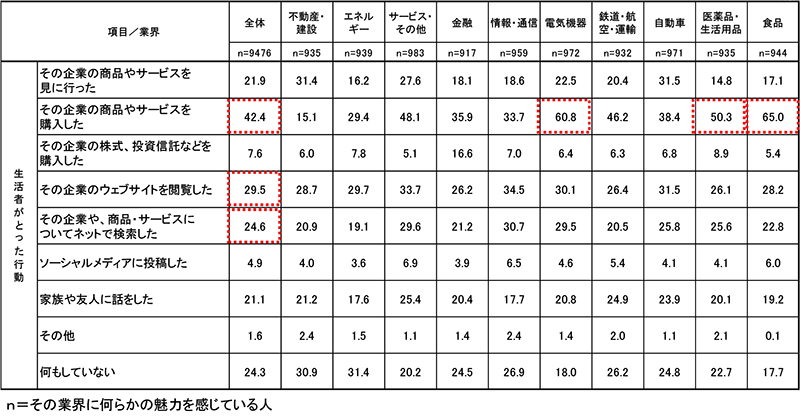
When asked what actions they actually took after finding a company appealing, excluding those who "did nothing" (24.3%), three out of four respondents (75.7%) reported taking some action toward the appealing company. Among these, over 40% (42.4%) responded that they "purchased the company's products or services." This was followed by "visited the company's website" (29.5%) and "searched online for the company or its products/services" (24.6%), indicating consumers' proactive engagement with appealing companies (Table).
By industry, over half of consumers who felt attracted to companies in the food (65.0%), electrical appliances (60.8%), and pharmaceuticals/daily necessities (50.3%) sectors subsequently took actual purchasing actions.
Table: Actions Taken by Consumers Toward Attractive Companies
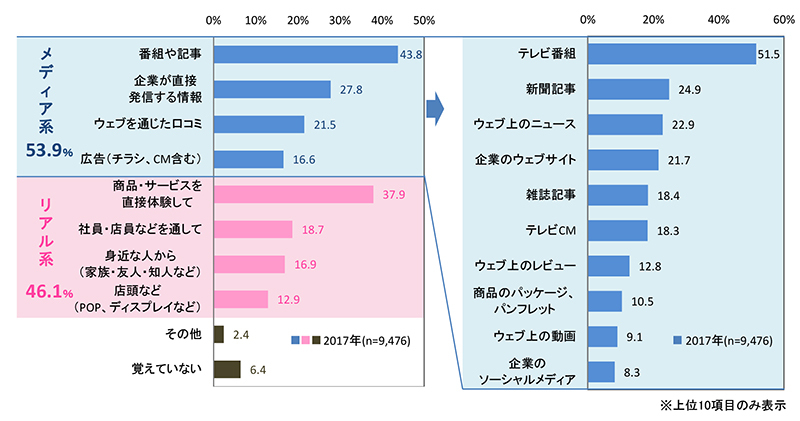
When asked about the information channels through which they perceived a company's appeal, "media-related" sources (including "TV programs or articles" at 43.8%) ranked first at 53.9%, while "real-world" sources (including "directly experiencing products/services" at 37.9%) ranked second at 46.1%. Media-related channels slightly outpaced real-world channels as points of contact for perceiving corporate appeal (graph).
Looking more closely at the media-related items, the top three were: 1st "TV programs" (51.5%), 2nd "newspaper articles" (24.9%), and 3rd "online news" (22.9%), highlighting contact points through reporting. However, the fact that "company websites" (21.7%) ranked fourth indicates that consumers also find appeal in information directly disseminated by companies.
<Graph> Triggers for consumers finding companies appealing
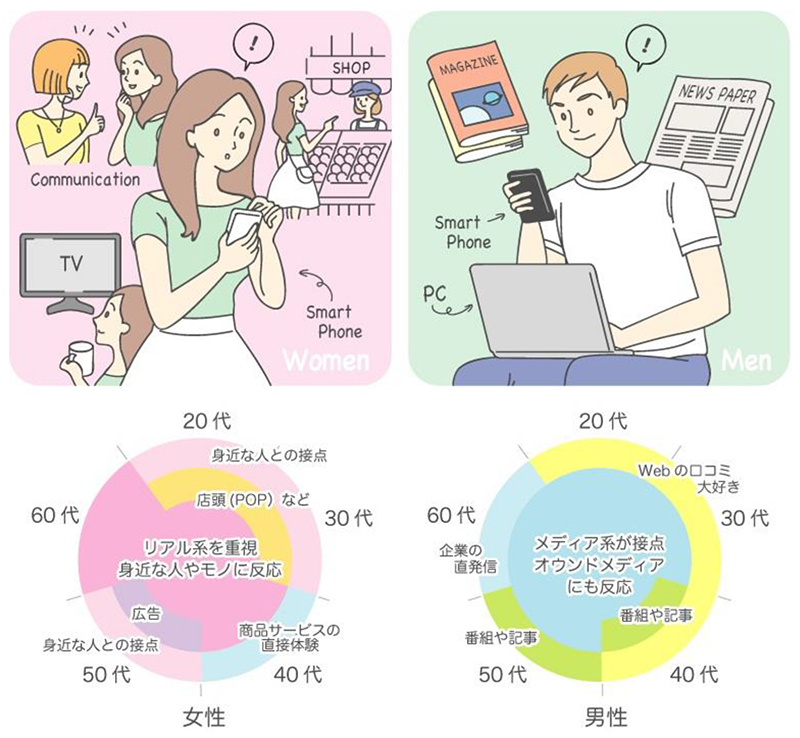
By gender and age group, men (71.2%) exceeded women (64.8%) for media-related touchpoints, while women (61.5%) exceeded men (54.7%) for real-world touchpoints. Men seem more likely to find companies appealing through media touchpoints, while women are more likely to do so through real-world touchpoints.
Men tend to respond more readily than women to "information directly communicated by the company (owned media, etc.)". By age group, "online word-of-mouth" is significantly higher among those in their 20s to 40s, while "TV programs or articles" are the trigger for those in their 40s to 50s, and "information directly communicated by the company" is the trigger for those in their 60s.
Women, on the other hand, place greater importance on connections through people close to them. By age group, those in their 20s, 30s, and 50s prioritize "people close to them," while those in their 40s emphasize "direct experience with products/services." Regarding media-based touchpoints, "advertisements" were most influential for women in their 50s, higher than for men, making it the only media touchpoint where women were more likely than men to find a company appealing.
Characteristics of Men and Women Who Find Companies Attractive
Was this article helpful?
Share this article


