
Note: This website was automatically translated, so some terms or nuances may not be completely accurate.
 LGBT Survey 2018 [1/4]
One in 11 People Identify as LGBT: The Latest Situation Surrounding LGBT Individuals

Yoshimoto Taeko
The Dentsu Inc. Diversity Lab, which researches the field of Diversity & Inclusion (an approach that respects each person's diverse individuality and aims for the social participation of all people), announced the results of its large-scale survey on sexual minorities, including LGBT individuals, titled "LGBT Survey 2018" in January 2019.
This survey began in 2012, followed by another in 2015, making this the third iteration. Around the time of the first survey in 2012, awareness of the term "LGBT" was very low. It was an era of trial and error for companies, even regarding whether they should discuss topics related to sexual minorities and how much they could safely communicate. Six years later, the situation has changed dramatically. More companies are now correctly understanding and supporting sexual minorities.
In Tokyo, an ordinance prohibiting discrimination based on SOGI (Sexual Orientation and Gender Identity) has been enacted, promoting understanding and establishing systems in workplaces. Globally, understanding and consideration for sexual minorities are becoming standard, as seen in the International Olympic Committee's decision to add non-discrimination clauses to its contracts with host cities.
This series delves into the "LGBT Survey 2018," packed with the latest public opinion surrounding LGBT issues. Part 1 covers the current situation of the LGBT community and the latest public sentiment.
【Table of Contents】
▼Point 1: LGBT population ratio is 8.9%. Nearly the same proportion as left-handed people
▼Point 2: Awareness of "LGBT" has nearly doubled compared to three years ago, reaching 68.5%
▼Point 3: Difficulties in coming out, insufficient support systems... Workplace challenges remain significant
Point 1: LGBT population ratio is 8.9%. Nearly the same proportion as left-handed people
First, among the 60,000 survey respondents aged 20-59, 8.9% identified as LGBT. This figure translates to approximately 1 in 11 people, nearly matching the proportion of left-handed individuals in Japan.
At Dentsu Inc. Diversity Lab, we conduct our surveys using a proprietary sexuality map, acknowledging that many individuals do not self-identify as LGBT.
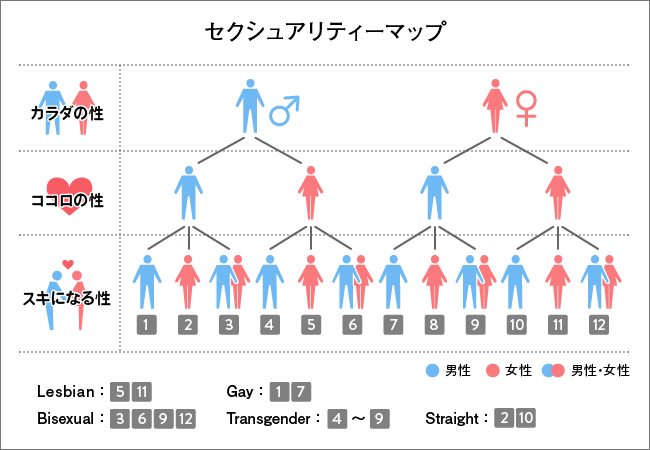
Respondents were asked about their "biological sex" (physical sex), "gender identity" (psychological sex), and "preferred romantic gender" (romantic orientation). Those who identified as "heterosexual with biological sex matching gender identity" (i.e., categories 2 and 10 in Figure 1) were defined as the straight group, while all other respondents were classified as the LGBT group.
Sexuality is diverse. The LGBT group we define encompasses not only L (Lesbian), G (Gay), B (Bisexual), T (Transgender). It also includes other sexual minorities such as "X-gender" individuals whose gender identity does not align with the female or male assigned at birth, and "questioning" individuals who are exploring their gender, gender identity, or sexual orientation (options like "I cannot say I am either male or female" or "I don't know" were also provided and included as part of the LGBT group).
According to a survey conducted in 2015, the proportion of the LGBT population was 7.6%, indicating an increase of approximately 1.3 percentage points over about three years. This is analyzed as resulting from the rapid increase in information about LGBT issues in recent years, which has broadened public awareness and understanding , thereby increasing opportunities for individuals to reflect on their sexuality and confront it honestly.
Point 2: Awareness of "LGBT" has doubled compared to three years ago, reaching 68.5%
Next, we surveyed the level of societal awareness regarding LGBT issues. When asked, "Do you know that LGBT is one of the collective terms for sexual minorities?", a total of 68.5% responded with "Yes" or "Somewhat". This represents an increase of approximately 2 times, or 30.9 percentage points, from the previous survey's 37.6%.
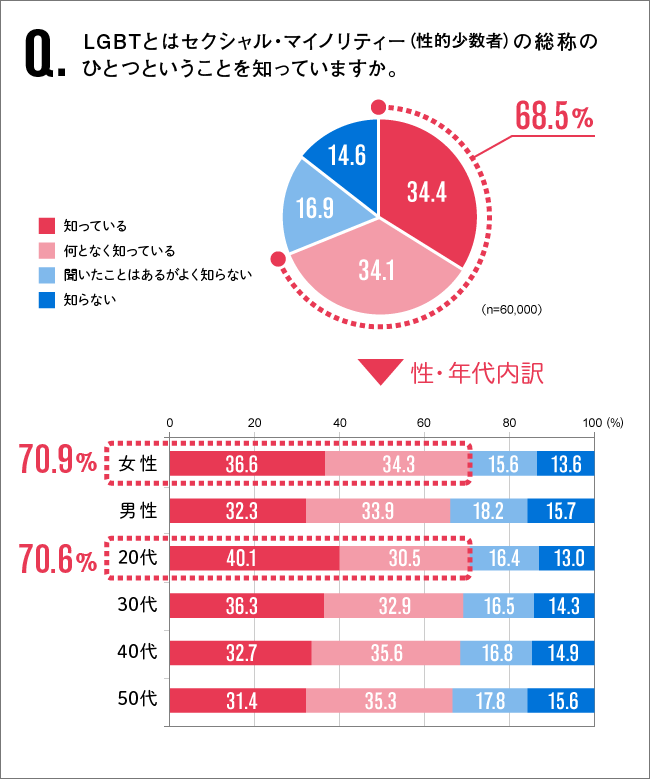
We believe this rapid increase in awareness stems from the growing volume of LGBT-related information and content featured across various media (the influence of media on LGBT awareness will be covered in the next installment). Awareness was particularly high among women at 70.9%, and also notably high among those in their 20s at 70.6%, indicating a trend of greater awareness among younger demographics.
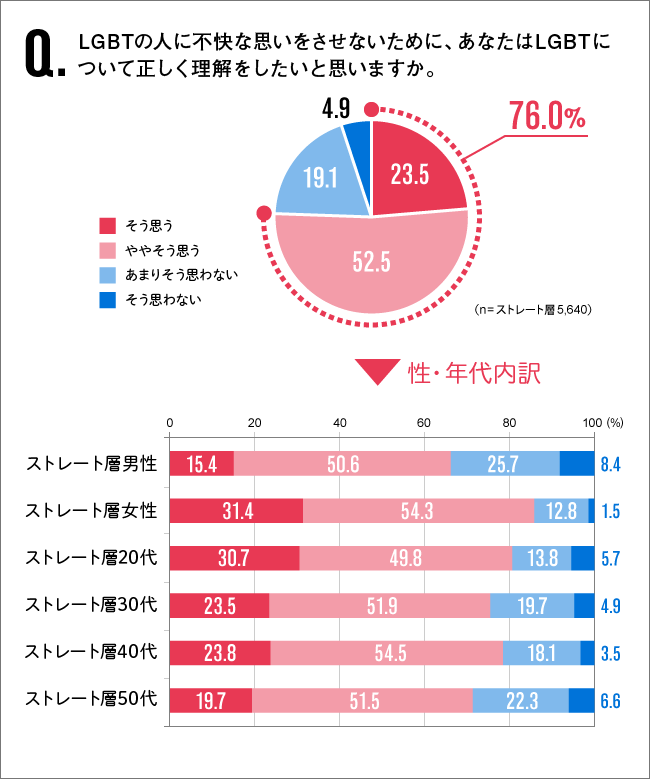
When asked, "To avoid causing discomfort to LGBT individuals, do you want to understand LGBT issues correctly?", 76.0% of straight respondents answered "Yes" or "Somewhat yes." This suggests that going beyond mere awareness of the term LGBT, the desire to understand correctly for the sake of those directly involved has become commonplace.
Point 3: Difficulties in coming out, insufficient support systems... Workplace challenges remain
While awareness and understanding are progressing, challenges remain. When asked if they had come out as LGBT, 65.1% of LGBT individuals responded that they had not come out to anyone. This figure is actually higher than the 56.8% reported in 2015, which is concerning.
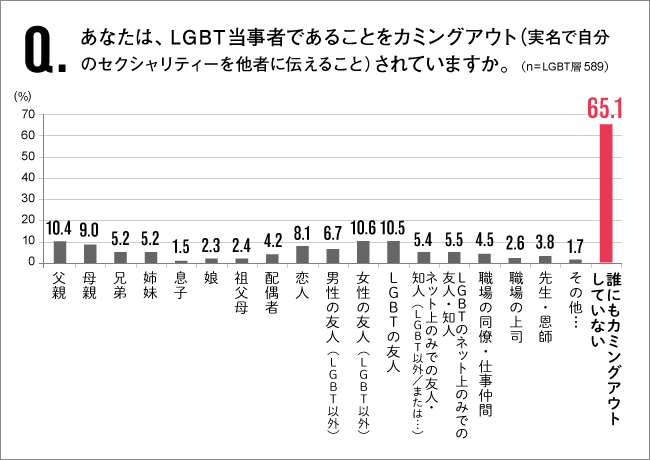
While coming out should be left to the individual's choice and certainly not forced, it is crucial to create an environment where people can thrive without disadvantage, regardless of whether they choose to come out or not.
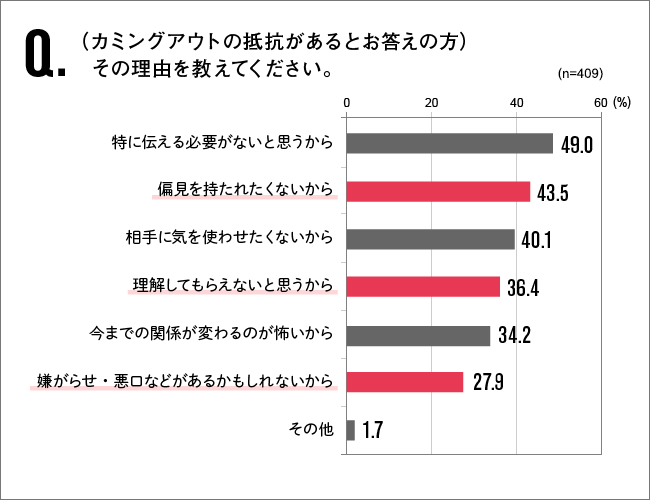
However, when asked about reasons for reluctance to come out, the most common response was "I don't feel the need to tell anyone (49.0%)". At the same time, many cited negative views about the current environment, such as "I don't want to be judged (43.5%)" and "I don't think people would understand (36.4%)".
Furthermore, while family and friends are the most common recipients of coming out (49.0%), workplace colleagues/coworkers (4.5%) and workplace superiors (2.6%) are far less common, indicating that coming out at work is still uncommon. Even if you think there are no LGBT individuals in your workplace, they may simply not have come out yet.
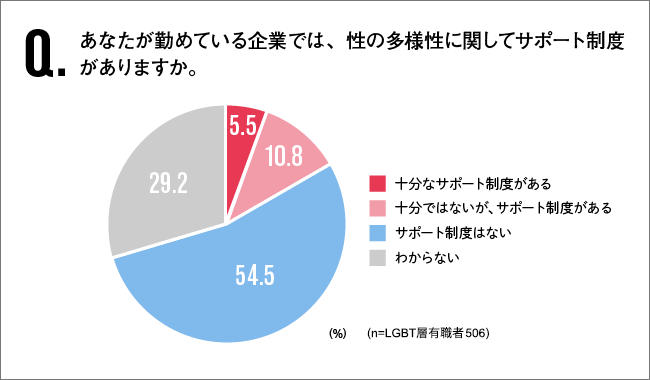
When asked if their company offers support systems regarding sexual diversity, over half (54.5%) of LGBT individuals responded that their workplace lacks such support systems. Only 5.5% felt their workplace provides sufficient support systems.
While more companies are establishing support systems—such as providing benefits like spousal allowances for same-sex marriages, holding internal events and study sessions to promote LGBT understanding, and installing gender-neutral restrooms—there still seem to be many workplace challenges.
It seems we have entered a phase where companies and society must take concrete action to create environments where diverse people can live comfortably.
<Preliminary Screening Survey Overview>
・Survey Participants: 60,000 individuals aged 20–59
・Survey Area: Nationwide
・Survey Period: October 26–29, 2018
・Survey Method: Internet survey
<Dentsu Inc. LGBT Survey 2018 Overview>
・Survey Participants: 6,229 individuals aged 20–59 (589 LGBT individuals / 5,640 straight individuals)
・Survey Area: Nationwide
・Survey Period: October 26–29, 2018
・Survey Method: Online survey
Was this article helpful?
Share this article


Newsletter registration is here
We select and publish important news every day
For inquiries about this article
Author