Note: This website was automatically translated, so some terms or nuances may not be completely accurate.
 The Miracle of Rapid Growth! The Power of Japanese Anime That Captivates the World [1/1]
See the Numbers! Anime is Killer Content for the World's Gen Z
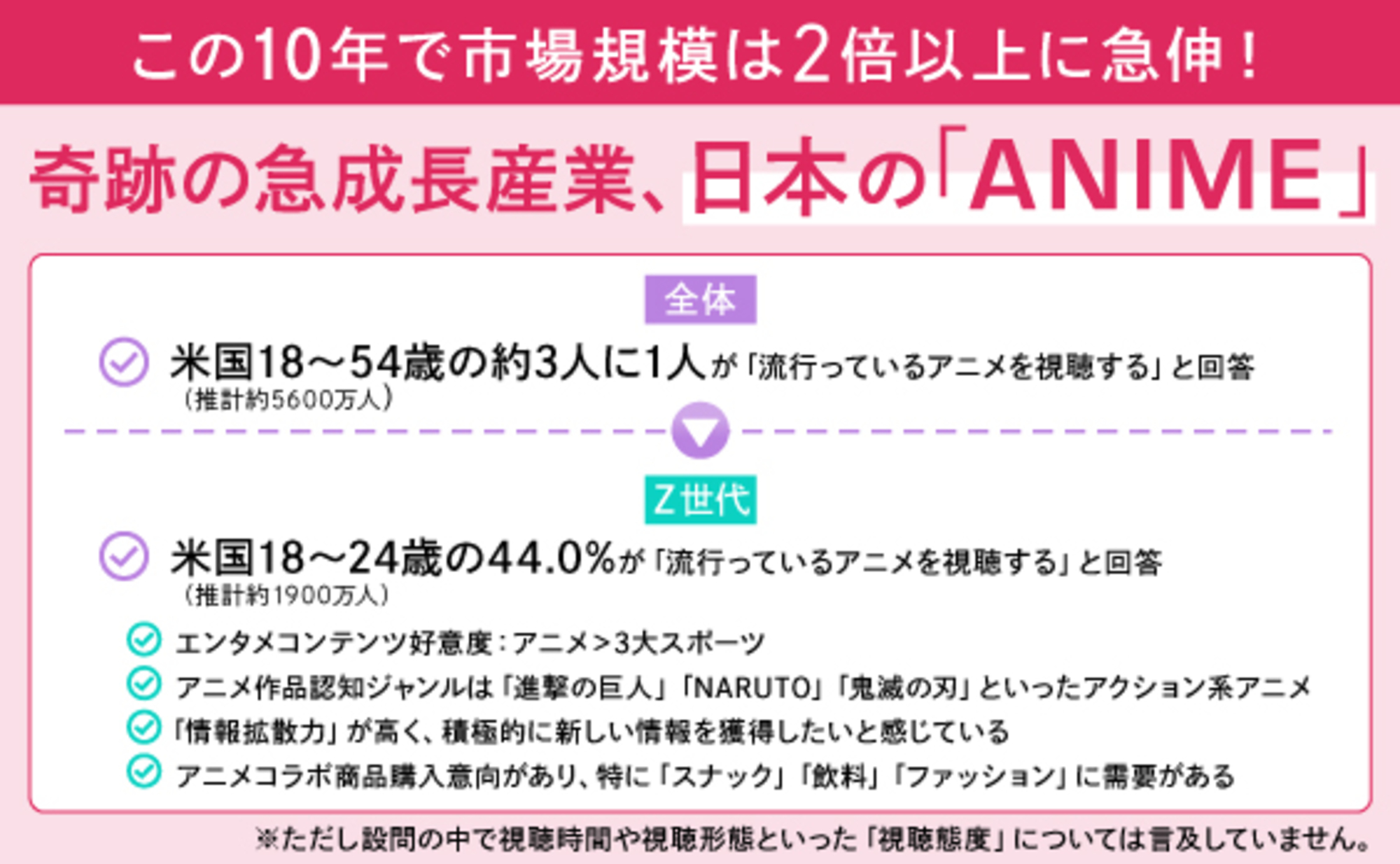
Japanese animation (ANIME) is hugely popular overseas! ...Hearing this, many might think, "Yeah, I know that." But now, anime's popularity has fully entered its "next phase." It is an astonishing "growth industry" whose market size has more than doubled in just the last decade, primarily driven by overseas demand(※).
※In this series, "anime" refers exclusively to "Japanese anime" produced within Japan. It does not include American-made animated works.
Behind this lies the remarkable growth of video streaming platforms. Anime born in Japan is now being "streamed in real time" to people worldwide. The explosive increase in video consumption time during the COVID-19 pandemic has further accelerated this trend.
For the digitally native Generation Z in particular, it's no exaggeration to say anime is shifting from a "niche culture for passionate fans" to becoming "mainstream entertainment culture."
This series explores anime's global popularity, incorporating findings from Dentsu Inc .'s original research conducted in the U.S. In Part 1, Emi Shimizu from Dentsu Inc.'s Content Business Design Center—who has lived in the U.S. for many years—reports on the cutting edge of anime trends, focusing on America!
<Table of Contents>
▼Beyond Anime: Manga's Explosive Growth in the U.S. – A Major Shift Among Gen Z!
▼Overseas Fans Now Drive Over Half of the Anime Market!
▼What's Gen Z in the U.S. Enjoying? Sports? TV Dramas? Or Anime?
▼Companies Across All Industries Are Starting Anime Collaborations
In the US, alongside anime, manga popularity is rapidly expanding. A major shift, especially among Gen Z!
Japan's anime industry has grown rapidly in recent years, reaching an industry scale of ¥2.7422 trillion in 2021. It is now an extraordinarily massive industry.
In July 2022, Dentsu Inc. surveyed men and women aged 18-54 across the U.S. to investigate anime penetration in the country and the characteristics of anime consumption, particularly among Gen Z. (See the article's end for survey details)
Let's look at some of the key findings.
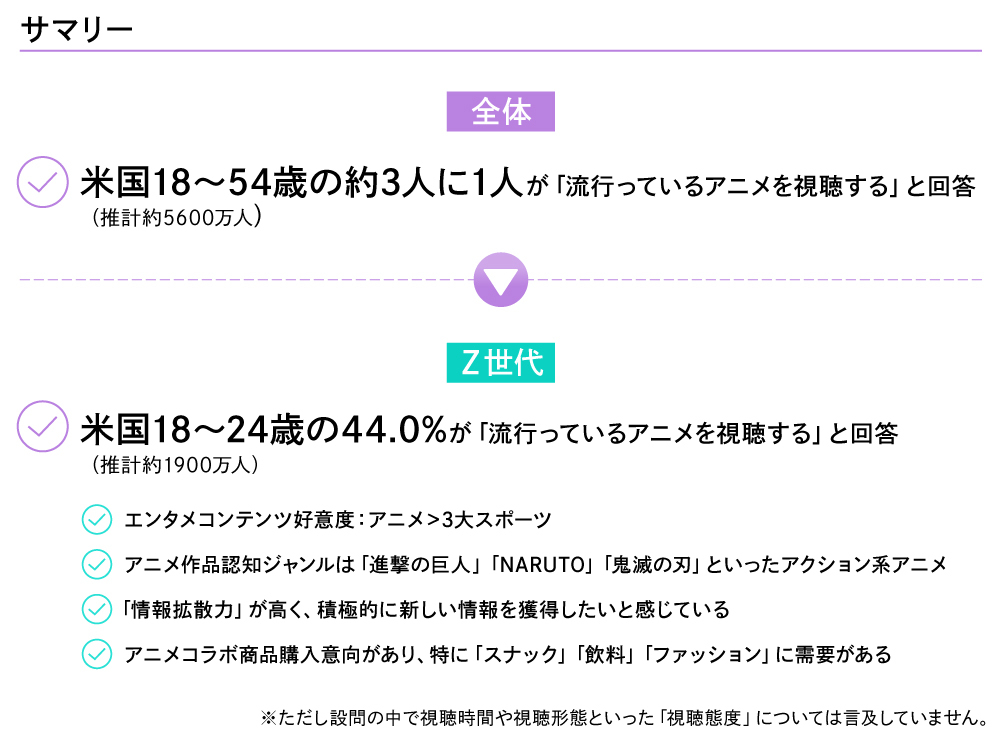
What do you think? This is not a survey targeting anime fans. Yet, 44% of American Gen Z respondents said they watch anime.
Moreover, it goes beyond just "watching anime." Over 40% also reported having friends they discuss anime with and having read the "original manga" of anime series. This is a clear shift from previous trends, indicating the emergence of an ecosystem centered around anime, essentially a Japanese subculture ecosystem.
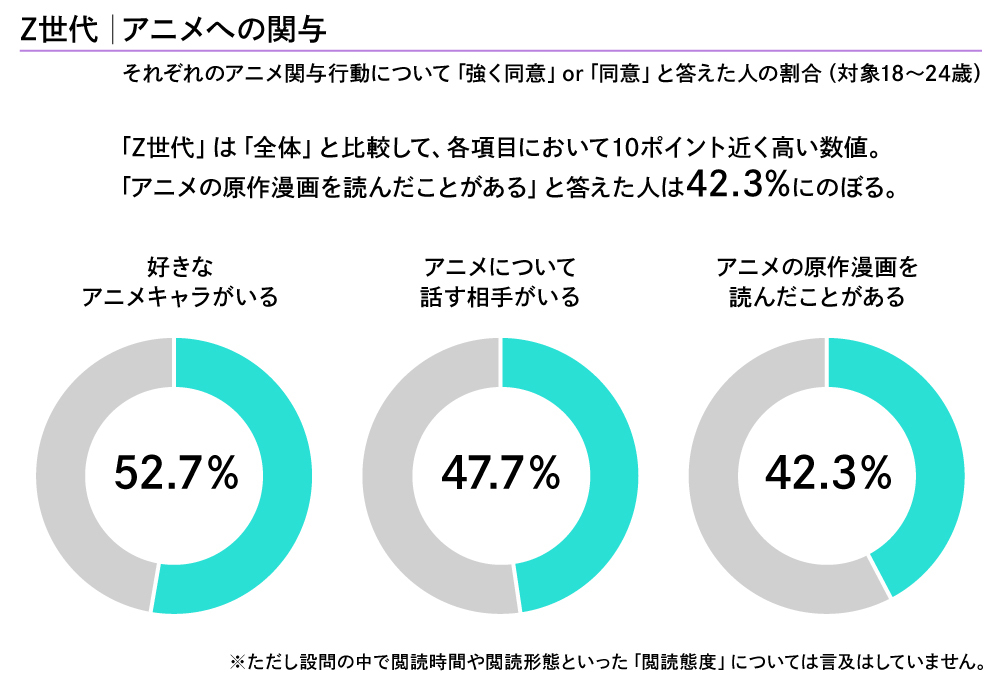
What deserves particular attention is the high percentage reading the original manga.
In Japan, the "manga superpower," manga comes first. Overseas, however, the opposite is true: anime viewing is the starting point for everything. Since anime often adapts only part of the original manga's story, many viewers who finish watching a season of anime then think, "I want to know what happens next" or "I want to read the original manga." This is why anime is increasingly becoming the gateway for people to start reading manga.
In the streaming era, some countries, primarily the US, are seeing astonishing increases in manga (Japanese comics) sales. Considering these survey results, we can infer that Generation Z is at the center of this trend.
Having lived in the US for many years, I've noticed that in recent times, it's become commonplace to see Japanese manga sections in American bookstores.

Incidentally, in this survey, the question "Do you consider yourself an anime otaku?" also yielded a high figure of 34% among Generation Z. That means 34% of all American Generation Z, an estimated 15 million people, identify themselves as anime otaku. Isn't that incredible?
Japanese anime and manga are no longer just for a niche group of enthusiasts. We should recognize that a major shift has occurred over the past few years.
Overseas fans already support over half of the anime market!
Let's step back from the US survey for a moment and look at the global picture.
Naturally, the domestic market share was much larger for anime, but with the spread of video platforms, the overseas share began to surge rapidly around 2015. By 2020, the overseas market finally surpassed the Japanese market.
The combined scale of the anime industry in Japan and overseas temporarily declined in 2020 due to the impact of COVID-19, but in 2021, it reached a record high of 2.7422 trillion yen. This is nearly double the size of ten years ago, making it a rare "growth industry" today.
Various factors underlie this shift in market composition, but the most significant is undoubtedly the proliferation of video-on-demand (VOD) platforms. Platforms like Netflix, Amazon Prime, and Disney+ have actively distributed high-quality, diverse anime worldwide.
In recent years, increased time spent at home has cemented the habit of "watching streaming video at home" worldwide. Now, everyone enjoys video content on smartphones or TVs. To meet this surging demand, platform providers have intensified their efforts to source high-quality, diverse video content from around the globe.
Amidst this, one type of content they focused on was Japanese anime. Anime born in Japan is now instantly translated and distributed worldwide almost in real time.
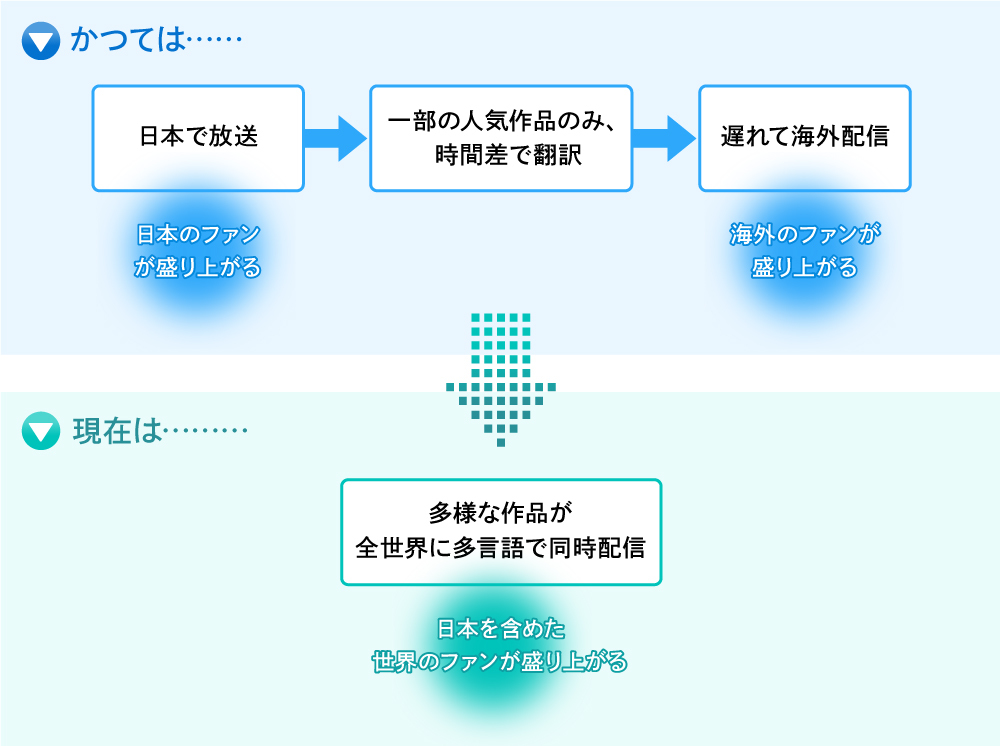
Global simultaneous streaming means fan moments are synchronized worldwide. Anime creators are adapting to this, with official X (formerly Twitter) and YouTube accounts now offering Japanese and English versions to reach international fans. For some series, the viewership of official YouTube channel PVs is even dominated by overseas traffic.
As an aside, with streaming becoming the mainstream way to watch video, services have emerged that measure the popularity of video content using metrics different from traditional TV ratings. Among these, Parrot Analytics, a research firm that predicts the "popularity" of series programs like dramas, is gaining significant attention.
The company evaluates and ranks content popularity by analyzing multiple factors, such as the volume of mentions on social media and engagement rates. In 2021, among a lineup of popular drama series, the Japanese anime "Attack on Titan" surprisingly took the top spot.
In the past, only a few popular works were translated and distributed, remaining inaccessible to international fans. Now, however, the total number of anime titles distributed globally has increased dramatically. The availability of diverse anime genres has expanded the potential audience to include people who previously had no exposure to anime, ultimately increasing the total number of anime viewers.
What entertainment do American Gen Zers enjoy? Sports? Dramas? Or anime?
The next survey results we'll introduce reveal "where anime stands among various entertainment content."
The entertainment content compared includes "movies," "music," "games," "TV dramas," "influencers (like YouTubers)," and "sports (MLB, NFL, NBA)."
To analyze trends as accurately as possible, anime was divided into four categories for the survey: "Kids & Family," "Action," "Heroine-Focused," and "80s-90s." Please understand that this categorization is purely for convenience.
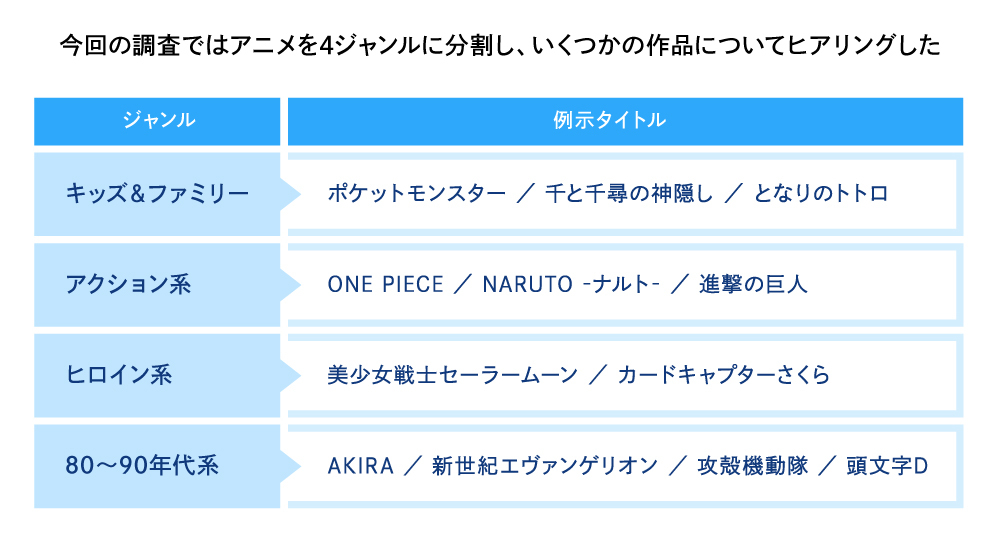
The most significant finding in this survey is the difference in position between "Anime" and "Sports" when comparing all generations versus Generation Z.
The following graph shows the percentage of respondents who answered "Yes" to the question: "Please indicate which entertainment categories you like (multiple answers allowed)." First, let's look at the results for all generations.
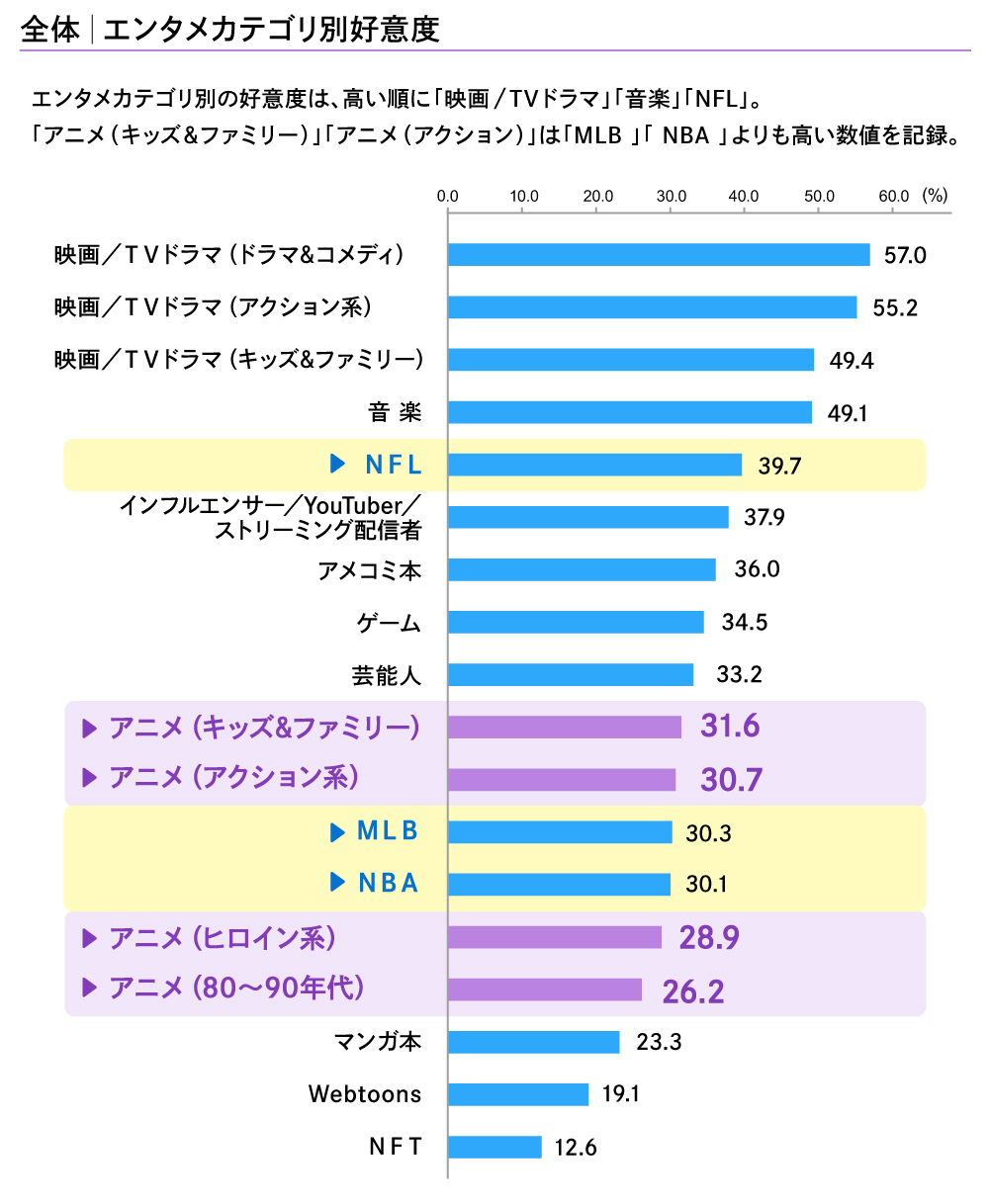
Compared to anime, we see that within sports, the NFL enjoys particularly high favorability.
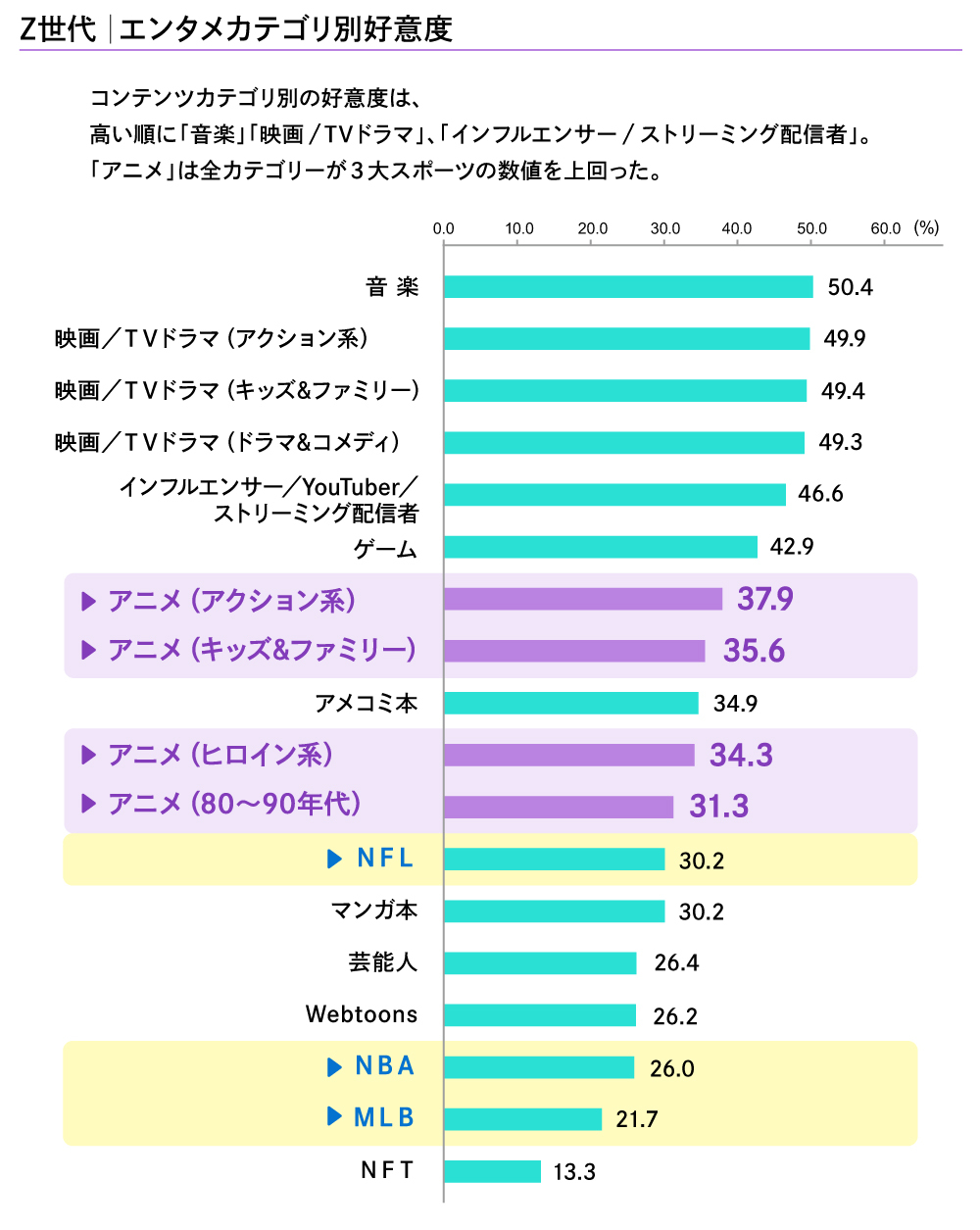
Now, what happens when we limit the same question to Gen Z? The results show that their preference for anime surpasses that for the so-called "Big Three" American sports, including the NFL, which ranked highly in the graph above.
Back in the early 2000s when I attended university in the U.S., Japanese culture like anime and manga was a niche interest enjoyed by a small group of passionate fans. I never imagined a day would come when more people would say they like anime than major sports like the NFL, MLB, or NBA.
But today, new stars—celebrities, artists, athletes, and influencers from Generation Z—routinely express positive opinions about anime.
For example, it made news when Angels player Shohei Ohtani recommended anime and manga titles to his fellow anime-loving teammates. Megan Thee Stallion, born in the 1990s and who placed two songs in the top 25 of the 2020 Billboard Hot 100 year-end chart, has also publicly declared herself a huge fan of anime, including My Hero Academia.
It's no longer unusual to see NFL superstars or popular pop stars beloved by teens posting anime-related content on social media that goes viral. To me, these scenes symbolize how truly the times have changed.
Companies across all industries are beginning to collaborate with anime.
Finally, let's consider corporate promotional campaigns utilizing anime.
While companies have long tied up with manga and anime content, a notable recent trend is that the primary goal of these collaborations is often "reaching younger demographics, especially Generation Z."
Even long-established, popular companies worldwide are struggling to capture the attention of younger demographics. With diverse anime now permeating Generation Z globally, it's only natural that anime has become a focal point for collaboration opportunities.
While less known in Japan, examples like Pizza Hut Taiwan launching collaboration pizzas with the anime "Attack on Titan" show how unique tie-in products and collaborative campaigns are emerging worldwide.

In this survey, we also asked American Gen Z about their "purchase intent for collaboration products with entertainment content." The results showed high purchase intent for "anime collaboration products" not only in the "snack," "beverage," and "electronics" sectors, but also in the "fashion" category.
Here's an important point. When hearing "anime collaboration," it's easy to assume "we should collaborate with the currently popular, trending work." However, the key to a successful campaign actually lies in "selecting works that align with the company or brand's own worldview and context."
Even within the broad category of "anime," each work has its own distinct fandom. If there's even a slight mismatch between the company and the work, fans will react negatively with remarkable sensitivity.
Conversely, campaigns where synergy between the company and the work is achieved see fans themselves function as influencers for the campaign. They actively mention the collaboration on social media, creating positive viral effects that spread beyond just the fans.
In future installments, we'll delve deeper into the insights of global anime fans by introducing examples of anime being used as a marketing solution by overseas companies, as well as platforms like and "My Anime List," the largest anime community in the English-speaking world!
[Survey Overview]
Survey Title: Survey on Perceptions of Japanese Anime in the United States
Survey Commissioned By:Dentsu Macromill Insight, Inc.
Survey Method: Internet Research
Survey Participants: Men and women aged 18-54 nationwide in the U.S.
Allocation: Approximately 600 respondents each from general age groups, Generation Z, and anime fans
Number of Respondents: Approximately 1,800
Survey Period: August 5, 2022 - August 17, 2022

Was this article helpful?
Share this article


Newsletter registration is here
We select and publish important news every day
For inquiries about this article
Author

Emi Shimizu
Dentsu Inc.
Content Business Design Center
Business Producer